Labrador Retriever Viera Brings Comfort Both Across State, At Home in Old Lyme

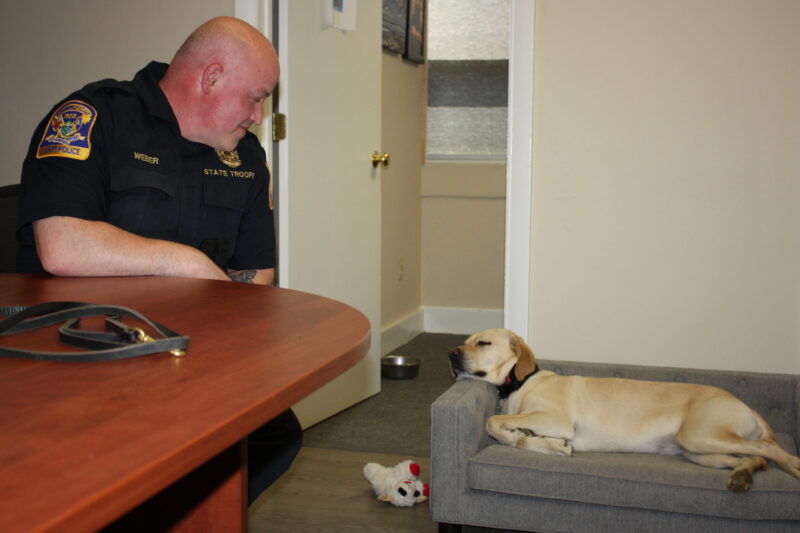
Old Lyme Resident State Trooper Matt Weber’s new partner, Viera, was trained through the state police Comfort K9 program.

OLD LYME–One of the latest graduates of the Connecticut State Police Comfort K9 program is a Labrador Retriever named Viera who, in four short months, has been there for traumatized children, shell-shocked First Responders, and her own partner, when they most needed a helping paw.

Viera had spent most of her life in training for the New York-based Guiding Eyes for the Blind program when the two-year-old was reassigned to Old Lyme Resident State Trooper Matthew Weber in November.

Weber said she wasn’t cut out for life as a Seeing Eye dog. 

“I think she has a little bit too much energy for that,” he said from the Old Lyme Police Department earlier this week as Viera padded around with a huge stuffed cow in her mouth. “That’s why we wanted her.” 

Resident State Trooper Matt Weber and Comfort K9 Viera.

Viera and Trey, another Labrador retriever and Guiding Eyes dropout, who works alongside Trooper Stephanie Cortes, comprised the most recent Comfort K9 class. A month of obedience training from the state’s K9 instructors honed the dogs’ ability to remain calm, companionable and compliant in a wide range of situations. 

“Viera is just a rock steady dog in all sorts of environments, around different types of people,” Weber said. 

Her role as a therapy animal has had her snuggling up to young victims of violence during forensic interviews. She’s gravitated toward the tears of otherwise stoic First Responders gathered to debrief after difficult calls. 

She laid by the side of Weber’s wife, Donna Bennett, at Smilow Cancer Center in New Haven. 

“Viera also met with numerous other patients, and did the same cheering up the nurses and doctors,” Weber said. 

Bennett died earlier this year. 

The couple shared a love of dogs, including the Nova Scotia Duck Tolling Retrievers bred by Bennett. Now it’s Viera and five Tollers, who live at home with Weber in Old Lyme. 

He said he can’t imagine a life without dogs. 

“They’re your best buddies, your confidants,” he said. “You can go and unwind and relax with them. If you’ve had a stressful day at work, you forget about everything for a while.”

It’s gratifying to be able to share her with the wider community, according to the state trooper. 

He described a recent meeting Viera attended during which Emergency Services personnel discussed their response to a quadruple-fatal car crash in Newington. 

“Nobody wants to talk and open up, and then when Viera or the other dogs start playing, it kind of brings a smile to people’s faces, and it loosens the room up a little bit, and then they can talk,” he said. “So that’s pretty rewarding, knowing the power that she has.”

Weber said his work across the state is done in addition to his regular duties as the Old Lyme Resident State Trooper. 
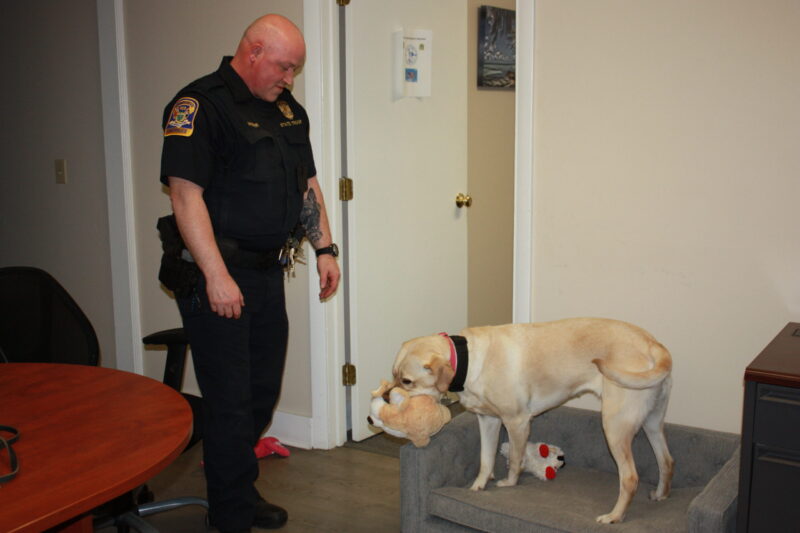
Weber describes comfort dog Viera as a “big goofball.”

Besides responding to critical incidents, assisting crime victims and providing support to first responders and their families, state police comfort dogs are charged with helping to improve the relationship between law enforcement and the community.

Old Lyme Police Department Corporal Dominic Solari said Viera breaks down barriers in a landscape where distrust of law enforcement is rampant. 

“Even if you have a personal relationship with somebody that you may have dealt with on positive terms as a police officer, a lot of times there’s still that little bit of a wall there,” he said. “And she helps to break down the wall.”

A lot of that work is done in schools, according to Weber and Solari. 

“Viera can sit there in the middle of the room with 15 kids crawling all over her,” Solari said. “You don’t have to worry about the dog snapping or anybody getting upset over the dog’s actions.” 

Weber said traditional police K9s used for jobs like search and tracking are separate from their comfort cousins.

Weber explained he had been a member of the State Police K9 unit for nine years when his German Shepherd, Tazz, died at the age of 10 in late 2023. Weber had retired his four-legged partner just two weeks earlier. 

He said Viera is a different breed from the highly-skilled working dog, who’d been by his side for so long. 

“You always have to be cognizant when you have a Shepherd of what they’re capable of, and even though they’re highly trained, you still have to make sure you don’t put them in a situation where they could fail,” he said. “With Viera, all she knows how to do is lick and get pets.”

Weber and Viera start out every morning in a rotation of the Lyme-Old Lyme School District’s five buildings. She attracts attention from the youngest students to the oldest, he said. 

Mile Creek School Principal Kelly Enoch in a phone interview this week said elementary students and teachers alike enjoy meeting Viera in the front vestibule as students stream in from cars and buses at the start of the day. 

The six-year principal said students are more likely to approach a police officer if there’s a dog nearby. And as they’re petting the dog, they’re more likely to start asking questions. 

“We just feel really strongly that we want the children to see police officers as friends and people that help them,” she said. “They’re not people to be afraid of.”

The district also feels strongly about therapy dogs, with at least one certified pup working alongside a teacher or school psychologist in each building. Mile Creek’s therapy dog, a Goldendoodle named Isla, is entrusted to Enoch. She said she brings her to school two or three times per week. 

Donated stuffed animals and a dog-sized couch help make life comfortable at the Old Lyme Police Department.

At the secondary level, Weber has found that students’ affection for dogs remains evident. 

“The high school kids that otherwise wouldn’t talk to you, they come over and pet your dog,” he said.

Weber and Solari said the department is looking to rejuvenate its dormant Cop Club as another way to break down those barriers between police officers and the community. 

The program had been popular with high school students before it was interrupted by the COVID-19 pandemic, according to Solari. 

A collaborative project between the Old Lyme Police and the Lymes’ Youth Service Bureau, it began in 2011 with the goal of bringing together cops and kids through a series of monthly planned activities. The group mixes students, who’ve had difficult upbringings, with more privileged members of the student body. 

Weber said that when Cop Club starts up again, Viera will be there. 

“Anywhere I go, she goes,” he said. 

Op-Ed: Dip Into Region 18 ‘Rainy Day Fund’ to Dampen Debt Impact

Mary Powell St. Louis

Town residents have received their postcard reminder about the 2025-2026 district budget meeting and referendum vote from Regional 18 school district both scheduled for May 5 and May 6 respectively.   

By means of background information on the school budgeting process, it is important to understand some of the Connecticut school laws defined by the general statutes. According to the Connecticut General Statutes Section 10-262(j) on minimum budget requirements, a school budget may not be less than the budget from the prior fiscal year except for limited circumstances defined in the statute. 

Additionally, section 10-51(d)(1) was amended in 2024, such that a regional school district can create a “reserve fund for educational purposes” rather than the prior designation of such fund for only “capital and nonrecurring expenditures.” The statute had also been amended in 2021 to change the amount regional school districts are allowed to appropriate from the current fiscal year’s budget from 1% to 2%.   

Key takeaway: Outside of exceptional circumstances, a school budget can never go down and there has been expansion for a regional school district like Lyme/Old Lyme in terms of how a budget surplus can be used.  

The Region 18 school district has long taken the opportunity to fund their “undesignated fund,” or reserve fund, for at least the last 10 years (per the annual October Board of Education meeting minutes on the district website). For the last four years since the change in the statute to support 2% funding of the reserve fund, Region 18 has appropriated approximately $700,000 annually to the reserve. The current reserve fund balance stands at $3.1 million. Although the Board of Education has not formally approved any of the current earmarked projects in the reserve, they are formulated in the five-year facilities plan for the district. There is no reason to doubt that at the October 2025 Board of Education meeting, the board will again vote to fund the reserve based on past experience and determination of a budget balance (unaudited at the time of the decision) in a similar range of $700,000.   

You may ask why these details matter. The 2025-2026 school district budget up for referendum stands at a 7.39% increase over the previous year’s budget and over half of the increase represents debt service (bonds) predominantly related to the $57.5 million PK-8 building project.  Debt service obligation (principal and interest) for the district is estimated to increase annually for the next five years then start to drop dramatically.

Rather than increasing the budget as proposed to cover the current year debt service requirement, I recommend the board consider the use of a portion of the reserve funds to dampen the impact of debt service on the budget in the next five years.  

Why not use all the reserve? Well, we don’t want to do that as it could adversely impact the credit rating of the district for future debt service.  Further, the forecasted campus improvement projects could not be funded for the foreseeable future.    

My suggestion is to use a portion of the reserve, equivalent to the maximum allowable 2% of budget holdback. Instead of increasing the budget by 7.39% to $39,650,803, the requested budget could be about $38.5 million, or a 5.5% increase.  Presuming the recent historical trend of budget surplus continues, this strategy would limit the growth of the budget until the debt service started to decline in five years, at which time the contribution to the reserve fund could be resumed.   

I hope that the residents of Lyme and Old Lyme consider contacting the Board of Education members about the above issues and that the board takes this into consideration at the district budget meeting on Monday May 5.  

Editor’s Note: The author, Mary Powell-St. Louis, was a member of the Region 18 Board of Education for eight years.

Ferry Landing Pier/Boardwalk Closes in Old Lyme, Another Pier Opens in Haddam

New Pier Provides Alternate Fishing Location While Old Lyme Boardwalk Closed During Construction of New Connecticut River Bridge

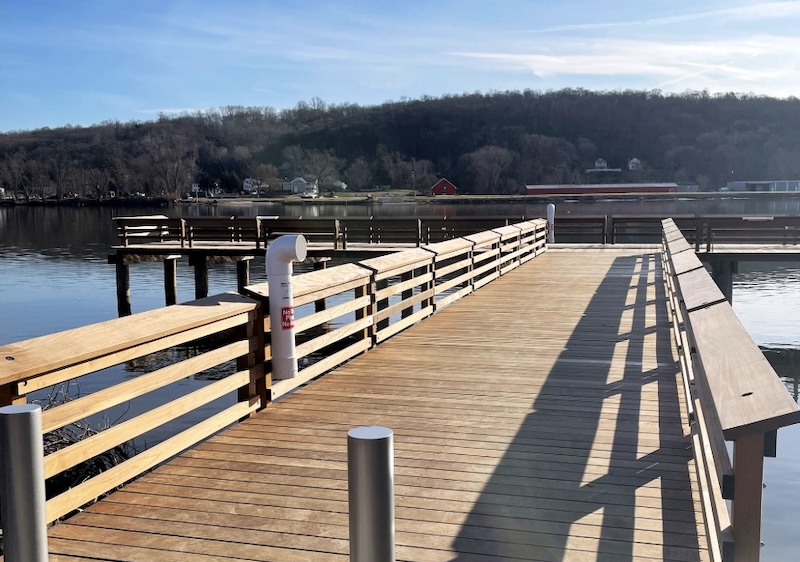
The new pier at Eagle Landing State Park in Haddam provides an alternative to the one at Ferry Landing State Park in Old Lyme, which is closed at least until 2030. Photo courtesy of Amtrak.

OLD LYME–The state Department of Energy and Environmental Protection (DEEP) has announced the opening of the pier at Eagle Landing State Park in Haddam as an alternate fishing location for local anglers and outdoor enthusiasts who have been displaced by the construction of the new Connecticut River Bridge between Old Lyme and Old Saybrook. 

The DEEP in a press release said Ferry Landing Pier/Boardwalk in Old Lyme is closed to make way for Amtrak’s construction of a new Connecticut River Bridge between Old Lyme and Old Saybrook.

An announcement posted on the Old Lyme website earlier this month said reconstruction of the pier at the state park in Haddam was undertaken by Amtrak in anticipation of the temporary closure of the Ferry Landing Pier. 

The DEEP said the new pier at Eagle Landing State Park, and Amtrak’s commitment to build it, resulted from public feedback during the environmental review phase of the Connecticut River Bridge Project. 

This $1.3 billion project broke ground in September. It’s supported by an $826.64 million grant from the Federal Railroad Administration. The remaining portion will be funded by Amtrak and the State of Connecticut.

According to Amtrak, the bridge project will replace the existing 118-year-old bridge with a modern moveable bridge that will support a maximum train operating speed of 70 mph – a 55 percent increase from today’s maximum speed of 45 mph. 

Maritime navigation and safety will also improve due to the increased vertical clearance of the new bridge compared to the existing bridge, the company said.

The DEEP said Amtrak will build an improved, fully accessible observation deck more than 1,000 feet long at Ferry Landing State Park in 2029, once the new Connecticut River Bridge is in service and the old bridge has been demolished. 

The Ferry Landing Pier and boardwalk upgrade is expected to open in 2030 or 2031, according to the DEEP. Plans call for a 50% wider walkway with improved accessibility in a location slightly west of the existing site. The state agency promised better access to deep water, and stronger, more durable concrete piles for more support compared to the wooden piles used for the original structure.

Referendum on Lyme-Old Lyme Schools’ Budget to be Held Tuesday, Budget Meeting Monday

‘Rainy Day Fund’ Will Not be Used to Offset 7.4% Budget Increase

LYME/OLD LYME–Registered voters and qualified taxpayers on Tuesday will be asked to weigh in on the proposed $39.7 million budget for the regional school district serving Lyme and Old Lyme. 

The District 18 Board of Education earlier this month voted unanimously to hold a District Budget Meeting this evening, Monday, May 5, at 6:30 p.m. in the Board of Education Conference Room at Center School. Members of the school board will adjourn to a referendum vote the next day.

A livestream of Monday evening”s meeting can be viewed at this link: https://www.youtube.com/channel/UCF2_W7yYtFwx067Ici9776Q/live

The agenda for the meeting is at this link: https://docs.google.com/document/d/1WB8EzTFs_0MSwy-MnBEaU67YXJNbRkvJ0Vwdw3qYFrk/edit?tab=t.0

The proposed budget represents an increase of $2.7 million, or 7.39%, over the current spending plan. Superintendent of Schools Ian Neviaser has said the bulk of the proposed budget increase is related to debt coming due on the extensive renovation project in four of the district’s five buildings. 

Of the proposed budget’s $2.7 million increase, $1.8 million is attributable to debt payments on the renovation project. 

Voters in late 2022 authorized spending up to $57.5 million on the project. During this budget season, Neviaser has emphasized the district will be spending about $17 million less than that due to grant funding and good interest rates.

The proposed budget includes an increase in special education spending of $726,721 over the current year.

Neviaser said the increase in special education costs is driven by more students, who need to be placed in programs outside the district to meet their needs. There are four students requiring outplacements in the coming year compared to one student when the current budget was approved. 

There are currently 180 kindergarten through grade 12 students with disabilities in the district compared to 162 in 2020-21, according to budget documents. 

Employee benefits are up $448,485, salaries for certified staff members are up $278,654 and transportation costs are up $164,234.

The proposed budget includes maintenance and improvements to district facilities totaling $359,200 for a sound system in the high school auditorium, lighting in the middle school auditorium, replacement of the preschool playground and paving of the sidewalk in front of the middle school. 

Reductions were achieved by turning the high school assistant principal position into a ten-month position rather than a full-year position and reducing middle school education staffing by one position. 

A music teacher cut in Neviaser’s initial recommendation is back in the proposed budget after the school board agreed the reduction would be detrimental to the music program. The district will find savings elsewhere in the proposed budget to cover the cost, Neviaser said. 

District budget documents show that Old Lyme would be responsible for $31.51 million of the budget, while Lyme would pay $6.96 million. Both towns are billed by the regional school district based on enrollment.

That’s a proposed increase in Old Lyme of $1.99 million, or 6.7%, and in Lyme of $299,504, or 4.5%.

Neviaser in a Tuesday email said the regional school board won’t use any of its $3.1 million undesignated fund balance – or Rainy Day Fund – to offset the spending increase despite calls to explore the option.

“The board has not chosen to make any changes to the current proposed budget and plans to go to referendum with what we believe is a fiscally responsible and reasonable request of a 2.69% increase in the operating budget coupled with a 4.7% increase in debt service, which is the main driver for the overall 7.39% increase,” he said. 

School board Chairman Jason Kemp, who said he was speaking for himself rather than the full board, wrote in an email Tuesday that the undesignated fund is generally used for projects that might be too large for an annual budget, but too small to go to referendum and bonding. 

“While nothing is planned at the moment, an example of such a project would be to replace the track which we are told can’t really be resurfaced again. It would be fiscally irresponsible to spend that down significantly to cover a year of debt service on the PK-8 school project,” he said. 

Residents voting through an absentee ballot must submit the 2025 application, which are available on the town’s websites and the Secretary of the State website. Only absentee ballot applications with the current year printed on them will be accepted. 

Absentee ballots must be received by the town clerk before the close of polls on the day of the referendum. 

The referendum is open to registered voters and non-resident property owners in each town.

The referendum will be held May 6 from noon to 8 p.m. The vote will take place in Old Lyme at the Lyme-Old Lyme Middle School Gym, 53 Lyme Street. Lyme residents will vote at the Lyme Town Hall, 480 Hamburg Road.

Editor’s Note: This article has been updated with details of the time and location of the Budget Meeting, and links to both the meeting agenda and the livestream of the meeting.

Hurtle’s ‘Lyme Home Watch’ Earns Accreditation From National Organization for Third Year

Bill Hurtle and his wife, Jennifer.

LYME, CT — Lyme Home Watch has earned accreditation from the National Home Watch Association (NWHA) for the third year.

Home Watch uses visual inspections to check for obvious issues at vacation or primary homes while the owners are away, according to a press release from the association. NWHA has been around since 2009, ensuring that all principals of NHWA-accredited member companies are background checked, insured and bonded.

Owner Bill Hurtle said the need for his services became evident as he saw friends and family head south for the winter, leaving their home unoccupied or having a non-professional “home watcher” monitor their property.

Hurtle is a resident of Lyme since 2013. For about two decades, he worked as a microbiologist for the Department of Homeland Security. Prior to that, he was employed by the Department of the Army and at the United States Army Medical Research Institute of Infectious Diseases in Frederick, Maryland.

Lyme Home Watch’s primary mission is to provide house checks for the exterior and interior of a home. They also provide pre- and post-storm checks, facilitate contractor and vendor meetings, and offer keyholder services to their clients.

Hurtle is a graduate of the NHWA’s Home Watch Boot Camp and has earned the designation of Certified Home Watch Professional, which places him among the élite Home Watch providers in the industry.  

Lyme Home Watch serves Lyme, Old Lyme, Niantic, Old Saybrook, Essex, and Westbrook.