
Old Lyme Town Band Celebrates 50 Years with Gala Community Concert, April 26

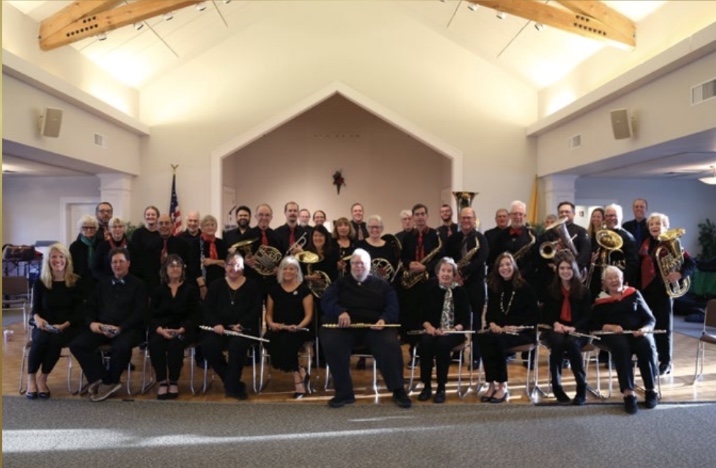
On Saturday, April 26, the Old Lyme Town Band celebrates its 50th anniversary with a free Community Concert at Lyme-Old Lyme High School. All photos courtesy of Old Lyme Town Band.

OLD LYME —The Old Lyme Town Band (OLTB) sounds off its 50th anniversary season with a free gala concert in the auditorium of Lyme-Old Lyme High School on Saturday, April 26, at 7 p.m. A reception will follow the concert. All are welcome and there is no charge for admission.

These four early members of the Old Lyme Town Band still play in it today. Michele Smith Dickey at right conceived the idea of re-forming the band in 1975 after a 65-year hiatus. The other three members are from left to right, Barry Weiner, Ann Lander, and Ned Perkins.

it was Michele Smith Dickey of Old Lyme—a member of the current band—who conceived the idea of re-forming the band in 1975 after a 65-year hiatus. She notes there were about 30 musicians at that time and the first volunteer conductor was Donald Janse. That was, in Dickey’s words, when, “We started making music and making friends a half century ago”. “

The original incarnation of the Old Lyme Town Band (OLTB) spanned 1886-1910. It was re-formed by Dickey in anticipation of the US Bicentennial coming a year later in 1976.
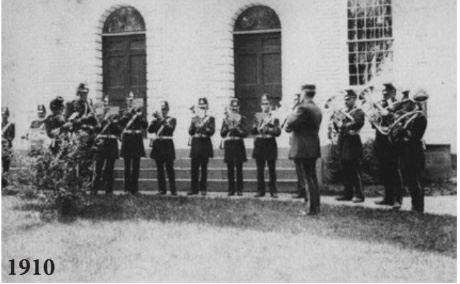
This photo shows the band in 1910 shortly before it took a 65-year break.

“The group has played continually for half a century,” she noted, continuing, “It’s great to have a musical outlet for people of all ages where friendships are forged.”

A series of 15 conductors followed Janse through the years. Under the direction of its current conductor, Richard Chiappetta, the band entertains audiences with a variety of music including movie medleys, traditional marches, showtune favorites, and Americana selections. 

Dickey commented that the band has grown to more than 50 members since 1975 and continues to provide summer and holiday concerts to shoreline and river valley communities. 

The April 26 concert will feature a commissioned piece by composer Anthony Susi titled, “Impressions of Old Lyme.” It was inspired by three Lyme Art Colony painters in summer residence at the home of Florence Griswold, where the new school of painting became the center of American impressionistic art. Susi hopes “Impressions of Old Lyme,” expresses the rich art history of the community. “The French impressionists often painted scenes around Paris; the American impressionists in Old Lyme painted the rural landscapes of New England.”
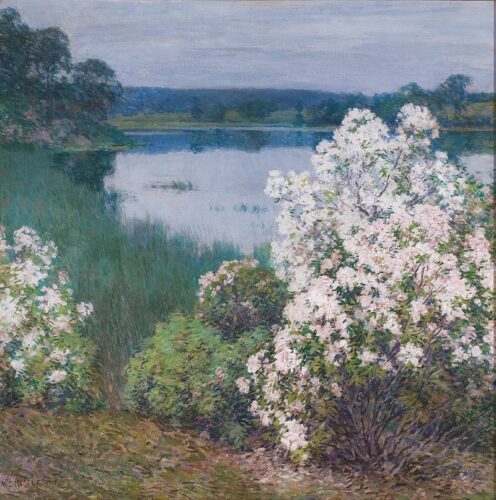
This famous work,“Kalmia” by Willard Metcalf, is one of the paintings that inspired Anthony Susi’s original work, “Impressions of Old Lyme,” which will be given its premier by the Old Lyme Town Band at their celebratory concert on April 26.

They used a technique of high-key colors and broken brush strokes seen in the paintings “The Ledges” by Childe Hassam, “Peonies” by Matilda Browne, and “Kalmia” by Willard Metcalf. The works reflect the meadows, marshes, and flowers in the area known for inspiring art.

Brian Girasoli, OLTB President, said that the show will feature debut compositions as well as old favorites as the group celebrates 50 years of musicianship. 

“Since 1975, we  have been fortunate to not only have nearly a thousand people from the surrounding area provide his or her musical acumen, but also the support of the community to put on more than a dozen concerts each year,” he continued. 

Concert dates can be found at oldlymetownband.net/oltb and by visiting Old Lyme Town Band on Facebook. Regular annual events include a concert preceding the fireworks display at the Midsummer Festival, a summer concert on the Town Green, and a winter holiday concert at Katharine Hepburn Cultural Arts Center in Old Saybrook.  New this summer will be a concert at Water’s Edge in Westbrook.

The OLTB welcomes players of all ages, students to retirees. No audition is necessary. Rehearsals are held Monday evenings from 7 to 9 p.m. at Christ the King Church in Old Lyme.

For more information contact oldlymetownband@gmail.com.
Scientists Continue Fight Against Hydrilla Scourge; Presentation in Lyme on Latest Efforts

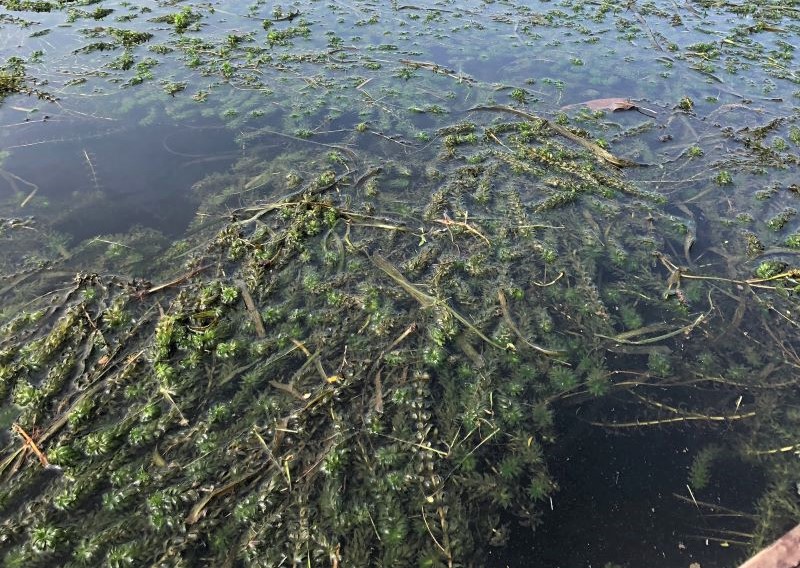
This photo was taken September 2020 during an inspection of Whalebone Cove when it was found 60 to 70 percent of the waterways were clogged with hydrilla vines.

LYME – Experts on the Connecticut River hydrilla will be at the Town Hall on Wednesday to talk about plans to include Hamburg Cove in a growing, multi-year effort to reduce and control the highly invasive water weed. 

The presentation will begin at 7 p.m., according to a public notice filed by the U.S. Army Corps of Engineers (USACE). A question and answer period will follow. 

The Connecticut River Hydrilla project, overseen by the Army engineers in partnership with the Connecticut Agricultural Experiment Station and the Lower Connecticut River Valley Council of Governments, began in 2023 to figure out which aquatic herbicides ― and how much of them ― are best suited to fighting off the uniquely pernicious aquatic species. 

The USACE said herbicides will be introduced to Hamburg Cove this summer or fall. All herbicides being used are registered for aquatic use by the U.S. Environmental Protection Agency.

The project last year applied an herbicide treatment to Selden Cove and several other sites on the lower Connecticut River. 

Hydrilla degrades water quality, chokes out native plants and threatens the habitat of migratory fish like shad and herring, according to the Connecticut River Conservatory. It’s been described by U.S. Sen. Richard Blumenthal, D, as, “the worst invasive aquatic species known to man.”

Wednesday’s meeting will be in-person only, according to the notice. There will be information on the project itself as well as the concerning effects of hydrilla on the Connecticut River system.

Registration is requested. Those interested in attending should email info@eightmileriver.org.

Op-Ed: After HROD Defeat, Some Thoughts on Improving Old Lyme’s Approach to Managing Major Projects Going Forward

Editor’s Note: We originally published this op-ed submitted by Howard Margules of Old Lyme on July 12, 2024. After the 4-1 defeat of the Halls Road Overlay District proposal by Old Lyme’s Zoning Commission last Monday (April 14), several members of the Halls Road Improvement Committee, including its former chair Edie Twining—who resigned yesterday—suggested republishing it as a constructive contribution to the discussion regarding how to move forward from this point.

Is a Town Planner the Answer?

Our town’s major projects—Halls Road, sewers, Shoreline Gateway, and Affordable Housing—are all vital to our town’s future economic viability. 

They also share something else in common: they have been “works in process” for quite a while, and all remain unfinished. It is important to point out that these projects have been ongoing across multiple administrations, regardless of which political party is in power; so this is not a partisan issue but one that crosses party lines. 

Why do these projects take so long to complete, and what can be done to expedite them?

Over the last ten years I have been involved, one way or another, in most of these projects. 

I am a current member of both the Halls Road Improvement Committee and the Planning Commission and the former Chair of the Economic Development Commission. Thinking back on my front-row experiences has led me to some observations on those questions and suggestions for improving timely project completion.

Relying on Volunteers

Our town is very fortunate to have a motivated, engaged volunteer corps staffing our town Boards, Committees and Commissions. I have worked with good people from both parties, and I have been generally impressed with the competence, knowledge and commitment they bring to the job. And, they are doing this work for “free.” 

But, there are issues with relying on volunteers. 

First, there is a town requirement that the Boards and Commissions be balanced politically. This occasionally leads to appointments made simply to fulfill the political balance requirement rather than appointing the most qualified individual.

Additionally, there have been instances where the Committee or Board Chair has had no input in the selection, or, objected to the appointment, but was overruled, even though the person appointed was not the best candidate. 

Second, our town relies almost solely on volunteers to address some very complex projects which often require specific expertise and knowledge that may be absent in our volunteers. 

Additionally, most Boards and Commissions only meet once per month, which is acceptable for routine issues but inadequate for addressing major complex projects. 

Finally, it is also difficult to put too much pressure or expectations on volunteers since they can always elect to just bow out. Relying almost totally on volunteers makes it hard for the town to complete major projects successfully in a timely fashion.

Low Accountability

Many municipalities, especially larger ones, employ a full- or part-time professional planner, to lead major projects. They are professionals with the expertise required to address the complex issues major projects raise. Most importantly, they are held accountable as professionals for completing projects. 

Currently, we don’t have the structure or ability to hold any one person accountable. Accountability gets more complicated given the number of Boards and Commissions involved, various interests that have to be satisfied, and political agendas that occasionally get in the way.

Lack of Collaboration

All of these major projects require approvals from multiple Boards and Commissions Typically, this is done sequentially. One Board or Commission generates proposals that then require approval from another body. Of course, it is natural then for everyone to want to add their two cents. 

The sequential review and approval process frequently leads to varied opinions, occasionally to conflicts, and thus delays. Each set of potential conflicts must be resolved in sequence, drawing out the process and the projects unnecessarily. 

In my view, it would be more beneficial to provide a mechanism for the Boards and Commissions to collaborate initially, perhaps reaching broad consensus and some level of buy-in before the official approval process. 

The Board of Selectman should form a specific project committee for each major effort. We do have some such now, but they do not include representatives of the bodies that will have to provide approval later on. 

The relevant Boards and Commissions or representatives of those bodies need to be involved early in the project, if not from its inception. 

Relevant Expertise

Expert advice (engineering, law, environmental science, design, etc.) is required for these major projects. We are very fortunate in Old Lyme to have a wide range of skills represented in our citizenry and we have benefitted from their help over many years. 

Unfortunately, those with the most relevant skills are often still working, raising children, etc. and have little time to volunteer. We can take advantage of these local skills where they are available, but major projects need consistent and constant expert input, even if it means we must hire professionals to assist.  

Even to manage the work of hired experts can require Board or Commission members to climb a steep learning curve.This is another area in which a professional planner could be very helpful.

Leadership

Finally, these complex projects require engaged leadership from the Board of Selectmen. The Board of Selectmen needs to assist with coordination, monitoring, oversight, timetables, expense control, lobbying public officials for funding, and commit to completing projects on time and on budget.

Our town will face more challenges going forward. If we are to successfully face these challenges and secure our economic future, we need to enhance our approach to supporting and managing major projects.

Lyme Grange Presents Recognition Awards for Long [Decades of] Service 

LYME – Thirteen members of Lyme Grange 147 have earned recognition awards for decades  of service. 

The 129-year-old organization is based in the Hamburg section of Lyme off Rte. 156. 

Grange Secretary Nancy Beebe announced the Long Service awards in a press release dated April 10.

 “To the Grange, ‘long’ means time measured in decades, not mere years, because of its traditions of consistency and continuity in community service,” she said. “We are deeply thankful to their dedication and to their donation of time and skills.” 

The awardees are:

  • Ruth Young, 80 years
  • Alione Cone, 75 years
  • Bruce Stark, 65 years
  • William Narducci, 60 years
  • Dorothie Smith, 60 years
  • Bill Firgelewski, 55 years
  • Charles Monte, 55 years
  • John Andrews, 50 years
  • Shirley Pennala, 50 years
  • Terri Bischoff, 45 years
  • Andrina Monte, 45 years
  • Doreen Lammer, 40 years
  • Ernest Lammer, 40 years. 

The long service awardees have over the years volunteered in a multitude of Grange activities, notably in helping to judge and administrate portions of the annual Hamburg Fair, now in its 122nd year.

Letter to the Editor: Are Old Lyme Residents Being Overtaxed? Demand Answers to Why Town Surplus Fund is so High, How it Impacts Tax Rates

To the Editor:

Are the residents of Old Lyme being overtaxed?  I would bet that most residents probably believe that our property taxes are relatively reasonable compared to other CT towns, but is that really correct? To try and find an answer to that question I Took a look  at the town budget.

Reviewing the budget, the first thing that jumps out is that our “Unassigned Surplus Account” (UAS.) UAS is high. What does that mean and why is it important? Our town’s budget allocates funds for specific purposes. If revenues exceed expenditures that have already been accounted for, the town may assign the excess funds into an account titled an “unassigned surplus”.  Think of it as a “rainy day fund” designated for unusual or unexpected expenditures. Our town’s current  UAS is about 15 million dollars representing about30 % of the town’s total revenue.

Is 30 the right number or Is it excessive? Instead of maintaining a large surplus should the money be returned to the taxpayers in the form of lower taxes in the future or used to fund capital projects or some combination of the two?

How does our UAS compare to other CT towns?  In 2020 The Office of Legislative Research for CT indicated the UAS number for CT. ranged from 0.1% for Stamford to 39.6% for Warren. The state auditors recommend that Connecticut towns aim for a surplus of 16%.

Why is ours on the high side? The reason given for keeping a high UAS is that in case of a catastrophic storm, that either temporarily or permanently wipes out our beach communities, our tax revenues will shrink.  Even if that is correct, it is also true that in those circumstances our services and expenses would likely also decrease. Is it also reasonable to anticipate that FEMA or the state would compensate us for some portion of catastrophic losses? Other shoreline towns like Clinton and Old Saybrook, that have equal or greater risks than Old Lyme, maintain lower UASs. Why? How did the Town of Old Lyme determine that 30% is the optimal percentage? What was the formula or methodology employed to arrive at that number? Old Saybrook has a target of 15%, and if the UAS exceeds that amount, they have a plan in place to reduce it. They don’t let it continuously grow.

I realize the town faces some significant new upcoming capital expenditures, but that does not seem to explain why we have built up this level surplus over the last few years even before these projects were approved.

Alternatively, did the town look at possibly obtaining catastrophe insurance, limited to reimbursement for the loss of  tax revenue, rather allocating millions of dollars to surplus? It might be a more economical solution.

Does a 30% surplus represent fiscal responsibility or irresponsibility? I don’t have the answers, but you may want to demand answers on the level of surplus and its impact on tax rates before deciding if you are being overtaxed.

Sincerely,

Howard Margules,
Old Lyme.