Unless you are a devoted fan of the Marvel Cinematic Universe (MCU), The Fantastic Four: First Steps is not worth seeing.
Recruiting the latest phenomenon of actors (Pedro Pascal, Vanessa Kirby, Ebon Moss-Bachrach, and Joseph Quinn) and maintaining their distinguished action-packed sequences will not make up for the empty writing. At multiple points during the screening, I felt like leaving.
While I managed to convince myself to stay for the sake of this review, I wasn’t interested in sticking around for the two signature credit scenes that preview the next installments in the Marvel movies.
Superhero movies always require a suspension of disbelief. The viewer knows anything in these movies is possible if there is room plausible deniability.
But even after years of watching Tony Stark and Peter Parker assemble new suits out of thin air, I had a hard time “believing” the scientific research of Reed Richards/Mister Fantastic.
While I am aware that the MCU has extensively developed their multiverse-setting, I went into this movie expecting a proper origin story for the Fantastic Four and the beginning of the MCU. It is totally reasonable when the costumes, set design, and titles are imitating the aesthetics of the 1960s. It turns out this is just another earth set in the future that appears to be our past.
Another disappointment came through the humor.
Marvel movies have made an impression on the world that wasn’t solely the result of top-notch special effects and marketing, but through relatable and likable characters. That is mostly the result of great chemistry between the performers and a sense of humor.
But I didn’t find myself laughing in this Marvel movie. In fact, the jokes were predictable and hackneyed. It’s more than the jokes; it’s the entire story. There also came a moment when Sue Storm/Invisible Woman attempted to rally and inspire everyone, and it made no sense. When it came to the consequential moment that resolved the conflict, I found it to be along the lines of a Deus ex machina.
But, since it’s a Marvel movie, it does deliver with action sequences that are captivating enough to believe that our heroes are exploiting the gravity of a neutron star to propel themselves back home. And the music certainly amplifies those entertaining sequences.
But I can’t praise it entirely, especially with the antagonist, the Silver Surfer. The effects aren’t bad, they’re good — they’re too good. But this isn’t something to praise, it felt like a trip into the Uncanny Valley (when fake human appearances end up more disturbing than endearing). Devoted MCU fans will find a way to see this.
But for the rest of us movie-goers? We’re not missing anything if we decide to do something else. I would not place The Fantastic Four high on a list of prioritized movies of 2025.
About the Author: Having lived in Old Lyme and Lyme since the age of three, Kevin Ganey has always had a passion for movies that is beyond simply watching, but understanding the craft of cinema and and experiencing films as if they were a musical album. Kevin also has his own website devoted to movie analysis, CityOfCinema.com, and also co-hosts a podcast, Moviehouse Mystics, with Koda Uhl (available on Apple Podcasts, Spotify, and YouTube.)
On Aug. 28, the NextGen Acela (pictured above) will start running between Washington and Boston. Photo courtesy of Amtrak.
Jim Cameron
Amtrak’s oldest new trains are arriving shortly: the NextGen Acela (finally) starts running between Washington and Boston on August 28.
Ordered in 2016 for $1.8 billion, the first trains arrived from the Alstom assembly facility in Hornell NY in 2020. That meant jobs there for 1300 workers and business for 180 suppliers across 29 states. These new trains are 95% “made in the USA”.
Like any new trains, the new Acelas required extensive testing, especially for crash worthiness and compatibility with the aging tracks and wires in the Northeast Corridor. That’s when the problems started.
Even before field testing, it took Amtrak 14 attempts to finally pass computer simulations. In road testing, windows shattered, there was water corrosion and leaks in the hydraulic tilting system. Road testing also found issues with the trains’ wheels’ traction on our old tracks. And the pantographs (drawing electric power from the overhead catenary wires) kept losing contact at high speed. Some 129 field modifications were ordered.
That’s why these sleek new trains are about three or four years “late”. But was it worth the wait?
Twenty-eight train sets are on order but only five will be in service to start, the rest going into service by 2027. They’ll replace the first-gen Acelas which have been running for up to 27 years, accumulating millions of miles of travel.
Despite constant maintenance and repairs, the older Acelas have been showing their age. Reports indicate that some train sets have been stored, cannibalized for spare parts to keep the other aging trains running. Eventually the old trains will all be scrapped.
Is the NextGen Acela ready for prime time? We shall see. But beware of the PR hype coming your way from Amtrak, proclaiming NextGen Acela as the savior of American passenger rail.
Make no mistake… these are nice new trains. The train sets will be bigger: nine cars vs.six, carrying up to 386 passengers vs 304. And the new Acela trains can add three more cars if needed while the old Acela consists were permanently coupled. And with more train sets, there will hopefully be a greater frequency of service.
The interior of the new cars looks sweet… comfy seats, fold-down tables, power plugs and more wheelchair spots. There will be a new Café Car and promised (free) 5G Wi-Fi connectivity. Seating will be 2 x 2 in Business Class (there is no coach class) and 2 x 1 in First Class with meals there brought to your seat. The windows will be larger and the ride is said to be smoother, even at top speed.
But here’s where the hyperbole hits the tracks.
The NextGen Acelas are being described as offering “160 mph” speeds. But there are only 32 miles of the 457 mile tracks from DC to Boston that can handle those speeds… four miles in New Jersey and 28 miles in Rhode Island and Massachusetts.
In Connecticut the new Acelas, like the old ones, will go no faster than Metro-North… maybe up to 90 mph in a few stretches. You can blame our many bridges and curving tracks for the lower speed limits.
There is no word yet on fares, though they will probably match existing Acela fares. This is already an expensive ride: one-way from Stamford to Boston is about $330 in Business class and $573 in First (compared to $134 and $227 on the slower, 50+ year old Amfleet Northeast Regional trains). Running time on Acela, about three hours. On the older trains, three and a half hours.
Are those fares worth the promised speed and comfort? Maybe if you’re on an expense account. But I’ll take it for a spin (on my own dime) and will let you know.
Editor’s Notes:i) Jim Cameron is the founder of the Commuter Action Group and advocates for Connecticut rail riders. He writes a weekly column called ‘Talking Transportation,’ which is published by a number of publications in the state. ii) ”Talking Transportation” recently won first place in the general column/commentary category in the Connecticut Society of Professional Journalists Excellence in Journalism Contest.
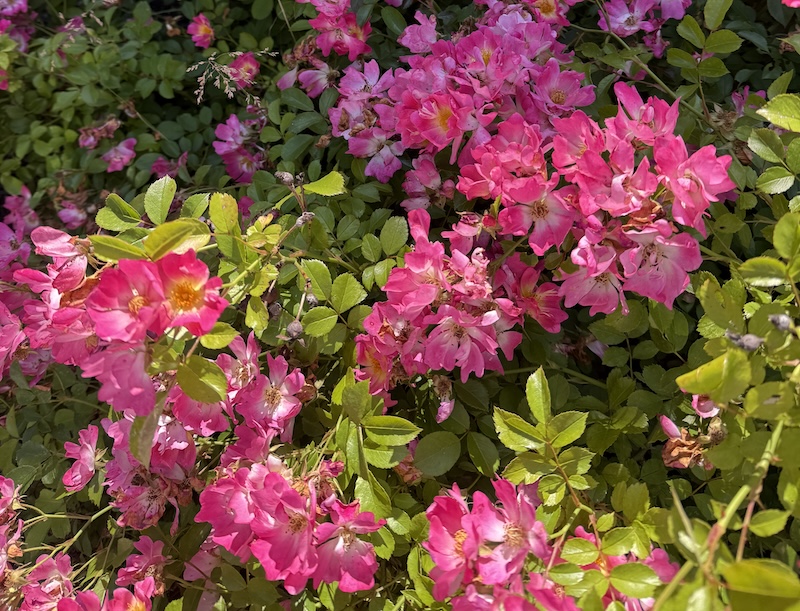
Summer flowers can offer contrasting colors. All photos by LymeLine.
Watering is so important during the heat of summer. If you planted trees or shrubs this spring, particularly evergreens, these plants require extra moisture to establish a strong root system. We have had an abundant amount of rain this spring and into the summer, however it is important to keep an eye on the weather.
Here in New England, plants require at least an inch of water per week. If you are using a regular hose, you lose 40% of moisture to evaporation. However, a hose is necessary for thorough watering when a plant goes into the ground and daily watering for containers.
Soaker hoses in your borders are the best method of watering, attached to a house spigot with a timer. By using this method of irrigation, moisture goes to the roots of plants where it is needed and not on the foliage, which can cause diseases such as black spot and powdery mildew. Soaker hoses attached to a timer can be used efficiently not only in the borders of the garden but also in the vegetable garden, where annual vegetables require a lot of water to produce a good crop.
In addition, composted manure when added to the containers together with copious amounts to the vegetable garden, helps to retain a good amount of moisture. Manure, used as mulch for the vegetable garden, adds more nutrition and manure used as mulch does not cap or form a hard crust, so water goes directly to the roots where it is needed.
LAWNS
Water the lawn only when the green glow begins to fade. An established lawn will bounce back following dry hot spells.
SOIL
I want to emphasize the importance of soil and soil health, which has been severely neglected and abused with poisonous chemicals for years. Soil is the most important element of plant growth; it is not an inert medium that merely holds the plants erect, it is a living organism that needs to be replenished with nutrients.
The nutrient is composted manure; manure builds soil structure and together with its bacteria joins the millions of microbes below the surface to produce nutrients for the roots of the plants. If you have not already done so, I strongly suggest that you carefully discard all chemical fertilizers, herbicides and pesticides.
The addition of composted manure to your soil in spring, early summer and in early fall, together with natural brown bark mulch, builds the carbon compound or humus component in the soil. We are all carbon-based creatures, as is every living element; carbon is our lifeblood and the lifeblood of the soil in our gardens.
As we build the humus component by adding composted manure and fine-bark mulch, we are producing the healthiest possible growing environment and the strongest disease resistant plants.
As we add the composted manure and natural fine bark mulch season after season, the humus component continues to build in the soil, continuously extracting carbon from the atmosphere into the soil.
ROSES
Roses bloom throughout the summer.
Roses flourish beautifully with the addition of composted manure and mulch, which should be applied on the soil about two feet away from the base of the plant. Roses also require deep watering once a week. Now, in July add another light layer of composted manure around the roses. Manure is food for the roots of the roses and no other products are necessary for growth and bloom.
Stop adding manure to the roses in mid-August, so that they can gradually move into a slow dormancy through late summer and early fall, this is a natural part of their growth cycle.
If you are a first-time rose grower or adding to your rose collection, David Austin English roses are my personal preference. The David Austin nursery is only twenty-one miles from my hometown in Shropshire in England. Visiting the Rose nursery in June was a fragrant and exhilarating pleasure that overwhelmed my senses.
David Austin roses are more trouble-free than many other roses and with the fact that they are repeat bloomers, with beautiful colors and fragrances extends our enjoyment of this lovely shrub throughout the summer months.
Carding Mill Valley begins as a peachy orange double flower, changing to an apricot-pink
A lovely combination is climbing roses and clematis planted together; both enjoy the same planting environment with their heads in the sun and their feet (roots) cool, with the added nutrition of manure and mulch. This combination looks great, climbing over a fence, wall or arbor. The combination I enjoyed, was a purple clematis and a pink climbing rose, which I planted on a trellis on the old stone chimney breast of my farmhouse.
It is of the utmost importance to stop feeding roses right now, in August. The reason for this is that roses require at least nine weeks to gently move into slow healthy dormancy before the first frost arrives.
In my September tips I will give you suggestions on partially pruning roses in early fall, followed by a second pruning the following April. This double pruning method produces the strongest and most prolific bloom.
MULCH
Please do not use artificially colored red mulch, rubber mulch or cocoa mulch; use only natural brown bark mulch. Do not mulch right up to the base of the plants, as this invites rodents to nest and gnaw on the stems or trunks of the plants.
Note of why NOT to use Cocoa mulch: Cocoa mulch, produced by Hershey, has a Thorazine compound and other poisons which are hazardous to pets who are attracted by the chocolate odor. Ingestion of this chocolate mulch can cause seizures and death within hours.
HYDRANGEAS
Hydrangeas need plenty of water to sustain their flowers.
Plant Hydrangeas in a sunny area, if you live near the coast that allows them to enjoy gentle seas breezes. Away from the coast, plant Hydrangeas in part sun on the west or east aspect of the garden in organically rich soil with composted manure and add extra composted manure this month around the base.
If you have the blue macrophylla Hydrangea add some peat or aged oak bark around the base, the acidity in the peat or oak bark encourages a deeper blue color. Hydrangeas are a wetland plant and require plenty of water throughout the summer. We had a late spring and with all the spring and early summer rain and good sunshine, the foliage and bloom of the hydrangeas are performing well.
Watch out for powdery mildew and spray with the following powdery mildew recipe you can mix yourself:
Recipe for powdery mildew -Two tablespoons baking soda, one dessert spoon of vegetable oil, a squirt of dish soap with a gallon of water in a sprayer. For any recipe spray you make at home, spray only in the morning when there is no wind and when the temperature and humidity added together do not go above 180.
Pruning Hydrangeas – Prune Hydrangeas immediately after they finish blooming in late August or early September but no later, as Hydrangeas set their buds for the next season by mid September. If you prune after September, you will lose next season’s bloom. When you prune, cut out some of the old wood and the weakest of the new shoots. In October put more composted manure and brown mulch around the base to nourish and protect the roots through the winter.
GARLIC
Did you know that garlic is the antibiotic of the garden. I love using garlic in my recipes. Garlic is an important anti-fungal element to protect your plants, and I suggest planting more garlic in early fall.
To avoid fungal diseases, plant garlic around strawberries, tomatoes and raspberries to avoid fungal diseases.
Plant garlic in these places:
around mildew-prone plants to prevent mildew on such plants as summer phlox and bee balm.
under fruit trees to avoid scab and root disease.
next to ponds or standing water to control mosquito larvae or pour garlic water into the water to deter adult mosquitoes.
(The following recipes are from a garden book I am writing.) Where you notice marauders have been munching, like insects or animals make a garlic spray to apply on the plants including vegetables.
Garlic spray recipe
4 large, crushed garlic cloves, unpeeled 2 teaspoons of vegetable oil 1 squirt of mild dish detergent
Put all ingredients in 2 cups of hot water in the blender, blend, then leave overnight, in the morning then put these ingredients in a gallon sprayer with cold water and spray in the early morning when there is no wind, observing the rule of 180. Observing the rule of 180 is when the temperature and humidity when added together do not go above 180.
Hot pepper sprayrecipe
To deter squirrels and chipmunks, try a hot pepper spray using either 4 hot chilies or one cup of cayenne pepper in 2 cups of hot water, in the blender, blend and leave overnight then put in a gallon sprayer with cold water and spray the problem areas in the early morning.
This pepper spray works well to deter squirrels, chipmunks, deer as well as dogs and cats that may be leaving their deposits in the garden.
HANDS:
Gardener’s hands are your their tools when working in the garden so it’s important to take care of them. My hands remain healthy by indulging in a hot cream treatment once a week before bed.
Hot Cream Recipe:
Combine Calendula cream with honey and essential oil of lavender heated in the microwave, apply generously and put on white cotton gloves for sleep. When I wake up my hands are soft and smooth as a baby’s bottom.
Also please wear gloves, when working in soil that contains manure or when spreading manure. Manure is an organic product that contains bacteria; bacteria is great for the soil but like many bacteria not healthy for you. The garden gloves I prefer are the soft leather farmer’s gloves that are washable.
FLAVORED OILS
Many herbs are at their peak right now and are ideal for using in flavored oils.
The oil I use as a base is organic olive oil. I harvest basil, parsley, sage, tarragon and oregano in the morning, rinse them well, pat them dry with a paper towel and then make the recipe. Then choose an herb that you want to use that day, and add to two cups of organic oil.
For thyme and lavender, I use only the flowers with one cup of oil to a handful of blossoms.
Combine the herb mixture in a blender, then store covered in a wide mouthed jar for three days, shake at least three times a day for the first two days and on the third day let the mixture settle to the bottom, then strain it through a paper coffee filter or cheese cloth into a clean jar. You will now have a tinted but clear mixture.
Refrigerate each mixture and use within two to three weeks. The herb oils I choose to make are rosemary, lavender, lemon, garlic, shallots and basil with olive oil as the base for each These are my favorites and are great brushed on vegetables and meats for grilling.
The Lavender oil is great for desserts; one I enjoy is this oil on vanilla ice cream.
Rosemary and lemon oil taste excellent on salads.
MOLES:
I know I have given you a few mole remedies in the past; but I have not given you the exlax method for a while. I can attest to the fact that I have used this method as have many of my fellow gardeners for years, as it works so well. Buy Exlax, from the Drug store, the main ingredient of Elax is Senna, which is a natural herb. Insert Exlax into the mole holes, the moles and voles eat it then die of dehydration.
If you have dogs and cats, do not use chocolate Exlax only the plain Exlax as chocolate is dangerous to pets.
In early April of next year, apply organic grub control, which means less grubs for the moles to feed on, and without their supply of grubs, the moles will go elsewhere for food. In addition, the white grubs of Japanese beetles are largely diminished with the grub control.
Japanese beetles love our plants and here is a method to deal with them naturally. In the early morning, the Japanese beetles are drowsy and can be captured. Lay a drop cloth under the plant or plants where you see them and gently shake the plant; the drowsy beetles will drop onto the cloth, which should be gathered up and then drop them in a garbage bag and discard.
Many of us now garden organically no longer using poisonous herbicides or insecticides, organic gardens have encouraged the earthworm population to once again increase; earthworms are a great boon to the garden soil as their castings add 50% nutrition to the soil together with eleven trace minerals.
SUMMER PHLOX
A swallowtail butterfly lands on late summer flowers.
I just love my summer phlox and to keep the mildew problems at bay I use the natural baking soda mix I mentioned above.
I have found that white Phlox Miss Lingard or white Phlox David are more resistant to mildew than other summer phlox.
Monarda, commonly known, as Bee Balm and Hydrangeas are also prone to the problem of powdery mildew, and this is where the baking soda recipe can be used to excellent effect.
For a second bloom on the Summer Phlox, prune off ten to twenty inches of the flower stems after the first bloom has gone by and within a few weeks you will experience a new bloom.
KEEP YOUR GARDEN CLEAN
A healthy garden is a clean garden. Do not put any diseased items into your compost.
Deadhead all annuals and perennials to encourage the second bloom and clean up all spend blossoms.
When Coreopsis and Spirea have bloomed, use garden shears to shear off dead flowers and they too will rebloom.
August has given plentiful spring and early summer rain and has resulted in bountiful fragrance, bloom and foliage.
We have a relatively short growing season here in New England, and being able to enjoy a healthy colorful border is so uplifting. That being said, by mid-August, when early perennials have gone by, we are able to give ourselves more enjoyment by filling in gaps with annuals or later blooming perennials
I constantly remind myself that gardens are a constantly changing scene of beauty in motion and plantings which looked good last year, but by this year they may have outgrown their space and need division or transplanting to another area of the border or even to another border which may be a little sparse.
When the weather is cooler in September, transplanting can be tackled on some of these overgrown specimens, so that every plant has its own space with good air circulation and can be able to perform their very best.
Divide those plants that have been in the soil for four years or more. You may have noticed that these plants have not been blooming as profusely as they did when first planted. When you divide and set aside the divisions, there are always fellow gardeners who will gratefully receive the transplants.
Now in August, continue the deadheading; by doing so your garden will always appear fresh and perky. After the hot, dry days we have had of late, watering is of major importance. In this regard, make sure the garden receives at least one inch of water a week and containers receive a daily dose of water, in the early morning and early evening.
Soaker hoses in the borders are a much more efficient method of watering; by using this method, the water goes straight to the roots where it is needed. By using soaker hoses you won’t lose 40% of moisture to evaporation and are also preventing water from landing on plant foliage, which in many instances results in disease and mildew.
When you cut back tired looking annuals, a new flush of bloom will appear in a few short weeks. As you walk around the borders right now, you will see their original vibrancy has gone by and a boost of new specimens to perk things up is required. These specimens can be found right now because many garden centers are offering late season bargains.
When the perennial Coreopsis and Spirea have finished blooming; cut off the dead bloom with the garden shears and enjoy the appearance of new bright bloom shortly.
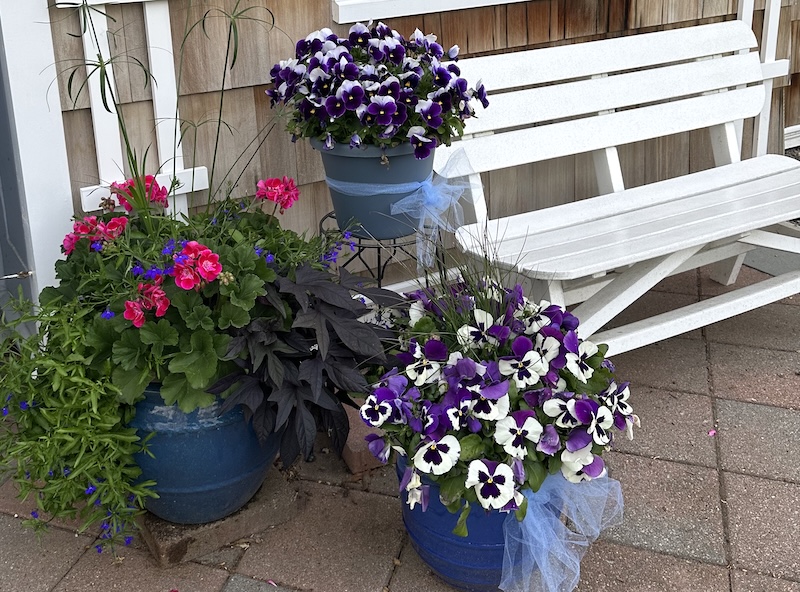
CONTAINERS
When carefully tended, container gardens always bring color to your patio or paths. We spotted these outside the Lyme Art Association.
Make sure you have composted manure and fine bark mulch applied on top of the soil in your containers and water them daily. In hot weather the containers will need to be watered twice daily, morning and evening watering is the best. If you do not have time in the morning before you leave for work or errands, empty your ice cube trays on the containers; this provides slow -release watering until you can get to them later.
Every couple of weeks apply a little extra composted manure to containers when watering; this will keep these miniature gardens bright and cheerful into early fall. Apply the manure on top of the natural brown mulch as the combination of manure and mulch will help retain moisture and continue to retard weeds.
In the morning if you do not have time to water the containers before you go to work or run errands, simply empty your ice trays into the containers, this provides slow -release watering until you are able to add more moisture when you return home.
With the high heat and humidity that has been occurring recently, powdery mildew may be happening on certain species like Summer Phlox, Monarda and Hydrangeas. If you notice this problem, spray my mildew remedy of one gallon of water in a spray container, adding one tablespoon of baking soda and a dash of vegetable oil. Always spray in the morning before the temperature and humidity numbers combined equal 160.
Continue adding more composted manure to vegetables each month, as vegetables, particularly annual vegetables are heavy feeders. To prevent animals from munching on your precious bounty, place an old sneaker or a piece of carpet that your dog had lain on among the vegetables; these odors help keep furry marauders away.
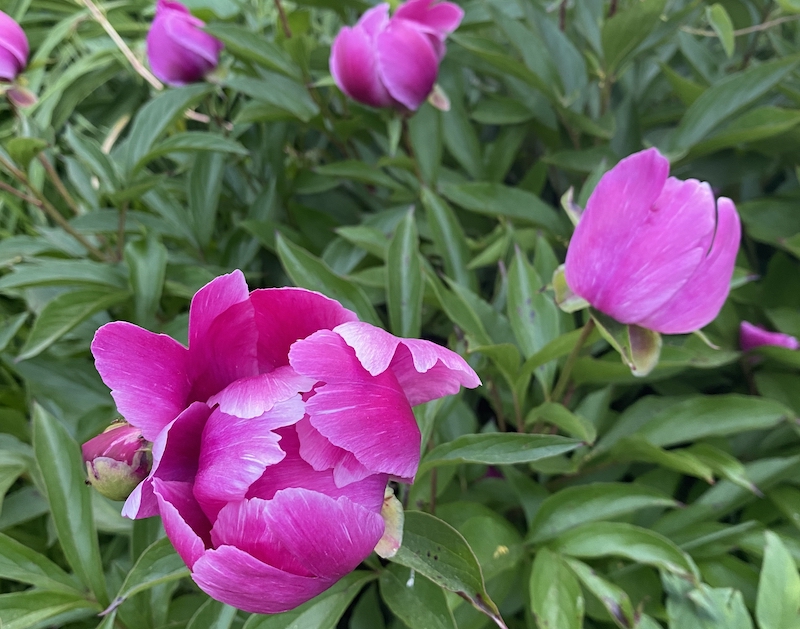
PEONIES
Perfectly pink peonies always brighten a yard.
Place your orders for Peonies now so they can be delivered for September planting. September is the month to transplant, divide Peonies.
Following the first hard frost in November cut any existing Peonies down to within six inches of the ground and add a little natural brown mulch around them to protect the pink-eyed roots, which are close to the soil surface. When planting Peonies or transplanting make sure that the ‘pink eyes’ on the roots are barely covered with soil, if the Peonies are planted any deeper, it is likely that you may not have bloom next year.
Begin compiling your list of spring bulbs now for the best choice of bulbs to be available for you.
Please feel free to email me with any gardening questions to MaureenHaseleyJones@gmail.com. I look forward to seeing you in your garden in September, in the meantime enjoy being outdoors and remember to stretch, hydrate and take time to smell the bloom.
If you would like a garden consult or conversation with my son Ian, of LlandscapesbyIan.com, feel free to get in touch with him. As the saying goes ‘ the apple does not fall far from the tree’ and in my estimation Ian has outpaced me with regard to creativity and production.
Maureen Haseley-Jones
About the author: Maureen Haseley-Jones is a member of a family of renowned horticultural artisans, whose landscaping heritage dates back to the 17th century. She is one of the founders, together with her son Ian, of The English Lady Landscape and Home Company. Maureen and Ian are landscape designers and garden experts who believe that everyone deserves to live in an eco-conscious environment and enjoy the pleasure that it brings. Maureen learned her design skills from both her mother and grandmother, and honed her horticultural and construction skills while working in the family nursery and landscape business in the U.K. Her formal horticultural training was undertaken at the Royal Botanic Gardens at Kew in Surrey.
Continuing our summer reprise of some older columns, here’s an update on memories of years past …
This week marks the 56th anniversary of the grand-daddy of all rock festivals … Woodstock. I was in my teens the summer of 1969, but couldn’t get off from my job to join the swarms of rock fans. But I did see most of them.
That summer I was as a “temp seasonal” toll collector on the Tappan Zee Bridge, joining Westchester and Rockland counties across the mighty Hudson River.
Most days life as a toll collector on the Tappan Zee was a delight, as I was usually assigned to the far outside lane, also known as “the country club” because of its green vistas and views of the mighty Hudson River.
There were two things I learned in that job: how to roll quarters and how to listen to the radio. The tiny toll booths lacked air conditioning, but I could bring a fan or a radio. My portable FM entertained me eight hours a day as I listened to both the music and the FM DJs … a job I eventually earned at Long Island’s WLIR after college graduation.
New York’s FM stations were buzzing about Woodstock for weeks, and that Friday and much of Saturday, it seemed that every kid in the tri-state area was heading for Yasgur’s Farm. Most weekends were pretty crazy in my toll collecting job, because in those days tolls were collected in both directions … 50 cents north-bound and 50 cents coming home. (Today the toll is $6.75 roundtrip, if you have an E-ZPass).
Busy as it was on summer weekends on that bridge, nobody expected a half-million people would show up heading to Woodstock, especially not the folks at the NY Thruway Authority. But after the rock fest was well underway, the Thruway brass realized the mobs would eventually be heading home, clogging the bridge. Because the music was expected to end late on Sunday, many of us temp-collectors worked overtime into the wee hours of Monday morning.
Late into the night we had five toll lanes open southbound, most of us enjoying some handsome overtime. However, traffic was so light, they sent us home by about 1 am. But I was due back in the booth five hours later.
Of course, the music didn’t end until early that Monday morning, meaning that the usual morning rush hour carried as many burned-out hippies as it did regular business commuters. I remember one station wagon that pulled in to my toll lane, caked in mud up to the windows and stuffed with a dozen zonked-out kids.
“Hey man,” said the driver with bloodshot eyes that struggled to focus. “We don’t have any money (to pay the 50 cent toll). How about these instead?” That day, his Tappan Zee toll was an orange and a warm Coke.
Later that summer, after being reassigned to the New Rochelle toll barrier on the New England Thruway, I learned about the “exact change” lanes. As folks threw their change into the basket, the coins went into a machine with rotating discs and holes the size of nickels, dimes and quarters. As the coins fell though the holes, their value was totaled and the driver could pull away.
What I didn’t know was the people threw more than coins into those baskets.
One day, while inside the booth removing change buckets, I heard a car stop in the lane outside followed by an ominous thump. Not the clinking of change, but a thump.
Imagine my horror as I watched an entire orange work its way down the change chute, hitting the rotating discs like a food processor, spewing orange juice and peel everywhere over the machinery, the buckets of coins and me.
Oh, for those days back in “the country club lane” back on the Tappan Zee!
Editor’s Notes:i) Jim Cameron is the founder of the Commuter Action Group and advocates for Connecticut rail riders. He writes a weekly column called ‘Talking Transportation,’ which is published by a number of publications in the state. ii) ”Talking Transportation” recently won first place in the general column/commentary category in the Connecticut Society of Professional Journalists Excellence in Journalism Contest.
It seems every classic movie gets a sequel or a reboot nowadays. The Naked Gun was bound to step up to the plate.
Thankfully, this new installment to the franchise returns with its full absurdist glory.
This installment in the franchise casts Liam Neeson as Detective Frank Drebin Junior, son of the iconic character created by comedy legend Leslie Nielsen, who- appropriately, spends part of the film seeking signs from his father.
While investigating a suspicious death, Drebin crosses paths with Beth Davenport—a glamorous mystery novelist and the sister of the deceased—whose clues lead straight to a shady tech billionaire.
I never thought I’d be writing this, but Pamela Anderson rocks this role. She proves that her standout performance in The Last Showgirl was no fluke, and we should expect more from her moving forward.
But absurd humor isn’t for everyone. Some argue that comedy should be clever and concise- not cheap, literal, or slapstick.
I’d argue that when it lands, absurd humor doesn’t just hold its own- it steals the show. Look to the original Naked Gun movies- or Airplane!, another Nielsen classic- where the most unrealistic scenarios unfold, and everyone plays it straight. That spirit guides this movie, directed by Akiva Schaffer (The Lonely Island), and produced by Seth MacFarlane (Family Guy, American Dad, Ted)- two proven masters of absurd comedy.
In this hybrid era of moviegoing, the constant question is “Where can I stream it?” Paramount is taking the old-fashioned approach by releasing through the theaters first.
I laud this decision. We need as many opportunities as possible to sustain the magic of going to the movies.
A good old comedy can always rally a crowd for such an occasion.
This will likely land best with longtime fans of the misadventures of the Police Squad. Viewers will find countless Easter Eggs paying tribute to the original trilogy- I particularly loved the stuffed beaver’s cameo and the blunt shade thrown at Detective Nordberg (his own son won’t even pay tribute to him- for obvious reasons).
This is a chance to introduce a new generation of comedy fans to a goldmine of laughter. The Naked Gun isn’t just a long-awaited sequel- it’s a revival of a comedic style that embraces in the absurd and doesn’t care if it makes sense.
Whether you are in it for the nostalgia or curious for old-school humor, The Naked Gun delivers- and it’s well-worth a trip to the theaters.
About the Author: Having lived in Old Lyme and Lyme since the age of three, Kevin Ganey has always had a passion for movies that is beyond simply watching, but understanding the craft of cinema and and experiencing films as if they were a musical album. Kevin also has his own website devoted to movie analysis, CityOfCinema.com, and also co-hosts a podcast, Moviehouse Mystics, with Koda Uhl (available on Apple Podcasts, Spotify, and YouTube.)