
TOP STORY: Failed Halls Road Overlay Makes Way for Election Day in Old Lyme

OLD LYME–When Democratic First Selectman candidate Martha Shoemaker beat Republican challenger John Mesham by 123 votes two years ago, plans to transform Halls Road into a livable, pedestrian-friendly village center were still being hashed out in committee meetings and consultants reports.

Now, following the defeat earlier this year of a Zoning Commission application for the Halls Road Overlay District (HROD) that would have allowed developers to build apartments in the commercial zone, the issue has become a flashpoint in the rematch between Shoemaker and Republican challenger John Mesham. 

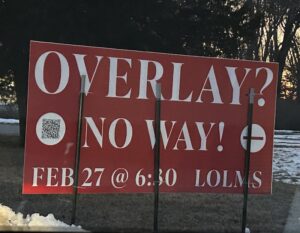
The “Overlay? No Way!” crowd was evident over the winter in signs across town and at a Zoning Commission public hearing that filled the high school auditorium to maximum capacity. A vast majority of the 550 attendees came out in opposition. 

According to Mesham, it never should have gotten to that point. 

“If I was on the Board of Selectmen, I would definitely not have ever voted to present that project to Planning and Zoning,” he said last week in an interview at the Republican headquarters on Halls Road. 

Mesham, who spent 29 years in law enforcement before retiring from the Connecticut State Police in 2020, said experience as an executive officer in the Bridgeport and Montville barracks has prepared him to run a public agency like the Town Hall. His current term on the Inland Wetlands and Watercourses Commission has taught him about the regulatory process. 

Shoemaker is a retired 35-year teacher, 12-year union president, and two-term member of the Region 18 Board of Education. She was selectwoman from 2021-23 before being elected first selectwoman.

The overlay proposal drafted by the Halls Road Improvements Committee (HRIC) was submitted to the Zoning Commission late last year by Shoemaker after a 2-1 vote of the selectmen. Shoemaker and fellow Democrat Jim Lampos were in support; Republican Jude Read cast the lone nay vote. 

Lampos and Read are both running for reelection as selectmen. 

Part of the Process

Shoemaker at the Town Hall last week said she followed statutory guidelines and local precedent for submitting the proposal to the Zoning Commission. 

The first proposal in 2021 was submitted, and then pulled, by then-First Selectman Tim Griswold after critics described it as an overreach, and a revised 2023 version that first floated the overlay zone was later rejected by the Zoning Commission. Members cited concerns about its effectiveness and the lack of water and sewer infrastructure.

The commission is empowered to approve, deny or modify applications. Shoemaker said she put the proposal in their hands so they could do their job. 

“And I know that the zoning board would have moved and pulled things out of it, or tweaked it to something that they could have been more comfortable with, because they weren’t going to put Old Lyme in jeopardy,” Shoemaker said. 

Asked if she would have done anything differently in retrospect, the first selectwoman said she said she would not have delayed the continuation of the public hearing for as long as she did. 

The hearing, which began in January, was initially continued to the end of February. But the meeting was postponed to April at the request of Shoemaker and the HRIC, who informed residents the move was prompted by “strong interest” in the topic that required a larger venue and more time for the commission to review communications from residents. 

“I think there were a group of people who sort of defined it as something that it wasn’t, and placed fear into the minds of some of the people in this town,” she said. 

Critics said the plan had the potential to create more than 1,000 apartments on 40 acres if it went through. Proponents argued topography and regulatory realities would effectively limit development to under 400 apartments at the most. 

Shoemaker said she should have educated the public more about the project instead of letting misinformation spread. 

“I think the most important thing is providing the facts,” she said. 

Mesham during his interview disputed the idea that forwarding the project to the Zoning Commission was largely a procedural issue bound by statute and the other applications that have come before it. 

“So, you know, you can say it’s part of the process, but really, part of the process is the Board of Selectmen reading the room and saying ‘we’re not gonna move ahead with this,’” he said. 

Sidewalk Consensus

He said his first order of business if elected will be to call for a “shovel-ready” plan for sidewalks, lighting and “probably some greenery” to improve Halls Road.

“I think people move to Old Lyme because they like Old Lyme,” he said. “And we don’t need to drastically change Old Lyme.” 

Sidewalks, too, are at the top of Shoemaker’s priority list for a second term. In May, she signed off on a grant application to the Connecticut Department of Transportation (DOT) for $800,000 to install sidewalks on the north half of Halls Road. 

“I think there’s total consensus on sidewalks,” she said. 

Less clear is the future of a pedestrian bridge – sometimes referred to as the bow bridge – proposed by the HRIC, according to Shoemaker. 

“It’s something that’s nice to have, but is it a need or a want? And we have to weigh that out,” she said. 

The state Department of Energy and Environmental Protection this year transferred ownership of the state’s property on the east bank of the Lieutenant River to Old Lyme, as long as the town puts a fishing pier and parking spaces there. The land swap is a necessary component of designs for the walking bridge and trail system funded with $135,000 in federal American Rescue Plan money and a $28,500 state grant. 

“If we want the walking bridge, we have to do the fishing pier,” she said. “So do we want the fishing pier? What do we do to the environment if we start to build a fishing pier? There’s a lot of questions that still need to be answered.”

Mesham reiterated it’s time to get back to basics on Halls Road. 

He said what started as a call for greenery, signage, and lighting “spun out of control” with efforts to attract developers and add large-scale improvements like the bridge. 

“It clearly got too big for what people want, so I think we need to get back to the original intent of the Halls Road Improvement Committee,” he said. 

Candy Drive Donation Deadline for Halloween ‘Trick or Treating’ on Lyme Street is Oct. 27

OLD LYME — Lymes’ Youth Service Bureau (LYSB) and Old Lyme Town Hall are again collecting donations of Halloween candy for their neighbors in the Old Lyme Village.

For years, children and families have enjoyed the tradition of trick or treating on Lyme Street and surrounding streets. In recent years, more than 750 children went door-to-door in the village area.

If your children plan to trick-or treat in the village this Halloween, but you live in a different neighborhood—or if you just feel like helping the cause—you are invited to consider donating candy.

Wrapped candy donations can be dropped off at Town Hall or LYSB by Monday, Oct. 27, so the candy can be distributed in time for Halloween.

If you prefer to make a donation and let LYSB buy candy on your behalf, then visit this link: www.lysb.org/donate

LYSB is at 59 Lyme St. and Old Lyme Town Hall is at 52 Lyme St., both in Old Lyme.

Call LYSB at 860-434-7208 with any questions.

Lyme Public Hall Hosts Concert with Braiden Sunshine from ‘The Voice,’ Saturday

Braiden Sunshine takes a cheerful break from recording in the studio. Photo courtesy of Braiden Sunshine.

LYME, CT — Braiden Sunshine, who first captured national attention as a contestant on NBC’s The Voice in 2015, will perform at Lyme Public Hall on Sunday, Oct. 26.

The performance will run from 4 to 6 p.m. A $10 donation is requested to support the Public Hall’s community concert series featuring local musicians.

In publicity materials for the event, organizers describe Braiden Sunshine as a passionate and dynamic artist, known for his soulful voice and captivating performances, who continues to hone his craft through live shows across the Northeast and a growing catalog of original music.

Sunshine is set to release several new tracks this year.

The Lyme Public Hall is located at 249 Hamburg Rd. (Rte. 156).

For more information on the event and/or Lyme Public Hall, email info@LymePublicHall.

Visit this link for more information on Braiden Sunshine,

Community Foundation of Eastern Connecticut Pledges up to $10,000 for Animals Rescued in Old Lyme

The Community Foundation of Eastern Connecticut (CFECT) is stepping in to support numerous animals under the control of Old Lyme Animal Control after they were rescued from a home in Old Lyme.

NEW LONDON–In response to injuries sustained by 27 animals seized by Old Lyme Animal Control in an alleged hoarding situation in Old Lyme, the Community Foundation of Eastern Connecticut (CFECT) has announced an emergency grant of up to $10,000 to support ongoing veterinary care, rehabilitation, and adoption efforts. 

The Foundation in a press release said it reached out to Old Lyme Animal Control Officer Lynn Philemon to offer urgent assistance after hearing the animals had been seized. 

The CFECT is matching the $4,500 raised by community members during an Oct. 4 fundraiser and will continue to provide support as needed to help cover veterinary treatment and recovery costs.

Maryam Elahi, President and CEO of the Community Foundation of Eastern Connecticut, said the full cost of the harm done to the animals is not yet known. 

“Our donors and Board have long prioritized the well-being of animals and the health of our shared environment,” she said. “We are matching local fundraising efforts to ensure that every animal rescued from this heartbreaking situation receives the medical attention, care, and compassion they deserve — and ultimately finds a safe, loving home.”

The 20 dogs, along with several birds and chinchillas, were rescued in July from unsafe living conditions and are now under veterinary care or in foster homes awaiting adoption. The animals continue to require extensive medical treatment — from tumor removals and dental surgeries to spay, neuter, and heart evaluations — with total costs estimated at more than $20,000.

The Foundation’s support for this effort builds on its longstanding commitment to animal welfare and environmental stewardship across its 42-town region. Since 2015, CFECT has advanced the work of environmentally focused and animal-protective nonprofits. These funds have enabled the Foundation to invest in conservation, rescue, education, and policy reform throughout Eastern Connecticut.

“Our role is to listen, respond, and mobilize resources when our community—including its most vulnerable beings—needs us most,” Elahi said. 

So far in 2025, the CFECT has provided more than $86,000 in grants specifically dedicated to animal welfare, supporting veterinary care, adoption services, spay and neuter programs, and community-based rescue initiatives across the region.

Talking Transportation: Rules Vary for Bikes on Board

Jim Cameron

Taking mass transit is great. But when you step off your train or bus, what do you do to get to your final destination? Increasingly, that means BYO wheels: a bike, e-bike or scooter.

The problem is the rules for bringing your “wheels” are much different depending on your carrier.

METRO-NORTH:

You can bring your non-electric-powered bike on the train anytime except rush-hour. Some cars include wall-mounted racks; check TrainTime for bike-friendly trains and car markings. If you have a folding bike that can stow in the overhead rack, you can bring it anytime.

But if your bike or scooter is powered, the rules are quite different.

First, you can’t ride your e-whatever at the station, on the platform or in the train. You can only bring your wheels on the train if it folds up, weighs less than 100 pounds and is your property, i.e. not a CitiBike, VEO etc.

You cannot charge your e-bike on the train. It must have UL-certified batteries and be stored in an area so it doesn’t block other passengers. Whatever the rules may be, the train conductor or railroad staffer always has the final say and can stop you and your bike from being on the train.

Remember… if your final destination is Grand Central Terminal there are any number of Citi Bike stations just outside on the street. At New Haven there are bike-shares available through Ride New Haven.

SHORE LINE EAST & HARTFORD LINE:

The e-bike rules here are quite similar. Unlike on Metro-North, regular (non-electric) bicycles are welcome anytime. On the Harford Line, CT Rail trains welcome bikes anytime for free. But Amtrak Hartford Line trains accept bikes only with a reservation and a charge of $20. All e-bikes with lithium-ion batteries are banned on all trains on the line.

At Hartford’s Union Station you can rent a scooter (but no bikes) through VEO. Bikes may be added in the future.

CT TRANSIT BUSES:

Connecticut’s buses were pioneers in allowing bikes … not on the bus, but on racks mounted on the front of the bus. The racks only hold two bikes, and it’s first-come, first-carried.

Only standard non-motorized bikes are allowed on racks; e-bikes, scooters, and motorized vehicles are not permitted, regardless of weight.

OTHER BUSES IN CONNECTICUT:

All GBTA (Greater Bridgeport) buses are equipped to carry your bicycle … two-bike maximum, first-come first-served. Norwalk Transit rules aren’t crystal clear. You might want to consult your carrier’s website or ask the driver before trying to transport your device.

PORT JEFFERSON FERRY:
The Port Jefferson Ferry allows bicycles and e-bikes onboard, but according to company policy, they are considered luggage and must be kept with the rider at all times. Cyclists are required to carry their bikes as well as any baggage up and down staircases to the passenger decks. If there’s room you can use the elevator.

Whatever your destination, always BYO (and wear) a helmet when operating on two wheels. And remember: E-bikes and scooters should use UL-certified batteries and never be charged aboard any vehicle or station.

Editor’s Notes: i) Jim Cameron is the founder of the Commuter Action Group and advocates for Connecticut rail riders. He writes a weekly column called ‘Talking Transportation,’ which is published by a number of publications in the state.
ii) ”Talking Transportation” recently won first place in the general column/commentary category in the Connecticut Society of Professional Journalists Excellence in Journalism Contest.