TOP STORY: Lyme Academy Receives $1.8 Million Donation Enabling Purchase of Adjacent Property Owned by Gil Boro

Gift is Largest in Academy’s History
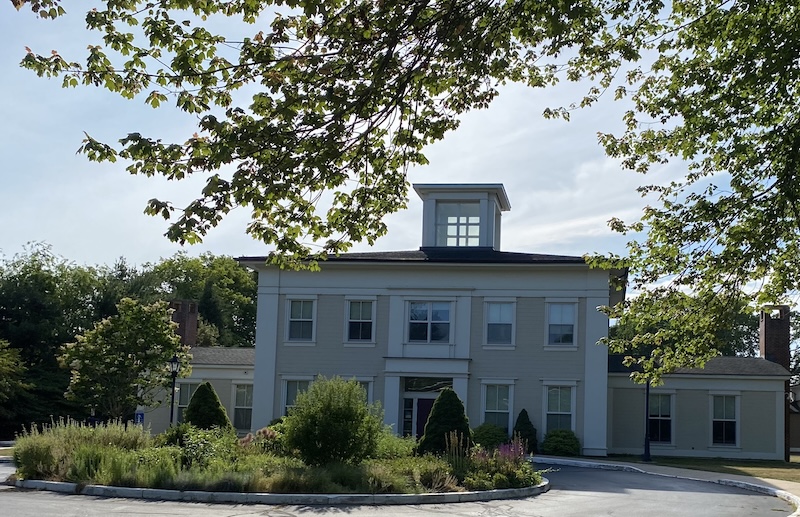
Lyme Academy of Fine Arts has received a major donation enabling it to purchase the adjoining property at 80-1 Lyme Street to the left of the administrative building shown in the photo above. LymeLine file photo.

OLD LYME — In what Michael Duffy, who serves as Lyme Academy Board of Trustees Chair, describes as, “an act of astonishing generosity,” a local couple is donating $1.8 million to the Academy to enable it to purchase the neighboring property at 80-1 Lyme Street, which is better known as the former Studio 80 + Sculpture Gardens owned by Gilbert ‘Gil’ Boro.

The donors, who wish to remain anonymous, will retain the right to live in the 3747 sq. ft. residence on the property for their respective lifetimes after which time, ownership of the house will be transferred to the Academy. 

Explaining the complexities of the transaction to LymeLine in a July 7 Zoom call, Duffy noted that the Academy’s sculpture program is expanding so rapidly that it is, “running into difficulties’ in terms of the space it needs. He gave as an example the stone-carving class held last summer, which ended up having to create what he described as a, “makeshift workplace in one of the [Academy’s] parking lots.”

Chad Fisher adjusts the patina on his bronze sculpture ‘Avarice.’ File photo courtesy of Lyme Academy.

Duffy credited Sculpture Director Chad Fisher with the increasing success of the Academy’s sculpture program. He noted there are now three applications for each single place across all the Academy’s program courses.

One of the features of Boro’s 4.3 acre property is a huge, stand-alone sculpture studio with a soaring ceiling, which enables outsize works of sculpture to be designed and fabricated in the space. Duffy noted there is still a mechanical hoist in the studio remaining from when Boro used the studio to create his own contemporary sculptures there. Some of Boro’s sculptures and works by others are still dotted around the sprawling grounds, which have direct water frontage on the Lieutenant River.

Looking across Gil Boro’s Sculpture Grounds, past several of his signature works in the foreground and to the left, the huge sculpture studio can be seen to the right. LymeLine file photo.

Pointing out there is already a pathway between Academy and Boro’s property—a tangible sign of the already existing connection between them—Duffy continued, “There’s a logic to it [combining the properties.]”

Duffy recalled at his very first meeting with Boro some five years ago, one of the main topics of their conversation was, “How can we cooperate?” Duffy said that unfortunately that early desire to work more closely together failed to blossom due to the impact of the COVID pandemic and Boro’s declining health.

Adding that this development seems “natural” now, he commented that Boro’s sons—who are managing the sale on their father’s behalf—are “really excited” about the prospect of acquisition since, “It keeps the spirit of Gil [Boro] alive in perpetuity.” 

Boro, who now lives in a residential home in Brooklyn, NY, close to one of his sons, is being kept fully informed of developments. Some of his sculptures and works by others are still dotted around the sprawling grounds, which have direct water frontage on the Lieutenant River.

Gil Boro relaxes in a wicker chair during one of the last events held in the sculpture studio. Photo by Christina Goldberg.

The donors are planning some changes to the immediate exterior of the house including filling in the outdoor pool and installing a fountain in its place. They also intend to turn the current pool cabanas into artist’s studios. 

By coincidence the donors are both architects by profession, which is the same profession in which Boro began his own career. 

In another coincidence, the college was founded in 1976 by the sculptor Elisabeth Gordon Chandler and so Duffy remarked it seems fitting that this major expansion of the college’s facilities and grounds should be primarily to serve the Academy’s sculpture program.

Duffy said that the plans for the future of the property were presented for discussion at the Old Lyme Historic District Commission’s regular meeting on July 7 and will also be discussed at the next Old Lyme Zoning Commission meeting on July 14.

Asked when the transaction might be completed, Duffy responded enthusiastically, “We hope to close by the end of July.”

Describing the process by which the transaction has come about, Duffy noted that the first conversations were some 10 months ago but at that time, the price of the Studio 80 property was beyond the Academy’s reach. He said he felt “a sense of loss” when the idea had to be shelved. 

Now that these donors, who have been taking classes at the Academy for several years, have enabled the plan to come to fruition, a delighted Duffy commented, “This is a great vote of confidence in the future of Lyme Academy as we approach our 50th anniversary.”
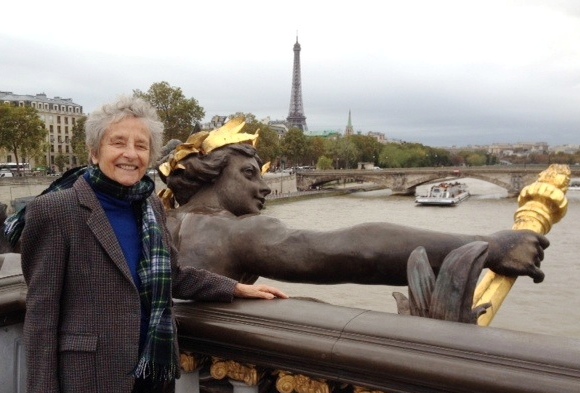

Happy ‘Bastille Day’! Memories of Celebrating ‘Le Quatorze Juillet’ in Spectacular Style

Nicole Prévost Logan

Editor’s Note: On this French National Holiday, we are pleased to republish a column from our oft-times Paris-based correspondent Nicole Logan (no relation), which she wrote in 2023 about the huge parade in Paris that celebrates the most memorable day in French history when the Bastille was stormed in 1789.

Letter From Paris:

Watching the 14th of July defilé [parade] is a well-anchored tradition for the French.

This year, as always, it was a two-hour impeccably choreographed event. Each French president takes it very seriously since it is an opportunity to display the military profile of the country, the vision for its future, as well as the latest technology, and to reaffirm the fact that strategic solidarity with European allies has become a priority. 

The tradition of a military parade on France’s national day — July 14th or Bastille Day — dates back to 1919, when  troops marched to celebrate the victory at the end of the Great War. In its early days, the defilé took place on the Longchamp hippodrome in the Bois de Boulogne in Paris.

Today the Champs Elysées offers a majestic setting with the perspective of the modernistic sky scrapers of la Défense district, the Arc de Triomphe and the wide avenue leading to the Place de la Concorde. The TV Channel France 2 cameraman played with the hieroglyphs of the Luxor obelisk, which stand at the center of the square, before zooming down to the bleachers where President Macron, his wife Brigitte and the official personalities were seated.

Prime Minister Narendra Modi of India was on a state visit to France and a delegation of Indian troops was the first to march down the avenue. I was struck by their very unusual gait. They were not just swaying their arms back and forth but it looked as though those very arms were going full circle. 

Celebrating ‘Le Quatorze Juillet’ in Paris. Photo by Yewin on Unsplash.

The military parade has a special significance for me  – an officer’s daughter and the sister of an Air Force General – especially as the kickoff was done in synch with an air parade. To the delight of the crowd, two small planes flew one on top of the other, with the top one upside down.Those planes are part of the Air and Space acrobatic team of the French Air Force, who have been world champions since 2022. 

The “Big Nine” of the Patrouille de France gave a spectacular performance: nine Alphajets  flying in perfect unison with tricolor smoke trailing behind them. The Patrouille has existed since 1953 and is based in Salon-de-Provence.  

In all, more than 6o planes took part in the event: 26 RafalesMirages, and Falcon aircraft and 28 helicopters, including two light helicopters Guépard. The latest generation F4 Standard Rafale demonstrate improved connectivity with satellite and intra-flights links.

The modernization of the technology was developed during the French-led Operations Serval and Barkhane in the Sahel region since 2013. 

Polyvalence, info-valorization and integration principles were on display in the new military equipment such as  Leclerc tanks, Cesar canons, five-tons heavy tanks, 2022 hussards for infiltration and exfiltration of intelligence, armored vehicles essential for logistics in delivering troops, and equipment, such as anti-personnel mines, anti-ballistic missiles and trailers with drones .  

France already has eight aircraft carriers — the largest one being the Charles de Gaulle — along with 10  nuclear submarines.

The parade was an opportunity to display the latest equipment from the defense maritime system in existence from Belgium to both Cherbourg and Mont Saint Michel, as well as for the nuclear approach that was developed during the Harmattan Operation in the war against Libya in 2011. 

More than 6,500 men and women marched down the Champs Elysées. Their superb performance required at least six hours of rehearsals. The graduates of the élite military schools like Ecole Polytechnique, Saint Cyr-Cohêtquidan (founded in 1802 by First Consul Napoleon Bonaparte in Fontainebleau), Ecole de l’Air (created in 1933 and the oldest air force academy in the world), and Ecole Navale always have a special place in the military parade.  

Marching also were some of the 800,000 firefighters who are engaged in the fight against the growing danger of forest destruction. Thirty thousands of them are volunteers. In February 2023, they took part in a rescue mission to Turkey and Syria after the earthquake which killed 60,000 people. France uses 21 bi-engine bombers , including 12 Canadairs ( pioneered by Canada) to fight the fires from the air.

La Légion Etrangère [Foreign Legion] always stands out on the 14th of July. It is the only group which has its own band. The pace is strikingly slow. One soldier swirls his baton high in the air. The men from many nationalities are dressed completely in white. Some wear leather aprons. A soldier with a  beard longer than his companions’ holds a dog on a leash. 

The colorful contingent of the Garde Republicaine , accompanied by the noise of the horses’ hooves on the pavement is most popular with the public. Created in 1802 by (again)  Bonaparte – this special corps of 3,300 men and women is  part of the Gendarmerie Nationale. 

The defilé ended up with quite a moving choreography of young people positioned to form a Croix de Lorraine – the declared symbol of the Résistance  by General de Gaulle in 1940. The commissar of the armies read the letter of Jean Moulin, hero of the French Underground.

And finally, the crescendo of the haunting “Chant des partisans, ” a 1828 Russian melody imported by a Russian emigré to France in 1917, rose over the ceremony. 

The 2023 ceremony was indeed bristling with the symbolism of France’s destiny and its De Gaulle heritage.

Editor’s Note: This is the opinion of Nicole Prévost Logan.

Nicole Prévost Logan

About the author: Nicole Prévost Logan divides her time between Essex and Paris, spending summers in the former and winters in the latter. She writes an occasional column for us from her Paris home where her topics will include politics, economy, social unrest — mostly in France — but also in other European countries. She also covers a variety of art exhibits and the performing arts in Europe. Logan is the author of ‘Forever on the Road: A Franco-American Family’s Thirty Years in the Foreign Service,’ an autobiography of her life as the wife of an overseas diplomat, who lived in 10 foreign countries on three continents. Her experiences during her foreign service life included being in Lebanon when civil war erupted, excavating a medieval city in Moscow and spending a week under house arrest in Guinea.

Sound View Celebrates ‘The Fourth’ in Traditional Style

There were decorated bikes galore … All photos by M. Shoemaker.

OLD LYME—It was a beautiful day for a parade and yet again, Sound View put its best foot forward with a wonderful one. The crowds came out to join the celebration featuring decorated bikes, a cheery band, esteemed veterans, local dignitaries and much more. Awards were presented in categories including best-decorated bike or wagon, most patriotic outfit, best float, and funniest outfit.

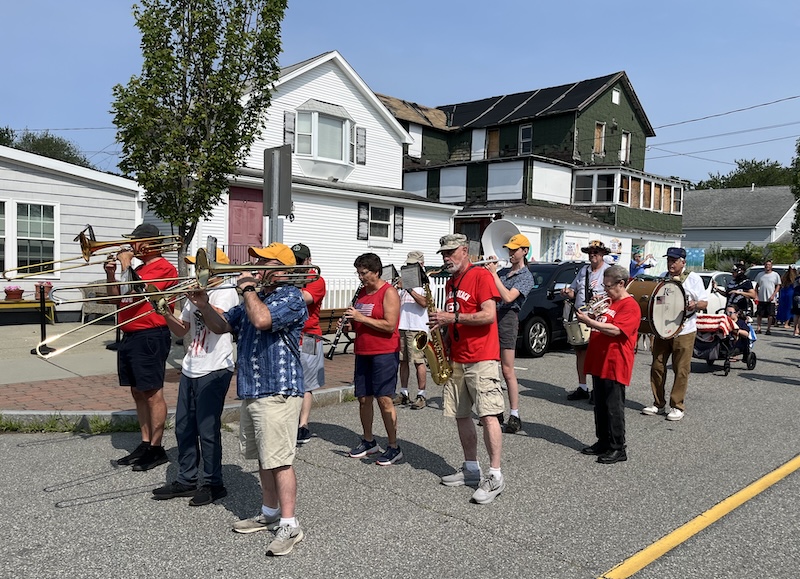
There was patriotic music …
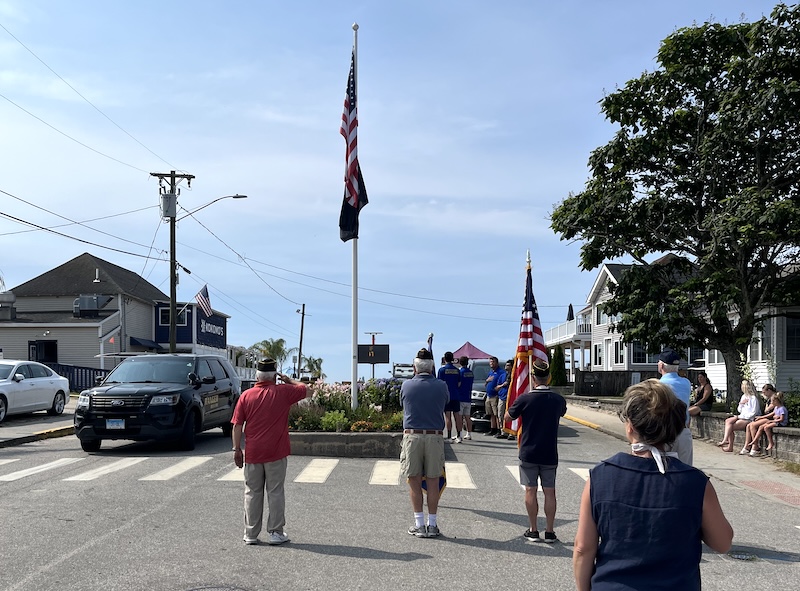
Looking out toward Long Island Sound, the flag at the foot of Hartford Ave. was appropriately saluted.
Uncle Sam and Mr. Eagle joined the happy throng …
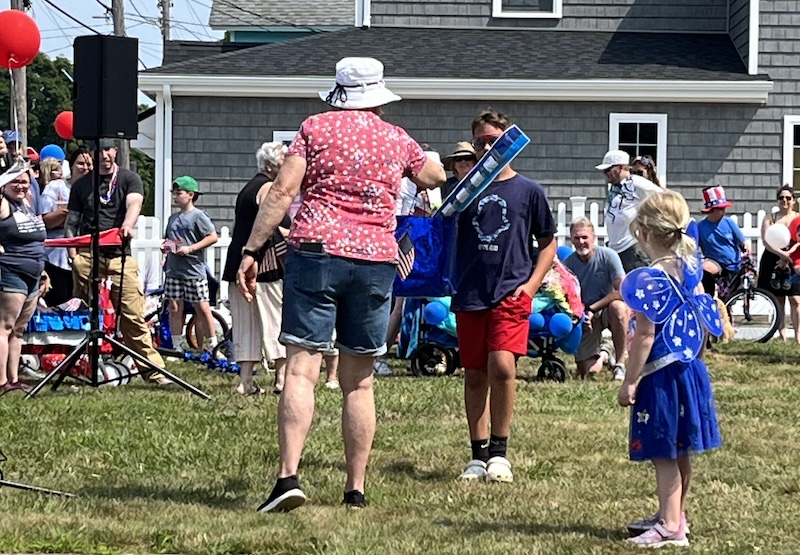
Awards were presented …
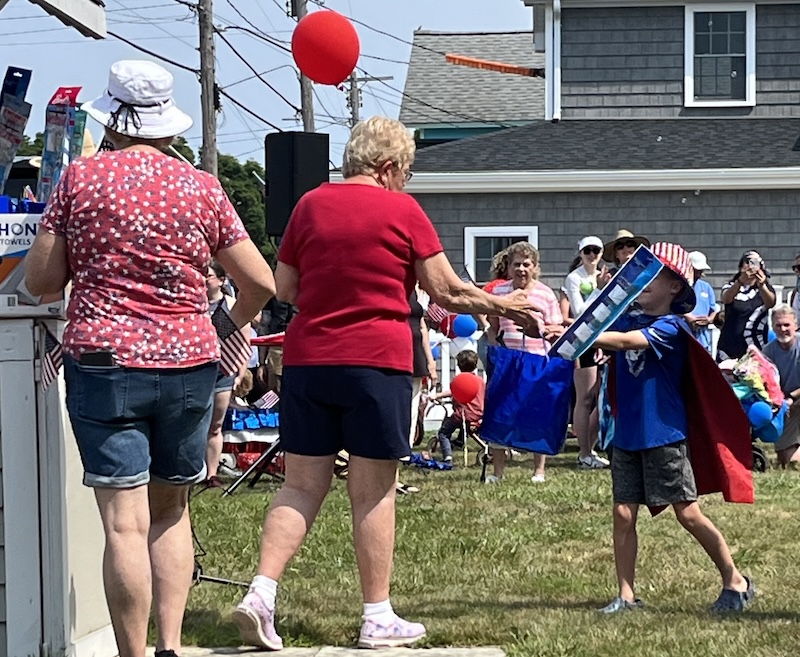
And still more awards, this one presented by Gail Fuller, rounded off another memorable parade.

The Sound View Beach Association (SVBA) hosts the parade. It is an all- volunteer, non-profit, civic organization, which owns and manages the Shoreline Community Center and also provides the flags in the Sound View area.

Everyone is invited to join or help. The SVBA welcomes new members, volunteers and donations—all donations are tax deductible and the SVBA is registered for “matching gift” grants with many companies.

TOP STORY: New Champs Crowned at Rogers Lake July 4 Boat Parade

Jim and Christine Levasseur and family floated away with the 2025 Rogers Lake Boat Parade trophy.

OLD LYME—There are new Independence Day champions on Rogers Lake.

Rogers Lake Boat Parade organizers Christina and Dave Evers in an email said this year’s trophy for the “most enthusiastic, patriotic, and best decorated” boat has been awarded to Jim and Christine Levasseur and family.

The Evers said the family’s enthusiasm put them over the top during Friday afternoon’s parade around the lake.

“They never stopped dancing,” the organizers said. “There was a close second place winner, but the Levasseur family really brought that energy!”

The Levasseur family was recognized for their enthusiasm during the parade, as well as for their decorations.

Judges were placed randomly along the water.

The winners keep the trophy for 12 months and then return it to be presented to next year’s winner. The Levasseurs took the title from the King family.

This year marked the sixth annual boat parade. The trophy added friendly competition to the festivities in 2022.

Talking Transportation: Connecticut and Monorails—A One Track Mind

Jim Cameron

While taking a summertime break this week, here’s a column I wrote awhile back.

What is this fascination that people have with monorails?  I can’t tell you how often people suggest them as “the answer” to our state’s clogged roads.

“Why don’t we build a monorail down the middle of The Merritt Parkway?,” asked an architect at a recent meeting.  To my astonishment, such an idea was once studied!

As lore has it, back in the mid-1980’s local tech giant Sikorsky was asked by CTDOT if a monorail could be built and a plan was submitted.  Sure, such a system could be built, they concluded, but where would you put the stations and the necessary parking? 

Since hearing of this white-whale of a tale, shared by Merritt Parkway Conservancy Executive Director Wes Haynes, I have been on a relentless search for details of the proposal, but I’ve come up empty.  Sikorsky has no record of the plan.  CTDOT said “Huh?”

Digging through the archives of the Stamford Advocate, I found articles from 1985 discussing the idea—a $700 million monorail down the median of the Merritt Parkway from Greenwich to Trumbull as an alternative to Bridgeport developer Francis D’Addario’s idea of widening the parkway to eight lanes … or double-decking I-95.

Motorists were surveyed and CTDOT apparently spent $250,000 for a study.

The amazing research librarians at the State Library dug through their dusty files and came up with a CTDOT report from 1987 pooh-poohing the idea, not only on grounds of impracticality but because it would compete with existing rail service.  Heavens no!

In 1998 a monorail was once proposed for Hartford, connecting downtown to Rentschler Field in East Hartford.  It was to cost only $33 million and the cost was supposedly to be paid by the Feds.  It never happened.  The idea was revived again in 2006 when the Adriaen’s Landing convention complex was opened, but again, nothing.

A pseudo-monorail “People Mover” system was built at Hartford’s Bradley Airport in 1976 connecting the remote parking to the main terminal, all of seven-tenths of a mile away.  The fixed-guideway system, with cars designed by Ford Motor Company, cost $4 million but never operated because the $250,000 annual operating cost was deemed impractical.  In 1984 it was dismantled, though you can still see one of the original cars at the Connecticut Trolley Museum in East Windsor.

Whatever your fantasies are about space-age travel by monorail, let me dispel your dreams with some facts.

Monorails are not fast. The Disneyworld monorail, built by a Japanese company, has a top speed of 55 mph but usually just averages 40 mph.  Even on a bad day Metro-North can better that.  The 3.9 mile long Las Vegas monorail does about 50 mph shuttling losers from casino to casino.

Monorails are expensive.  The Vegas system, opened in 2004, cost $654 million.  That’s why existing monorails like Disney’s have never been extended.

Monorails are not Maglevs.  Don’t confuse the single-track, rubber-tired monorails with the magnetic-levitation technology in use in Shanghai and being tested for passenger trains in Japan.  The Shanghai maglev can travel over 250 mph, the Japanese test trains have hit 374 mph.

No, monorails are not in Connecticut’s future and are not the answer to our woes.

Editor’s Notes: i) Jim Cameron is the founder of the Commuter Action Group and advocates for Connecticut rail riders. He writes a weekly column called ‘Talking Transportation,’ which is published by a number of publications in the state.
ii) ”Talking Transportation” recently won first place in the general column/commentary category in the Connecticut Society of Professional Journalists Excellence in Journalism Contest.