Labrador Retriever Viera Brings Comfort Both Across State, At Home in Old Lyme

Old Lyme Resident State Trooper Matt Weber’s new partner, Viera, was trained through the state police Comfort K9 program.

OLD LYME–One of the latest graduates of the Connecticut State Police Comfort K9 program is a Labrador Retriever named Viera who, in four short months, has been there for traumatized children, shell-shocked First Responders, and her own partner, when they most needed a helping paw.

Viera had spent most of her life in training for the New York-based Guiding Eyes for the Blind program when the two-year-old was reassigned to Old Lyme Resident State Trooper Matthew Weber in November.

Weber said she wasn’t cut out for life as a Seeing Eye dog. 

“I think she has a little bit too much energy for that,” he said from the Old Lyme Police Department earlier this week as Viera padded around with a huge stuffed cow in her mouth. “That’s why we wanted her.” 
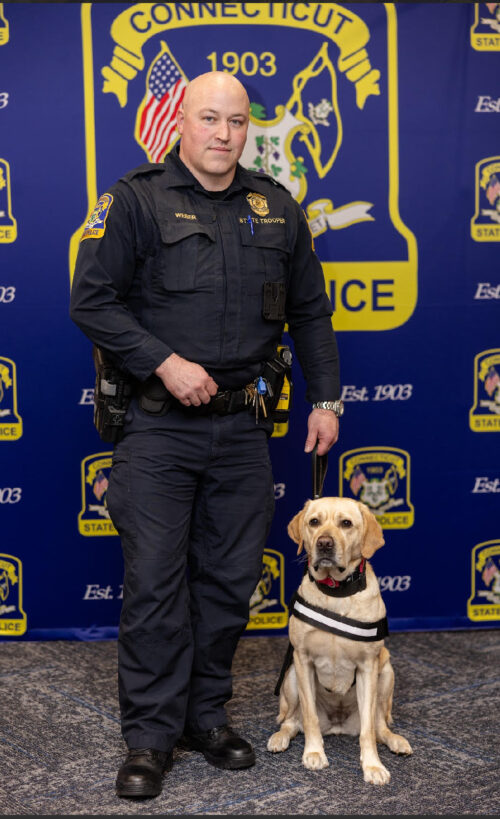
Resident State Trooper Matt Weber and Comfort K9 Viera.

Viera and Trey, another Labrador retriever and Guiding Eyes dropout, who works alongside Trooper Stephanie Cortes, comprised the most recent Comfort K9 class. A month of obedience training from the state’s K9 instructors honed the dogs’ ability to remain calm, companionable and compliant in a wide range of situations. 

“Viera is just a rock steady dog in all sorts of environments, around different types of people,” Weber said. 

Her role as a therapy animal has had her snuggling up to young victims of violence during forensic interviews. She’s gravitated toward the tears of otherwise stoic First Responders gathered to debrief after difficult calls. 

She laid by the side of Weber’s wife, Donna Bennett, at Smilow Cancer Center in New Haven. 

“Viera also met with numerous other patients, and did the same cheering up the nurses and doctors,” Weber said. 

Bennett died earlier this year. 

The couple shared a love of dogs, including the Nova Scotia Duck Tolling Retrievers bred by Bennett. Now it’s Viera and five Tollers, who live at home with Weber in Old Lyme. 

He said he can’t imagine a life without dogs. 

“They’re your best buddies, your confidants,” he said. “You can go and unwind and relax with them. If you’ve had a stressful day at work, you forget about everything for a while.”

It’s gratifying to be able to share her with the wider community, according to the state trooper. 

He described a recent meeting Viera attended during which Emergency Services personnel discussed their response to a quadruple-fatal car crash in Newington. 

“Nobody wants to talk and open up, and then when Viera or the other dogs start playing, it kind of brings a smile to people’s faces, and it loosens the room up a little bit, and then they can talk,” he said. “So that’s pretty rewarding, knowing the power that she has.”

Weber said his work across the state is done in addition to his regular duties as the Old Lyme Resident State Trooper. 
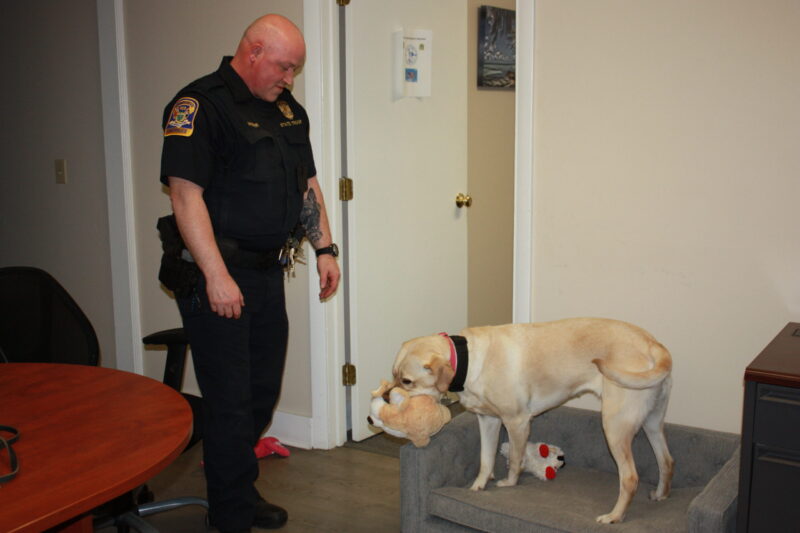
Weber describes comfort dog Viera as a “big goofball.”

Besides responding to critical incidents, assisting crime victims and providing support to first responders and their families, state police comfort dogs are charged with helping to improve the relationship between law enforcement and the community.

Old Lyme Police Department Corporal Dominic Solari said Viera breaks down barriers in a landscape where distrust of law enforcement is rampant. 

“Even if you have a personal relationship with somebody that you may have dealt with on positive terms as a police officer, a lot of times there’s still that little bit of a wall there,” he said. “And she helps to break down the wall.”

A lot of that work is done in schools, according to Weber and Solari. 

“Viera can sit there in the middle of the room with 15 kids crawling all over her,” Solari said. “You don’t have to worry about the dog snapping or anybody getting upset over the dog’s actions.” 

Weber said traditional police K9s used for jobs like search and tracking are separate from their comfort cousins.

Weber explained he had been a member of the State Police K9 unit for nine years when his German Shepherd, Tazz, died at the age of 10 in late 2023. Weber had retired his four-legged partner just two weeks earlier. 

He said Viera is a different breed from the highly-skilled working dog, who’d been by his side for so long. 

“You always have to be cognizant when you have a Shepherd of what they’re capable of, and even though they’re highly trained, you still have to make sure you don’t put them in a situation where they could fail,” he said. “With Viera, all she knows how to do is lick and get pets.”

Weber and Viera start out every morning in a rotation of the Lyme-Old Lyme School District’s five buildings. She attracts attention from the youngest students to the oldest, he said. 

Mile Creek School Principal Kelly Enoch in a phone interview this week said elementary students and teachers alike enjoy meeting Viera in the front vestibule as students stream in from cars and buses at the start of the day. 

The six-year principal said students are more likely to approach a police officer if there’s a dog nearby. And as they’re petting the dog, they’re more likely to start asking questions. 

“We just feel really strongly that we want the children to see police officers as friends and people that help them,” she said. “They’re not people to be afraid of.”

The district also feels strongly about therapy dogs, with at least one certified pup working alongside a teacher or school psychologist in each building. Mile Creek’s therapy dog, a Goldendoodle named Isla, is entrusted to Enoch. She said she brings her to school two or three times per week. 

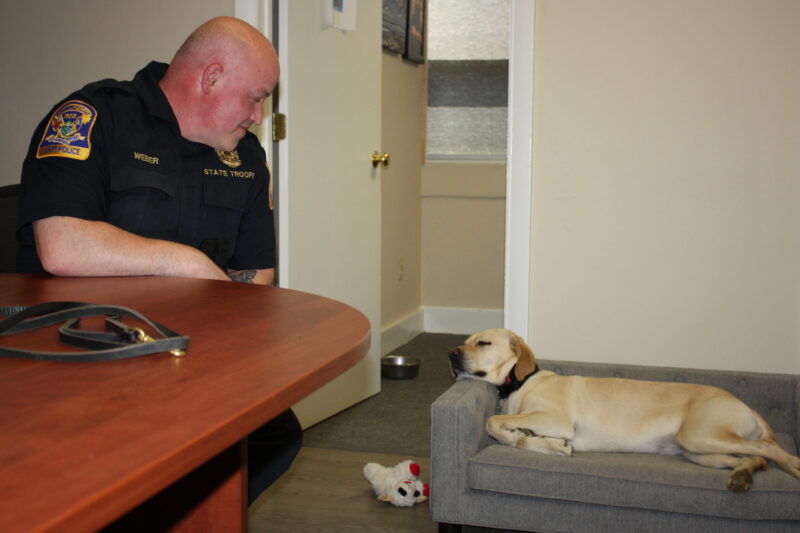
Donated stuffed animals and a dog-sized couch help make life comfortable at the Old Lyme Police Department.

At the secondary level, Weber has found that students’ affection for dogs remains evident. 

“The high school kids that otherwise wouldn’t talk to you, they come over and pet your dog,” he said.

Weber and Solari said the department is looking to rejuvenate its dormant Cop Club as another way to break down those barriers between police officers and the community. 

The program had been popular with high school students before it was interrupted by the COVID-19 pandemic, according to Solari. 

A collaborative project between the Old Lyme Police and the Lymes’ Youth Service Bureau, it began in 2011 with the goal of bringing together cops and kids through a series of monthly planned activities. The group mixes students, who’ve had difficult upbringings, with more privileged members of the student body. 

Weber said that when Cop Club starts up again, Viera will be there. 

“Anywhere I go, she goes,” he said. 

Op-Ed: Dip Into Region 18 ‘Rainy Day Fund’ to Dampen Debt Impact

Mary Powell St. Louis

Town residents have received their postcard reminder about the 2025-2026 district budget meeting and referendum vote from Regional 18 school district both scheduled for May 5 and May 6 respectively.   

By means of background information on the school budgeting process, it is important to understand some of the Connecticut school laws defined by the general statutes. According to the Connecticut General Statutes Section 10-262(j) on minimum budget requirements, a school budget may not be less than the budget from the prior fiscal year except for limited circumstances defined in the statute. 

Additionally, section 10-51(d)(1) was amended in 2024, such that a regional school district can create a “reserve fund for educational purposes” rather than the prior designation of such fund for only “capital and nonrecurring expenditures.” The statute had also been amended in 2021 to change the amount regional school districts are allowed to appropriate from the current fiscal year’s budget from 1% to 2%.   

Key takeaway: Outside of exceptional circumstances, a school budget can never go down and there has been expansion for a regional school district like Lyme/Old Lyme in terms of how a budget surplus can be used.  

The Region 18 school district has long taken the opportunity to fund their “undesignated fund,” or reserve fund, for at least the last 10 years (per the annual October Board of Education meeting minutes on the district website). For the last four years since the change in the statute to support 2% funding of the reserve fund, Region 18 has appropriated approximately $700,000 annually to the reserve. The current reserve fund balance stands at $3.1 million. Although the Board of Education has not formally approved any of the current earmarked projects in the reserve, they are formulated in the five-year facilities plan for the district. There is no reason to doubt that at the October 2025 Board of Education meeting, the board will again vote to fund the reserve based on past experience and determination of a budget balance (unaudited at the time of the decision) in a similar range of $700,000.   

You may ask why these details matter. The 2025-2026 school district budget up for referendum stands at a 7.39% increase over the previous year’s budget and over half of the increase represents debt service (bonds) predominantly related to the $57.5 million PK-8 building project.  Debt service obligation (principal and interest) for the district is estimated to increase annually for the next five years then start to drop dramatically.

Rather than increasing the budget as proposed to cover the current year debt service requirement, I recommend the board consider the use of a portion of the reserve funds to dampen the impact of debt service on the budget in the next five years.  

Why not use all the reserve? Well, we don’t want to do that as it could adversely impact the credit rating of the district for future debt service.  Further, the forecasted campus improvement projects could not be funded for the foreseeable future.    

My suggestion is to use a portion of the reserve, equivalent to the maximum allowable 2% of budget holdback. Instead of increasing the budget by 7.39% to $39,650,803, the requested budget could be about $38.5 million, or a 5.5% increase.  Presuming the recent historical trend of budget surplus continues, this strategy would limit the growth of the budget until the debt service started to decline in five years, at which time the contribution to the reserve fund could be resumed.   

I hope that the residents of Lyme and Old Lyme consider contacting the Board of Education members about the above issues and that the board takes this into consideration at the district budget meeting on Monday May 5.  

Editor’s Note: The author, Mary Powell-St. Louis, was a member of the Region 18 Board of Education for eight years.

Talking Transportation: Don’t Believe the Hype

Jim Cameron

Don’t believe everything you read or see in the media. 

Sage advice on any topic, but especially when it comes to coverage of transportation.  A couple of recent stories illustrate my point.

Improved Cell Service on Metro-North

The Governor and Connecticut Department of Transportation (CDOT) Commissioner held a media event recently in Stamford to promote the fact that AT&T has improved its cell coverage along the New Haven line. That telco spent $6 million installing 30 high-powered macro towers and small cell nodes, some of them on CDOT land, in a public-private partnership. Many are specifically aimed at dead-spots in service on the trains.

This is good news…if you are an AT&T subscriber.  If you use Verizon or T-Mobile and find an area with no cell coverage on your commute, this won’t help you. The AT&T enhancements are for its customers only.

There is no word from the other companies on how they might be filling holes in their service. But… it’s a start.

However if you read the media coverage, you’d think every commuter’s cellphone coverage had been improved!  “Cellphone service to get upgrade on Metro-North rail line,” proclaimed the Hearst papers. “Wireless service upgrades coming to New Haven line for CT commuters,” said WSHU public radio.

Improved cell coverage is a crucial issue for commuters looking to be more productive during train-time. But attention-grabbing headlines such as these may lead to a perception of better service. The more you’re told “cell service is getting better” the more you’ll think it is.  Or so they hope.  

But… don’t believe the hype.

Faster Than Acela?

In April another media event, this time at Grand Central, celebrated faster train service from New Haven: three early morning (5 – 7 am) super-express trains, one of them cutting ten minutes off its old running time, making that single train “faster than Acela”.

Great news… if you’re a pre-dawn-commuter from New Haven. Again, kudos to Metro-North for much needed signal and infrastructure improvements. But has the average commute to Grand Central really improved?  Not really. The exception is not the rule.

With limited stops these super-express trains still average only 52 mph. Regular express trains get about 46 mph and locals run just 38 mph.  Remember: the M-8 cars on Metro-North are capable of 80 mph.

How Did the Media Portray These Improvements?

“New Metro-North schedule, with shorter trips on New Haven line, now in effect,” trumpeted the Hearst papers. “Metro-North Is Faster Than Acela,” promised Bloomberg (quoting MTA chairman and CEO Janno Lieber).

The “faster than Acela” claim is technically true…for one Metro-North train. Keep in mind that New Haven to Grand Central is 73 miles but to Penn Station (on Amtrak) is 75 miles. But not wanting to always sound like a grouch, I say good for Metro-North.

What worries me is the media coverage which over generalizes and lacks the caveats I’ve cited. Telling commuters repeatedly that their trains are running faster, when they are not, may be persuasive but it is not accurate.

So, take media coverage of transportation with a grain of salt.  The headlines don’t always tell the full story. And don’t believe the hype.

Editor’s Notes: i) This article has been updated to reflect a correction sent by the author regarding AT&T’s investment in new cell towers, which he had incorrectly stated as $60 million, rather than $6 million.
ii) Jim Cameron is the founder of the Commuter Action Group and advocates for Connecticut rail riders. He writes a weekly column called ‘Talking Transportation,’ which is published by a number of publications in the state.
iii)”Talking Transportation” recently won first place in the general column/commentary category in the Connecticut Society of Professional Journalists Excellence in Journalism Contest.

Death Announced of Susan P. Rankin, Former Associate Pastor at First Congregational Church of Old Lyme

A Remembrance of Susan Rankin by Jasper Craven

On a perfect summer day in late August of 2022, I met Susan Rankin on the bank of the Passumpsic River, in St. Johnsbury. It was the first I’d seen her since the pandemic and we caught up for hours, seated at a picnic table with pizza from Kingdom Crust. I’d brought my then-new girlfriend, Lauren, on Susan’s insistence, even though the reason for our gathering was somewhat grim. We were supposed to discuss her obituary. 

Susan was then in her early 70s, and for much of her life she’d been sick. Shortly after she moved to Vermont, in the mid 1980s, she’d been in a bad car accident that left her with a brain injury. In the decades since, she’d struggled mightily with migraines and other comorbidities, yet remained insatiably curious and exceptionally witty. She was also deeply caring.

For the first eight years of my life, Susan lived across my driveway, in an apartment she rented from my parents on Old West Road, in West Barnet. During my early childhood, she took care of me a lot. Nominally, she was my baby-sitter, but she always treated me like family. I don’t think she ever charged my parents for her services, nor did she gripe at any last-minute requests for care.

I was an energetic flower child, prone to bursts of wild dancing in the nude and other forms of joyful chaos. Susan handled me with patience, letting my wild side thrive while also imparting some manners and responsibility. She had me haul things to her shed and help with other chores, but also spoiled me rotten. She read to me, took me to the playground, introduced me to figure skating. She also cooked for me a lot, reminding me at the river that among all the creative dishes she made I was most obsessed with a simple peasant meal: creamed tuna and peas.

At Christmas each year, Susan would shower me with presents. But she also tempered my materialism by insisting we purchase presents and wrap them for less fortunate families. She also drilled into me the value of thank you cards — which has served me well through the years.

As I grew up, Susan continued to be in my life. She read books to my elementary and middle school classes, picked me up after high school, and called regularly while I was in college. We talked about life, politics, television, and religion. 

Rarely would she dwell on her own acute medical issues. Instead, she wanted to know how I was doing, an instinct she turned to even during our riverside chat. I was there to learn more about Susan’s life so that, one day, I could properly chronicle it for her obituary. Still, she couldn’t help but spend the majority of our time discussing the particulars of mine, regaling Lauren with many tales of my mischievous youth.

As the sun started to set, Lauren and I walked Susan to her car, said goodbye, and went our separate ways. We hadn’t discussed her obituary much, but I assumed we’d carve out another time to do so. We spoke a good deal more after that, but neither of us ever broached the obituary again, hoping, perhaps, that such evasion would forestall the inevitable. Then, on January 3rd 2025, Susan died at the age of 76.

*******

Obituary

Susan P. Rankin was born on September 8th, 1948. She grew up in the rural hamlet of Hiram, Maine, with her parents Albert P. Rankin and Helen E.(Brown) Rankin. She also had a younger brother, Alan. 

Susan attended high school at Fryeburg Academy, in Maine, then appears to have spent some time in college before working for about a decade as a medical secretary. At age 30, Susan heard the call of the ministry. She completed her undergraduate studies at UMaine at Orono before entering the Bangor Theological Seminary. She graduated from this latter institution in 1982 with a Master of Divinity.  

Susan then served at several churches under the umbrella of the United Church of Christ, a socially liberal mainline Protestant denomination with New England roots. Its flock came to encompass three of Susan’s favorite politicians: Barack Obama, Howard Dean, and Jim Douglas.

In 1982, Susan served as the Interim Pastor at a church in North Haven — one of the Maine’s most remote islands, with a wintertime population of just 400. At the end of that year, she was appointed Associate Pastor at the First Congregational Church of Old Lyme, Connecticut. A news article announcing Susan’s appointment noted that she would be spending much of her time focused on youth programs. It was this work, she told the paper, that excited her the most.

In October 1985, Susan landed as interim pastor at the United Church of Christ, in Greensboro, where she served for a year. She also served as an interim pastor at Hampden Congregational Church in Hampden, Maine.  Before the first day of her dream job, settled pastor of the United Church of Strafford, Vermont, she was rear-ended in a motor vehicle accident and suffered a chronic brain injury. At the congregation’s behest, she struggled to serve as best she could until they could call another pastor, but she was never able to serve as a full-time parish minister again. 

Still, Susan remained active in the Vermont Conference of the United Church of Christ. She served as head of the Nominating Committee, and contributed significantly to the Ministerial Standing Committee, the Department of Mission, and Department of Christian Education. 

“I sometimes felt that Susan was a modern-day Job,” reflected her former pastor in Barnet, Reverend Howard Gaston. “She had lost so much in her life and yet continued to have a faith that she tried to share with others and for her own life struggles.”

He concluded: “I know that like Job, ‘the lord has restored her fortunes and gave her twice as much as she had before’ in God’s loving presence.”

***

Remembrance Continued

Susan spent much of the 1990s volunteering in the community when her health allowed it. She was an active ally and, later, board member, for the Brain Injury Alliance of Vermont. She also helped lead support groups for people with head injuries at her two favorite hospitals: NVRH and Dartmouth-Hitchcock. (She would frequently illustrate for me the caring and humane staff she dealt with in both locales.)

Susan’s brain injury made it difficult for her to grasp technology, but she loved keeping in touch with the ones she loved. And so, in the early aughts, she bought a newfangled email machine. Her most frequent pen pal was her brother, Alan, who, in 2004, became homeless in Boston due to a debilitating mental health condition.

Alan corresponded with Susan from a computer in the library, which he visited often to check in on the season of his beloved Boston Red Sox. Like Susan, Alan was uncommonly kind and tender despite his struggles. He was quieter than she was, but nonetheless caring. 

Alan was often resistant to Susan’s help, though she convinced him to visit once a year or so for a “vacation” marked by hot showers, good food, and fun outings. Later the family of my close friend, Ezra Racine, offered Alan a job at Eagle Eye Farm, a residential care facility near Lake Willoughby. 

He worked there until his physical and mental health became too compromised to continue. Eagle Eye Farm helped Alan for months after he ceased to be their employee. The whole Alexander family – particularly John, the patriarch – was extremely kind and generous.

Susan tirelessly coordinated efforts to keep Alan housed and cared for. After he had a stroke, she also expertly coordinated his care. Susan participated in the National Alliance on Mental Illness Family Support Group while Alan was alive. After he passed, in November 2017, she continued to provide support for others. She also wrote his touching obituary, and dusted off her pastoral skills to plan his funereal.

The pandemic hit Susan hard. She was hoping to start a grief support group for people who had lost loved ones, but her own health was deteriorating. Among other things, she developed a tremor that interfered with her ability to use an iPad for video conferencing into meetings for the Brain Injury Alliance. “Susan was an advocate who tirelessly gave her support and unwavering resolve to make Vermont a better place for the brain injury community,” the organization recently stated.

Despite her mounting health challenges, Susan took pride in keeping her check book balanced, and her bedside table stacked high with books. She loved to read, especially memoirs and biographies. She also subscribed to, and read, many magazines. If she caught wind that I was writing for a new publication, she would often subscribe to it. Once, when one of these publications didn’t pay me for months, she angrily canceled her subscription. I often joked that her voracious reading habits were single-handedly keeping my industry alive. 

I last saw Susan a few days before Christmas on a short stay in a rehabilitation facility. She was clearly weak physically, but maintained the funny spark I’d come to adore. 

She told my mother and me about the strangest new turn in her health struggles: hearing the same Christmas song play incessantly in her hand. She told it in her classic way, finding humor and resilience in an objectively terrible situation.

Not long after, Susan returned home and died of natural causes in her own home, as she had wished.

Susan is predeceased by her parents, her brother, Alan, her dog Clooney to whom she was devoted, and many dear friends. She is survived by close friends she considered family, including me, my folks, Kathy Gale, Betty Keller, Bob Hawes, Allyson Crawford, Jeanne Eisner, and her old neighbors on Old West Road.

There will be a party in remembrance of Susan on Sat. June 7th in Peacham.

Please contact Bess O’Brien at bobrien@pshift.com to attend.

Donations in Susan’s memory may be made to Doctors without Borders and/or Brain Injury Alliance of Vermont.

Ferry Landing Pier/Boardwalk Closes in Old Lyme, Another Pier Opens in Haddam

New Pier Provides Alternate Fishing Location While Old Lyme Boardwalk Closed During Construction of New Connecticut River Bridge

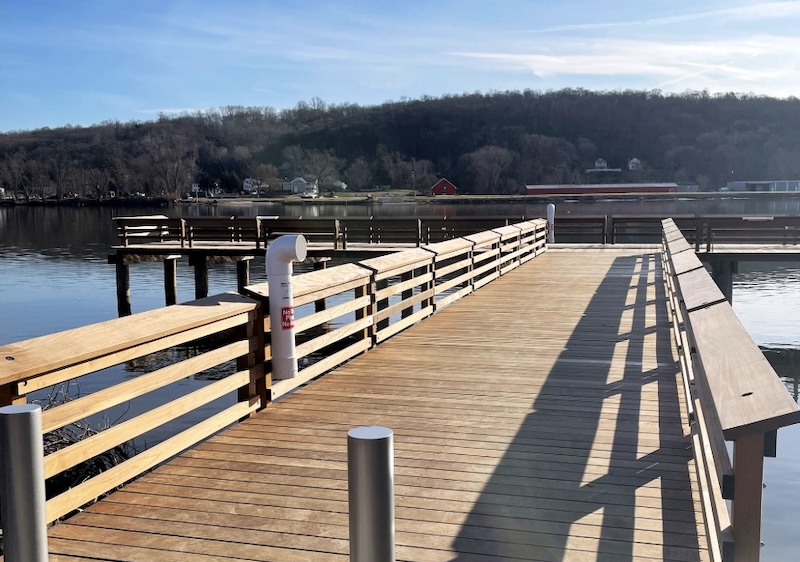
The new pier at Eagle Landing State Park in Haddam provides an alternative to the one at Ferry Landing State Park in Old Lyme, which is closed at least until 2030. Photo courtesy of Amtrak.

OLD LYME–The state Department of Energy and Environmental Protection (DEEP) has announced the opening of the pier at Eagle Landing State Park in Haddam as an alternate fishing location for local anglers and outdoor enthusiasts who have been displaced by the construction of the new Connecticut River Bridge between Old Lyme and Old Saybrook. 

The DEEP in a press release said Ferry Landing Pier/Boardwalk in Old Lyme is closed to make way for Amtrak’s construction of a new Connecticut River Bridge between Old Lyme and Old Saybrook.

An announcement posted on the Old Lyme website earlier this month said reconstruction of the pier at the state park in Haddam was undertaken by Amtrak in anticipation of the temporary closure of the Ferry Landing Pier. 

The DEEP said the new pier at Eagle Landing State Park, and Amtrak’s commitment to build it, resulted from public feedback during the environmental review phase of the Connecticut River Bridge Project. 

This $1.3 billion project broke ground in September. It’s supported by an $826.64 million grant from the Federal Railroad Administration. The remaining portion will be funded by Amtrak and the State of Connecticut.

According to Amtrak, the bridge project will replace the existing 118-year-old bridge with a modern moveable bridge that will support a maximum train operating speed of 70 mph – a 55 percent increase from today’s maximum speed of 45 mph. 

Maritime navigation and safety will also improve due to the increased vertical clearance of the new bridge compared to the existing bridge, the company said.

The DEEP said Amtrak will build an improved, fully accessible observation deck more than 1,000 feet long at Ferry Landing State Park in 2029, once the new Connecticut River Bridge is in service and the old bridge has been demolished. 

The Ferry Landing Pier and boardwalk upgrade is expected to open in 2030 or 2031, according to the DEEP. Plans call for a 50% wider walkway with improved accessibility in a location slightly west of the existing site. The state agency promised better access to deep water, and stronger, more durable concrete piles for more support compared to the wooden piles used for the original structure.