OLD LYME–A resurfacing project on Interstate 95 will result in several months of intermittent nighttime lane and ramp closures between Exit 70 and 72 starting Tuesday.
The work begins in Old Lyme just after the Baldwin Bridge and extends to the Rocky Neck Connector overpass in East Lyme, according to the state Department of Transportation (CT DOT).
CT DOT Spokesman Joe Cooper in a Saturday email said specific closures can only be confirmed a few days in advance because paving depends on the weather. Portable message boards will be placed on the highway at least two days in advance to let drivers know a closure is coming.
“Any lane or ramp closures will be temporary, scheduled at night, and limited in duration,” he said.
Detour routes will be posted.
The agency in a press release said work will last from 7 p.m. to 5 a.m. through Nov. 23 in both the northbound and southbound directions.
The $11.6 million project, which also includes resurfacing on Interstate 91 in Rocky Hill and Wethersfield, is being carried out by Griswold-based American Industries.
Crews will fix storm drains, patch and seal damaged sections of pavement, put down a thin new asphalt surface with a protective coating, and replace unsafe guardrails.
The DOT encouraged motorists to allow extra travel time, remain alert, and follow all signage in the work zone. The agency said Connecticut State Police will guide motorists through the work zone.
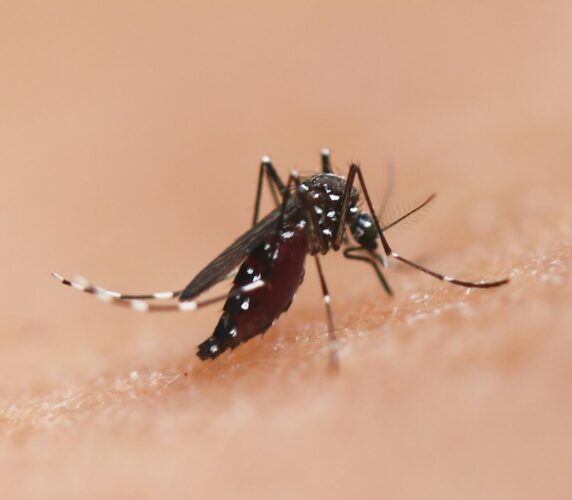
A mosquito prepares to bite. Image courtesy of the National Institute of Allergy and Infectious Diseases for Unsplash.
NEW HAVEN, CT – The State Mosquito Management Program is warning Connecticut residents about the risk of infection by West Nile virus (WNV) this season.
On Wednesday, Aug. 27, the Connecticut Agricultural Experiment Station (CAES) issued a press release stating that it has detected WNV-infected mosquitoes in 34 towns this season including Old Lyme.
The other 33 towns where WNV-infected mosquitoes have been found are Bethel, Bridgeport, Cheshire, Danbury, Darien, East Haven, Easton, Fairfield, Glastonbury, Greenwich, Groton, Guilford, Hamden, Hartford, Hebron, Manchester, Meriden, Milford, New Britain, New Haven, Newington, North Branford, North Stonington, Norwalk, Southington, Stafford, Stamford, Stratford, Wallingford, West Hartford, West Haven, Westport, and Wethersfield.
The CAES notes that no human cases of WNV have been reported so far this season but now is often the time of year when the first cases are reported to public health.
“We continue to detect West Nile virus in mosquitoes throughout Connecticut, with the highest levels of activity in Fairfield and New Haven counties and in the metropolitan Hartford area,” said John Shepard, Medical Entomologist at CAES. “This includes infection of mammalian-biting mosquitoes, which increases risk of human infection.”
“West Nile virus transmission is expected to continue until mosquito activity ceases in October,” said Dr. Philip Armstrong, Chief Scientist at CAES. “We encourage everyone to take simple measures to prevent mosquito bites.
This includes applying insect repellent and covering bare skin, especially in wooded areas and during dusk and dawn when biting mosquitoes are most active.”
To reduce the risk of being bitten by mosquitoes, residents should:
Minimize time spent outdoors between dusk and dawn when mosquitoes are most active.
When it is necessary to be outdoors, use mosquito repellents containing an EPA-registered active ingredient, including DEET, Picaridin, IR3535, oil of lemon eucalyptus, para-menthane-diol (PMD), or 2-undecanone. EPA registration of skin-applied repellent products indicates that they have been evaluated and approved for human safety and effectiveness when applied according to instructions on the label.
Wear shoes, socks, long pants, and a long-sleeved shirt when outdoors for long periods of time, or when mosquitoes are more active. Clothing should be light-colored and loose-fitting and made of tightly woven materials that keep mosquitoes away from the skin.
Wear clothing and gear treated with permethrin. Permethrin is an insecticide that kills or repels mosquitoes and ticks.
Be sure door and window screens are tight-fitting and in good repair.
When sleeping outdoors, use tents or mosquito netting in an unscreened structure. Treat camping gear with permethrin when possible.
Cover strollers and baby carriers with mosquito nets when outside.
West Nile virus is the most common mosquito-borne viral disease in the United States and occurs every summer in Connecticut. Most people infected with WNV do not experience any symptoms. However, about one in five develop West Nile fever, which includes symptoms such as fever, body aches, joint pain, headache, and rash. In rare cases—approximately one in 150—WNV can cause a severe illness that affects the central nervous system.
Of those severe cases, about one in 10 are fatal.
Adults over the age of 60 are at the highest risk of serious illness.
The response to mosquito-transmitted diseases in Connecticut is a collaborative inter-agency effort involving the Department of Energy and Environmental Protection (DEEP), the Connecticut Agricultural Experiment Station (CAES), the Department of Public Health (DPH), the Department of Agriculture, and the Connecticut Veterinary Medical Diagnostic Laboratory (CVMDL) at the University of Connecticut (UCONN). These agencies are responsible for monitoring mosquito populations and the potential public health threat of mosquito-borne diseases.
The CAES maintains a network of 108 mosquito-trapping stations in 88 municipalities throughout the state. Mosquito traps are set Monday – Thursday nights at each site every 10 days on a rotating basis and then at least once a week after detection of virus. Mosquitoes are grouped (pooled) for testing according to species, collection site, and date.
For information on WNV and eastern equine encephalitis (EEE) virus, how to prevent getting bitten by mosquitoes, and the latest mosquito test results, visit the Connecticut Mosquito Management Program website at https://portal.ct.gov/mosquito.
OLD LYME – Linda Joyce (McElroy) Savago (Lola), formerly of Mystic and Old Lyme, passed away at home with her family in Omaha, NE, on August 23, 2025, at 82. She had shown remarkable strength throughout her year-long fight with cancer, and she maintained her sense of humor, kindness, and compassion right to the end.
Born in New London, CT, to Dorothy Mae Partelow of Hope Valley, RI, and Irving “Patrick” McElroy of Exeter, RI, Linda spent her childhood on Groton’s “town farm,” an almshouse that cared for the town’s poor until it closed in 1952 …
Linda was preceded in death by three husbands-Ronnie Lagrua, Gerald T. Lawlor, and Samuel Savago; two sons-Gerald T. Lawlor III and Brian Patrick Lawlor; and her brothers Wayne and Patrick.
She is survived by her son Andrew Lawlor of Omaha, Nebraska; two nieces … five grandchildren … and four great grandchildren …
A private Celebration of Life will be held later in Omaha.
Editor’s Note: Linda Ahnert wrote this article for LymeLine back in 2008. As summer draws to close, we decided to republish it today to celebrate the anniversary of a very memorable event at which both Linda and I were present. Much has changed since that day—the Inn is no longer an Inn, several of the people mentioned in Linda’s story have sadly passed away (read Linda’s epilogue at the end of the article for more on that), but the game of boules—or pétanque depending on which part of France you come from—goes on and is still enthusiastically played in many locales in Connecticut. If you are not familiar with the game, Linda explains all.
The former Bee and Thistle was still in business as an Inn back in August 2008 when the boules extravaganza described in this article took place.
On Sunday, August 24, the 2008 Summer Olympic Games in Beijing ended.
On that same day, another sports competition took place in Old Lyme. Like the closing ceremonies in China, the event here went on for hours and there was much celebrating. But unlike the Olympian feats, the local contest had nothing to do with speed or strength. Or even with athletic prowess.
The opposing teams gathered, courtside, behind the Bee and Thistle Inn, to play a challenge match of boules. (For the correct pronunciation, think of the Yale fight song “Boola, boola”—just drop the “a” and—voilà—you have “bool.”) This outdoor sport is popular throughout France where it is played in city parks or in village squares. In the south of France, it is called pétanque (pronounced “pay-TONK.”)
It is similar to Italian bocce, although bocce is more of a bowling game and pétanque involves more tossing, like horseshoes. On this late summer afternoon, players from the Bee (l’Abeille in French) were competing against the Boules des dimanches (Sunday boules) team.
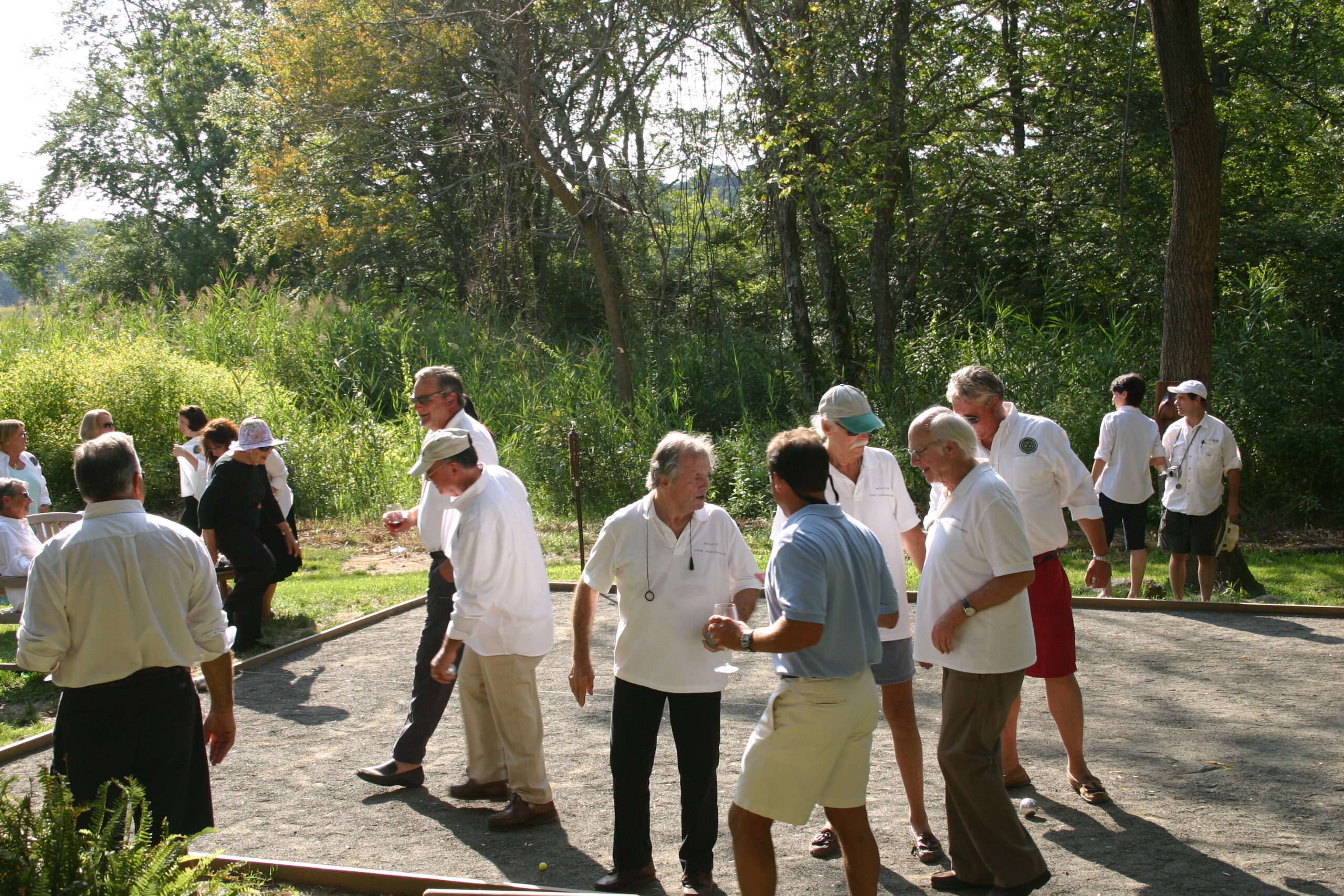
Jacques Pépin (center facing camera, in white shirt) discusses a vital game decision with other team members.
By issuing the challenge, the “Bees” were playing in the big leagues because their opponents were no mere Sunday players. In fact, the visiting team included some Frenchmen who grew up playing pétanque. One of them is Jacques Pépin, who lives just down the shoreline in Madison. The superstar chef and cookbook author is also a pétanque player par excellence.
Another member on Pépin’s team was food writer Lee White, an Old Lyme resident (and LymeLine contributor.) She and her husband Doug first played boules at Pépin’s house and became members of the group, which gets together on Sundays throughout the summer. Lee said there are about 30 players in the league and that “it’s a lot of fun playing and getting to know each other.”
The team’s roster also includes other gastronomic all-stars. There’s Priscilla Martel and Charles van Over, formerly of the Restaurant du Village in Chester, and the restaurant’s current owner/chefs, Cynthia and Michel Keller; Jean Pierre Vuillermet, owner/chef of the Union League Café in New Haven and its general manager, Jean Michel Gammariello; and Claude Martin, former owner/chef of Métro Bis in Simsbury.
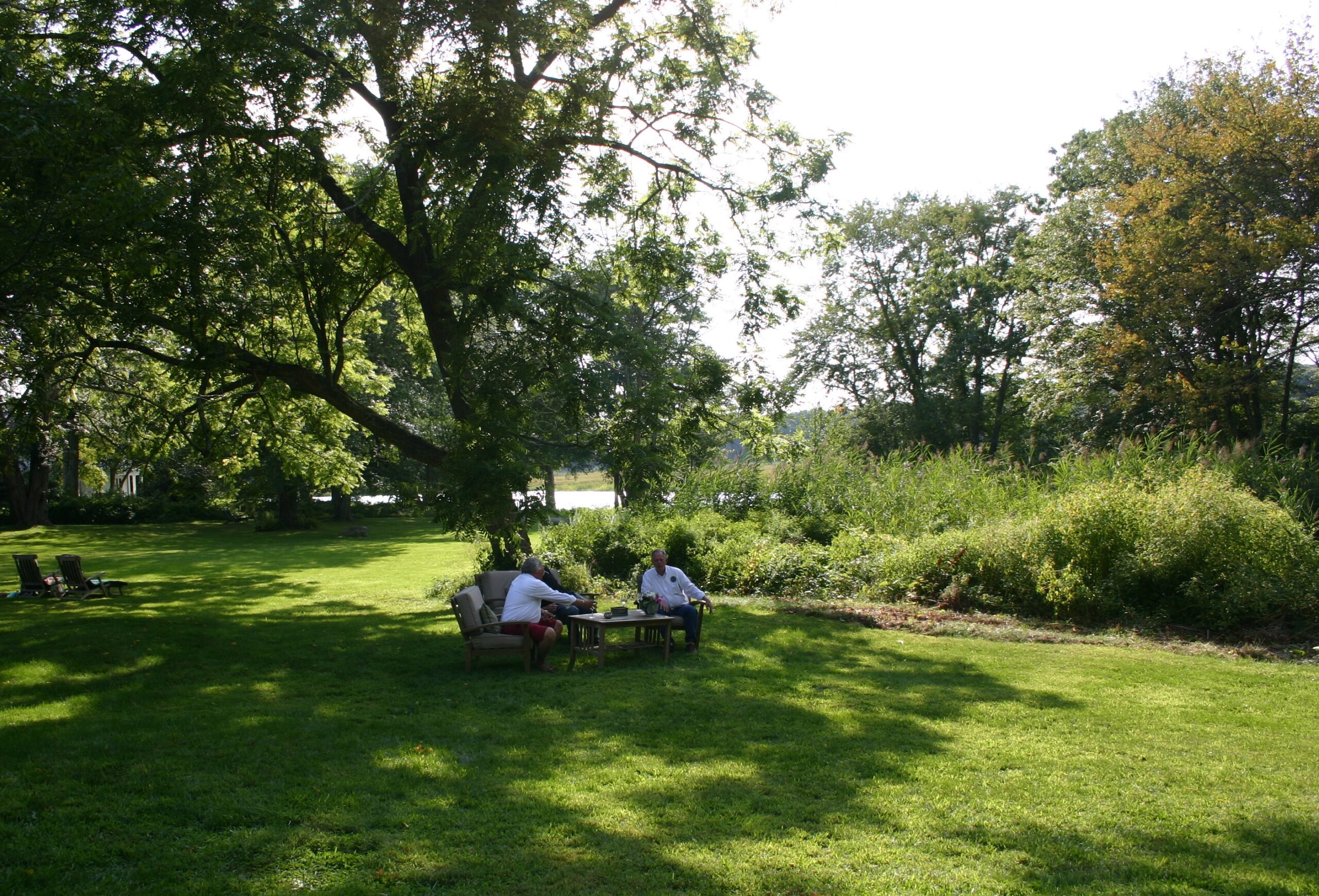
The Bee and Thistle’s lawn slopes away from the boules court and gently down to the Lieutenant River.
In addition to the professional chefs, Lee White noted that there are other “amazing cooks” who are on the team. And CBS correspondent Morley Safer, a huge fan of the game and who has a pétanque court at his home in Chester, also plays with the group when he is in Connecticut.
Lee White explained that last year she and Doug invited Linnea and David Rufo, owners of the Bee and Thistle Inn, to their house for a meal. Afterwards, Lee suggested a game of boules to her guests. “They fell in love with it,” Lee said and, within a month, the Rufos had installed a pétanque court at the inn. And they began hosting “Boules at the Bee” on Thursday nights.
This summer Linnea literally threw down the gauntlet to the veteran players on Pépin’s team. And she did it with panache—she sent a white leather glove on a satin pillow to Pépin, challenging him to a match at the Bee and Thistle.
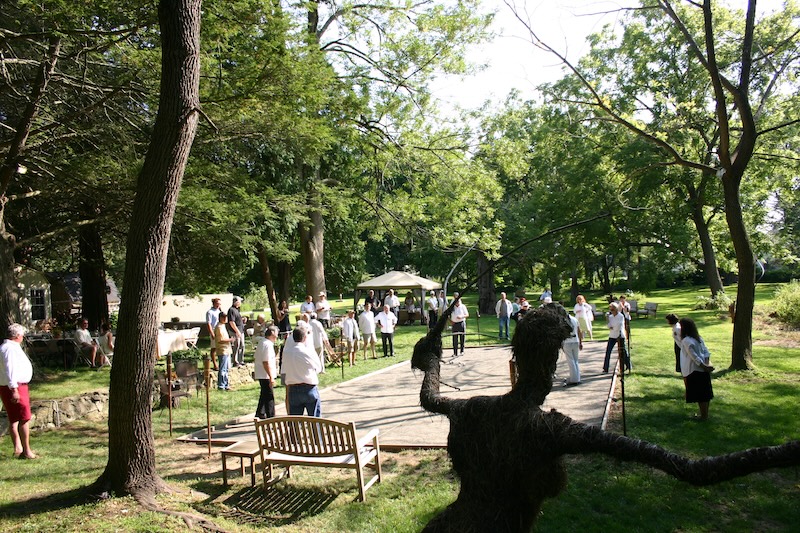
One of the sculptures on the grounds (foreground) looks over the boules court at the Bee and Thistle Inn.
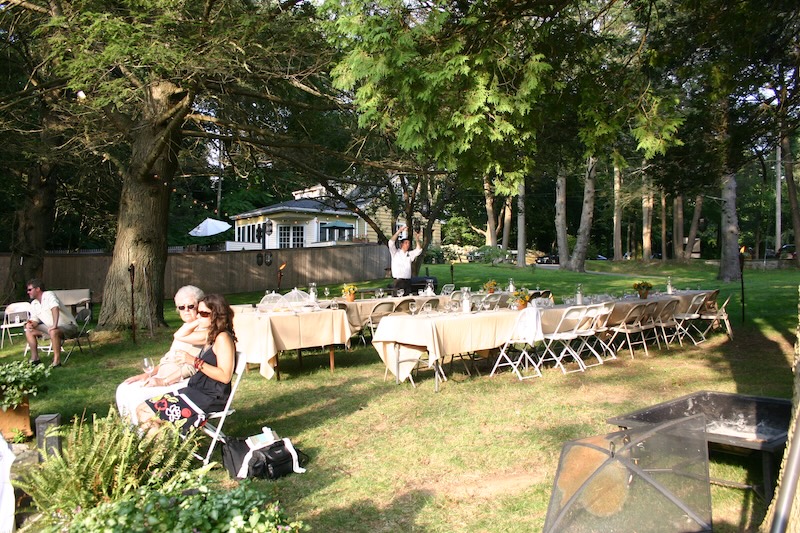
The weather was spectacular the day of the showdown and the players began arriving at 3 p.m. The setting actually looked more like an English garden party—the green lawns sloping down to the Lieutenant River, the sculpture on the grounds, and the tables set for an al fresco feast.
But once the games began, you could easily have imagined yourself to be in the French countryside. There was the clacking sound of the boules (which are made of steel), the whoops of exuberance when someone made a particularly good shot, and the good-natured bantering among the players.
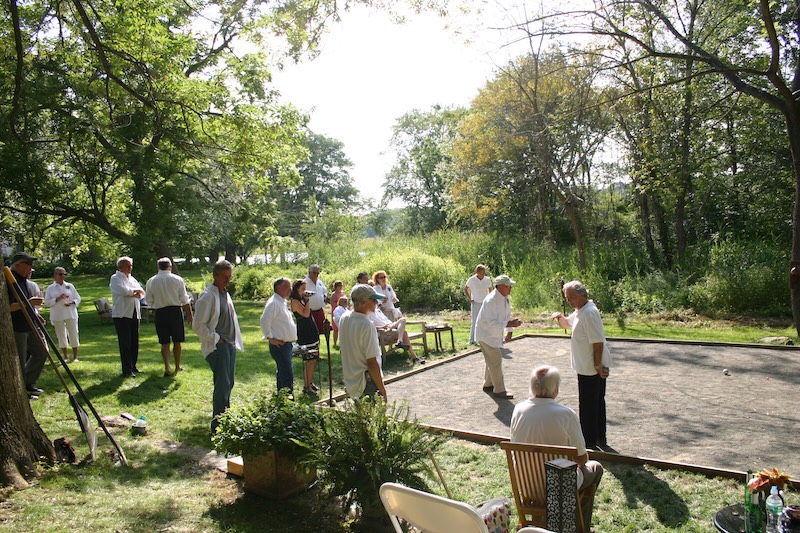
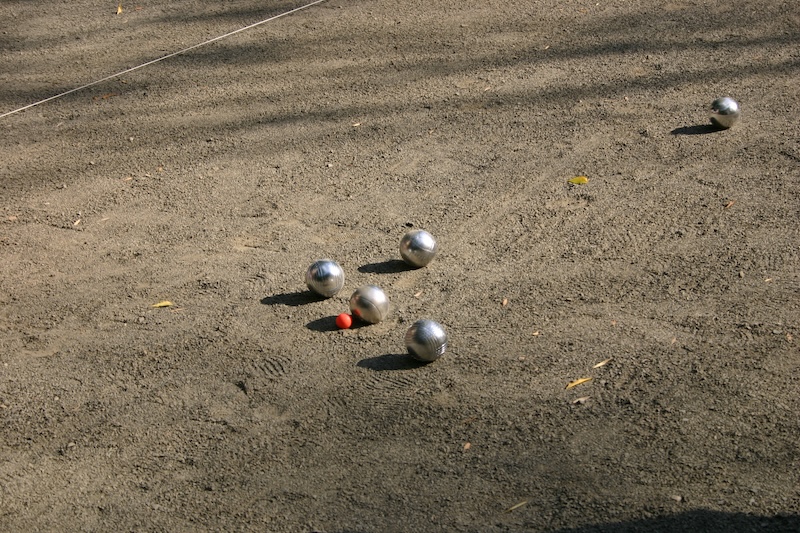
The winning boule in any game is the one nearest to the (in this case, red) cochonnet after the final throw in the game has been played.
The basic rules of the game are deceptively simple. There’s a small wooden ball called a cochonnet (which means piglet.) The goal for the teams is to toss their boules as close as possible to the cochonnet. But the game can change on a dime when an opponent knocks one of your boules out of the way or if the cochonnet itself is hit.
Or, as one of Pépin’s compatriots, Claude Martin, summed it all up, “You see, this is totally screwed up because it’s French.”
Even if you’ve never been to France, you may have read about pétanque in Peter Mayle’s bestselling books. An Englishman who moves to Provence, Mayle becomes smitten with the game and quickly masters its unwritten rules. Number one is “Anyone playing without a drink is disqualified.”
The traditional pétanque-playing drink in the south of France is pastis, a licorice-flavored liqueur. But here in southern Connecticut, the beverage of choice is wine. Underneath a canopy on the lawn, large garden urns served as chillers for bottles of wine.
The tables were set for the upcoming feast.
And what is good wine without good food?—especially with so many gastronomes on the playing field. Across from that outdoor wine bar, there was an oyster bar where a professional shucked oysters throughout the afternoon. Not to mention the gravlax, the cheese platter, and the lamb sausage in lettuce wraps … During a break in the play, Pépin himself was grilling the lamb.
Lee White said that whoever is hosting the event on any given Sunday is responsible for providing the food but, with so many chefs on the team, there is plenty of expert help in the kitchen. She also marveled that the French “eat and drink a lot, but they don’t get fat.”
After about three hours of playing as well as eating and drinking, Linnea invited everyone to sit down to dinner. And she had prepared quite a spread—roasted pork with a spice rub, grilled vegetables, tomato bread pudding, and salads. Members of Pépin’s team supplied some of the to-die-for desserts.
Sometimes the players needed to take a break from the action.
Pépin’s Boules des dimanches team defeated the rookies from the Bee. Afterwards, Lee White confessed that “we were nervous and were very excited to win.” And when the ceremonial plaque was presented, the ever gallant Pépin requested that the award remain at the Bee and Thistle for a rematch next summer.
But the day was far from over. As twilight descended, lights illuminated the court and play resumed. And it would go on for hours, as it always does with pétanque enthusiasts.
Editor’s note: LymeLine heard through the grapevine that the party at the Bee and Thistle lasted until 1 a.m. And, as the French say—c’est normal!
Epilogue and Author Comments:
Seventeen years have passed since I wrote about the “Boules Bash” in Old Lyme.
It was so much fun remembering that day, but there was some bittersweetness, too. Lee and Doug White as well as David Rufo and Morley Safer have passed away. Two beloved restaurants—the Bee & Thistle Inn and the Restaurant du Village in Chester have closed. And Peter Mayle, whose best-selling books about life in Provence introduced readers to the wonderful world of boules, died in 2018.
Since I am a Francophile and also love to cook, it was a thrill to meet Jacques Pépin. After drinking a few glasses of wine, I even summoned up the courage to start our conversation en français! I was already a fan—over the years I had watched his cooking shows and read his books.
During the pandemic, Pépin began posting short daily videos on Facebook, which I still follow.
A few weeks ago, there was a wonderful spread of photos—a group of players on a pétanque court; mouth-watering close-ups of a roast chicken, parslied potatoes . . . and a picture of Pépin and his daughter Claudine at the table. Pépin’s comment: “We had a great weekend of friends, food, and boules.”