Two years is a brief time for any town leader to accomplish ambitious goals, yet First Selectman Martha Shoemaker and Selectman Jim Lampos have made noteworthy progress in their first term. Their achievements include enabling online meeting access, addressing deferred maintenance, tackling flood and erosion issues, repairing the Hawk’s Nest sluice gate, using grants for our emergency operations center, supporting Senior Center renovations, and improving accessibility and safety at Sound View.
Martha and Jim put Old Lyme first—let’s re-elect them on Nov. 4.
Sincerely,
Mary Jo Nosal, Old Lyme.
Editor’s Notes: Mary Jo Nosal is a member of the Old Lyme Democratic Town Committee. She is also a financial supporter of olwenonline.com/, but has no input to the editorial process, which remains completely independent.
OLD LYME—Costs for the Town of Old Lyme have exceeded $13,000 to resolve a Freedom of Information complaint from a local news outlet that Old Lyme First Selectwoman Martha Shoemaker held back serious allegations against a member of the independent Old Lyme Ambulance Association.
A review of legal bills filed at the Town Hall shows the town has spent at least $13,035 to defend Shoemaker in front of the state Freedom of Information Commission (FOIC) since the case began more than a year ago. That is when the CT Examiner appealed to the transparency watchdogs to compel Shoemaker to comply fully with its request for documents, including any allegations of sexual assault or harassment going back to the beginning of 2024.
Shoemaker ultimately produced two incident reports containing accusations that an adult Emergency Medical Technician (EMT) touched an intern inappropriately and repeatedly, according to the testimony of CT Examiner reporter Francisco Uranga. But FOIC hearing officer Valicia Dee Harmon noted 168 days had elapsed since the news outlet asked for the information, and it was only provided after the commission got involved.
The commission in June ordered the town to respond promptly to requests for public documents going forward.
A state police spokesman said the law enforcement investigation into the EMT concluded in December. He was never charged.
The legal invoices from the New London-based Suisman Shapiro firm span the alleged incident in March 2024 through the current bill cycle.
Since the bills in many instances were not specific enough for LymeLine to independently verify which fees pertained to the case against Shoemaker, the first selectwoman sat down with LymeLine to identify the relevant expenses.
Included in the legal fees was $3,250 for attorney Kristi D. Kelly to prepare for and attend FOIC hearings in December 2024 and April 2025, plus a meeting of the full commission last month.
Attorneys John A. Collins III and Michael P. Carey, as well as a member of the paralegal staff, joined Kelly in billing the town for numerous emails, conference calls and meetings. Other expenses included reviewing files, redacting documents, corresponding with a commission ombudsman regarding complaint resolution, reading CT Examiner articles on the subject and writing hearing briefs.
The town pays the attorneys $185 per hour, while paralegal staffers receive $95 per hour. The attorneys receive $37 for any task that takes less than 20 minutes.
Rare Fine
The FOIC last month also upheld Harmon’s decision to issue a rare $250 civil fine.
Shoemaker took responsibility for the fine. From her office in the Town Hall this week, she showed LymeLine a copy of the check dated earlier this month from her personal account and the green postcard from the United States Postal Service confirming receipt. Russell Blair, spokesman for the FOIC, on Friday said the payment had not yet been processed.
“I made a mistake,” Shoemaker said. “I paid the fine. And we’ve revamped.”
Shoemaker in a written follow-up was more specific about the mistakes she made in handling the request for public documents.
She acknowledged receiving the two incident reports in March, which she said she “failed to recall” while responding to multiple Freedom of Information requests in June.
“When I became aware of the outstanding incident reports at the December FOIA hearing, I directly provided them to the FOIA hearing officer and CT Examiner,” she said.
Kelly last month told the commission she had “no knowledge as one of the town’s attorneys that an incident report even existed” until the December hearing.
Old Lyme Republican Selectwoman Jude Read, in response to a request for comment, said it sends a bad message when Town Hall officials cover up allegations of sexual assault.
Read is running for reelection on the Republican ticket along with first selectman candidate John Mesham.
“Yes, the town has wasted probably thousands of dollars. Yes, the First Selectwoman has chosen to break the law,” Read said in a written response to LymeLine. “But more importantly, what does it say to every other young man or woman subjected to this kind of thing in the workplace? It says, ‘keep quiet. Don’t talk. We don’t want to know about it.’ And I think that’s just plain wrong.”
Shoemaker this week apologized for failing to recall the documents.
“I am sorry for this oversight,” she said. “I take full responsibility for it, and have initiated additional FOIA processes at Town Hall.”
The hearing officer in her decision acknowledged Shoemaker has implemented a more formal process for logging and tracking Freedom of Information requests, assigned an administrative assistant to be the point person, and signed up for yearly FOI education training with the commission’s public education officer.
Shoemaker emphasized the trooper investigating the case had access to all of the documents at the onset of his investigation.
The state police spokesman said troopers submitted an arrest warrant to the court, but prosecutors declined to move forward with the case.
Editor’s Note: This article was updated with information from the FOIC spokesman.
Full Slate of Candidates for November Election Unveiled, Shoemaker Will Not Run Again for BOE
Old Lyme First Selectwoman Martha Shoemaker
OLD LYME–First Selectwoman Martha Shoemaker, unanimously endorsed this week by Democrats in her bid for a second term, wants to keep trying her best for the town.
“There are still things that I want to finish,” she said Thursday at the Town Hall.
Shoemaker, who also serves on the Region 18 Board of Education, said she will not run again for the school board.
The first selectwoman cited several big projects she hopes will come to fruition in the next two years, as well as some new initiatives bolstered by volunteers committed to making the roads safer and the shoreline more resilient.
“I’d like to see the sewer project through,” she said of the decades-long push to update several beach communities currently reliant on septic systems. “I’d like to see the Grassy Hill (Road) Bridge and the Emergency Operations Center completed.”
She said she’s excited to see the work being done by a reinvigorated Flood and Erosion Control Board. The group had been dormant for four years before she made good on a campaign promise two years ago to bring it back.
“We live in an area that is prone to floods, and we need to do everything in our power to make sure that we’re keeping all water areas safe,” she said.
She also pointed to the creation of the Road and Public Safety Committee earlier this year to address resident concerns about speeding and other safety issues.
Shoemaker became first selectwoman in 2023 with a 51.8% majority. She brought in 1,820 votes compared to Republican opponent John Mesham’s 1,697.
The Republican Town Committee on Thursday had not yet announced the slate of candidates approved at the party’s Tuesday endorsement meeting.
Shoemaker acknowledged the past two years have not been without controversy.
A plan from the Halls Road Improvements Committee to reenvision the commercial strip as a mix of apartments and businesses was widely panned. The Board of Selectmen, which had voted to send the proposal to the Zoning Commission, reacted to the subsequent outcry by putting the Halls Road committee on hold while considering a new path forward.
The scaled-back focus now is on sidewalks, according to Shoemaker. She signed off in May on a grant application to the Connecticut Department of Transportation (DOT) for $800,000 to install them on the north half of Halls Road.
Also contentious was Shoemaker’s failure to promptly disclose public documents requested by the CT Examiner involving the independent Old Lyme Ambulance Association. Reporters for the media outlet told the state Freedom of Information Commission it took 168 days for Shoemaker to provide incident reports revealing allegations that an intern was touched inappropriately and repeatedly by an adult emergency medical technician.
The state commission issued Shoemaker a $250 civil fine for not promptly handing over the public documents. The hearing officer at the time acknowledged Shoemaker had put corrective measures in place and agreed to annual transparency training.
“I made a mistake,” Shoemaker said, without specifying where she went wrong. “I paid the fine. And we’ve revamped.”
The Democratic Town Committee on Wednesday voted on a slate of candidates that includes incumbent Jim Lampos for selectman, according to a committee press release.
Shoemaker said Lampos’ love for the town makes him an ideal running mate, again.
“He is so thoughtful in his comments,” she said of the business owner and author of several books on local history. “He has a historical perspective to anything that we are looking to do.”
Also endorsed were: (*incumbent, +current alternate)
Planning Commission – Michael F. Riggio
Board of Finance – Kimberly Thompson*, Candace A. Fuchs*
Board of Finance Alternates – Diane Y. Linderman*, Tom Walsh, Fred Behringer (U)*
Zoning Commission – Michael Fogliano (U)*
Zoning Board of Appeals – Michaelle Pearson+, Kip Kotzan*
Zoning Board of Appeals Alternates – Kathleen Tracy*, Richard Korsmeyer
Board of Assessment Appeals – Devin Berke+
Regional Board of Education – Jason L. Kemp*, Michael J. Hansen, Sheryl Shyloski and Cynthia Love McCollum
Editor’s Note: This article was corrected to show the Republican Town Committee endorsement meeting was held Tuesday.
Shoemaker Admits Mistake, Will Pay $250 Fine Herself
Old Lyme First Selectwoman Martha Shoemaker. LymeLine file photo.
OLD LYME–The state Freedom of Information Commission (FOIC) has taken the rare – but increasingly utilized – step of issuing a civil fine to Old Lyme First Selectwoman Martha Shoemaker for failing to turn over public records about alleged sexual improprieties at the Old Lyme Ambulance Association to a local online news outlet, CT Examiner.
The commission, charged with administering and enforcing the state’s Freedom of Information Act (FOIA) voted Wednesday to uphold a report from hearing officer Valicia Harmon. A staff attorney for almost 20 years, Harmon in an audio recording of the meeting told the commission it was only the third or fourth time she’d found a case concerning enough to warrant a fine.
She set Shoemaker’s fine at $250.
Known colloquially as the state’s Sunshine Law, the FOIA attempts to shine light on the halls of government by preserving access to public documents and meetings.
CT Examiner reporter Francisco Uranga at the meeting told the commission it took 168 days for Shoemaker to hand over two incident reports at the center of the case, which he said contained allegations that an intern was touched inappropriately and repeatedly by an adult emergency medical technician with the independent Old Lyme Ambulance Association.
The employee resigned. An investigation by the Connecticut State Police was closed in December after prosecutors declined to move forward with the case, according to state police.
Shoemaker, who is in her first term as first selectwoman, said in a phone interview that she made a mistake.
“I accept the decisions by the FOIC and I have worked diligently over the past year to educate myself and my staff as well as to improve upon our internal processes for responses to requests for town records that my office receives,” she said.
Shoemaker received the incident reports on March 18 and 19 of last year, according to Harmon’s report. The resignation letter from the employee involved in the alleged incident came on March 19.
The report said Shoemaker testified she didn’t provide the reports because they “didn’t come to mind” when she was asked three months later for documents related to alleged incidents of sexual harassment or assault.
Shoemaker told LymeLine she will pay the fine personally.
“It is not coming from the town coffers,” she said.
FOIC Executive Director Colleen Murphy in a Thursday phone interview with LymeLine said three of the 14 cases heard by the commission this week included a fine, which she described as unusual. She said it could be evidence of a philosophical shift in a commission that historically has relied on training opportunities to try to encourage government officials to “do the right thing.”
State lawmakers in 2023 increased the maximum fine for violations from $1,000 to $5,000.
“In the aftermath of that legislation passing, we’re seeing some more traffic in the area of fines,” she said.
What is Reasonable?
According to Harmon’s report, CT Examiner in June 2024 asked Shoemaker for documents including employee rosters, resignation letters and any allegations of sexual assault or harassment. Uranga and CT Examiner writer Andy Thibault the next month filed a complaint with the FOIC stating the first selectwoman had not provided all the requested information and had improperly redacted one document.
The reporters asked the commission to impose a $5,000 fine and mandatory FOI training.
Uranga on Wednesday told commission members the documents are important because they revealed the allegations he was investigating turned out to be about “sexual assault, not simply sexual harassment.”
“That distinction, I think, is crucial and clearly documented in the redacted reports, and goes to the heart of why we take this case (and the delay) so seriously, and why it simply defies belief that the first selectwoman of a small, privileged town could fail to recall these incident reports until prompted by Attorney Harmon,” he said in prepared remarks at Wednesday’s commission meeting.
Harmon in her report said it was only after the first evidentiary hearing in December that Shoemaker provided the news outlet with the two incident reports detailing incidents of alleged sexual harassment that led to the resignation of a town employee.
“If they hadn’t filed a complaint with the commission, it’s likely that those records would never have been discovered,” Harmon told commissioners.
Harmon told commission members that her recommended fine reflected the gravity of keeping the public in the dark on the serious matter, while taking into account the selectwoman’s willingness to put corrective measures in place.
“I thought that the fine was small, but it was firm,” Harmon said.
Harmon said she didn’t believe Shoemaker intentionally violated the Sunshine Law. But she said the standard for authorizing a fine doesn’t require a person to act with intent.
The law empowers the commission to impose a fine if there are no “reasonable” grounds for withholding a document.
“And I think that it wasn’t reasonable to not recall that there were these two investigation reports concerning a very serious incident that resulted in someone resigning,” Harmon said.
Town Attorney Kristi Kelly, of the New London-based Suisman Shapiro law firm, told the commission she had “no knowledge as one of the town’s attorneys that an incident report even existed” until the December hearing.
The documents were provided to CT Examiner within a week of Kelly finding out about them, she said.
The commission’s 5-2 vote in favor of Harmon’s decision was opposed by two members with experience as local elected officials.
Commission member Matthew Streeter, a former South Windsor mayor, who went on to become a professional town manager, said he has sympathy for elected officials in small towns. He said first selectmen often don’t have the experience that trained professionals do.
“These are people that volunteer,” he said.
He said the commission used to reserve fines for repeat offenders, with education for first time offenses. “But now I think that it seems that we’re changing it, that we’re going to just throw the book the first time to a first selectman.”
Member Jonathan Einhorn, a former New Haven alderman, made a failed motion to strike the civil penalty from the report. He ultimately voted with Streeter to reject the hearing officer’s decision.
Murphy, the commission’s executive director, saidin her phone call with LymeLinethat members are trying to “figure out the contours” of the legislature’s decision to allow heftier fines – and whether that means more of them.
The commission in April issued its first $5,000 fine to a town attorney in East Haven accused of flouting the state transparency law and repeatedly defying directives from Harmon, who was the hearing officer in that case as well.
Murphy reiterated commission members have relied historically on training as a way to encourage compliance. “It’s too early to tell, but they may be headed in a slightly different direction,” she said.
Editor’s Note: 6/28: This article has been updated to note that Shoemaker is in her first term as First Selectwoman. 6/29: This article has been updated with a photo of Shoemaker.
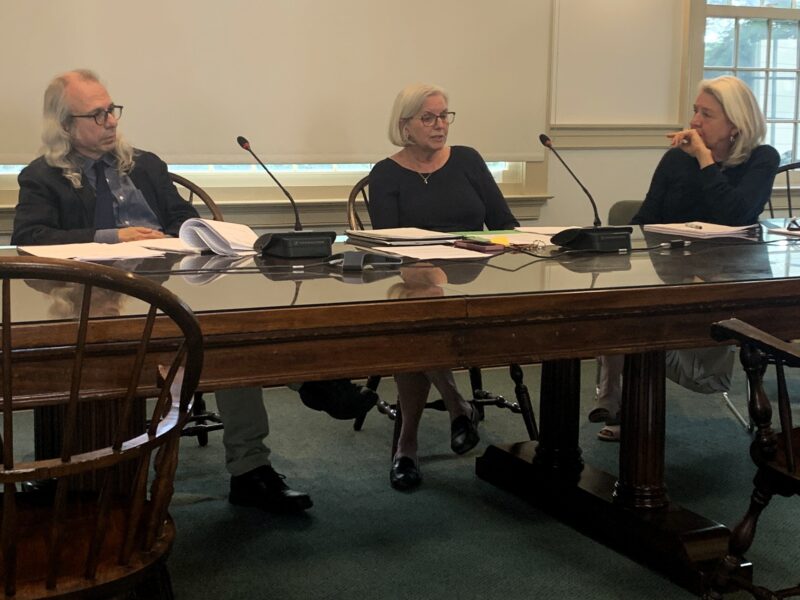
Old Lyme First Selectwoman Martha Shoemaker, center, with Selectman Jim Lampos, left, and Selectwoman Jude Read, right.
OLD LYME–Selectwoman Jude Read is calling for the dissolution of the Halls Road Improvements Committee (HRIC) as the Old Lyme Board of Selectmen continues to back away from big picture changes to the road that have evolved over the past decade.
On the selectmen’s table now is a scaled-back plan that includes new sidewalks, but no other substantial upgrades like the bow bridge and trail system envisioned by the HRIC. First Selectwoman Martha Shoemaker in May signed off on a grant application to the Connecticut Department of Transportation (DOT) for $800,000 to install sidewalks on the north half of Halls Road.
Josh Morgan, DOT Communications Director, said in a Tuesday email that he expects the award announcements to go out in the next several weeks.
During their Monday evening regular meeting, the selectmen considered creating a new committee to guide the process if a grant is awarded. But Read emphasized the existing Halls Road committee should be disbanded before forming a new one.
“The other thing I think would be helpful – these are my thoughts – is, if and when we start a new committee, we’re careful about the charge, what the goal is, (and) how many people are on that committee.”
Read also suggested requiring a unanimous vote when appointing members to a new committee. She is the lone Republican on the board with Shoemaker and Selectman Jim Lampos, both Democrats.
Lampos and Shoemaker declined to disband the committee right now because they need more information on the status of projects that were pending when selectmen voted to put the group on a hiatus in April.
The HRIC has been controversial since it started in 2015 under Democratic then-First Selectwoman Bonnie Reemsnyder with a charge to consider a master plan for the commercial span. The result – honed over the course of dozens of public meetings, information sessions, and workshops – evoked images of village-like storefronts and apartments, a pedestrian bridge, more greenspace and sidewalks.
Reemsnyder successor Tim Griswold, a Republican, a few years later called the vision too grandiose. He said at the time that he preferred to focus on building sidewalks one segment at a time before considering such broad plans.
But opposition came to a head earlier this year when more than 550 people filled the Lyme-Old Lyme High School auditorium for a public hearing on changes to the town’s zoning regulations that the committee hoped would turn their vision into reality.
The proposal to create an overlay district in the commercial zone would have allowed as many as 40 housing units per acre to be built above, or behind, ground-floor businesses.
The plan was rejected by the Zoning Commission, HRIC Chairwoman Edie Twining subsequently resigned, and the board of selectmen put the committee on hiatus while attempting to manage the fallout.
Crossing That Bridge
Before making any decisions on whether to disband the HRIC, Shoemaker and Lampos on Monday said they wanted to get a better understanding of how much has been spent on Halls Road projects to date and which contracts remain outstanding.
At the behest of the HRIC, selectmen in 2023 hired AI Engineers of Middletown to come up with plans for a pedestrian bridge over the Lieutenant River and a trail system between Lyme Street and Halls Road. The company’s work was funded with $135,000 in federal American Rescue Plan money and a $28,500 grant through the Connecticut Recreational Trails program.
Old Lyme Finance Director Anita Mancini said the committee spent $13,500 of the trails grant so far.
The committee in an FAQ document said AI Engineers was tasked with taking charge of conceptual designs, formal designs, permitting and the construction bid process. No funding for construction has been secured.
The decision to accept or reject the designs would be up to the public, according to the committee. Old Lyme’s form of government calls for the public to vote on major decisions at town meetings, with options to send the biggest issues to referendum.
Shoemaker said the town could be responsible for returning $13,500 to the state if the town doesn’t complete the design project.
Read argued it might be prudent in some cases “to take a loss.”
“Is it better to lose $13,500 or spend another $15,000, have it designed, and not be sure if the town’s going to approve it or not?” she said.
Shoemaker and Lampos reiterated they need a better idea of the financial picture first.
They said it’s been difficult to pinpoint how much has been spent, and in which line items, in a decade of budgets overseen by multiple administrations.
Lampos credited the current selectmen with making the budget process and town procedures more transparent.
“I think there’s a lot of clarity, but there’s just so much that we can answer for what happened before us,” Lampos said.
LymeLine in April requested documents related to the amount expended so far on HRIC projects. Shoemaker on Monday said the information will be available next week.
Lampos, who wrote the grant with Shoemaker’s executive assistant Katie Balocca, emphasized there is nothing in the grant to cover the HRIC’s bow bridge proposal.
“It is currently on hiatus. We’re not addressing it,” he said.
Building the bow bridge would require the state Department of Energy and Environmental Protection to transfer ownership of its property on the east bank of the Lieutenant River to Old Lyme, which the agency has agreed to do as long as the town agrees to put a fishing pier, a dock for portable boats and parking spaces there.
Lampos acknowledged the idea, like other elements of the HRIC plan, is controversial. That’s why the grant application focuses solely on sidewalks.
“Almost everybody was saying, ‘forget the overlay,’ half the people were saying, ‘forget the bridge,’ and just about everyone was saying, ‘but we want the sidewalks,’” he recounted.
Read wondered if a new committee should be limited to overseeing only what’s in the grant or if they should be empowered to look at other improvements and funding sources.
“We have requests for sidewalks, lighting, signage, beautification,” she said.
Lampos put it this way: “If we don’t get the grant, I think we cross that bridge at that time.”