TOP STORY: Rare First Selectman Contest in Lyme Pits Corporate Experience Against Volunteer Approach

Christy Zelek, an unaffiliated candidate running with support of the Lyme Democrats, is facing off against Republican Tom St. Louis in the race for Lyme first selectman.

LYME–In a rare contested race for the town’s top office, a retired pharmaceutical manager intent on keeping zoning decisions local faces a political newcomer emphasizing collaboration and consensus. 

Going back 25 years, only the 2001 and 2017 elections included a challenge for first selectman. This year’s opening emerged after an announcement from current Republican First Selectman David Lahm that he would not be running for another term. 

Republican-endorsed First Selectman candidate Tom St. Louis, who appears on the ballot with wife and (also Republican-endorsed) selectman candidate Mary Powell-St. Louis, brings experience from a career at Pfizer and four years as an appointed alternate member of the Lyme Planning and Zoning Commission. 

He said managing budgets and staff while building a professional network has prepared him to focus on his main priority: ensuring development decisions stay in local hands as the state calls for more affordable housing.

“If we don’t have control over how we use land in town, the very fabric of Lyme is at risk,” he said. 

Democrat-supported unaffiliated candidate Christy Zelek said she is running out of a sense of civic duty on a record of volunteerism, including service on the Lyme Ambulance Association Board of Directors, multiple parent-teacher organizations and the local Boy Scouts. 

Zelek works as an administrative assistant at Westbrook Middle School.

She described herself as “people oriented,” an attribute she said sets her apart from the corporate experience St. Louis has made a pillar of his campaign platform.  

“I just listen to what everyone has to say, and I don’t go in with my set of ideas and push them through,” she said. 

Zelek appears on the ballot as a petitioning candidate and is running with the support of the Lyme Democratic Town Committee (DTC). The Democrats have also gotten behind incumbent selectmen John Kiker and Kristina White. 

Due to state minority representation law prohibiting more than two members of any political party from serving on the three-member Board of Selectman, Kiker is once again running as the DTC-endorsed candidate while White petitions for a seat. 

The candidate, who finishes second in the first selectman race, is automatically considered for one of the two remaining selectmen seats. Those two seats are filled by the next highest vote-getters overall, in accordance with Connecticut’s minority representation rules.

The potential makeup of the Board of Selectpeople includes notable combinations this election season. It could end up in the hands of a trio of Democrat-supported candidates; It could also result in a husband-and-wife Republican majority. 

Both candidates are seeking elected office for the first time. St. Louis ran for a Board of Finance alternate position in 2021 but lost to Democrat Jim Miller. 

Prepared to ‘Go it Alone’

St. Louis in an interview at the Lyme Public Library earlier this month said he is a 27-year resident active in coaching, Scouting, and local organizations. He worked as an engineer and in management at Pfizer for 37 years before retiring in 2023. 

He and Powell-St. Louis have three sons between the ages of 23 and 17. 

He cited budget oversight, personnel management, and strategic planning as key skills he would bring to the position of local CEO. 

“The town budget is about $12 million, roughly,” he said. “That’s fairly consistent with the size of the teams that I was managing for the last 12 years of my career at Pfizer.”

Experience on the Planning and Zoning Commission gave him familiarity with town operations and how land is used in town. It’s also where he learned earlier this year about the local implications of a comprehensive affordable housing bill that made it through the state House and Senate before it was vetoed by Gov. Ned Lamont. 

Among the provisions in the failed bill was the “fair share” framework, which would have required municipalities to plan for a prescribed number of affordable housing units within their borders. Data from the state Office of Policy and Management shows projections call for somewhere between 122 and 346 affordable housing units in Lyme, depending on the variables. 

The CT Mirror reported the subject is likely to show up in a special session of the state General Assembly slated for Nov. 12 and 13. 

He said the bill takes control of zoning decisions away from the town. 

He suggested one way to address the problem is to form alliances with other small towns similar to Lyme – like Redding in the southwest corner or several towns in the northeast – that share more in common with Lyme than its immediate neighbors. 

Another way to defy the state mandate is to accept the consequences, according to St. Louis. That means forfeiting eligibility for many types of state funding if the town refuses to make progress on affordable housing.

The “fair share” provision of the housing bill rewards participating towns by giving them priority access to state grants, including those offered through the Small Town Economic Assistance Program (STEAP), the Clean Water Act, and the Main Street Investment Fund.

He acknowledged that several major projects on Lyme’s horizon, such as bridge replacements and fire station upgrades, could qualify for those grants.

““You’ve got this situation where Lyme may be reluctant to go after this (fair share) target because it represents such a dramatic change in our land use decisions, but then we would also have to be prepared to essentially go it alone on a revenue piece,” he said. 

He emphasized that kind of decision shouldn’t be made unilaterally.

“That’s a pretty important decision that you’re going to need town engagement on,” he said.

He called for revenue diversification to make up for any loss of state funding. That could mean looking at ways to utilize the town’s existing commercial zones more fully without expanding them, and exploring land leases for technologies like solar energy. 

“You’re not going to take an open field along a major stretch of road and turn it into a solar farm. There will be zero appetite for that,” he said. “Now, whether or not there are, on our town conservation lands, some areas that, to a great extent, are shielded and would present us the opportunity to do some lease, I think that we would have to engage in a conversation about that.”

He would also explore ways to seek reimbursement from the state to help offset the loss of taxable income on town land conserved as open space. 

Husband and Wife

St. Louis acknowledged Democrats have been critical of the Republicans for running a married couple at the top of the ballot. But he said he and his wife have different backgrounds and make their own decisions. 

“We’ve been married for 31 years and raised three boys together. But, in that, we have lived very different experiences, actually,” he said. 

He pointed to a disagreement at a recent Republican forum on how to deal with the infestation of the invasive plant known as hydrilla that is overtaking the Connecticut River. 

The forum was organized by the Republicans after Zelek and the Democrats declined to participate in a debate sponsored by LymeLine and the Greater Old Saybrook of Commerce. When the Democrats declined the Republicans’ forum as well, it was up to St. Louis and Powell-St. Louis to spar among themselves. 

“You know, I think it was pretty apparent at the open forum that there are issues that we don’t see eye to eye on, but we can do that and engage in civil conversation, and maybe not influence each other towards the same outcome, but we can have that respectful conversation,” he said. 

A Collaborative Approach

Zelek, a 17-year resident of Lyme, has volunteered in leadership positions with the Lyme Ambulance Association — where she was vice president and helped recruit members and secure a new ambulance — as well as the Boy Scouts, multiple parent-teacher organizations, and a high school ‘Safe Grad’ committee.

She spoke to LymeLine earlier this month from an Adirondack chair in her front yard overlooking Tiffany Farm. Multiple drivers over the course of the interview waved or honked their horns as they drove by. 

“Anything that I join, I tend to be in a leadership role, from small things to big things,” she said. 

Zelek was raised in a military family that settled in Massachusetts when she was 10 years old. She attended Alfred University in New York, where she graduated with a double major in English and communications. She has held jobs in insurance, event planning and real estate, and is employed currently as an independent consultant with the health and wellness company Arbonne in addition to working at Westbrook Schools. 

She is divorced with three sons aged 19, 16 and 15. 

Knocking on doors at homes across town, she said she’s heard residents’ concerns about traffic, bicyclist safety, and keeping taxes low. 

She said attending town board and commission meetings, including the boards of selectpeople, education, finance, and planning and zoning, has shown her those groups play a crucial role in shaping Lyme’s future. 

“We have an incredible community of people that have backgrounds that are amazing,” she said. “And it’s such a gift that they’re willing to keep sharing their knowledge and their time.”

Zelek said a growing sense of collaboration has been evident in Lyme lately. She cited examples ranging from the fire department and ambulance company beginning to work more closely, to library leadership engaging the wider community in talking about the impact of loneliness and possible solutions. 

“I feel like that’s what we all have to be doing, is working together,” she said. 

If elected, Zelek’s top priorities would be enhancing public safety, including safer conditions for bicyclists, and improving communication with residents. She supports a balanced budget and careful spending. 

She described herself, like the Scouts she leads, as thrifty. 

“I do clip coupons and return my cans,” she said. 

Zelek cited her open mind and collaborative approach as the biggest strengths.

“I don’t have an agenda; I really just want to get out and help people come together to get to the solutions that are best for the town,” she said. “I’m not going in thinking I have any one way to do anything. Everybody has a different issue and a different way to come to a solution for issues, but somehow we can come together and maybe not come up with a perfect answer, but a pretty good answer for the majority of the people.”

The Trump Effect

St. Louis recalled meeting people on the campaign trail with people who had little patience for Republicans.

Some of them would shut the door in his face, according to St. Louis. Others would refuse to engage with him unless he denounced President Donald Trump. That’s when he’d tell them he prefers to focus on local issues rather than national politics. 

He reiterated his top issue is zoning control, which he described as unrelated to national politics. 

“I see it in their eyes that they’re worried about how the national politics might play at the local level,” he said. “ But that’s not why I’ve lived here for 27 years and raised a family here. I love the community and I love the rural aspects and the small town feel of it all. And I just don’t see national concerns playing out in our day-to-day lives here. But I respect that some people do.”

He acknowledged some national issues do hit close to home. He said he disagrees with Trump’s decision to halt the offshore wind projects because of the effect on State Pier in New London, but supports Trump’s recent agreement with Pfizer to expand U.S. investment. 

“There are things he says that I’d prefer he not say, but when I look at the actions, I’m trying to look at the local impact here,” he said. 

Zelek is among those who have seen national political divisions become more pronounced locally in recent years. But on a personal level, she said she maintains friendships across the political spectrum and values differing views. 

The lifelong unaffiliated voter said she votes for the person, not the party. 

Asked for her thoughts on Trump, she said she does not believe he is a positive role model for young people. 

“He’s not what we’ve taught our children to be,” she said. “And that’s a really simple line for me.” 

She counted taking care of others and being kind as ideals she’d like to see instilled in her children.

“If it looks like someone needs help, just reach out,” she said. “Just saying hello, I think, is a huge thing. A simple hello can lead into more of it. And treat people how you want to be treated. I also say repeatedly, ‘the only person you have control over is yourself.’”

TOP STORY: All-Volunteer Lyme EMS Begins Shift Toward Paid Staff, Eyes Long-Term Station Improvements

Lyme Ambulance Association Chief of Service Steve Olstein stands in the organization’s only dedicated personnel space. It’s located behind the ambulance in the basement garage of the Hamburg fire station. LymeLine photo.

LYME–At the helm of one of the last all-volunteer ambulance corps in the state, Lyme Ambulance Association officials say hiring paid responders for two shifts per week is a necessary change that requires a new outlook for the 50-year-old organization. 

In the short term, it means coming up with temporary places in existing facilities where the new hires can bunk and members can gather. In the longer term, it means the ambulance association will need a place at the table as officials discuss a formative plan to rebuild the Hadlyme Fire Station and expand the Hamburg Fire Station in the coming years. 

Steve Olstein, chief of the independent, nonprofit ambulance service now rebranding itself as Lyme EMS, told LymeLine the group held out longer than most before deciding to add paid staff members to its volunteer ranks. 

“We had a very stable cadre of very experienced people living in town, and so we always had responders,” he said. “We just always did.”

The ambulance service is licensed by the state to respond to 911 calls and to carry out basic life saving functions. Advanced care is provided by professional paramedics with Middlesex Hospital or Lawrence + Memorial Hospital. 

Lyme EMS owns two ambulances, with the town providing shelter and fuel for the vehicles and workers compensation insurance and a pension plan for qualifying volunteers.  

Olstein estimated that the service’s 12 volunteers cost the town roughly $2,400 each annually. 

Now, Olstein said the town’s ambulance volunteers are aging out—and most volunteers introduced to the service as young adults end up leaving town. 

He referenced a current 16-year-old volunteer whose training is viewed more as a broad investment in the public good than a local business decision. 

“It’s expensive when we invest a lot of time and some money in them, and the only way we can justify it is that the world is a better place with another EMT,” he said. 

On the other end of the age spectrum, Olstein recounted experienced volunteers, who would go on as many as 85 of the typical 300 calls per year before aging out of the retiree-dominated field. 

“We couldn’t find a replacement for every person who left and we lost,” he said. 

Recruiting paid responders is going to require a shift in attitude in an organization where volunteers going back a half century have been happy to wait for calls at home rather than carve out space at any of the firehouses. 

He said hiring staff members requires a more professional, but also more social, approach. 

“If you want to recruit, you really should have an esprit de corps,” he said. “You should have a place where you can say: ‘This is ours. This is what you’re joining. We have substance and pride and a place where we can meet, where we’re not asking somebody else’s permission.’” 

He said the temporary change would allocate space in the emergency operations center lounge in the Hamburg station for sleeping quarters, as well as a room at the back of the Hadlyme station to serve as Lyme EMS headquarters. 

The ambulance company’s current dedicated personnel space—set up haphazardly in a back bay of the Hamburg first station basement garage with a few folding tables, four file cabinets and a weight-lifting station—is substandard, according to Olstein. While acknowledging EMS members are already welcome to use the emergency operations lounge as a place to relax, he added they’d prefer to have a space they could customize to their needs. 

He estimated it would cost about $30,000 to install two bunk beds along with partitions in Hamburg station lounge and make cosmetic changes to the 60s-era kitchen, bathroom and gathering space in the Hadlyme station. He cited potential improvements like painting the wood paneling, updating the industrial bathroom, replacing the mustard yellow kitchen counter and adding a couple small appliances.

“We don’t have anything,” he said. “We don’t have a refrigerator. We don’t have a microwave. We don’t have a coffee-maker. So to have a place where we can store and heat up our food and make a pot of coffee, to me, is a real plus.” 

‘Band-Aid’ Approach

The back room of the Hadlyme fire station will become the temporary Lyme EMS headquarters as part of a plan to help professionalize the organization as it evolves into a hybrid model of paid and volunteer members. LymeLine photo.

At a Board of Selectpeople meeting last week, Lyme Facilities and Emergency Management Director Josh Adams used the term “band-aid” to describe the Lyme EMS plan for the Hadlyme and Hamburg fire stations. 

He said the temporary, three- to five-year fix is meant to last until the proposed overhaul of the 60-year-old Hadlyme facility provides a new, permanent headquarters for the ambulance company and sleeping quarters for firefighters and EMTs.

Adams and Board of Finance Chairman Alan Sheiness agreed it was realistic to believe shovels could be in the ground in about three years. Sheiness emphasized the importance of careful planning and budgeting in the near and long term, while Adams said the return on investment would come immediately in the form of better response times. 

The emergency management director said stationing responders with the ambulances, rather than having volunteers first retrieve them, can save crucial minutes during emergencies.

“The quicker the ambulance can get there, with the people and equipment to get them in and out, makes a huge difference,” he said. “If you’ve ever had to call 911 and wait, you know how long five minutes seems when you’re waiting for someone to get there.” 

According to the 2024 Office of Emergency Medical Services Annual Report from the state Department of Public Health, Lyme Ambulance has a mean response time of 16.26 minutes. The mean response time in rural towns statewide is 9.74 minutes. 

The response times for area towns include Chester at 14.77 minutes; Deep River, 13.67 minutes; East Haddam, 13.32 minutes; Salem, 12.63 minutes; Old Lyme: 12.08 minutes; and Essex at 9 minutes. 

Olstein said Lyme EMS response protocol dictates that the assigned crew member closest to the medical emergency reports directly to scene so that any time sensitive treatments can be started as soon as possible, while the other crew member gets the ambulance and then goes to the scene.  The mean response time for responders going directly to the scene is approximately 11 minutes.

Lyme Ambulance Association Board of Directors President George Mooney at the selectpeople’s meeting said discussion about the group’s evolving needs is not new.

“Two years ago, Lyme EMS started a conversation with the town leadership because we saw potential long-term issues with our all volunteer staffing model,” he said. “…This is really the next phase of the dialogue.” 

Olstein said Lyme EMS plans to hire the paid EMTs for Saturday and Wednesday night shifts, which have proven the hardest to fill. The shifts at first will run from noon to midnight, but will change to 6 p.m. to 6 a.m. once the temporary sleeping quarters are installed. 

The first new hires will be funded by the ambulance service, Olstein said. But EMS officials have been warning the town that declining volunteer numbers and increasing expenses could change the equation in the future. 

In a memo prepared for the selectpeople’s meeting, Lyme EMS officials said the initial discussions about staffing stemmed from a promise to keep the town informed if changes to the organization’s volunteer model were being considered.

“Based on recent challenges trying to support 14 shifts with 12 responders when we really need 20, the initiative to hire part-time paid staff was taken by Lyme EMS as a means to provide a stop-gap in staffing but also to see how it could work longer term for our town an organization,” the document said. “This proposal is primarily to help us deal with the current situation but also to inform and advise the town of the longer term commitment that will have to be framed and negotiated in the upcoming financial planning cycle.”

First Selectman David Lahm last week emphasized the proposal to demolish and rebuild the Hadlyme station while expanding the Hamburg station will require a building committee. Members will include officials from the fire department, Lyme EMS and the town, as well as residents. 

The outgoing first selectman said he plans to install the building committee before he leaves office in mid-November following the municipal election. 

Designs and cost estimates for the long-term vision at the two fire stations have not yet been created. Fire Chief John C.L. Evans told selectpeople the department has authorized funding to develop a preliminary document outlining space and equipment needs to help guide architects when the project moves forward. Grant funding opportunities are also being explored.

Who’s Paying?

Lyme EMS Chief of Service Steve Olstein said the temporary sleeping quarters for its paid EMTs will be set up in a not-yet-specified area of the the Emergency Operations Center lounge pictured here. LymeLine photo.

The ambulance service until about two ago didn’t bill customers for calls, according to Olstein. He credited a philanthropic population willing to answer each fundraising appeal with a check, but said the demands of keeping current with ambulance technology finally caught up with the community’s generosity. 

The chief of service described an evolution that has taken the ambulance company from a 1971 Cadillac ambulance – built on the same chassis as a hearse – to the current iterations outfitted with state-of-the-art power loading systems for stretchers that can go for about $60,000 a time. 

“The cost of everything has increased so much that it really became impossible for us to exist strictly on donations,” he said. 

But even with the new revenue source, he said this year marks the first time that there is more cash going out than coming in. 

“We have a very strong reserve, so there’s no financial stress. It’s just nobody, who’s involved in a business, wants to see it have negative cash flow, because of the implications for the future. If you’re always negative, sooner or later you’re going to have a problem.” 

He said billing rates set by the state have been slow to address the rising costs of ambulance service in the town with an aging population, where many rely on federal Medicare benefits. Data from the 2020 U.S. Census puts the number of residents over the age of 65 at 31.6%. 

In between the near and the long term, he said it remains critical for the ambulance service to become more involved in the local emergency management planning framework and to help officials understand how the historically insular ambulance service operates. 

“We don’t need anything today. We’re fine,” Olstein said of the group’s bottom line. “But you need to know that the way things are going, there’s going to come a time when we will.” 

Editor’s Note: This article was updated with information subsequently provided by Olstein about the mean response time for individual responders going directly to the scene.

TOP STORY: Lyme Democrats Support Unaffiliated Petitioning Candidate Christy Zelek for First Selectman

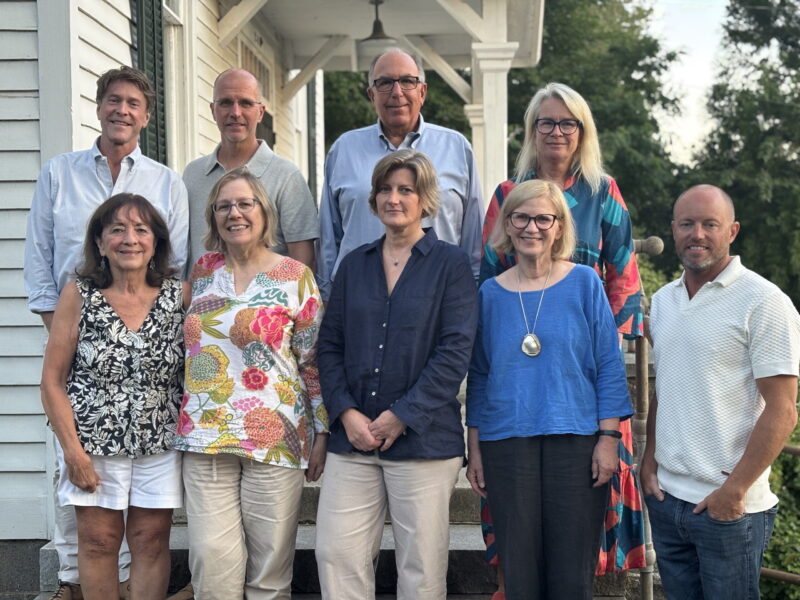
The Lyme DTC this week announced a slate of nine candidates while pledging support to two petitioning candidates. From left to right are: (back Row) John Kiker, Walter Burhans, Jim Miller and Kristina White; and (front row) Anna James, Toni Phillips, Christy Zelek, Joan Motyka and Adam Brevoort. Not pictured: Carol House and Susan Leon. Photo courtesy of Lyme DTC.

Democrat Kristina White Seeks Reelection as Petitioning Candidate for Selectman 

LYME–The Lyme Democratic Town Committee (DTC) this week endorsed nine candidates for the Nov. 4 municipal elections, while pledging support to unaffiliated petitioning candidate Christy Zelek for first selectman and Democrat Kristina White for selectman. 

The group met in a Tuesday caucus to approve its slate, according to a press release. 

Zelek will face Republican Tom St. Louis in a rare contested race for first selectman. Election data from the Secretary of the State going back 25 years shows only two elections included challenges for the town’s top spot. 

Lyme DTC Chair John Kiker said Zelek will be the town’s first female first selectman if elected. 

“Christy Zelek has the skills to do a great job as our first  selectman and has our full support,” he said. 

A list of qualifications provided by the DTC show Zelek, who has raised three children in the school system since she moved to town in 2008, has held leadership positions in parent-teacher groups at the high school, middle school and elementary school level and in the local Boy Scouts organization.

She previously served as a member of the Lyme Ambulance Association Board of Directors for four years, including two as vice president. During her tenure there, the board created and expanded an investment program; pursued grants and private funding; and updated the retirement plan with the Lyme Fire Company.

Zelek works as an administrative assistant at Westbrook Middle School.

She told Democrats on Tuesday that she looked forward to the possibility of serving as first selectman. 

“I am grateful to have received the support of the Lyme DTC. I’m running for office because I love this town. My priorities will include keeping our town the beautiful, historic place it is; keeping our financials in check;  keeping our taxes low and supporting our schools; and continuing to address our town’s capital  needs, such as our roads, bridges and town equipment,” she said. 

Lyme DTC Nominating Committee Chairperson Liz Frankel touted the slate, which includes incumbent candidates John Kiker for selectman, Jim Miller for Board of Finance and Anna James for the Region 18 Board of  Education.

“All totaled, we are supporting a group of 11 candidates for each available board and  commission opening this year to ensure our values continue to be well-represented on town  boards and commissions,” Frankel said. “We are proud to support this talented group of individuals who are  not only highly qualified, but extremely interested in serving the town we all love and cherish.” 

Frankel said state election law dictates the committee can nominate only one candidate for selectman, so Democrats will once again run Kiker on the slate while “actively supporting Kristina’s reelection as a petitioning candidate.”

“They’ve both done an excellent job on the Board of Selectmen and we want to see them both continue to serve our town,” she said.  

Connecticut’s minority representation laws prohibit more than two members of the same political party from serving on a three-member board. In Lyme, each party may nominate only one candidate for selectman.

The following candidates were endorsed by the DTC to run on the Democratic ballot line in the November election. They are all serving currently.

John Kiker – Selectman 

Jim Miller – Board of Finance (U)

Walter Burhans – Board of Finance Alternate (U)

Anna James – Board of Education 

Carol House – Planning & Zoning Commission 

Toni Phillips – Zoning Board of Appeals 

Adam Brevoort – Zoning Board of Appeals Alternate 

Joan Motyka – Library Board of Directors (U)

Susan Leon – Library Board of Directors 

TOP STORY: Lyme Republicans Endorse Tom St. Louis for First Selectman

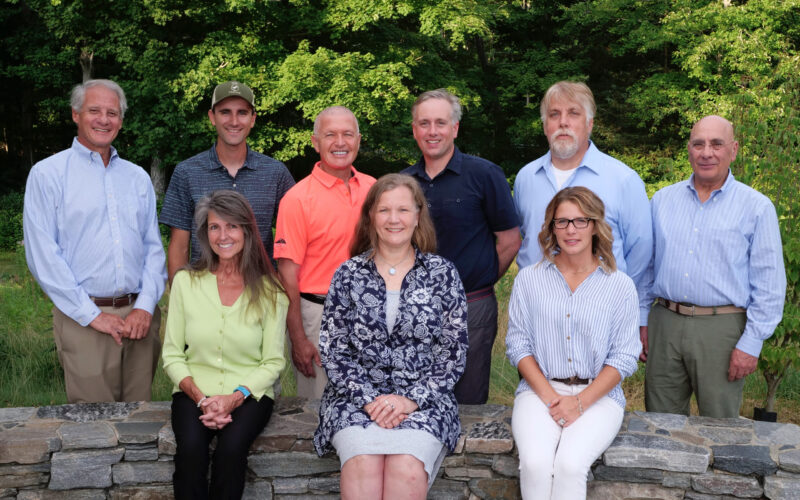
The Lyme RTC this week announced a slate of 11 candidates. From left to right are: (standing) Mitchell Etess, Steven Deveaux, Tom St. Louis, Corey Lomas, Isaiah Griffith and Stephen Buccheri; and (sitting) Jennifer Tiffany, Mary Powell-St. Louis and Lannie Mossberg. Not pictured are Harry “Skip” Broom and Lori Caine.

Mitchell Etess, Retired Mohegan Tribal Gaming Authority CEO, Tapped for Board of Finance

LYME–The Republican Town Committee (RTC) this week endorsed the husband-and-wife team of Tom St. Louis for first selectman and Mary Powell-St. Louis for selectman. 

The Republican’s 11-member slate also includes retired Mohegan Tribal Gaming Authority CEO Mitchell Etess for Board of Finance. 

St. Louis will face unaffiliated petitioning candidate Christy Zelek in a rare contested race for first selectman. Election data from the Secretary of the State going back 25 years show only two elections included challenges for the town’s top spot. 

St. Louis on Wednesday said he retired from Pfizer two years ago as the director of a manufacturing group operating across multiple facilities. He cited familiarity with federal and state labor law and experience managing people and budgets. 

The candidate said he was compelled to run after the Connecticut General Assembly passed a comprehensive bill to make housing more accessible. Gov. Ned Lamont vetoed the bill largely because of opposition from town leaders, who didn’t want to be required to plan for more housing based on targets set by the state. 

He said he could see the local implications of the proposal from his seat as an alternate member of the Planning & Zoning Commission for more than three years. 

“It was apparent that the state was now clawing back at the autonomy that they had given us decades ago to manage our own zoning,” he said.  

He is not running for reelection to the Planning & Zoning alternate seat, which is up in November. 

St. Louis and Powell-St. Louis raised three boys in the local school system and served as longtime leaders in the Boy Scout organization. 

Powell-St. Louis, who is the RTC chairman, previously served two terms on the Region 18 Board of Education. She said she was spurred to run for selectman this year after successfully engaging the public in reversing a decision by the school board to eliminate a music teaching position from the district budget that she said would have a cascading effect on arts instruction across the district.   

She said the Republican slate includes a mix of experienced and first-time candidates. Among the newcomers is Etess, who expressed an interest in serving after being approached by St. Louis and Powell-St. Louis with the idea. 

“I think the Lyme Republican Town Committee is very enthusiastic about our slate,” she said. “We are very happy to be able to have options for the community of Lyme, and all of us that are on the slate are looking forward to serving.” 

The following candidates were endorsed by the Lyme RTC to run for election in November: (*incumbent, +current alternate)

Tom St. Louis – First Selectman

Mary Powell-St. Louis – Selectman

Mitchell Etess – Board of Finance 

Corey Lomas – Board of Finance Alternate 

Harry Broom Jr.* – Board of Assessment Appeals

Lannie Mossberg – Board of Education (U)

Jennifer Tiffany+ – Planning & Zoning Commission 

Steven Deveaux – Planning & Zoning Commission Alternate

Stephen Buccheri – Zoning Board of Appeals 

Isaiah Griffith – Zoning Board of Appeals Alternate 

Lori Caine* – Library Board of Directors

Editor’s Note: This article was updated with a name omitted from the slate.

Lyme First Selectman David Lahm Will Not Seek Reelection; No Candidates Announced Yet

LYME – Newly unaffiliated First Selectman David Lahm will not be seeking reelection in November. 

“I’ll be 66 years old when I leave office,” he said from the Town Hall Tuesday night. “I’ve been a volunteer in one way or another in this town, and in the service of our country in the military, since 1975. It’s time for my wife and I to build some time for us.”

Lahm was a Republican selectman when he was appointed to the top seat in 2022 after the mid-term retirement of Democrat Steve Mattson. 

He said he informed the leadership of both major political parties back in January of his intention not to run for another term. No candidates for the first selectman’s seat have been announced. 

“All things considered, I would have liked to have spent another term, but I look at some people I know who are no longer with us, and I don’t want to be one of these guys who works and then, six months after he retires, dies,” Lahm said. 

Lahm acknowledged that he switched his political affiliation from Republican to unaffiliated a few weeks ago. He said he based the decision on “national politics” under President Donald Trump. 

“I can’t be affiliated with that administration,” he said. 

But his discontent with the situation nationally did not drive his local reelection decision, according to the first selectman. He said officials in Lyme “have a long tradition of working across the aisle.”

Lahm recalled starting out his voting life as a Democrat. He became a registered Republican in 1992. 

“I changed then because I felt the Democratic Party had left me, and I now feel the Republican Party has left me,” he said. 

Lahm began volunteering in Lyme at age 16 as part of the Lyme Fire Company. He went on to join the U.S. Army, earn his law degree, and serve in the Connecticut National Guard until his retirement as a full colonel in 2012. His service includes tours in Afghanistan and Iraq.

Lahm was elected to the Board of Selectmen in 2021. Democrat Kristina White was appointed to take his place when he took over for Mattson as first selectman.

The board under Lahm’s leadership changed its name to the Board of Selectpeople in 2023, though he said at the time they would retain the gendered forms of their titles individually.

Republican Town Committee Chairwoman Mary Powell-St. Louis in a Wednesday phone call said the committee is finalizing its slate of candidates for all board and commission seats up for election in November. She expects to announce the full slate by the end of June.

Powell-St. Louis said she’s been the local Republican chairwoman since March of last year. She replaced Lahm, who resigned from the committee the previous December.

She said she wishes him well on “the next chapter of his journey.”

“I think he’s been a solid force for the town and I think his leadership was well received by the entire community – the Republican, Democratic and unaffiliated sides,” she said. 

She described Lahm’s decision to change his political affiliation as a personal one. 

She said the Republican Town Committee is more concerned with local issues than what happens on the national stage. 

“Speaking for myself, I think that the national politics don’t belong in the small town of Lyme,” she said. “We’re focused on the local issues and local representation.” 

John Kiker, a selectman and the chairman of the Democratic Town Committee, said Lahm’s inclusive leadership style will be missed. 

Kiker and Democrat Kristina White serve with Lahm on the three-member board. 

“He definitely sought our input on all matters,” he said. 

Kiker also emphasized Lahm’s thoughtful way of addressing problems. 

“He has a very calm way of dealing with people, taking things in and making a decision,” he said. 

White in a Wednesday phone interview said Lahm’s commitment to Lyme, a town that has always relied on volunteers, is evident. 

“I think he just exemplifies how we run the town, and exemplifies the character of the town that has always been for people to step up and volunteer,” she said. “And he did that, both as a selectman and stepping in after Steve Mattson resigned.”

Both Kiker and White said they will be running for reelection as selectmen. 

Kiker said local Democratic leadership has identified a possible candidate for first selectman. He declined to announce the name pending a vote by the full Democratic Town Committee in May.