TOP STORY: The Ones Who Didn’t Win: A Short History of Electing First Selectmen in Small-Town Connecticut

LYME–Some residents may notice a little quirk in municipal election law when it comes to picking the top officials in small towns like Lyme and Old Lyme. 

Lyme Town Clerk Linda Winzer has years of experience guiding confused citizens through the ballot that separates the three-member Board of Selectmen into separate races for “First Selectman” and “Selectman.”

She said the top vote-getter in the first selectman race earns the title, and the other candidates — those who ran unsuccessfully for first selectman and those running for selectman — are counted together to fill the remaining spots on the Board of Selectmen.

Essentially, the loser of the first selectman’s race is thrown into the race for selectman – but Winzer prefers not to describe it that way. 

Instead, she said the first selectman candidate “who didn’t win” gets a chance to serve the town in a different role instead. 

It’s a distinction that matters in a town where public service and goodwill among neighbors have long trumped competition.

The practical implications of the process were seen this Election Day in Lyme when voters elected Democrat-backed unaffiliated candidate Christy Zelek as first selectman, with opponent Tom St. Louis bumped down to the selectman contest. Of the three remaining selectman candidates — Republican Mary Powell-St. Louis and incumbent Democrats John Kiker and Kristina White — only Kiker won a seat. The third seat went to St. Louis, who outpolled his wife and White.

Kiker was the endorsed Democratic candidate and White, although a Democrat, ran as a petitioning candidate because state law specifies a town committee may only nominate one candidate for selectman when the board of selectmen is composed of a first selectman and two selectmen.

In Old Lyme, the reelection of Democratic First Selectwoman Martha Shoemaker relegated Republican challenger John Mesham to third selectman. That’s where he displaced his running mate, one-term Republican Selectwoman Jude Read, for a seat at the table with incumbent Democrat Jim Lampos. 

Eastern Connecticut State University History Professor Tom Balcerski, director of the university’s Center for Connecticut Studies, said the creation of the first selectman position goes back to a state law passed in 1945. The broader selectmen concept, however, is as old as the American colonies. 

The postwar law included the provision that votes for the “unsuccessful candidate” in the first selectman contest count toward the selectmen’s race. The state Superior court almost 15 years later upheld the standard on the grounds that it was consistent with the “historical plurality rule,” which essentially says the candidate with the most votes wins. The judge went on to say the logic works down the chain as well, with the unsuccessful candidate for first selectman deserving a seat among the rest of the selectmen if he earned enough votes. 

Balcerski postulated that because lawmakers in the post-war era were living in what we now know as a less partisan time, they assumed parties would nominate their strongest public servants to this newly created first selectman role.

“And the idea is that if someone’s running for first selectman, it should not preclude them from still serving,” he said. “There’s this notion of public service on the board itself.”

Balcerski compared it to the similar but much older notion, enshrined in the Constitution until the 12th amendment, that the president would be the highest vote getter and the vice president would be the second highest vote getter. Obviously that didn’t pan out, and now the president and vice president run on a ticket. 

He acknowledged the “Jeffersonian problem” of having a federalist as vice president was a real issue in the national setting. But he argued the landscape is different at the town level. 

“I think it still has to be argued that in a local setting, where it’s neighbor and neighbor, that two people from different points of view can work together,” he said.

The provision also exists as a check to ensure both parties are represented on the Board of Selectmen, predating state minority representation statute protections that limit how many members of the same political party can serve on one board. 

Because neither Lyme nor Old Lyme has adopted a municipal charter, they must follow the state law.

Balcerski, who grew up in New Jersey before becoming an expert on the Nutmeg State,  described the arcane first selectman rule as “very Connecticut.” 

“It’s quirky, but honestly, good luck trying to get a town to change a tradition,” he said. “It’s been around for centuries.”

No Losers

In the 1970s, towns were given the option to opt out of the first selectman election framework by adopting a charter, special act or ordinance. At the center of the push was the town of Willington in the northeast part of the state. 

Willington’s state represenative at the time argued the town should have the right to decide for itself what happens to the unsuccessful first selectman candidate. 

Then-state Rep. Robert “Skip” Walsh of Coventry is described in a 1999 Office of Legislative Research report urging the state not to put its thumb on the scale of small town politics. 

Walsh said the state statute at the time effectively limited each party to a couple of candidates each for first selectman and selectman – “and then one out of the four loses.”

Willington residents at the public hearing in Hartford at the time said the law requiring a losing first selectman candidate to join the Board of Selectmen creates voter confusion, fosters potential conflict between members, gives the unsuccessful first selectman candidate an unusual advantage, and blurs the distinction between the administrative first selectman role and the legislative selectman role. 

Walsh at the time advocated for a more straightforward election approach. 

“One shall win; one shall lose,” he said. “And the loser will be out of the picture, and that’s it.” 

Balcerski said the partisan language in the Willington case is a sharp contrast to state election law, which does not set up civic duty as a binary choice. 

 “That’s partisanship creeping into our view of government,” he said. “If you see a world of winners and losers, under no circumstance should the loser be permitted a share in government.”

He reiterated lawmakers’ sense of optimism when they trusted that political parties would put forth their best candidates, and that those candidates could work together in whatever hierarchy the voters decided. That postwar confidence endures in some of the smallest towns of what’s long been called — with both affection and irony — the “Land of Steady Habits.”

“It actually is not necessarily the biggest compliment, because it comes from the colonial revolutionary period  into the early republic whereby we just kept electing the same people over and over and over,  more even than the rest of New England,” Balcerski said. “But I find that that is just bedrock in this place that we live in.”

Lyme, through it all, has remained rock solid as the ledge it’s built on. The foundation is public service. It’s a point that Winzer, the town clerk, underscored back when she carefully explained how the town’s top board is formed.

“I don’t like using the word loser,” she said. 

TOP STORY: Lyme Board of Selectpeople Candidates Respond to Our Questions

Hopefuls Weigh In On Affordable Housing, Shrinking Volunteer Numbers and Taxes

A snapshot of the sample ballot from Lyme’s municipal election on Nov. 4. Early voting starts Oct. 20.

LYME–A rare contested election for the Board of Selectpeople is playing out on road signs spread across the town’s serene landscape in variations of red, white and blue. 

The candidates responded with a 350-word limit to four questions that we posed. We thank them for responding in a timely fashion and adhering to our rules.

Click on each name below to learn more about them in their own words. 

  1. Why are you running for the Lyme Board of Selectmen, and what skills or experiences make you the right candidate for that role?
  2. Lyme, like the other municipalities in the state, is being called upon to increase the availability of affordable housing. What is your view on the need for affordable housing in Lyme, and how should the town balance state requirements with local calls to preserve its rural nature? 
  3. Lyme proudly relies on its volunteers to create a safe and supportive community, from fighting fires and responding to medical calls to sitting on boards and commissions. With volunteer numbers shrinking and a limited pool to pull from, what ideas do you have for encouraging more people to serve the town? 
  4. In order of importance, what do you see as the top three challenges facing Lyme over the next two years?

Candidates for Lyme First Selectman

Tom St. Louis (R)

Christy Zelek (U–petitioning)

Candidates for Lyme Selectmen

John Kiker (D—incumbent)

Mary Powell-St. Louis (R)

Kristina White (D—petitioning incumbent)

In Lyme, all Board of Selectpeople seats are up for election every two years. Voters will be asked to vote for one candidate for first selectperson and one candidate for selectperson. The winner of the first selectperson contest wins the title, with the next two highest vote-getters securing spots as selectpeople. State law specifies no more than two members of the Board of Selectpeople can be from the same party.

Absentee ballots for the Nov. 4 election are available now. Early voting begins Oct. 20.

In keeping with our long-held tradition, we will not be making candidate endorsements.

Share on Facebook | Share on X | Share on LinkedIn

TOP STORY: Old Lyme Board of Selectmen Candidates Respond to Our Questions

Candidates Weigh in on Halls Road, Climate Change and Taxes

Share on Facebook | Share on X | Share on LinkedIn

OLD LYME–In a rematch of the election that put Democrat Martha Shoemaker in the town’s top spot two years ago, this year’s Board of Selectmen race promises lively discussions about successes, failures and each candidate’s vision for the future. 

The candidates responded with a 350-word limit to four questions that we posed. We thank them for responding in a timely fashion and adhering to our rules.

Click on each name below to learn more about them in their own words. 

  1. Why are you running for the Old Lyme Board of Selectmen, and what do you see as the most important challenges facing the town in the next two years?
  2. The pace and scale of development on Old Lyme has been a key issue in town, from the prospect of apartments on Halls Road to the implications that sewers might have for the shoreline gateway. How would you describe Old Lyme as it is today, and what is your vision for the town’s future?
  3. How important are shoreline environmental issues—such as flooding, beach erosion, water quality, and climate change—to Old Lyme’s long-term vitality, and what steps would you take to address them?
  4. What would you do to ensure that rising property taxes don’t make Old Lyme unaffordable for residents?

Candidates for Old Lyme First Selectman

Martha Shoemaker (D—incumbent)

John Mesham (R)

Candidates for Old Lyme Selectman

Jim Lampos (D—incumbent)

Jude Read (R—incumbent)

In Old Lyme, all Board of Selectmen seats are up for election every two years. Voters will be asked to vote for one candidate for first selectman and one candidate for selectman. The winner of the first selectman contest wins the title, with the next two highest vote-getters securing spots as selectmen. State law specifies no more than two members of the Board of Selectmen can be from the same party.

Absentee ballots for the Nov. 4 election are available now. Early voting begins Oct. 20.

In keeping with our long-held tradition, we will not be making candidate endorsements.

TOP STORY: Lyme Democrats Support Unaffiliated Petitioning Candidate Christy Zelek for First Selectman

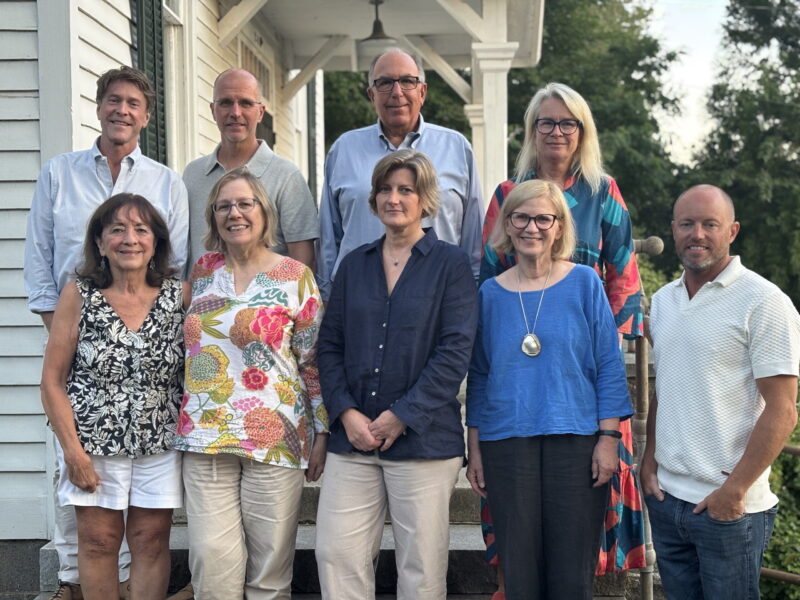
The Lyme DTC this week announced a slate of nine candidates while pledging support to two petitioning candidates. From left to right are: (back Row) John Kiker, Walter Burhans, Jim Miller and Kristina White; and (front row) Anna James, Toni Phillips, Christy Zelek, Joan Motyka and Adam Brevoort. Not pictured: Carol House and Susan Leon. Photo courtesy of Lyme DTC.

Democrat Kristina White Seeks Reelection as Petitioning Candidate for Selectman 

LYME–The Lyme Democratic Town Committee (DTC) this week endorsed nine candidates for the Nov. 4 municipal elections, while pledging support to unaffiliated petitioning candidate Christy Zelek for first selectman and Democrat Kristina White for selectman. 

The group met in a Tuesday caucus to approve its slate, according to a press release. 

Zelek will face Republican Tom St. Louis in a rare contested race for first selectman. Election data from the Secretary of the State going back 25 years shows only two elections included challenges for the town’s top spot. 

Lyme DTC Chair John Kiker said Zelek will be the town’s first female first selectman if elected. 

“Christy Zelek has the skills to do a great job as our first  selectman and has our full support,” he said. 

A list of qualifications provided by the DTC show Zelek, who has raised three children in the school system since she moved to town in 2008, has held leadership positions in parent-teacher groups at the high school, middle school and elementary school level and in the local Boy Scouts organization.

She previously served as a member of the Lyme Ambulance Association Board of Directors for four years, including two as vice president. During her tenure there, the board created and expanded an investment program; pursued grants and private funding; and updated the retirement plan with the Lyme Fire Company.

Zelek works as an administrative assistant at Westbrook Middle School.

She told Democrats on Tuesday that she looked forward to the possibility of serving as first selectman. 

“I am grateful to have received the support of the Lyme DTC. I’m running for office because I love this town. My priorities will include keeping our town the beautiful, historic place it is; keeping our financials in check;  keeping our taxes low and supporting our schools; and continuing to address our town’s capital  needs, such as our roads, bridges and town equipment,” she said. 

Lyme DTC Nominating Committee Chairperson Liz Frankel touted the slate, which includes incumbent candidates John Kiker for selectman, Jim Miller for Board of Finance and Anna James for the Region 18 Board of  Education.

“All totaled, we are supporting a group of 11 candidates for each available board and  commission opening this year to ensure our values continue to be well-represented on town  boards and commissions,” Frankel said. “We are proud to support this talented group of individuals who are  not only highly qualified, but extremely interested in serving the town we all love and cherish.” 

Frankel said state election law dictates the committee can nominate only one candidate for selectman, so Democrats will once again run Kiker on the slate while “actively supporting Kristina’s reelection as a petitioning candidate.”

“They’ve both done an excellent job on the Board of Selectmen and we want to see them both continue to serve our town,” she said.  

Connecticut’s minority representation laws prohibit more than two members of the same political party from serving on a three-member board. In Lyme, each party may nominate only one candidate for selectman.

The following candidates were endorsed by the DTC to run on the Democratic ballot line in the November election. They are all serving currently.

John Kiker – Selectman 

Jim Miller – Board of Finance (U)

Walter Burhans – Board of Finance Alternate (U)

Anna James – Board of Education 

Carol House – Planning & Zoning Commission 

Toni Phillips – Zoning Board of Appeals 

Adam Brevoort – Zoning Board of Appeals Alternate 

Joan Motyka – Library Board of Directors (U)

Susan Leon – Library Board of Directors