Though April showers may come your way, They bring the flowers that bloom in May, So if it’s raining have no regrets, Because it isn’t raining rain you know, it’s raining violets. – Al Jolson
Azaleas in full bloom are a welcome sign of the approaching summer.
April was a month of activity in the garden, and our old nemesis, weeds are beginning to rear their heads, so we need to extract the little devils before they take hold and are difficult to remove.
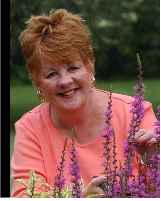
Maureen Haseley-Jones
Having said that, I must point out the benefits of many weeds. Nettles are food for butterflies, clover extracts nitrogen from the air, which is then absorbed into the soil and the oil from jewel weed soothes poison ivy rash. The young foliage of Dandelions is great in salads and when lightly cooked it tastes like spinach with the added advantage of containing many healthy nutrients.
In this group, I do not want to forget our songbirds and other wildlife who depend on weed seeds as a food source.
WEED REMOVAL
Weeds must be pulled gently so that the weeds and roots do not break apart, because if this happens, thousands of weed seeds will reseed and you will find yourself with an endless cycle of unnecessary weeding. When careful weeding has been accomplished, apply an organic weed pre-emergent, with a corn gluten base by Bradfield Organics; this natural product will keep weeds at bay for about six weeks.
ROSES, RHODODENDRONS & MORE
Day lilies bring a splash of color to spring gardens.
Plant bare root roses at the end of April or beginning of May and plant container roses in mid- May. In the middle of May when the soil temperature has reached 55 degrees, add manure and on top of the manure add a fine bark mulch about one foot from the base of the roses. Check my Early Spring tips to remind yourself on pruning roses.
Be careful clearing winter debris from around rhododendrons, mountain laurel and azaleas; these evergreens have shallow roots and do not appreciate having their roots exposed. If winter weather did erode soil around some roots, add soil to cover the exposed roots and at the same time resettle the plant in place. In the middle of May apply manure and fine bark mulch as well as some peat, which adds much needed acidity for evergreens.
Plant Gladioli corms at two-week intervals in late April. Planting in two- week intervals ensure you will get a succession of bloom. Plant the corms eight inches below the surface; this extra depth helps to keep the heavy blooms erect.
The Red Lily beetle will soon appear, and I suggest applying organic Neem oil on the Lilies when they are about four inches above ground, the oil helps to halt this beetle problem.
SOIL SOLARIZATION & MULCHING
This is an effective way to control many soil-borne problems, specifically the tomato blight that causes fruit rot. Covering the soil with clear plastic in the area where tomatoes are to be planted at the end of April, for one to two months can generate high enough temperatures in the top six to 12 inches of soil to kill pests, nematodes, weed seeds and many disease organisms like the tomato blight. This process has proved invaluable for home gardeners and the beneficial effects last for several seasons.
To solarize, dig a trench several inches deep around the soil bed, and spread a thin, clear plastic film (1-4mils) over the bed. Press the plastic into close contact with the soil and seal the edges by filling the trench with soil. Leave the plastic on the soil until you are ready to plant tomatoes or other vegetables in about six weeks.
With a soil thermometer checking to see when the soil temperature has reached 55 degrees, then manure all the borders with composted manure in bags from the garden center or aged manure from the bottom of the farmer’s pile, then mulch with a fine brown hardwood mulch. It is important to wait until the soil temperature has reached 55 degrees so that the valuable bacteria in the manure can work its magic in the soil.
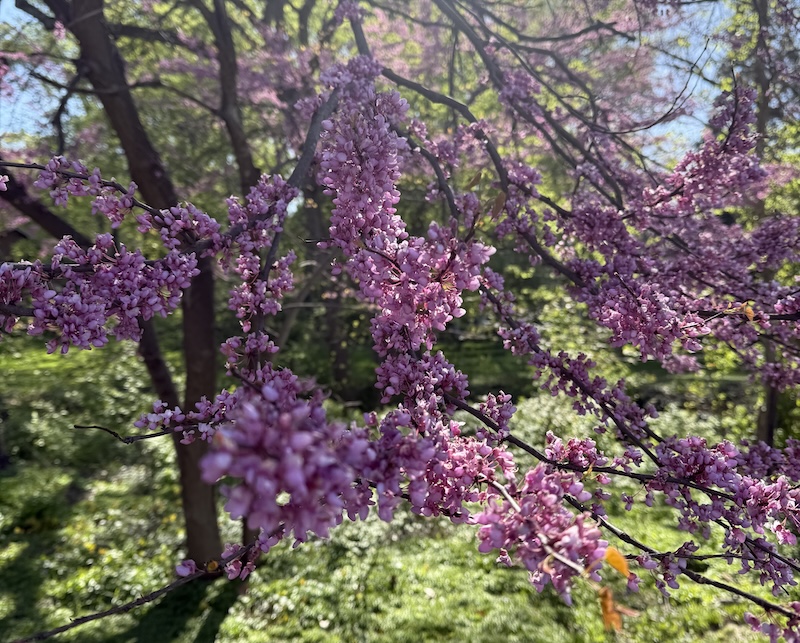
As spring temperatures rise, blossom begins to appear on trees.
In the vegetable garden, following soil preparation and planting, it is time to mulch. Mulch with composted manure that will not ‘cap,’ which means it does not form a crust like other mulches and air and water can penetrate through to the roots of the plants where it is needed for vegetable and fruit production.
If you did not apply an organic grub control on the grass in March, apply now to reduce the grubs, which is the food source for Moles; the grub control will help to cut down on the mole population.
Soil is the most important component of production in the garden; with compost, organic manure and peat to amend soil and rebuild its structure. The ratio to use is one part compost to three parts manure and apply peat to the planting mix in the ratio of one part peat to three parts manure when planting evergreens. And as mentioned above, peat adds the acidity which evergreens require.
Good soil structure assists with drainage, prevents compaction, and the rich nutrients with the amendments break down and encourage the soil animals beneath the surface to work at full capacity. In a sandy soil, humus is needed to produce micronutrients for this soil, which is the combination of manure, mulch and carbon from the atmosphere that binds the sand particles together which will produce a healthy workable soil. In heavy soil such as clay, the humus separates the clay particles which allow for air and drainage.
GROWING CONDITIONS IN LATE APRIL/EARLY MAY
These are very favorable for new plant-root development. This month is the best time to transplant evergreen shrubs and plant new evergreens. Apply composted manure and peat together with the topsoil in the planting hole. Then give the roots a workout with your hands before planting. Separating the roots in this way gives them the freedom to reach into the surrounding soil for nutrients and water remaining moist in the heat of summer.
Many years ago, when I moved into my farmhouse on the shoreline, I discovered that my soil was sandy, which is good for drainage but sadly lacking in nutrients. I began adding a few inches of manure to all planted borders in April, July and October. The result today is when I put a spade in the ground to check the color of the soil in spring it’s ‘black gold’.
Gloves should be worn when handling manure, as manure contains bacteria; the bacteria is great for the plants and the soil but not good for your health. These natural soil amendments tend to be slow acting; gradually making the nutrients available to the plants throughout the season with infinite rewards.. Composted manure is applied in spring around mid May when the soil temperature has reached 55 degrees and when the plants show about six inches of growth. This method allows the nutrients and soil animals to become active at the time when plant growth is occurring at a rapid pace.
DAFFODILS, FROSTS & ANNUALS
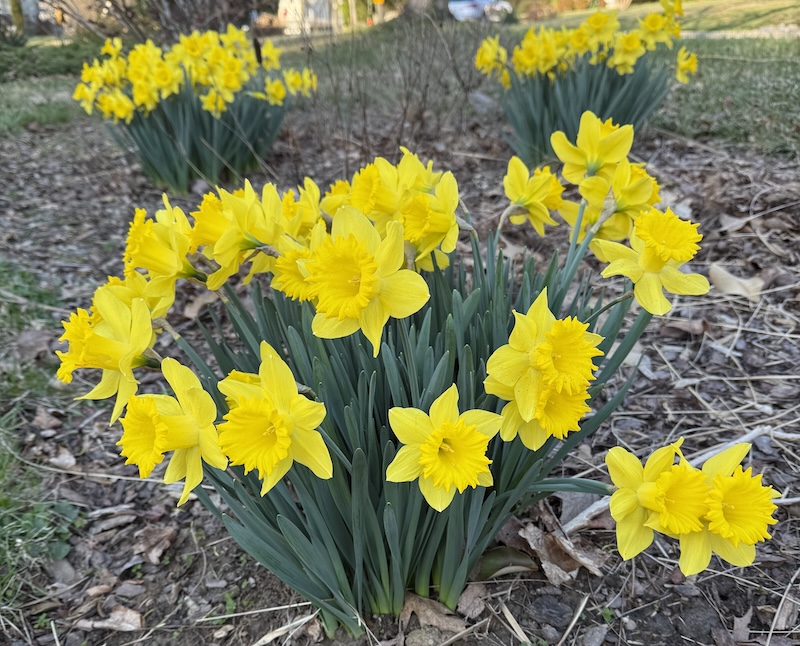
Daffodils are a sure sign of spring.
Daffodils, which are my favorite flower, are appearing in gardens and on roadways making a lovely spring time sight. When the Daffodil bloom has past, do not cut the leaves from the Daffodils or any of your spring flowering bulbs, the leaves send down energy in the form of food into the bulbs to store for next season’s growth.
This is the time to tackle a new lawn or patch seed, use only good quality grass seed, organic fertilizers and lime, which provide the alkaline, need for healthy grass growth.
Even after several consecutive warm days, frost can still occur. Having said that I suggest that you do not plant annuals until Memorial weekend. If you purchase annuals at the Mother’s Day sales, place the annual plants in a protected spot in the garden, like a wall, until planting. Do not cultivate around the perennials in the borders until mid May.
Do not panic if you are not able to get the April tasks done until May, your garden will wait for you and the constancy that is Mother Nature will continue to keep your patch of earth flourishing.
Enjoy the pleasure of being outdoors in warmer temperatures, inhaling the pungency of awakening soil and your connection with Mother Nature. Do not overdo it; warm up the body before the garden labor and stay well hydrated with lots of water.
We are inexorably entwined with the earth and know that even the smallest gesture of a garden has positive rewards; the effects are not only on you but on our planet.
It is important to have a well-thought-out plan before creating a new garden or landscape. Yo may wish to call my son Ian, who has followed in my footsteps as a landscape designer, and arrange a landscape consultation at LandscapesByIan.com
I will see you in your garden with more gardening tips later in May and if you have any gardening questions, please email MaureenHaseleyJones@gmail.com
About the author: Maureen Haseley-Jones is a member of a family of renowned horticultural artisans, whose landscaping heritage dates back to the 17th century. She is one of the founders, together with her son Ian, of, The English Lady Landscape and Home Company. Maureen and Ian are landscape designers and garden experts, who believe that everyone deserves to live in an eco-conscious environment and enjoy the pleasure that it brings. Maureen learned her design skills from both her mother and grandmother, and honed her horticultural and construction skills while working in the family nursery and landscape business in the U.K. Her formal horticultural training was undertaken at the Royal Botanic Gardens at Kew in Surrey.
Epigraph: “It’s a story they tell in the border country, where Massachusetts joins Vermont and New Hampshire;” “and they say that if you go to his grave and speak loud and clear: ‘Daniel Webster, Daniel Webster!’ “The ground’ll begin to shiver and the trees begin to shake. And after a while you’ll hear a deep voice saying: ‘Neighbor, how stands the Union?’” “Then you better answer ‘the Union stands as she stood, rock-bottomed and copper-sheathed, one and indivisible; — or he’s liable to rear right out of the ground.’”
(Stephen Vincent Benét: “The Devil and Daniel Webster.” The Saturday Evening Post. 10/24/1936.)
Tom Gotowka
How would you respond to Daniel Webster today?
The Wall Street Journal did so in an editorial published in early April: “Trump Is Trashing America’s Reputation;” which has been, “… built on its ideals and burnished over centuries as “the greatest geopolitical brand ever created.”
Moreover, legal scholars have decried Trump’s “raft of illegal executive orders and actions, declaring that we are in a constitutional crisis;”— “the President has acted unlawfully and unconstitutionally.”
This is my first “View” since the inauguration, drafted as the United States approached the end of the first 100 days of what has proven to be an unrestrained, chaotic, and cruel administration that has thrust the United States into a worldwide trade war, destroyed our relationships with longstanding allies, and substantially damaged our economy.
This is a “Ready, Fire, Aim” president, who is either getting terrible advice or acting wholly alone. His vanity tariffs arrived with a big splash and followed by a gradual retreat after they blew up in our collective American faces is a great example.
I devote this “View” to a lesson in Civics, and present a wide review of the historic and Constitutional issues that have emerged in this administration — annotated with relevant verbatim quotes from the Administration.
Part 1 includes an examination of the “Oath of Office for President of the United States,” how and why the Electoral College determines the outcome of presidential elections, the safeguards provided by the Founders in the doctrine of the separation of powers; and issues regarding the free press. I will also solve the mystery of the “swing states,” and discuss why they are so important in presidential elections.
I continue in Part 2 and discuss Presidential executive orders and pardons, attacks on Social Security and Medicaid, and the Veterans’ Administration. Finally, and very importantly, I will also consider the Alien Enemies Act; and the fourteenth, twenty- second, and twenty-fifth amendments to the Constitution.
As you proceed ahead, I want to remind you of a pertinent truism from the 60’s and 70’s. Joni [Mitchell] observed: “Don’t it always seem to go, that you don’t know what you’ve got ’til it’s gone?”
There is also a Dylan corollary, which I pray never becomes relevant: “When you ain’t got nothing, you got nothing to lose.”
As always, this “View” reflects my own thoughts and observations. Any irreverence or cynicism that sneaks by Madam Editor is mine.
Today’s Lesson in Civics:
I frequently refer to the “Founders” in this essay;—they are the group of late-18th-century American revolutionary leaders who united the thirteen colonies, oversaw the War of Independence, established the United States of America, and created our framework of government
1.The Oath of Office for President of the United States
This is the pledge or affirmation that the President takes upon assuming office. The wording of the oath is actually specified in Article II, Section One, Clause 8, of the United States Constitution: “I do solemnly swear (or affirm) that I will faithfully execute the Office of President of the United States, and will to the best of my ability, preserve, protect and defend the Constitution of the United States.”
A new president must take the oath before exercising or carrying out any official powers or duties. George Washington swore that same oath at his two inaugurations; the first of which occurred on Thursday, April 30, 1789. Chief Justice John Roberts administered the oath to President-elect Trump on January 20, 2025. Ordinarily, the President-elect has recited the Oath of Office with one hand on a Bible; although the Constitution does not specify that a bible must be used.
Trump did not place his hand on a bible, although he once used one as a prop in front of St. John’s Church on June 1, 2020 after law enforcement forcibly removed peaceful protesters during the George Floyd protests and had one for sale for $59.99 in 2014 through “Trump Retail.”
Note that to seek election to the presidency, candidates need only be at least 35 years old, a natural-born citizen, and a resident of the United States for at least 14 years.
Felons and Elections: The law is harder on voters than presidential candidates; It has been common practice in the United States to make felons ineligible to vote; — in some cases permanently. In some states, felons cannot vote for the leader of their country.
Over the last few decades, the general trend has been toward reinstating the right to vote at some point, although this is a state-by-state policy choice. Vermont and Maine allow all people to vote regardless of felony status, and most states allow all people to vote except for those who are actively incarcerated.
In Connecticut, you lose your right to vote if you are convicted of a felony. People who were incarcerated for felony convictions regain their voting rights immediately after their release; while people who have been convicted of election offenses must complete any terms of probation and parole.
2. Separation of Powers:
The Founders’ experience with the British monarchy informed their belief that assembling governmental powers in a single individual could subject the citizenry to arbitrary and oppressive government action.
Accordingly, to preserve individual liberties, they sought to ensure that a separate and independent branch of the federal government, framed in the Constitution, would exercise each of the government’s three basic functions: legislative, executive, and judicial.
Although the Constitution does not specifically refer to the principle of separation of powers, it does divide power among three branches: vesting legislative power in Congress; executive power in the President; and judicial power in the Supreme Court and any lower courts created by Congress.
In addition to this separation of powers, the founders designed a system of checks and balances to block any one branch from grabbing power.
As President-elect, Trump gave SenateRepublicans a directive, saying on his social media platform: “To all Senate Republicans: “NO DEAL WITH DEMOCRATS TO FAST TRACK NOMINATIONS AT THE END OF THIS CONGRESS.”— “I won the biggest mandate in 129 years. I will make my appointments of Very Qualified People in January when I am sworn in.” However, his margin of victory, measured by the national popular vote, is modest; even when compared with this century’s other close elections. Trump’s margin over Harris seems to have settled at about 1.6 percent; which puts him in 16th place among post-WW2 presidential victories; — just behind Jimmy Carter; — and smaller than any winner since Bush in 2000, when the margin was 0.5 percent.
J.D. Vance wrote on X that “Judges aren’t allowed to control the executive’s legitimate power.” sparking backlash from constitutional law experts, who noted that “the Vice President’s criticism of judicial rulings against the president’s agenda is ignoring the three branched separation of powers integral to the U.S. Constitution.” Vance made his statements following several court-mandated halts on key parts of the Trump administration’s agenda, creating concern that the Trump administration will ignore rulings made by one of the branches of government.
Even more upsetting, Elon Musk, far and away Trump’s top campaign donor and now “special government employee,” called for U.S. District Judge Paul Engelmayer to be impeached after his ruling early Saturday that temporarily halted DOGE employees’ access to Treasury Department data; “A corrupt judge protecting corruption,” Musk wrote. “He needs to be impeached NOW!”
In early April, Trump declared an “economic emergency” to bypass Congress and impose his worldwide “retaliatory tariffs;” — i.e. a 10 percent tariff on nearly all countries and territories, and higher levies for about 60 nations that it says are the “worst” offenders. As discussed above, his essentially unilateral action precipitated a global trade war, “tanked the stock market, and raised prices for American consumers.
“Senator Lisa Murkowski (R-AK) admits she fears retaliation for criticizing the Trump administration and says her fellow GOP colleagues are reluctant to speak out as well.”
Nevertheless, seven Republican senators have signed on to a bipartisan bill that would require Congress to approve President Trump’s tariffs on trading partners; — in supporting the “Trade Review Act of 2025.” Trump has indicated that he will veto the bill.
Trump slammed the Supreme Court after the justices temporarily blocked him from deporting Venezuelan immigrants, while declaring that America “cannot give everyone a trial,”— a bedrock constitutional right. He had previously shipped hundreds of Venezuelan men, without due process, to a notorious torture prison in El Salvador.
3. The Electoral College:
America’s founders were divided on how to pick a president. Some wanted Congress to select the nation’s leader, while others wanted citizens to vote directly. The Electoral College was created as a compromise; in part, to help ensure that the less populous states were equally valued in national elections with the larger more populous states.
Per Article II, Section 1, of the Constitution, each state gets one elector for every representative they have in Congress, both senators and members of the House of Representatives.
Electors act as representatives for the voters of their state in this “indirect popular election” system;” and so, and awfully simply, when you vote for a candidate, you are not actually voting for a President. Rather, you are informing your state on which candidate you want the state’s electors to pick. There are a total of 538 electoral votes and a candidate must win at least 270 to be elected.
The 12th amendment, ratified by the states on June 15, 1804; modified the way in which the president and vice president are elected under the Electoral College system; requiring that electors cast separate votes for president and vice president.
In New England, CT has seven electors, MA, eleven; ME, NH, and RI, four each; and Vermont, three. In contrast, California has 54 electors.
In addition, enactment of the 23rd Amendment to the Constitution in 1961 provided the District of Columbia with three electors, and declares that the District can never have more electors than the least-populous state. Forty-eight of the 50 States and the District of Columbia award their electoral votes on a “winner-takes-all basis.” So, for example, all 54 of California’s electoral votes go to the winner of the state election, regardless of the margin of victory.
However, Nebraska, and Maine award an electoral vote to the winner of each congressional district. The winner of the statewide vote gets two additional electoral votes. This “Congressional District Method” has been used in Maine since 1972; and Nebraska, since 1996.
Remarkably, it is possible to win the national popular vote, but lose in the Electoral College. In the 2016 election, Hillary Clinton won the popular vote by 3 million votes, — more than a two percent margin, while Trump won the Electoral College with 304.
This had also occurred in the 2000 presidential election, when Albert Gore Jr. lost the presidency to George W. Bush, though winning the popular vote by just 0.5 percent; — a virtual tie. 2000 was also the year that voters learned about “hanging chads” and how the U.S. Supreme Court’s 5-4 decision to stop a recount in Florida certainly determined the outcome of the election; handing the presidency to Bush.
In 2020, Biden beat the then incumbent Trump by 7 million votes, a margin of more than 4 percent. However, his Electoral College win rested on a slew of narrow victories in several key states.
Abolish the Electoral College? According to the highly respected Pew Research Center, more than six-in-ten Americans (63 percent) would prefer to see the winner of the presidential election be the individual who wins the most votes. Eight-in-ten Democrats and Democratic-leaning independents favor replacing the Electoral College; seeing the winner of the presidential election decided by whoever receives the most votes nationally. Most Republicans do not; and prefer maintaining the Electoral College as is.
Despite the interest, this is not likely to happen anytime soon. Fully overhauling the way the President is selected will require a Constitutional amendment; necessitating the votes of two-thirds of the House of Representatives, two-thirds of the Senate, and three-quarters of the states. Realistically, support of that magnitude is virtually impossible for practically anything in this severely divided United States.
Nevertheless, in mid-December, three progressive Democratic senators unveiled a constitutional amendment to abolish the Electoral College system.
Senators Brian Schatz (Hawaii), Dick Durbin (Illinois), and Peter Welch (Vermont); say “it is time to restore democracy by allowing for the direct election of presidents through the popular vote alone.” Schatz said: “n an election, the person who gets the most votes should win. It’s that simple. “No one’s vote should count for more based on where they live. The Electoral College is outdated and it’s undemocratic. It’s time to end it.”
On December 9, 2024, Trump posted on his social media podium that “The Democrats are fighting hard to get rid of the Popular Vote in future. They want all future Presidential elections to be based exclusively on the Electoral College!”
It is bewildering that he got it so wrong.
In contrast, he had tweeted on election day in 2012 that, “The electoral college is a disaster for a democracy,” and, “This election is a total sham and a travesty. We are not a democracy!” He then encouraged others to, “Fight like hell and stop this great and disgusting injustice! the world is laughing at us.”
4. The Swing States:
Thirty-eight states have consistently voted for the same party since the 2000 presidential election. Thus, it is the twelve states that do not regularly vote along party lines that receive an oversized amount of attention from candidates.
These supposed “swing,” “battleground,” or “purple” states are the highly competitive states that “swing” between the two parties in presidential elections. The group often polls in a similar fashion across presidential election cycles, although factors like changing demographics and turnout can make a traditionally red or blue state turn purple.
Accordingly, presidential candidates tend to spend more time campaigning in swing states.
John Hudak, former senior fellow at the Brookings Institution has said that “ultimately, these are the states where presidential elections are decided. It is where 75 percent or more of a candidate’s money is spent. On Election Day whoever wins the most swing states ends up becoming president.”
As above, “swing states matter because the U.S. presidential election does not happen by a national vote or a national referendum. The presidential election is fifty individual state races and a race in the District of Columbia.”
5. The Free Press:
The Founders believed a free press to be an essential freedom for a new democratic society. They acknowledged that belief in the first amendment of the Bill of Rights, protecting the right to gather information and report it to others. While at the time of ratification in 1791, the free press addressed newspapers, it now applies to all forms of newsgathering and reporting, independent of medium.
The first amendment protects Americans’ freedoms: “Congress shall make no law respecting an establishment of religion, or prohibiting the free exercise thereof; or abridging the freedom of speech, or of the press; or the right of the people peaceably to assemble, and to petition the Government for a redress of grievances.”
Of course, Trump has repeatedly raged that media outlets like the New York Times, the Washington Post, CNN, PBS, and NPR are purveyors of “fake news;” and has demanded funding cuts for both the Public Broadcasting Service (PBS), and National Public Radio (NPR): “for years, American taxpayers have been on the hook for subsidizing NPR and PBS, which he claimed spread radical, ‘woke’ propaganda and trash disguised as ‘news.”
Unbelievably, the Associated Press (AP) was banned the White House in February from press briefings and Trump media appearances because of its refusal to “align its editorial standards with President Trump’s executive order renaming the Gulf of Mexico as the Gulf of America.”
White House press secretary Karoline Leavitt, aka Cruella de Vil defended the decision: “If we feel there are lies being pushed by outlets in this room, we are going to hold those lies accountable,” the press secretary responded. “And it is a fact that the body of water off the coast of Louisiana is called the Gulf of America, and I’m not sure why news outlets don’t want to call it that but that is what it is.”
In early April, U.S. District Judge Trevor N. McFadden, a Trump appointee, ruled that the government cannot retaliate against the AP’s decision not to follow the president’s executive order to rename the Gulf of Mexico; and ordered the White House on Tuesday to restore The Associated Press’ full access to cover presidential events.
Trump has regularly criticized CBS News and its program “60 Minutes,” calling for severe penalties for the network’s reporting. He is pursuing a $20 billion defamation lawsuit against CBS, alleging that its editing of an interview with Harris constituted election interference; claiming without evidence that the network altered content to influence the electoral process and support Vice President Kamala Harris.
Recently, he accused “60 Minutes,” of referring to him in a “derogatory and defamatory way” on a nearly weekly basis, and called for the network to be taken off air. Trump said he had watched the show on April 13 and called its reports on Ukraine and Greenland, “two separate but highly inaccurate stories” about him.
Historically, the White House has not selected the members of the press pool. Rather, the White House Correspondents Association (WHCA), an independent organization of journalists, has coordinated entry in to the press pool.
However, the White House recently took control of deciding which outlets are allowed, usurping the historic role of the WHCA.
Author’s Comments: My current plan is that “A Lesson in Civics, Parts1 and 2” will be my final “Trump-centric” contributions to LymeLine; although I expect to present a related and dispassionate piece on immigration. In addition, I have promised my eight-year-old grandson, Hunter that I would investigate an issue that has recently been on his mind, — superheroes. He had just finished “Superman Smashes the Klan, a graphic novel; and We talked a little bit about the book, which he said “was a real scary story; and how cool it would be to have super powers.
Editor’s Note:This is the opinion of Thomas D. Gotowka.
About the Author: Tom Gotowka is a resident of Old Lyme, whose entire adult career has been in healthcare. He will sit on the Navy side at the Army/Navy football game. He always sit on the crimson side at any Harvard/Yale contest. He enjoys reading historic speeches and considers himself a scholar of the period from FDR through JFK. A child of AM Radio, he probably knows the lyrics of every rock and roll or folk song published since 1960. He hopes these experiences give readers a sense of what he believes “qualify” him to write this column.
Sources – A Lesson in Civics- Part 1: American Constitution Society. “More than 1,000 Law Scholars Sound Alarm on Constitutional Crisis.” [Press Release]. 02/26/2025 Baker, G. “Trump Is Trashing America’s Reputation.” WSJ. 04/07/2025 Baragona, J. “Trump’s claim that Democrats are ‘fighting hard’ to keep the Electoral College sparks confusion.” The Independent. 12/09/2024. Bauder, D. “AP wins reinstatement to White House events after judge rules government can’t bar its journalists.” AP. 04/09/2025. Bauder, D. “President Trump says CBS and ’60 Minutes’ should ‘pay a big price’ for going after him.” AP. 04/13/2025. Bolton, A, “Senate Democrats push plan to abolish Electoral College.” The Hill. 12/16/2024 Bolton, A. “Trump warns Senate GOP not to fast-track Biden nominees.” The Hill. 12/18/2024. Bolton, A. “7 GOP senators sign on to bill to check Trump’s trade authority.” The Hill. 04/07/2025. Bomboy, S. “How Congress delegates its tariff powers to the president.” National Constitution Center. 04/02/2025 Clark, S. “JD Vance Comment Questioning Courts’ Authority Sparks Backlash.” Newsweek.02/10/2025 Commander, A. “Donald Trump Hands Down New Directive to Senate Republicans.” Newsweek.12/17/2024 Dylan, R. (1965) “Like a Rolling Stone.” [Lyrics] On “Highway 61 Revisited” [LP record]. Santa Monica, CA:Universal Music Publishing Group Goitein, E. “How the President Is Misusing Emergency Powers to Impose Worldwide Tariffs.”Brennan Center for Justice.04/09/2025 Greenfield, J. “How to Finally Abolish the Electoral College.” Politico. 10/29/2024. Hall, G. “Trump Delivers Blow to CBS: ‘Disguised as News’.”Miami Herald. 04/19/2025. Hudak, J. “Why are swing states important?” Brookings Institute. 09/28/2016 Kellman, L. “The relationship between the White House and its press corps is time-tested — and can be contentious.” Associated Press. 02/12/2025. Kiley, J. “Majority of Americans continue to favor moving away from Electoral College.” Pew Research Center. 09/24/2024. Marquez, A. “Legal experts warn of ‘constitutional crisis’ as JD Vance and Elon Musk question judges’ authority over Trump.” NBC News. 02/09/2025 Mastrangelo, D. “Leavitt defends banning AP from Oval Office over ‘Gulf of America’ stance.” The Hill. 02/1/2025 Mitchell, J. (1970). “Big Yellow Taxi.” [Lyrics] On “Ladies of the Canyon” [LP album]. Burbank, CA: Reprise Records. Office of Public Affairs. “Justice Department Releases Guide to State Voting Rules That Apply After Criminal Convictions.” [ Press Release Number: 22-542] U.S. Department of Justice. 05/20/2022. Perez, A. “Trump Attacks the Supreme Court, Says America ‘Cannot Give Everyone a Trial’” Rolling Stone,04/21/2025. Policinski, G. & Paulson, K. “Freedom of the Press.” Free Speech Center. 04/19/2025. Reilly,L. “‘60 Minutes’ executive producer resigns, citing a loss of independence in the wake of Trump lawsuit.” CNN.04/22/2025 Rotondi, J. “What Are Swing States and Why Are They Critical in US Elections?” History. 01/03/2024 Diaz, J. “Trump Is the Oldest President to Take the Oath, Again.” NYTimes. 01/20/2025 Parks, M. “Abolishing the Electoral College Would Be More Complicated Than It May Seem.” NPR. 03/22/2019 Tur, K. ‘We are all afraid’: Sen. Murkowski says Republicans fear criticizing Trump.” MSNBC. 04/18/2025. The White House. “Fact Sheet: President Donald J. Trump Declares National Emergency to Increase our Competitive Edge, Protect our Sovereignty, and Strengthen our National and Economic Security.” [Press Release]. 04/02/2025 The White House. 04/14/2025.“The NPR, PBS Grift Has Ripped Us Off for Too Long.” [Press Release]. 04/14/2025
Christina and I spent a date night celebrating the Old Lyme Town Band’s 50th anniversary last night at the LOLHS Performing Arts Center — a musical tour de force.
We were impressed with the versatility and professionalism of the band members, who performed a setlist that ranged from the patriotic to “The Wiz” and a sea shanty.
OLD LYME—Saint Ann’s Episcopal Church welcomes Steve MacAusland for a talk titled, “Down the River and Through the Years with the James Bay Cree” at 9:30 a.m. on Sunday, May 4.
MacAusland will discuss how his canoe trip as a young man up the Eastmain River in Canada’s James Bay region led him to live with a Cree family for two winters and to work on a conservation project that protected one of the great natural resources of the area.
A video that MacAusland produced with WGBH Boston about this project will be shown.
All are welcome to the church at 82 Shore Road (Rte. 156).
“With These Hands: Connecting Self, Community, and the Earth” was first performed at York Correctional Institution in 2024 as the culmination of a year-long performance residency overseen by the Justice Dance Performance Project (JDPP). Graphic courtesy of JDPP.
OLD LYME — A staged reading of ‘With These Hands,’ a piece developed by incarcerated individuals at York Correctional Institution, will be performed next month at the First Congregational Church of Old Lyme.
The free performance will be held at 11:30 a.m. on May 4.
“With These Hands: Connecting Self, Community, and the Earth” was first performed at York in 2024 as the culmination of a year-long performance residency overseen by the Justice Dance Performance Project (JDPP).
Participants at York created written pieces, dances, and songs, while working with JDPP teaching artists to develop the performance.
JDPP will bring excerpts from the piece as a staged reading that includes narrative, song, and dance. The cast includes JDPP teaching artists from the project and women who are part of JDPP’s Stepping Out program for returning citizens in the community.