Hopefuls Weigh In On Affordable Housing, Shrinking Volunteer Numbers and Taxes
A snapshot of the sample ballot from Lyme’s municipal election on Nov. 4. Early voting starts Oct. 20.
LYME–A rare contested election for the Board of Selectpeople is playing out on road signs spread across the town’s serene landscape in variations of red, white and blue.
The candidates responded with a 350-word limit to four questions that we posed. We thank them for responding in a timely fashion and adhering to our rules.
Click on each name below to learn more about them in their own words.
Why are you running for the Lyme Board of Selectmen, and what skills or experiences make you the right candidate for that role?
Lyme, like the other municipalities in the state, is being called upon to increase the availability of affordable housing. What is your view on the need for affordable housing in Lyme, and how should the town balance state requirements with local calls to preserve its rural nature?
Lyme proudly relies on its volunteers to create a safe and supportive community, from fighting fires and responding to medical calls to sitting on boards and commissions. With volunteer numbers shrinking and a limited pool to pull from, what ideas do you have for encouraging more people to serve the town?
In order of importance, what do you see as the top three challenges facing Lyme over the next two years?
In Lyme, all Board of Selectpeople seats are up for election every two years. Voters will be asked to vote for one candidate for first selectperson and one candidate for selectperson. The winner of the first selectperson contest wins the title, with the next two highest vote-getters securing spots as selectpeople. State law specifies no more than two members of the Board of Selectpeople can be from the same party.
Absentee ballots for the Nov. 4 election are available now. Early voting begins Oct. 20.
In keeping with our long-held tradition, we will not be making candidate endorsements.
First selectman candidate Tom St. Louis (right) speaks at the Lyme Republicans’ candidate forum on Saturday. He is flanked by moderator Don Gerber, who is also the town engineer, and running mate Mary Powell-St. Louis.
LYME–At a Republican-sponsored candidates’ forum held Saturday with no representation from Democrat-endorsed contenders, it was left to husband-and-wife running mates Tom St. Louis and Mary Powell-St. Louis to spar among themselves.
The Democrats, under whose banner unaffiliated first selectwoman Christy Zelek is running, declined to participate in the forum. Instead, they opted to knock on doors so they could speak one-on-one with voters.
St. Louis, the Republican first selectman candidate, and Powell-St. Louis, who is running for selectwoman, headlined the forum billed by moderator Don Gerber as a “cordial event.” Gerber said there was no reason for people to be upset with each other.
“I’ll be quick to shut it down if I see that coming,” he said.
Gerber’s only opportunity to put his policy into action was decisive. It came in response to one of the roughly 30 people in the room, who asked St. Louis what he thought about his opponent’s ability to manage a budget.
“I think that it’s more appropriate to have that question answered by the candidates, who are not here, rather than for us to speak for the candidates that are running against them,” Gerber said. “So I would pass on that question.”
St. Louis thanked the resident for asking. “We really hoped to have an ongoing dialogue so that we can have that discussion,” he said.
Gerber called for the next question.
Hydrilla Hypotheses
St. Louis and Powell-St. Louis during most of the roughly 75-minute forum agreed on key issues, including the need to keep taxes low and to assert local control over zoning decisions. But one area of disagreement involved the hydrilla scourge overtaking the Connecticut River and tributaries, including Hamburg Cove and Selden Cove in Lyme.
The U.S. Army Corps of Engineers and state and regional partners are involved in a years-long project to investigate the safest, least toxic way to stem the hydrilla infestation. But the project has taken flak from critics opposed to use of the herbicide diquat in some of the test cases.
St. Louis has spent 37 years as an engineer at Pfizer, while Powell-St. Louis’ career as a physician includes roles in private practice and the pharmaceutical industry.
St. Louis said he’s comfortable with the idea of treating hydrilla with herbicides.
“I would never want to just wantonly treat a natural environment with a chemical,” he said. “But I look at this situation and say that ‘do nothing’ is not an option. We know what ‘do nothing’ entails. It means losing the cove.”
He said studies show there are no unreasonable adverse effects to human health or the environment.
Powell-St. Louis took the microphone to disagree.
“So we have a different set of opinions here, even in the same household,” she said.
She called on her background in medicine and public health, as well as her attendance at two presentations on the federal hydrilla project, to back up her skepticism.
“They’re either not revealing all the data, or the data isn’t there,” she said.
Financial Acumen
Asked by audience members for more areas of dispute between the couple, Powell-St. Louis said she’s the one with more opinions on the school district where she was elected for two terms to the school board, and where the couple sent their three sons from kindergarten through grade 12.
“I think that I probably have more knowledge and expertise, and maybe more opinions, about what has gone on within the school district,” she said.
Her husband countered that he’d likely be the one to try to “dive more fully” into Board of Finance issues, especially ensuring healthy contingency funds.
But Powell-St. Louis countered that previous experience on the school board and her current role on the building committee for a $57.5 million Lyme-Old Lyme Schools renovation project gave her plenty of insight into the issue of spending and saving.
She referenced advocacy during the spring budget planning process for the reinstatement of a music teaching position that had been stripped from a draft spending plan. Her recommendation at the time was to use a portion of the district’s reserve funds to dampen the impact of debt service on the budget in the coming years.
While the school board found savings elsewhere rather than acting on her suggestion at the time, she said the topic of how much to save was an extensive conversation at this week’s school board meeting. That’s when members decided to return more than half a million dollars of the district’s surplus to Lyme and Old Lyme to blunt the impact of future tax increases.
Powell-St. Louis credited her advocacy with keeping discussion about the reserve fund front and center.
She said while St. Louis is talking about diving into conversations about finances, she’s already orchestrated those conversations.
“Not you. I did it,” she told her husband to laughs from the crowd. “OK, so give credit where credit is due, please.”
St. Louis got more laughs when he asked “Are you done yet?”
The back-and-forth came amid criticism from the Democrats for running a married couple at the top of the Republican slate.
A post from the Lyme Democratic Town Committee on social media shows Lyme’s sample election ballot with “husband” and “wife” stickers pointing to the couple’s names.
“If this Republican husband-and-wife team is elected, the control of the Town of Lyme’s Board of Selectmen will be in the hands of one family,” the message said.
Powell-St. Louis on Saturday was adamant that the three-member Board of Selectmen is inevitably composed of three independent people with different backgrounds and areas of expertise.
“And so I have my own opinions,” she said. “I am capable of making decisions on my own independently, and I will do so, plain and simple.”
United on Housing
St. Louis and Powell-St. Louis on Saturday remained unified in their fears about the threat to local autonomy presented by looming state mandates requiring all cities and towns to take up some of the responsibility of creating new affordable housing opportunities.
St. Louis, a current member of the Planning and Zoning Commission, framed the issue as an example of government overreach that inspired him to run for first selectman.
A comprehensive affordable housing bill was vetoed by Gov. Ned Lamont during this year’s legislative session in Hartford. He promised a special session to revisit the issue.
The need for affordable places for people to live has emerged as a priority in the state as demand continues to outstrip supply. The National Low Income Coalition in its 2025 housing profile for Connecticut estimated there are 94,000 more low-income households than there are places for them to live affordably.
A home is considered affordable when the people living there don’t spend more than 30% of their income on rent or mortgage payments.
Among the provisions in the failed bill was the “Fair Share” framework, which would have required municipalities to plan for a prescribed number of affordable housing units within their borders.
St. Louis said such mandates override local zoning controls that limit residential growth to one, two or three acre lots.
“We should own our zoning code,” he said. “And so to that end, I’m going to be an advocate for the town. I’ll work with town principals. I’ll work outside the town with state representatives, representatives from other towns to make sure the governor gets the message that we want to own our land use decisions.”
He said the number of affordable housing units estimated as Lyme’s “fair share” in the failed bill ignored limitations including a lack of public water, sewers and transportation.
Powell-St. Louis stepped in with the numbers.
“So in that House Bill 5002, the recommended target number for what was called ‘fair share’ housing for Lyme was 176 affordable housing units,” she said. “176.”
“Right,” he said. “Versus the total housing units we have in town: less than 1,200.”
The forum included brief remarks from school board candidate Lannie Mossberg and alternate Zoning Commission candidate Steven Deveaux.
Absentee ballots for the Nov. 4 election are available now. Early voting begins Oct. 20.
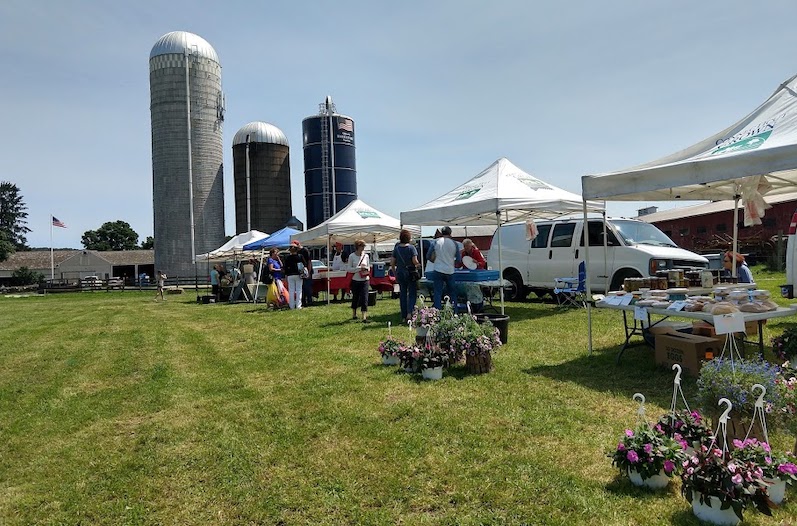
On Oct. 11, The Farmer’s Market at Tiffany Farms will be open for its final day of the 2025 season.
LYME, CT— Saturday Oct. 11 is the final day of the 2025 season forThe Farmers Market at Tiffany Farms.
It will be open rain or shine, farm field permitting.
Vegetables, fruit, meat, milk, cheese, eggs, chicken, and baked goods as well as preserves and maple syrup will be available at the farm on 156 Sterling City Road from 9 a.m. to 12:30 p.m.
Saturday’s lineup includes Chatfield Hollow Farm, Dondero Orchards, Falls Brook Organic Farm, Four Mile River Farm, From the Farm, Hooting Owl Farm, Long Table Farm, Marna Roons, Ms BeeR Haven, Space Farms Soap, Tiffany Farms Pasture Raised Beef, The Country Kitchen, Traveling Italian Chef, Wave Hill Breads and Mystic Cheese.
For more information, call the farm at 860-575-4730.
Report Notes Opposition to Affordable Housing is “Softening”
The image above shows the cover photo of Lyme’s 2025 Draft Plan of Conservation and Development.
LYME, CT— Residents continue to prize the town’s rural environment and natural resources above all else.
That’s according to the 35-page draft of the 2025 Lyme Plan of Conservation and Development (POCD), the town’s foundational planning document required by state statute to be updated every 10 years.
The draft comes as local officials and volunteers work to align the local vision of Lyme – painted as a safe, rural retreat by its residents – with state directives to spread more affordable housing options across all cities and towns.
The draft was produced as part of a roughly year-and-a-half-long process by the Lyme Planning and Zoning Commission and endorsed by the town’s Board of Selectmen last week. The draft will be filed with the town clerk and available for online review on Oct. 6, according to Planning and Zoning Commission member Carol House.
In a phone interview this week, House said the results show not much has changed since the 2015 plan.
“People like living in Lyme, and they want to keep a lot of it the way it is,” she said.
The draft update, obtained by LymeLine through a Freedom of Information request, is based largely on 704 responses to a survey distributed late last year to gauge opinions on topics including emergency services, open space and affordable housing. Eligible respondents live in Lyme, own property there, or volunteer with the local fire and ambulance companies.
House said the last survey distributed a decade ago garnered fewer than 300 responses. This time around, the commission brought back some questions for continuity while adding new definitions and questions to address emerging issues.
The draft report describes a population that remains willing to travel outside town borders for employment, shopping and services in order to keep the landscape unspoiled.
The vision statement, too, has remained largely consistent through two revisions over the past quarter century.
“Lyme will not attempt to become frozen in time, but will adjust to the demands and opportunities of modern life,” the statement reads. “As new technologies create the possibilities of new lifestyles, Lyme will adjust its regulations and requirements to allow people to work at home or to live in non-traditional family households. Change will occur as a result of our changing society, but in a way that preserves Lyme’s quality of life and natural resources.”
Still, House pointed to subtle shifts in the outlook among residents.
Among them is a “softening” of opposition to affordable housing, according to the draft report. Authors cited an almost 19% increase among residents in favor of using town funds to increase housing options. But they acknowledged supporters, who totaled 47.9% of respondents in the survey, still do not represent a majority.
The draft also shows new survey questions implemented this year revealed priorities not previously explored: that respondents “place a very high value on Lyme’s low crime rate and the ability to remain in their homes and community as they age.”
House, who serves as a co-chair of the town’s Affordable Housing Commission as well, said the POCD will provide guidance for the group tasked with figuring out how to diversify housing options in town. The commission has held off on proposing or implementing new plans while waiting to see what the surveys and final planning document had to say about the town’s appetite for change.
“I think all of that together will provide a clearer picture for how we need to move ahead with affordable housing,” she said.
First Selectman David Lahm in a Thursday phone interview said the “will of the people” is evident in the draft document.
“Open space is still the priority,” he said.
That doesn’t mean affordable housing is not an important factor, according to Lahm. He said survey responses show that encouraging accessory dwelling units (ADUs) – also known as in-law apartments, guest houses and granny pods – and affordable single-family homes can be a solution in town.
“The one thing they are not in favor of is multi unit housing,” he said.
The town’s environmental ethos has remained unchanged since the publication of the first plan in 1964, when town leaders laid the groundwork for a focus on farming and conservation they hoped would keep the town’s population of 1,300 relatively steady despite the completion of nearby Interstate 95 only a few years prior.
At the time, they feared the town’s inhabitants could number 5,000 by 1990 if left unchecked. So they put in zoning and subdivision controls restricting commercial development to existing areas in Hamburg and Hadlyme while keeping large tracts of undeveloped land intact.
Today, U.S. Census figures count the population today at 2,352 people. Land records show more than half the town’s land mass is preserved as open space.
Minimum lot sizes in Lyme now range from one to three acres across town in order to limit how many homes can be built. Only 4% of respondents said they believed smaller lot sizes should be allowed.
The document calls for Lyme’s “aggressive sewer avoidance program” to continue, with regular inspections and maintenance of septic systems and required pumping.
The draft is being presented against the backdrop of a state vision, outlined in the Connecticut Conservation and Development Policies Plan, that describes thriving economies and increased affordable housing as key components of sustainable, equitable, vibrant and resilient communities.
According to the plan’s authors, Lyme’s vision is in keeping with state goals for conservation and development.
“The State Plan is based on an overall philosophy of anti-sprawl, directing growth to those areas of Connecticut where infrastructure such as roads, public water and public sewers already exists, or where infrastructure can easily be expanded,” the document reads. “The State’s Plan also recommends that extensive growth be avoided in sensitive environmental areas and areas where little infrastructure exists. Lyme’s Plan meets both criteria.”
The draft POCD, stating that “uncontrolled growth and poor planning” can drastically change a town, emphasized the need to act in ways that preserve Lyme’s rural atmosphere.
Recommendations include increasing the availability of housing by converting existing homes into affordable units, promoting ADUs and creating design standards for residential development.
The plan continues to support farming, farm markets and work-from-home enterprises. Recommendations include limiting commercial development to existing zones while investigating regulations “that support local tradespeople, certain essential service providers and farm stores.”
The draft report acknowledges more than 50% of land in town is protected as open space, but cautioned there’s still a lot of room for growth: “If future development on Lyme’s remaining available land is not carefully monitored and controlled, Lyme could quickly be transformed into a more suburban town.”
Recommendations call for strengthening land use regulations, preserving open fields and cultural features, maintaining an inventory of historic sites, and educating residents about sensitive areas. Farmland should be safeguarded through policies that protect the town’s agricultural roots and promote local food production. Open space preservation should focus on large, connected tracts managed for biodiversity through dedicated funding in partnership with local, regional and state groups.
The POCD survey for the first time includes questions about emergency services, which exist locally as the publicly funded Lyme Fire Department and privately funded Lyme Ambulance Association.
Respondents supported continuing the volunteer-based models for the fire department and ambulance association, according to the draft report. Ambulance company leaders during a stakeholder interview said taxpayer funding for facilities and equipment will become necessary in the coming years.
Data in the report puts the number of ambulance association calls at 300 per year. The Town provides one bay in each firehouse, fuel for the ambulances, workers compensation coverage and a pension plan for those who qualify. The nonprofit organization’s operating costs and capital expenses for vehicles and equipment are funded by donations and by billing insurance companies.
Lahm credited the POCD writing committee, consisting of House, David Tiffany, Jennifer Tiffany and Mary Stone, for a job well done.
“They put a lot of hard work into that and came up with a good product,” he said.
A public hearing must be held no sooner than 35 days from the filing of the plan with the town clerk. A date has not yet been set, according to House. She said the commission hopes to schedule two hearing dates to ensure as many people as possible can participate.
The draft document will then go back to the Planning and Zoning Commission for any revisions and a final vote before the new year, House said.
OLD LYME –The Lyme-Old Lyme boys and girls soccer teams were on opposite ends of a rout in games this week.
The boys’ team held North Branford scoreless Thursday in a 8–0 Shoreline Conference game.
Ian Maeby and Menzi Mbele scored twice, with Colman Curtiss-Reardon, Elliot Dunn-Sims, Evan Coffee, and Sam Edmed each contributing goals. Assists came from Curtiss-Reardon, Maeby, Mbele, and Rowan McCormick.
Goalkeeper Liam McCormick made four saves and North Branford keeper Colby Rodman made eight.
The Wildcats are now 5–4–1 overall and 4–3–1 in conference play.
Wednesday, the Lyme-Old Lyme girls fell 7–1 to undefeated Bacon Academy.
Old Lyme’s lone goal came from Adrian Raby on an assist from Avery Spooner. In goal, Grace Osborne made one save and Ivy Wilson made four.
Bacon Academy saw three goals from Quinn Guntulis, two from Alyssa Blanchette, and one each from Ava Galante and Hannah Ferriglo. Guntulis had one assist. Goalkeeper Gabi Dontri made six saves.
The girls’ record is 4–6–2 in the Shoreline Conference.