
In It Together: College Drinking — Rite of Passage or Risky Business?

Photo by Meritt Thomas on Unsplash.

Underage college drinking is a significant public health problem, and it exacts an enormous toll on the intellectual and social lives of students on campuses across the United States. Drinking at college has become a ritual that students often see as an integral part of their higher education experience.

Many students come to college with established drinking habits, and the college environment can exacerbate the problem. 

About one in four college students report academic consequences from drinking, including missing class, falling behind in class, doing poorly on exams or papers, and receiving lower grades overall.

In a national survey of college students, binge drinkers who consumed alcohol at least three times per week were roughly six times more likely than those who drank but never binged to perform poorly on a test or project as a result of drinking, and five times more likely to have missed a class.

Although the majority of students come to college already having some experience with alcohol, certain aspects of college life, such as unstructured time, the widespread availability of alcohol, inconsistent enforcement of underage drinking laws, and limited interactions with parents and other adults, can intensify the problem.

In fact, college students have higher binge-drinking rates and a higher incidence of driving under the influence of alcohol than their non-college peers.

The first six weeks of freshman year are a vulnerable time for heavy drinking and alcohol-related consequences because of student expectations and social pressures at the start of the academic year. 

How much is a drink?

To avoid binge drinking and its consequences, college students (and all people who drink) are advised to track the number of drinks they consume over a given period of time. That is why it is important to know exactly what counts as a drink.

In the United States, a standard drink is one that contains about 14 grams of pure alcohol, which is found in:

  • 12 ounces of beer with 5 percent alcohol content;
  • 5 ounces of wine with 12 percent alcohol content;
  • 1.5 ounces of distilled spirits with 40 percent alcohol content.

Unfortunately, although the “standard” drink amounts are helpful for following health guidelines, they may not reflect customary serving sizes. A large cup of beer, an over-poured glass of wine, or a single mixed drink could contain much more alcohol than a standard drink. 

Factors related to specific college environments also are significant. Students attending schools with strong Greek systems and with prominent athletic programs tend to drink more than students at other types of schools.

In terms of living arrangements, alcohol consumption is highest among students living in fraternities and sororities and lowest among commuting students, who live with their families.

An often-overlooked preventive factor involves the continuing influence of parents. Research shows that students who choose not to drink often do so because their parents discussed alcohol use and its adverse consequences with them.

Ongoing research continues to improve our understanding of how to address the persistent and costly problem of harmful and underage student drinking. Successful efforts typically involve a mix of strategies that target individual students, the student body as a whole, and the broader college community.

For more information and resources, contact Alli Behnke, Prevention Coordinator at LYSB, abehnke@lysb.org   www.lysb.org/prevention

Article source: NIH

Alli Behnke

About the Author: Alli Behnke, MSW, MA is the Prevention Coordinator at Lymes’ Youth Service Bureau. She has been a Social Worker for 20 years working in the fields of prevention, therapy, youth leadership, and health coaching. Alli believes strongly in providing accurate information, education, and tools for success when empowering the Lyme/Old Lyme Prevention Coalition and REACH Youth Coalition to work together on strengths-based campaigns. The Coalitions address substance abuse and other risky behaviors challenging our youth and families. Contact her at abehnke@lysb.org or visit  www.lysb.org to become involved in this important community work.
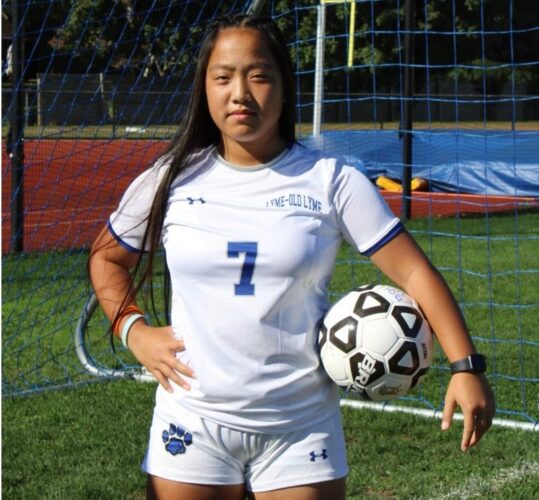
Girl’s Soccer: With Six Goals in Four Games, Fenton Continues Her Scoring Ways as Old Lyme Defeat H-K

Alexis Fenton has been a major feature in Old Lyme’s scoring success this season.

LYME/OLD LYME — The Old Lyme girls notched another victory this past Thursday (Oct. 7) afternoon moving to a season record of five wins, four ties and no losses. Playing Haddam-Killingworth (H-K) away, and although down one goal at the end of the first half, Old Lyme ended the game with a 3-1 victory.

H-K scored the lone goal in the first half off a deflected corner kick.

Then in the second half, Old Lyme’s Kate Walsh scored off an assist from Steph Mauro within the first five minutes in the second half. Alexis Fenton followed with an unassisted goal with seven minutes left to play and Ella Curtiss-Reardon scored the final goal off a ball from Kate Walsh with 3:21 left in the game.

Freshman goalie Olivia Kelly made seven saves for Old Lyme.

On Monday, Oct. 4, the Wildcats faced East Hampton away, where again, although level 1-1 at the half, they came through to secure a 2-1 victory.

Fenton scored less than a minute into the game from a pass by Ali Kyle. Then East Hampton scored off of a corner kick that went into the goal off an Old Lyme player with 22 minutes left in the half.

Fenton scored with a ball over the goalie’s head after a through ball from Lyla Powers in the second half to win the game.

This time, Kelly had nine saves for Old Lyme.

The previous Thursday, Sept. 30, the girls drew at home 0-0 with Cromwell, with Wildcat goalkeeper Kelly making eight saves for Old Lyme and junior Lily Kenney having six for Cromwell.

Going all the way back to Tuesday, Sept. 28, Old Lyme — playing at home — met Coginchaug and ended the game with a emphatic 3-0 victory and moreover, all three goals were scored by the same player, namely, Alexis Fenton.

The half-time score was 1-0 after Fenton scored unassisted with 26:53 left on the clock.

Fenton scored another goal in the second half, again unassisted, and this time with 36:15 minutes remaining.

Completing her hat-trick, Fenton scored a third time, but assisted by Callie Bass on this occasion, with 11:03 minutes to play.

Meanwhile, Kelly had six saves for Old Lyme, while junior goalie Emma Samperi made nine for Coginchaug.

Oct. 6 COVID-19 Update: CT DPH Corrects Lyme’s Cumulative Total Back to 129, One New Case in OL Takes Its Total to 430

Photo by CDC on Unsplash,

LYME/OLD LYME — The Daily Data Report issued Wednesday, Oct. 6, at 4 p.m. by the Connecticut Department of Health (CT DPH) shows one new confirmed COVID-19 case in Old Lyme over Tuesday’s number of 429, taking the cumulative total for the town to 430.

The data shows that in Lyme, however, the cumulative total of cases has been reduced from the 130 reported Monday, Oct. 4, and Tuesday, Oct. 5, to 129. This means that there have now been no new confirmed cases in Lyme since Sept. 13. We have been unable to obtain any information regarding how a previously confirmed case (the 130th) was subsequently deleted by the CT DPH.

The state does not issue reports over the weekend. Its next report will be Thursday, Oct. 7, at around 4 p.m..

On Aug. 26, Old Lyme’s cumulative case total stood at 372, meaning there have been 58 new cases there since that date. Meanwhile, Lyme’s cumulative total on Aug. 26 was 114 indicating 15 new cases have also been confirmed there during the same period.

Lyme-Old Lyme Schools started the new academic year Aug. 26.

COVID-19 Cases in Lyme-Old Lyme Schools

This is the latest information that we have with the most recent cases first — there may have been further updates, however, which we have not yet received.

On Wednesday, Oct. 5, Lyme-Old Lyme Schools Superintendent Ian Neviaser informed the school community that a positive case of COVID-19 impacting Lyme-Old Lyme High School had been reported the previous evening.

On Thursday, Sept. 16, Neviaser informed the school community that a previously reported positive case of COVID-19 is now impacting Mile Creek School and Center School.

On Monday, Sept. 13, a positive case of COVID-19 impacting Lyme-Old Lyme Middle School, which had been reported the previous day, was announced.

On Wednesday, Sept. 1,  a positive case of COVID-19 impacting Mile Creek School was announced.

On Tuesday, Aug. 31, Neviaser informed the school community that late on Monday, Aug. 30, a positive case of COVID-19 impacting Lyme-Old Lyme High School had been reported.

On Saturday, Aug. 28, Neviaser informed the school community that late on Friday, Aug. 27, a positive case of COVID-19 impacting Lyme School had been reported.

In all cases, contact tracing was completed and those individuals who needed to quarantine were notified. They will be able to return to school following their quarantine period. All other students and staff will continue to attend school as scheduled.

Fatalities Due to COVID-19 in Lyme, Old Lyme

There is no change in the number of fatalities reported in either Lyme (0) or Old Lyme (3).

The first two fatalities from Old Lyme, which were reported in 2020, were a 61-year-old female and an 82-year-old male. Details of the third, which was reported in 2021, have not been made available.

Visit this link for our Sept. 30 update, which includes statewide data.

Letter to the Editor: Colwell’s Beliefs, Her Endorsement by Old Lyme RTC, Raise Serious Questions

Editor’s Note: Commenting on this letter is now closed. Thank you all for a lively debate on this letter.

To the Editor:

The candidates chosen by a town’s political committee to run in an election must be assumed to reflect the beliefs and platform of that committee.  For example, Old Lyme’s Republican Town Committee has endorsed Mona Colwell for election to the Board of Education.  According to her Facebook page, Mona questions what brought down the World Trade Center, regarding which she wrote, “Will we ever know the truth?  Does it even matter?”  Another example is our 2018 gubernatorial election, which Ned Lamont won by 44,372 votes.  Not so, says Mona: “I do believe the election was rigged when thousands of UConn students were bussed in and through other means.”

To illustrate Mona’s logic of thinking, she asks on Facebook: “. . . someone PLEASE explain to me . . . how is a non-vaccinated person a threat to a vaccinated person? . . . What am I missing here, other than tyranny?”  Is she unaware that unvaccinated, infected people infect others, whether vaccinated or not, and that the spread of infections throughout the country provides the breeding ground for serious mutations?

Mona should not be making decisions for our children, and the RTC’s judgment in endorsing candidates should not be trusted.
Sincerely,
Aaron Emma,
Old Lyme.

Letter to the Editor: Unaffiliated Matt Ward Endorsed for Selectman by Old Lyme Republicans Due to His Integrity, Community Involvement

To the Editor:

The members of the RTC of Old Lyme have enthusiastically endorsed Matt Ward, an unaffiliated voter, as our candidate for Second Selectman in November’s municipal election. This choice was made because we felt Matt’s values of integrity and community involvement closely matched the needs of the town. Matt’s history as a resident of Old Lyme is replete with examples of his commitment to the town. He served 3 years on the Board of Directors of the LYSB, 10 years on the LOL Little League, and many other town activities. In addition, Matt is a Planning Commission Alternate. 

Matt has recently retired after 20 years as a State Police Officer. Matt and his wife Tara, well known in the community, have five children in the school system. He is a man of great energy, integrity, and commitment to our town. I ask you to elect Matt Ward as our Second Selectman on November 2nd.

Sincerely,

David Griswold,
Old Lyme.