

Lyme Academy Returns to its Roots with New Programs for Serious Art Students; Exhibitions, Classes for Community

The all-new Core Program at Lyme Academy of Fine Arts focuses on foundational artistic skills in drawing, painting and sculpture in the figurative tradition.

OLD LYME — The Lyme Academy of Fine Arts has officially reopened with a renewed dedication to the mission first articulated by its Founder, sculptor Elisabeth Gordon Chandler. The Academy was created in 1976 as an institution dedicated to the traditional, skills-based art education first taught in the Renaissance academies of Europe and later at Paris’s École des Beaux-Arts.

With this return to its roots, the Academy begins the academic year with the launch of a new Core Program of study for full-time students, which will commence in late September. Led by the husband and wife team of Jordan Sokol and Amaya Gurpide, who serve as Co-Artistic Directors, a dynamic new faculty of internationally-acclaimed instructors will teach students the foundational skills on which they can build a career in the fine arts.

Artistic Director and Director of Painting, Jordan Sokol (left) and newly-appointed Painting-Drawing Instructor, Hollis Dunlap — himself an alumnus of Lyme Academy College of Fine Arts — working in the Southwick-Keller Studio at Lyme Academy of Fine Arts.

Enrollment for the 2021-2022 academic year is now open and applications will be accepted on a rolling basis throughout the academic year.

The Academy’s Core Program is comprehensive and intense: classes are conducted five days a week, from 9 a.m. until 9 p.m. with weekly supplementary instruction in anatomy, sculpture, and the history of art. Landscape, still life and portraiture are included in the program, as are dedicated explorations of the properties of light and form.

Students work in custom north-lit studios, honing their technical skills through the direct observation of imported European plaster casts and live models. Intimate class sizes allow for in-studio demonstrations and individualized critiques, as well as guided museum and gallery visits. Faculty and guest lectures are regularly scheduled, many of which are open to the public.

The Core Program will run on a trimester schedule with the first (Fall) trimester beginning on Sept. 27, of this year. The cost per trimester is $3650, with scholarship opportunities available.

“We’re looking for students who want to apply themselves and work hard to grow and develop” said Sokol, himself an accomplished painter, continuing, “You’ve got to be willing to put in the thousands of hours required if you are serious about developing your talent. There are no short-cuts.”

It is anticipated that most students will study for three years, although some will pursue a shorter course of study and others longer, depending on their individual objectives and the progress they make developing their skills.

“As in the original vision for Lyme Academy, the institution will no longer confer Bachelor’s degrees. In the place of seat-time requirements for credit accumulation, students will instead focus on skill-building with an eye towards mastery, fully preparing our students for the 21st century art world,” the Academy’s Executive Director, Mora Rowe, said.

She added, “In addition to our Core Program, we are planning a full spectrum of public programming, which will include gallery openings, exhibitions, part-time classes, workshops, lectures, cultural events, and more. Our partnership with the community along with the accessibility and openness of our campus are of the highest priority.”
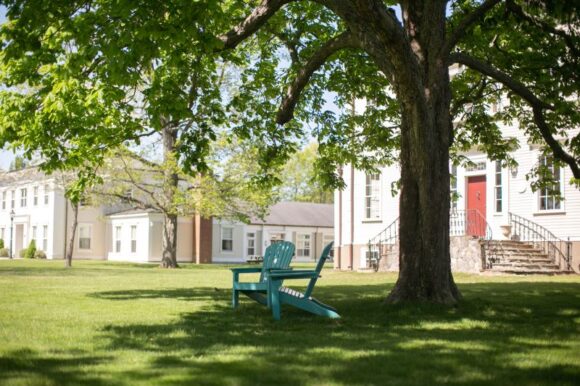
Lyme Academy of Fine Arts features 40,000 sq. ft. of studio and teaching space on the sprawling four-acre campus located in the heart of Old Lyme.

Two additional educational programs are currently under development. Firstly, the Academy will offer a Continuing Education program focused on students of all ages and abilities to benefit from a skills-based curriculum, with a choice of year-round study or individual classes. And secondly, a Portfolio Preparation program is also under development, which will be designed to provide a solid, skills-based visual education to develop one’s portfolio and abilities under the leadership of professional artists.

The Lyme Academy of Fine Art will host quarterly Gallery Openings beginning with the first exhibition, Memento Vivere, on Oct. 16. This invitational group exhibition will be curated by Sokol and Gurpide, and will also have the additional role of being an Inaugural Fundraiser for the Academy. The Memento Vivere exhibition, located in the Chauncey Stillman Gallery, will be open to the public from Oct. 17 through Dec. 10.

Lyme Academy is located midway between Boston and New York at 84 Lyme St. in Old Lyme, Conn. The town has been a site of artistic congregation for over a century after evolving as the heart of the Lyme Art Colony, which led to it becoming the Home of American Impressionism.

Visit this link for more information about Lyme Academy of Fine Arts or call 860.434.5232.

A View From My Porch: Continuing the Tikka Saga — with Slides of Trips to the UK

The London skyline by night with St. Paul’s Cathedral at center left. Photo by Nick Fewings on Unsplash.

Clearly, we all need a break; this lighter essay is mine.

In August, LymeLine published a recipe for chicken tikka masala from Lee White cooked in an “Instant Pot.” We made the dish, pictured below, with her recipe and found it to be an authentic and tasty interpretation of the “British staple.”

Christina and I enjoy the aromatic spices, and have some “history” with cilantro. We added steamed celery, carrots, and peas to Lee’s dish; as we often do with curries.

Coincidentally, chicken tikka masala is my “go-to” entrée in Indian restaurants, since it can be spiced mild to medium. Christina has a much more adventurous palate, and has been known to order a curry, “India spicy”, which usually piques the interest of the restaurant staff, who may hover nearby until she tastes the dish. I’ll eat all the naan; she won’t need it.

We were introduced to tikka on our first trip to England, where we visited my daughter, Erin’s (then) home in the Roman walled city of Chester, which also served as our base for Liverpool, London, and the broader countryside. 

There is no shortage of restaurants highlighting the cuisine of the subcontinent in London. Our choice was just over the London Bridge, near the entrance to the Borough Market; which, alone, is worth a visit.

I look to Madame Editor to corroborate or correct the following: former British Foreign Secretary, Robin Cook, described “tikka” as “the true British national dish.” Erin agreed, but not wholeheartedly; and went further and informed us that legend has it that the recipe actually originated in Glasgow, by Bangladeshi chefs, who created it to provide an alternative to their traditional, spicier dishes for the milder Scottish palate. 

I was surprised with the above, because I would have assumed that the national dish would be bangers and mash, fish and chips, or a bacon bap from a vendor in a train station.  I’ll defer to Madame Editor.

Author’s Notes: For the unfamiliar, an Instant Pot (IP) is, a relatively new small kitchen appliance that houses both a pressure cooker and a slow cooker. As Lee noted in her recipe, you can also sauté or brown meats in the IP. In our household, we use it once or twice a month

Here are a few vacation slides; actually, the captions.

  • We walked the Roman Wall in Chester and watched a lacrosse match at the Queen’s School for girls, which was founded in 1878, and renamed in 1882 as the “Queen’s School”, by decree of Queen Victoria, the school’s first patron
  • We were regularly within sight of the Queen Victoria Clock Tower at Chester’s East Gate. Built to celebrate Queen Victoria’s diamond jubilee, it is said to be the most photographed clock in England (after Big Ben).
  • We strolled along the canals in Chester and were impressed with the “fleets” of narrow boats, which are canal boats serving both as cruisers and residences.  
  • We visited both Penny Lane and the Cavern Club in Liverpool. The former has a famous barber; while the latter is known as the birthplace of the Beatles.
  • We visited the Roman Baths in Somerset, constructed in 70 A.D., and now considered one of the best-preserved historic sites in Roman Britain.
  • We visited the magnificent St. Paul’s Cathedral.
  • We saw the Rosetta Stone and the Pompei exhibit at the British Museum.
  • We shopped in Harrods and viewed the memorial to Princesss Diana and Dodi Fayed, which has since been removed. 
  • We visited the Churchill War Rooms, including the broadcast room where the PM recorded his wartime messages to the British public.
  • We visited some magnificent gardens on country estates, and much smaller, but meticulously maintained home gardens, whose gardeners were very willing to discuss local horticulture with we yanks. 
  • On Anglesey Island, in Wales, we were surprised to see moored sailboats with their keels resting on the seabed at low tide. We visited a church on a small off-shore island accessible only at low tides.

We want to return to the UK. And spend more time in Wales with Erin and her husband, RAF Squadron Leader Rugg, and perhaps fit Scotland into the itinerary.

Editor’s Note: i) This is the opinion of Thomas D. Gotowka.

ii) Growing up in England during the second half of the 20th century, there is no doubt that during my early years fish and chips, bangers and mash, or roast beef and Yorkshire Pudding were variously regarded as the national dish. Mr. Gotowka is correct that by the 70’s or 80’s curry in all its forms had become a major feature of the British culinary landscape. I am honestly not sure what would be considered the national dish at this point … I will consult with friends and family still located there and report back!

Tom Gotowka

About the author: Tom Gotowka’s entire adult career has been in healthcare. He’ will sit on the Navy side at the Army/Navy football game. He always sit on the crimson side at any Harvard/Yale contest. He enjoys reading historic speeches and considers himself a scholar of the period from FDR through JFK.

A child of AM Radio, he probably knows the lyrics of every rock and roll or folk song published since 1960. He hopes these experiences give readers a sense of what he believes “qualify” him to write this column.

Reading Uncertainly? ‘Troubles’ by J. G. Farrell is a “Compelling Read”

When a world is collapsing all about us, how much are we willing to recognize?

J. G. Farrell’s description of a veteran of the World War I trenches going to Ireland to rejoin a young lady he had met only once in London during the War is an allegory on human inertia and lethargy in the face of rapid change.

In 1919, Major Brendan Archer travels from London to Kilnalough, Ireland, thinking to ask Angela Spencer to join him in marriage, even though he could not remember ever asking her outright to do so. He finds an elusive young lady and a scene of inertia and decay.

Ireland has entered the “Troubles” with Sinn Fein pushing for complete separation from the British Empire. And that Empire is collapsing just as the Majestic Hotel, owned and operated by Angela’s father, Edward, the scene of the entire novel, is doing the same.

Farrell gives us the Hotel dominated by “dust.” Every page describes dust, “mould”, gloom, creepers, grime, cobwebs, collapsing floors, “man-eating” plants, and an ever-expanding entourage of reproducing cats. One room featured “an enormous greyish-white sweater that lay in one corner like a dead sheep.”

The weather wasn’t any better: “it rained all that July,” and the hotel residents complained of the coming  “dreadful gauntlet of December, January, February.” Both the hotel and Ireland exuded “an atmosphere of change, insecurity and decay.” But the residents continued to follow life’s rituals: prayers at breakfast, afternoon teas, dressing for dinner, and whist in the evening.

Add to this mordant scene the author’s interjection of gloomy news reports from around the world: White Russians and English military supporters being trounced in Russia, victorious Boers in South Africa, a mess in Mesopotamia and Egypt, rebellion in Poland, and, finally, the Indians attempting to remove themselves from British rule.

In the face of all this, the hotel’s owner and operator, Edward Spencer aggravates the Major: “ … his overbearing manner; the way he always insisted on being right, flatly stating his opinions in a loud and abusive tone without paying any attention to what the other fellow was saying.”

Does this also describe the Brits in other sections of the world?

The Major remains always a drifter “with the tide of events,” never able to respond, dominated, it seems, by “the country’s vast and narcotic inertia.”

This is a story of the collapse of a hotel, descending at last into ashes, and an allusion to the similar collapse of the British Empire, with the Second World War being its enormous fire. It is a compelling read, one that suggests some connections to the events of the second decade of the 21st century …

Editor’s Note: ‘Troubles’ by J. G. Farrell is published by Weidenfeld & Nicolson, London in 1970.

Felix Kloman

About the Author: Felix Kloman is a sailor, rower, husband, father, grandfather, retired management consultant and, above all, a curious reader and writer. He’s explored how we as human beings and organizations respond to ever-present uncertainty in two books, ‘Mumpsimus Revisited’ (2005) and ‘The Fantods of Risk’ (2008). A 20-year former resident of Lyme, Conn., he now lives in Peabody, Mass. He writes book reviews, mostly of non-fiction, a subject which explores our minds, our behavior, our politics and our history, but he does throw in a novel here and there. For more than 50 years, he’s put together the 17 syllables that comprise haiku, the traditional Japanese poetry, and served faithfully as the self-appointed “poet laureate” of Ashlawn Farm Coffee. His late wife, Ann, was also a writer, but of mystery novels, all of which begin in a village in midcoast Maine, strangely reminiscent of the town she and her husband visited every summer.

The Movie Man: Craig is Captivating, Seydoux is Stunning, But ‘No Time To Die’ Fails to Live Up to Expectations

Daniel Craig at the film premiere of ‘Spectre’ in Berlin. This file is licensed under the Creative Commons Attribution 2.0 Generic license.

Special to LymeLine.com

Kevin Ganey is ‘The Movie Man.’

This is a special review for me.

My first ever published piece as a writer was a review for the previous Bond film, Spectre. Much has transpired since then, both for me and the world.

But the appreciation of the art of cinema, manifested in many forms, remains as we struggle with whatever trouble life throws our way. Paraphrasing Mel Brooks, it’s, “Just another defense against the universe,” and a defense that has a special place in my heart.

Bond films are not known for their groundbreaking, cinematic expertise, even if they do consult Stanley Kubrick for lighting (The Spy Who Loved Me, 1977). Yet, they remain a necessity for the movie-going experience. Indeed, there were plenty over the years that pushed boundaries and blew us away.

But No Time to Die is not among those ranks.

Apart from being another installment in the Bond franchise made for the sake of pure entertainment, this one is necessary for screening since it is the final performance of Daniel Craig, who, I will proudly assert, is the best performer to take on the role of Ian Fleming’s iconic spy.

I will praise the movie on three separate counts. Two of them being characters and the other being a driving force for the plot.

Craig’s final run as Bond is indeed the most vulnerable of the 25 occasions the character has graced the silver screen, often portrayed as hardened man, who turns to booze, pills, and sex as a coping mechanism for years of trauma.

Then there is Léa Seydoux, who is the only actress to reprise her Bond girl character from a previous movie. For the record, yes, Maud Adams appeared in two films, but as two separate characters, namely Andrea Anders in The Man with the Golden Gun and the title character in Octopussy.)

Seydoux is, without question, the most sophisticated of all the women, who have blown the world away with their beauty alongside Bond, and she has now provided additional reasons for us to remember her contribution to the franchise.

While I can praise Craig and Seydoux, the same cannot be said for the film’s villains (Academy Award-winners Christoph Waltz and Rami Malek), who simply cannot live up to their performers’ hypes.

Then there is the plot.

Upon screening it, viewers will pick up on some hackneyed elements. But the danger is perhaps the most authentic since Goldfinger (in which the title character seeks to detonate a dirty bomb inside Fort Knox and the subsequent contamination of the gold thus wrecking the US economy.)

Why repeat the evil plans of the third film? Simply put: to remind the reader how impressive it is.

I close this review by thanking Craig for breathing new life into a character. When he took on the role, he transformed Bond from the occasionally campy figure to the gritty, no-nonsense, adrenaline-pumping performances he gave for an era dealing with new forms of international turmoil.

Will he read this? Very unlikely (unless he decides to scavenge local, online newspapers throughout the world), but I can dream, can’t I?

Again, thank you, Daniel Craig. The history of cinema will unquestionably look kindly on you.

About the Author: Though no longer a resident of Lyme, Kevin knows he can never sever his roots to the tree of his identity. When not attending to his job in Boston, he is committed to ensuring a better grasp of current (and past) releases of cinema to his home community as he strives to leave his own mark in the same field that has always been his guide to understanding life. If you enjoy his published reviews here on LymeLine.com, follow him on his new website at ‘The City of Cinema and read more of his unique insights into entertainment.

Old Lyme Soccer Girls Crush Westbrook 5-0

Freshman Kate Walsh passes the ball to senior Abby Manthous in Monday’s game against Westbrook. All photos by Elizabeth Mauro.

OLD LYME — Playing on their home field Monday afternoon, the Old Lyme girls emphatically defeated the Westbrook Knights 5-0.

The scoring started in the first half when Alexis Fenton scored a goal off an assist from Livie Bass with 28:22 left on the clock. Fenton then reversed roles and made the assist off which Kate Walsh scored the second goal with 7:23 left in the half.

With the score at 2-0 at the half-time whistle, the game could still have gone either way.

Stephanie Mauro (#18) scored the third goal unassisted.

But Steph Mauro tipped the balance when she opened the scoring in the second half with an unassisted goal just 15 seconds after the whistle was blown.

Callie Bass then scored a goal off a pass from Kanon O’Haru with 11 minutes left.

Zoe Eastman-Grossel rounded off the scoring with seven minutes left when she netted a goal off a pass from Kate Walsh.

Freshman goalie Oliva Kelly had four saves for Old Lyme.

Old Lyme is now 6-0-4.

The Wildcats next game is Thursday, Oct. 14, at home against Hale Ray.