Talking Turkey—How the Quintessential American Feast Evolved

What is better than people sharing a good meal?  Photo by krakenimages on Unsplash.

Editor’s Note: We are delighted to take the opportunity today to republish a topical article about the evolution of that most quintessential of American meals—the Thanksgiving feast—which our former colleague at the ‘Main Street News,’ Linda Ahnert of Old Lyme, wrote for us originally all the way back in 2007. She has kindly updated it this year with a new opening paragraph. Enjoy!

This is a special year for the celebration of our autumnal feast because it is the 400th anniversary of the very first Thanksgiving!

And since this article was first published, Plimoth Plantation has changed its name to Plimoth Patuxet Museums.  Its mission is to tell the story of the English colonists in Plymouth, Mass. and the native peoples who lived there.  So in 2020 the new name was adopted because it better reflects the multicultural history that is the essence of the museum’s mission.

After all, wasn’t this what we first learned about Thanksgiving in grade school? It was the story of the Pilgrims and Indians breaking bread together.  And what is better than people sharing a good meal?

Read on to find out what was really on the menu that first Thanksgiving in 1621 and to learn how this fall feast evolved into a national holiday.

Who Doesn’t Love Thanksgiving?
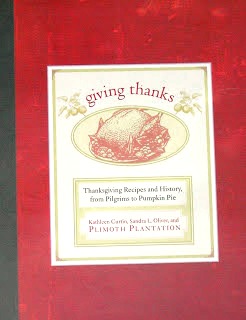
Giving thanks_bookA few years ago, a book entitled “Giving Thanks: Thanksgiving Recipes and History, from Pilgrims to Pumpkin Pie” was published.  The co-authors are Kathleen Curtin, food historian at the Plimoth Plantation, Mass., and Sandra L. Oliver, food historian and publisher of the newsletter “Food History News.”

The book is a fascinating look at how an autumnal feast evolved into a “quintessential American holiday.”

Most Americans, introduced to the story of the Pilgrims and Indians during childhood, assume there is a direct link between the traditional holiday menu and the first Thanksgiving.  But we learn from the book that many of those food items—such as mashed potatoes and apple pie—were simply impossible in Plymouth, Mass., in 1621.  Potatoes were not introduced to New England until much later and those first settlers did not yet have ovens to bake pies.

What we do know about the bill of fare at the first celebration in 1621 comes from a letter written by colonist Edward Winslow to a friend in England:  “Our harvest being gotten in, our governor sent four men on fowling, that so we might after a special manner rejoice together after we had gathered the fruit of our labors.”

Later 90 Indians joined the party with “their great king Massasoit whom for three days we entertained and feasted.”  Then the Indians “went out and killed five deer which they brought to the plantation.”

So venison was a principal food on the menu.  It also seems safe to assume that mussels, clams, and lobsters (all in plentiful supply) were served as well.  According to other journals of the colonists, the “fowl” that Winslow described were probably ducks and geese.  But wild turkeys were also bountiful in 1621, and so it is very likely that they were on the Pilgrims’ table.  Thank goodness for that.

Throughout the New England colonies, it became common to proclaim a day of thanksgiving sometime in the autumn.  In period diaries, there are many descriptions of food preparation—such as butchering and pie baking—followed by the notation that “today was the general thanksgiving.”

By the 19th century, Americans were taking the idea of a “thanksgiving” to a whole new level.  The religious connotations were dropping away in favor of a holiday celebrating family and food.  Roast turkey had become the centerpiece of these fall celebrations.

Turkeys, of course, were native to North America.  (Benjamin Franklin, in a letter, had even proposed the turkey as the official U.S. bird!)

And turkey was considered to be a fashionable food back in the Mother Country.  Just think of the significance of turkey in Charles’ Dickens’ “A Christmas Carol.”  When Scrooge wakes up in a joyful mood on Christmas morning, he calls to a boy in the street to deliver the prize turkey in the poulterer’s shop to the Cratchit family.  (Earlier in the story, the poor Cratchits were dining on goose.)

It is thanks to a New England woman that Thanksgiving became an American holiday.  Sarah Hale was a native of New Hampshire and the editor of “Godey’s Lady’s  Book,”  a popular women’s magazine.  She lobbied for years for a national observance of Thanksgiving.  She wrote editorials and sent letters to the president, all state governors, and members of Congress.

Finally, in 1863, she convinced Abraham Lincoln that a national Thanksgiving Day might help to unite the Civil War-stricken country.   The fourth Thursday in November was now officially on the American calendar.

“… that endless variety of vegetables …”

Connecticut’s own Harriet Beecher Stowe wrote this description of a New England Thanksgiving in one of her novels—“But who shall . . .describe the turkey, and chickens, and chicken pies, with all that endless variety of vegetables which the American soil and climate have contributed to the table . . . After the meat came the plum-puddings, and then the endless array of pies. . .”

The autumnal feast became a national holiday, but each region of the country put its own spin on the menu.   Not to mention that immigrants have also added diversity.  The result is a true “melting pot” of America.  The second half of “Giving Thanks” contains recipes that reflect what Americans eat for Thanksgiving in the 21st century.

In the South, for instance, the turkey might be stuffed with cornbread and there would be pecan and sweet potato pies on the table.  In New Mexico, chiles and Southwestern flavors may be added to the stuffing.

There’s the “time-honored traditional bread stuffing” recipe.  There’s also one for a Chinese American rice dressing and directions for a Cuban turkey stuffed with black beans and rice.  Desserts run the gamut from an (authentic) Indian pudding to an (exotic) coconut rice pudding.  Old-fashioned pumpkin pie is included as well as the newfangled pumpkin cheesecake.

But no matter what food items grace our Thanksgiving tables, it seems that we all end up stuffing ourselves silly.

Perhaps overeating started at that very first harvest celebration in 1621.  In Edward Winslow’s letter describing the feast with the Indians, he noted that food was not always this plentiful. But he wrote his friend in England “ … yet by the goodness of God, we are so far from want that we often wish you partakers of our plenty.”

A la Carte: More About Pie, Plus a Tart for Vegetarians

Lee White

Okay, my friend, Lisa, suggested what I make for Thanksgiving: two pies—one apple and one pumpkin. Easy-peasy. Also green beans and corn bread. 

I also want to let you know that I am not going away for the holiday, just a short drive down I-95. So, if you have questions, think of me as your own Butterball Hotline. You have my e-mail below the column, so if you have a question between now and turkey day, I’m around.

So, today’s column is the last word on pies … at least for 2021. 

When it comes to apple pie, the more different kinds of apples, the better. I used to buy my apples at a little orchard in eastern Connecticut. The white paper bag said baker’s choice, or something like that. I don’t know if is still around, but I do suggest a farm market that grows a variety of apples.

You want tart and sweet and hard and soft. If you don’t have a cheat sheet, ask the cashier at the farm market. I buy at least five pounds. You don’t need all five, but you can eat the rest.

Depending on the size, peel and core the apples. Cut them into 6 to 8 wedges. Place in a bowl and toss with lemon  juice. That will keep them from browning. Here is the recipe:

Apple Pie

  1. Preheat oven to 450 degrees and place a sheet pan onto the oven rack. Place bottom pie crust in a 9-inch pie plate, leaving about half an inch over the edge of the pie plate.
  2. In that bowl of apples, add ½ to 2/3 cup brown or white sugar, 1/8 teaspoon salt, ½ tablespoons corn starch, 1/8 teaspoon each of nutmeg and cinnamon (some people prefer vanilla instead of spices, so you can use a teaspoon of pure vanilla extract) and toss.
  3. Place the apples in the bottom crust and dot with maybe 3 tablespoons butter.
  4. Place the second crust over the apples. With your fingers, make an edge with the two crusts.
  5. Using a knife, cut a few slits over the top of the crust (for steam and to make it pretty). I cover the edge crust with pieces of foil to keep it from browning too fast. (Remove the foil about 10 or 15 minutes before pie is done.) After 10 minutes, reduce the heat to 350 degrees.
  6. Bake the pie until done, 45 minutes to an hour in all.

Photo by Dilyara Garifullina on Unsplash.

Pumpkin Pie

For a pumpkin pie, it is even easier, because it is just a one-crust pie.

  1. Buy a 15-ounce can of 100% pure pumpkin (I use Libby’s). Do not buy a can of pumpkin pie mix.
  2. Follow the recipe on the can of pumpkin.
  3. Preheat oven to 425 degrees and place a sheet pan onto the oven rack.
  4. Place the crust in the 9-inch pie pan; with your fingers make a pretty edge.
  5. Add the pumpkin mixture.
  6. Carefully place the pie on the sheet pan in the oven.
  7. After 15 minutes, reduce heat to 350 degrees and cook for 40 to 50 minutes, until a knife blade inserted into the center comes up clean.
  8. Cool for at least 2 hours.

If you are making a chocolate cream pie (or something like that), you may be asked to blind bake a pie. One woman on the internet suggested freezing the unbaked crust (maybe for two hours or even longer), then adding foil up to the top and then pie weights or dried beans. Bake at 350 degrees for about 30 to 35 minutes, until golden brown. 

Again, as I mentioned in last week’s column, you can use a frozen pie crust. I love Oronoque. It comes two to a package. There are always a few packages in my freezer. They come in their own pie pan so you don’t have to ask your friends please to return the good one. I cannot tell you how many I have bought, and they are not inexpensive.

Again, I am here through noon on Thanksgiving. On that day, when you get my column, there will be two recipes for leftover turkey and sides.

***

Over the last week or so, I thought about friends who are somewhat, or totally, vegetarian.

A new friend is vegan; had I known that, I would not have served pasta with marinara and pepperoni. My Times editor is a vegetarian, but eats seafood and dairy. My friend Nancy is vegetarian, but eats chicken,  seafood and dairy. My other editor in Madison eats healthy, and I think she is more vegetarian than carnivorish.

My first boss at Connecticut College was a vegetarian, but didn’t like tomatoes. 

I am a carnivore, but I love animals and think people who hunt for fun, including those who like fishing for catch-and-release have a character flaw. I will cook mussels and clams and oysters, but have never boiled a lobster.

I, obviously, am a hypocrite. 

If I ask people for dinner, and do not know what they will or will not eat, I will cook for them. I was allergic to lobster and crab, but am not anymore. I have a friend who has celiac disease, and when I find a nice recipe for her, I will make it for her.

I also have a few dessert recipes that are gluten-free. I pay little attention to people, who do not eat sweets, so Libby doesn’t eat my desserts.

Going through some of my old recipes, I found a vegetable tart recipe that doesn’t even require a crust and, like many of my recipes, is yellowed with age. This Thanksgiving I will be with friends who aren’t  picky. After that holiday, I will make this tart for my vegan friend. 

Harvest Vegetable Tart
Adapted from Thomas Keller in Ladies’ Home Journal, October 1996
Yield: serves 6

4 tablespoons extra-virgin olive oil
1 small onion, thinly sliced
1 red pepper, thinly sliced
4 tablespoons minced shallots, divided
3 teaspoons minced, garlic, divided
1 teaspoon finely chopped fresh thyme or ½ teaspoon, dried, divided
¼ teaspoon salt, divided
¼ teaspoon freshly ground pepper, divided
8 tablespoons chicken (or vegetable) broth, divided
1 medium eggplant, quartered lengthwise
1 large beefsteak tomato, quartered
1 medium zucchini
1 medium yellow squash
1 tablespoon chopped nicoise (black) olive (optional)

Heat oven to 350 degrees. Heat 2 tablespoons oil in medium skillet over medium heat. Add onion, peppers, 2 tablespoons shallots and 2 teaspoons garlic; cook until tender, 3 to 4 minutes. Stir in half the thyme plus 1/8 teaspoon each salt and pepper.

Brush bottom of a 12-inch deep-dish pizza pan with 1 tablespoon oil. Combine 2 tablespoons broth, remaining shallots, garlic, thyme, salt and pepper in cup. Sprinkle over mixture in pan.

Cut eggplant, tomato, zucchini and yellow squash into 1/3  inch-thick slices. Beginning in the center of the pan, arrange vegetables in overlapping circles, equally distributing them over pan.

Sprinkle tart with onion-pepper mixture. Combining remaining broth and broth and oil in a cup and drizzle over top; sprinkle with olives, if using.

Cover tart and bake 45 minutes;  uncover and bake 35 minutes more, or until vegetables are tender; cool. 15 minutes. Drain any liquid into glass measure. Invert into a platter, drizzled with reserved liquid. Cut into six wedges. [This this would be delicious at room temperature, too.]

About the author: Lee White has been writing about restaurants and cooking since 1976 and has been extensively published in the Worcester (Mass.) Magazine, The Day, Norwich Bulletin, and Hartford Courant. She currently writes Nibbles and a cooking column called A La Carte for LymeLine.com and the Shore Publishing and the Times newspapers, both of which are owned by The Day. She was a resident of Old Lyme for many years but now lives in Groton, Conn. Contact Lee at leeawhite@aol.com.

Letter to the Editor: Who is Old Lyme’s Ethics Ombudsman?

To the Editor:

Who is Old Lyme’s Ethics Ombudsman?

The answer depends on which town official you ask.

When asking  the Ethics Commission Chairman, she indicated that she wasn’t sure that the position exists.

When asking the Town Clerk’s office, they indicated that the current Democratic Registrar of Voters is the Ethics Ombudsman … but that can’t be. Old Lyme’s Code of Ethics states that the Ethics Ombudsman cannot hold any other elected or appointed office in the town. This would clearly be a violation of the Ethics Code.

A review of meeting minutes of the Ethics Commission indicated there is no record of vote to appoint an Ombudsman. The Ethics Commission has the responsibility of appointing the Ombudsman; failure not to appoint the Ombudsman would be a violation of the Ethics Code.

The losers here are town officials and town employees, who are not afforded the option of seeking advice about ethical and conflict of interest issues that arise in their duties.

Sincerely,

William Folland,
Old Lyme.

A Veterans Day to Remember in Lyme-Old Lyme Schools

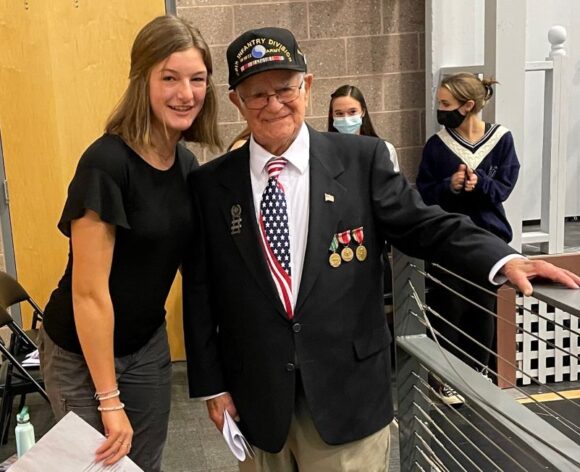
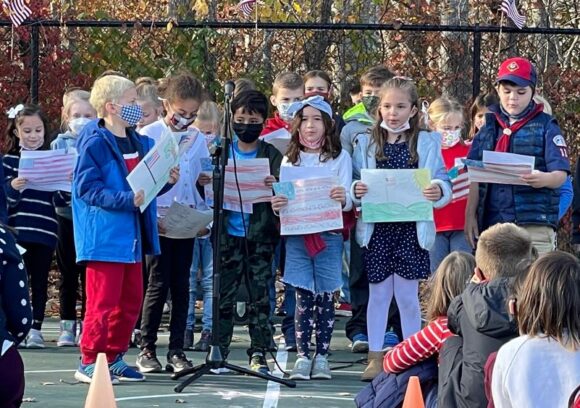
Herb Arico gave the keynote address at the Veterans Day Assembly at Lyme-Old Lyme High School. At 99 and a half years of age, he captivated the audience with tales of his experiences in World War II. All photos by Lyme-Old Lyme Schools.

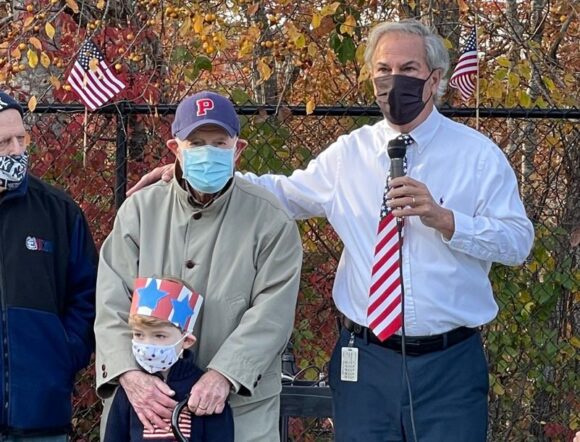
OLD LYME — In the words of Lyme-Old Lyme Schools Superintendent Ian Neviaser, “What an amazing day!” He continued in his email to LymeLine, “I have always said that Veterans Day is one the best days of the year in our schools … and this year was no exception.”

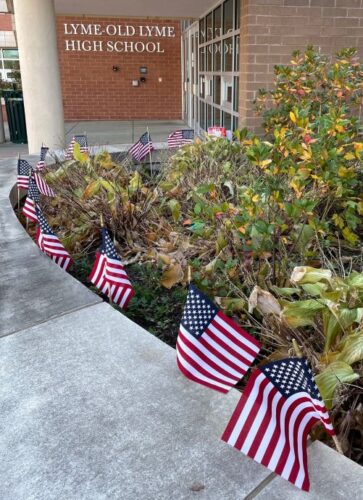
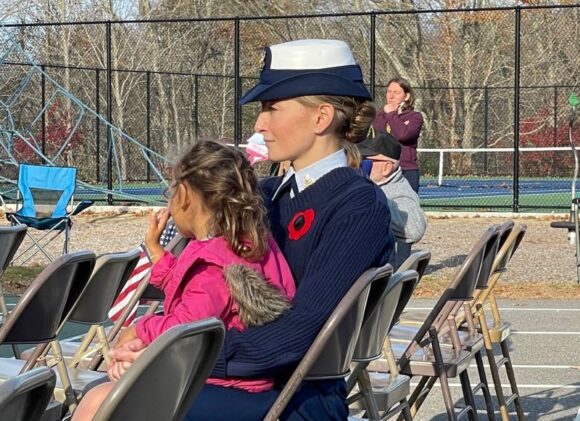
The flags were out at each school in the district …

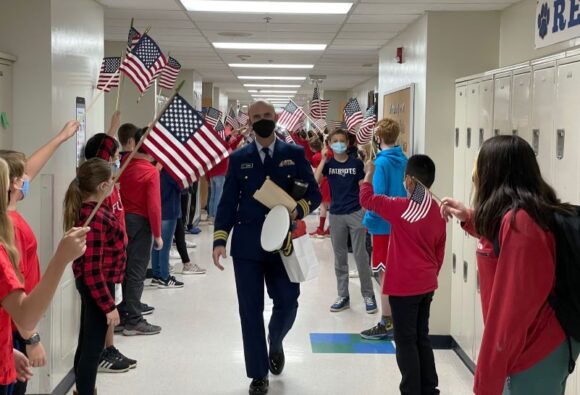
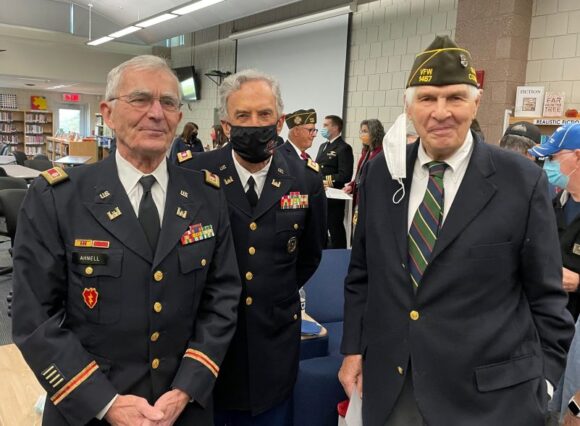
… and each veteran was given a rousing welcome.

Ceremonies were held at every school including an ‘Introduction of Veterans’ followed by a Town Meeting Assembly at Lyme Consolidated School  …

… and various classroom visits and activities honoring veterans throughout the day at Mile Creek School .

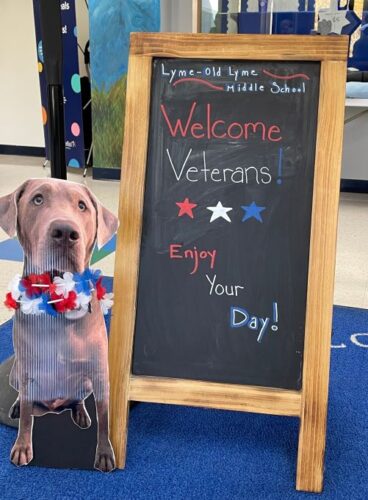
At Lyme-Old Lyme Middle School a Breakfast honoring veterans was held followed by an Assembly …

and at Lyme-Old Lyme High School similarly there was a reception for the veterans followed by an assembly.

Neviaser noted, “For the first time in a long time, we had not one, but two World War II veterans.  One was 98-years-old and the other was 99 going on 100.” The latter, Herb Arico, delivered a keynote speech about his time during the war at the high school assembly and completely captivated the audience as he shared his experiences.

Neviaser commented with a smile, “The students were so impressed they all wanted photos with him [Mr. Arico] after his speech.”

Neviaser admitted that COVID had been a concern saying, “I was worried that COVID might scare away some of our older veterans, but that clearly was not the case as we averaged about 50 veterans at each school.”

Editor’s Note: Here at LymeLine, we echo the respect paid to our veterans by Lyme-Old Lyme Schools on Nov. 11, and thank the veterans sincerely for their service.

Nosal Wins Seat on Zoning by Six Votes in Monday Night’s Recount

Old Lyme Selectwoman Mary Jo Nosal (File photo)

OLD LYME — UPDATED NOV. 11 at 1pm with a comment from Selectwoman Nosal. The final result in Monday evening’s lengthy recount of the votes cast last Tuesday for a five-year term starting 2022 on the Old Lyme Zoning Commission was as follows:

Mary Jo Nosal (D): 1,600
Sloan Danenhower (R): 1,594

This result confirmed Nosal, who currently serves as Old Lyme Selectwoman but did not seek re-election, as the winner of the race.

Asked her reaction to the recount result, Nosal told LymeLine in a text, “The recount validated the Nov 2nd election results. Clearly Mr. Dannenhower and I were supported by many voters in Old Lyme. It was a good race.”

She added, “I look forward to being seated on the Commission next year to fairly apply our regulations on the local concerns that come before the Commission.”

The unofficial result announced the night of the election was:

Mary Jo Nosal (D): 1,600
Sloan Danenhower (R): 1,593