Florence Griswold Museum Presents ‘Revisiting America: The Prints of Currier & Ives’ Through Jan. 23 

Broadway New York, n.d. Lithograph. Joslyn Art Museum, Gift of Conagra Brands, 2016.20.78

OLD LYME — The Florence Griswold Museum in Old Lyme, Connecticut, presents Revisiting America: The Prints of Currier & Ives, on view through Jan. 23, 2022.

Currier & Ives was a prolific printmaking firm based in New York City in the 19th century. Founded by Nathaniel Currier in 1834 and expanded by partner James Merritt Ives in 1856, the firm produced millions of affordable copies of over 7,000 lithographs, gaining it the title, “the Grand Central Depot for Cheap and Popular Prints.” 

Revisiting America comes from the Joslyn Art Museum in Omaha, boasting a collection of nearly 600 Currier & Ives prints donated by Conagra Brands. Currier & Ives perpetuated Victorian ideals in its depictions of family, history, politics, and urban and suburban life—concepts that persist today partly as a result of the wide distribution of their images. 

Revisiting America offers an opportunity for viewers to contemplate the complexities and contradictions of America’s past. For many people, what could be more iconic representations of America than the prints of Currier & Ives? For others, they are reminders of harmful stereotypes of the poor and indigenous and enslaved peoples. While a trip down America’s memory lane, the exhibition offers an opportunity to delve into the reality that the company’s romanticized scenes sometimes prioritized marketability over morality. 

For the presentation at the Florence Griswold Museum, Curator Amy Kurtz Lansing expands upon the exhibition’s original scholarship with a section discussing artist Frances Flora Bond Palmer, examples of how Currier & Ives images were re-discovered and used in the 20th century, an explanation of lithography, and additions pertaining to the Griswold family. 

Made to Sell 

Currier & Ives prints were first and foremost commodities, with subjects often determined by popularity and sales figures. 

The choices the company made about what not to include in their images are as significant as what is depicted. For instance, although cities were often characterized by deep poverty and inequality, and perceived as full of crime, the firm’s views of urban streets represent an idealized version of the city—populated by fashionable, well-to-do people, clean thoroughfares, and regal buildings.

These idealized images appealed to rural and urban customers alike by offering visions of city life unaffected by the social and economic issues of the day. Broadway New York depicts the intersection of Broadway and Ann Streets in Manhattan. Once a quiet residential district surrounding City Hall Park, where people stroll in the foreground, the area became a bustling commercial and entertainment hub around 1841. 

As author James Dawson Burn described, “There you may see the lean lanky Puritan from the east, with keen eye and demure aspect, rubbing shoulders with a coloured [sic] dandy, whose ebony fingers are hooped in gold.” The Currier & Ives print shows a bustling urban space with chic (but not diverse) passersby. 

Other popular sellers were depictions of leisure time activities. The age of industrialization allowed Americans more opportunity to fill their day with sports and other pastimes. Popular hobbies of the time included hunting, fishing, and horse racing, topics marketed to men for their offices, saloons, and clubs. 

Currier & Ives produced more than 750 prints related to horses and horse racing, such as Harry Bassett and Longfellow, in their Great Races at Long Branch, N.J. July, 2nd and Saratoga, N.Y. July, 16th 1872. The lithograph depicts two famous racehorses, Harry Bassett and Longfellow, whose two newsworthy races are memorialized in the text of the print. 

The Social Media of the Day? 

The sheer reach of Currier & Ives prints, sold in their New York City store, or by mail order, pushcart vendors, and far-flung agents, put their pictures in view of countless Americans, particularly women to whom they were marketed as affordable domestic decor.

The visually-based culture we live in today, with images circulating on the internet and social media, has its origins in the mass communications created in part by Currier & Ives. The prints promoted an optimistic ideal of home, family, and stability in their day, and continue to exemplify that view for Americans, who became acquainted with them in the 20th and 21st centuries, when we play out those same fantasies on our social media feeds. 

A Griswold Connection 

Nineteenth-century Americans took pride in the technological advancements being made across their nation. A rapid and wide-reaching revolution in transportation led the country from majestic clipper ships to powerful steam-driven boats and locomotives in a matter of decades.

At their height in the middle of the century, clipper ships—three-masted merchant ships designed for speed—ruled the seas and allowed for the faster-than-ever transportation of goods and people across the Atlantic and along the coasts. 

Pairing Charles Parsons’s oil painting Clipper Ship Challenge at Griswold’s Wharf, Pine Street, New York (ca. 1851), on loan from local collectors, with James E. Butterworth’s Currier & Ives lithograph Clipper Ship Flying Cloud, (1852), Curator Amy Kurtz Lansing makes a Connecticut connection to the pursuit of global trade. 

As captain of a fast sailing ship Florence Griswold’s father transported goods and people across the Atlantic until his retirement, while extended family members Nathaniel and George Griswold (owners of Challenge) imported tea from China. 

Frances Flora Bond Palmer (1812–1876) 

Most of Currier & Ives’s artists are unidentified, their works published under the name of the firm rather than their own signature. However, one of their most prolific contributors, responsible for at least 200 lithographs, was Frances (Fanny) Palmer. Born and educated as an artist in England, Palmer and her printer husband owned their own firm before immigrating to America in 1844.

Frances Palmer, Snipe Shooting, 1852, Lithograph. Joslyn Art Museum, Gift of Conagra Brands, 2016.20.338

For Snipe Shooting (1852), the artist sketched the image from nature and made the final drawing on the lithographic stone. The image was printed with two separate inkings of the stone in different colors. Palmer’s artistic skill, knowledge of lithographic techniques, and ability to compose what became some of their most iconic prints gave Currier & Ives its edge over the competition.  

Lithography Explained 

Derived from the Greek for “writing on stone,” lithography was invented in 1796 by the German Alois Senefelder. It differs from other forms of image reproduction in the way it allows artists to draw expressively and with varying thicknesses of line right on the printing surface. Unlike etched or engraved metal plates that wear down over time, lithography allowed for printing many more copies, leading to its quick embrace by the industry in America by the 1830s. 

By displaying lithography tools, including examples of stones used by artists today borrowed from neighboring Lyme Academy of Fine Arts, visitors better understand the process necessary to produce this type of print. 

The Legacy of Currier & Ives 

Why are Currier & Ives lithographs still so well-known today?

By the time Currier & Ives ceased operations in 1907 it had dispersed countless prints around the country. Hanging in homes, offices, bar rooms, clubs, and schools, these “engravings for the people” were often the only visual representations in Americans’ lives. After World War I, artists and collectors, striving to define an identity proudly distinct from Europe, delved into America’s past, where they re-discovered Currier & Ives. Suddenly appreciated again, newspapers in the 1920s published stories about the frenzied search for the prints in attics and shadowy corners, and noted their inclusion in art exhibitions.  

Currier & Ives prints began to be reproduced on Christmas cards, collectibles, stamps, everyday dishes, and glassware. Examples of these items are on display. Connecticut artist George Henry Durrie, whose snowy views of country homes appeared in nearly a dozen Currier & Ives lithographs, are the among the most commonly reproduced as evocations of Thanksgiving and Christmas. Visitors to the exhibition have enjoyed sharing their memories through social media and interaction with staff, such as this quote from the comment book, “My wonderful grandfather gave cards at Christmas with Currier & Ives pictures on the front. I am 67 years old and still have some of them. Nice memory!” In Connecticut, Travelers Insurance included Currier & Ives images on their annual calendar in beginning in 1936 and encouraged the prints to become lasting décor with instructions on how to cut out and put the calendar pages in 11 x 16 inch frames. The company still produces Currier & Ives calendars today.  

Collection  

Roy King, a private collector from New York, assembled the extensive Currier & Ives print collection over a period of three decades starting in the 1950s. He collected 672 lithographs, most of which were purchased individually.

In 1975, King sold his prints to New York holding company, Esmark. The collection was kept together and shown across the country at universities and museums. Esmark allowed the prints to be seen in over 100 galleries, museums, and universities as well as two dozen other countries, created a wider audience than ever before for these popular depictions of quintessential American life.

The prints were then purchased by Conagra Brands, which installed them in spaces that were open to the public in Omaha, Neb. I

n June 2016, Conagra Brands donated the collected to the Joslyn Art Museum, where it could remain a cherished presence in the Omaha community. 

Florence Griswold Museum  

The consistent recipient of a Trip Advisor Certificate of Excellence, the Florence Griswold Museum has been called a “Giverny in Connecticut” by the Wall Street Journal, and a “must-see” by the Boston Globe.

In addition to the restored Florence Griswold House, the Museum features a gallery for changing art exhibitions, education and landscape centers, a restored artist’s studio, 12 acres along the Lieutenant River, and extensive gardens and nature trail. The Museum is located at 96 Lyme Street, Old Lyme, CT.

Visit FlorenceGriswoldMuseum.org for more information, including a list of programs and activities related to the exhibition.  

Old Lyme Cub Scouts Put ‘Amazing Effort’ Into Supporting Local Thanksgiving Food Drive

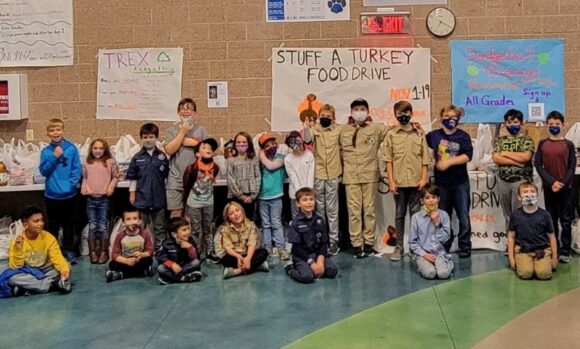
All the Old Lyme Cub Scouts involved in the Food Drive gathered for a photo to celebrate their successful efforts. All photos by Jon Goss.

OLD LYME — The Old Lyme Cub Scouts recently participated in the Thanksgiving Food Drive and Holiday Giving Program.  The Food Drive is a collaboration between Lymes’ Youth Service Bureau and the Old Lyme Police Union.

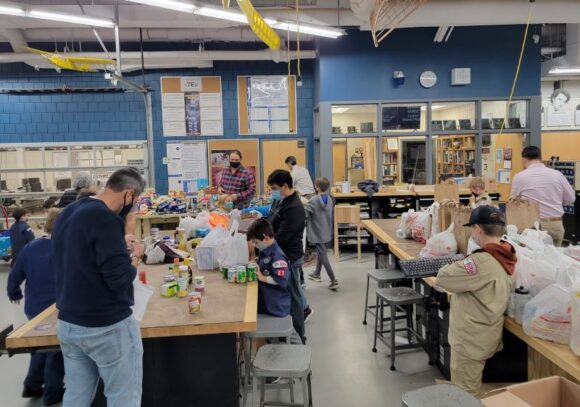
Sorting all the food donations was a big job.

The Cub Scouts left bags for collection on their neighbor’s doors and then returned a week later to collect nonperishable donated food items.

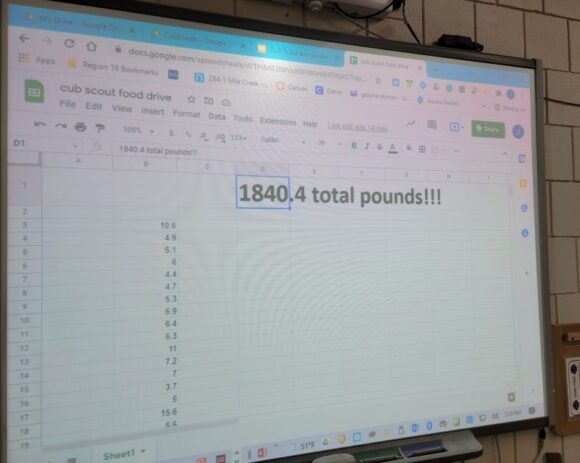
A careful count of all the pounds of donated food was kept.

The Cub Scouts collected over 1840 lbs. of food from the community and then spent an evening sorting all of the food items.

Asked by email how he felt about the efforts of the Cub Scouts, Pack Cubmaster Jonathan Goss replied, “I feel very proud of the Cub Scouts work. Each Scout was able to collect on average 100lbs of food which is about 12 grocery bags. They put in an amazing effort.”

Editor’s Note: We would like to add our sincere appreciation to all those involved in this year’s Food Drive. It was a Herculean effort by a large army of volunteers of all ages from a variety of groups. Kudos to you all!

Three Shows On View at Lyme Art Association; ‘Deck the Walls’, “Hands on the Land,’ ‘Polly Seip Solo Show’

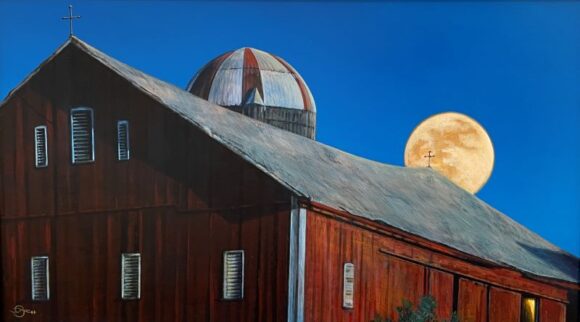
‘Harvest Moon’ by Del-Bourree Bach in acrylics is one of the featured works in the ‘Deck the Halls’ show on view at Lyme Art Association.

OLD LYME — There are currently three shows on view at Lyme Art Association (LAA.)

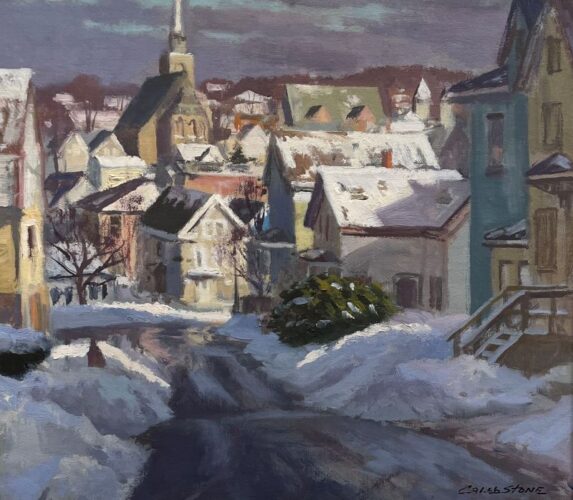
The signature show is the LAA’s perennially popular holiday art exhibition and sale, Deck the Walls, which is on view through Jan. 2, 2022. More than 200 original works of art by member artists will be on display and priced to sell as holiday gifts. Deck the Walls features a wide variety of appealing subjects and tends toward smaller, less expensive works.

Concurrently with Deck the Walls, an exhibition reflecting on the impact of humans on the local landscape will be on view. This show titled Hands on the Land is a collaboration with the Connecticut River Museum and was previously on view there.

A third show, the Polly Seip Solo Show, is also on view. Polly Seip won the first prize in the 2019 Associate Artists Show, and received the opportunity to present a solo show. Her luminous nocturnes are especially noteworthy.

‘Slate-Colored Junco’ by Bivenne Staiger reflects the wintry theme of the ‘Deck the Halls’ show.

“For Deck the Walls, the Lyme Art Association features a wide variety of appealing subjects at affordable prices that are great for holiday shopping. We hope to help solve those gift giving dilemmas – a beautiful piece of artwork is always appreciated!” says Jocelyn Zallinger, Gallery Manager.

“During the holiday season, the Lyme Art Association is a great place to come for a gentle activity for children on school vacation or for visiting guests. Whether you have a few minutes or more than an hour, the gallery is a wonderful way to decompress, stimulate conversation, or simply enjoy yourself,” comments Laurie Pavlos, Executive Director.

‘Winter Light’ by Caleb Stone is another of the signature paintings in the ‘Deck The Walls’ show.

The LAA is free and open to the public Wednesday through Sunday, from 10 a.m. to 5 p.m., and by appointment.

The LAA is located at 90 Lyme St. in Old Lyme, at the corner of Halls Road. Call 860-434-7802 for more information, or visit www.lymeartassociation.org.

Bon Appetit! Miracle in Paris Made Thanksgiving Memorable

Linda Ahnert

In 1968, I was a student at the Sorbonne and on November 28th, I wrote home to my parents: “Thanksgiving without turkey!! It’s 10:00 p.m. here which means it’s 4:00 p.m. at home and you guys are probably stuffed from eating all that delicious food.”

I continued, “As my special gastronomic treat today, I bought a bottle of real American orange juice—all the way from Florida! I received your card this morning and showed it to all the kids so they wouldn’t forget what Pilgrims and turkeys look like.”  

A bit of explanation for those who don’t know what life was like way back in the 20th century. In those Digital Dark Ages, there were no personal computers, no cell phones, and no emails. When we left home to study abroad for a year, our means of communication with family and friends back in the U.S.A. were hand-written letters airmailed back and forth across the Atlantic.  

I would write home faithfully once a week to describe everything I was experiencing in “la belle et douce France.” For someone who loved the language and literature, living in France was like a homecoming in a certain sense—all the places I had read about and dreamt of, I was now seeing. 

I would cut through the Luxembourg Gardens to attend morning lectures (inhaling the aroma of bread baking as I passed boulangeries along the way.) Afternoon language classes were held in a building a few blocks from the Seine and I could look across and see Notre-Dame. 

And by November of 1968, I had been in France for six months and had seen not just Paris but had travelled all over the country— Normandy, the Loire Valley, Grenoble and the French Alps, all the way to the Mediterranean Sea.  I didn’t dance “sur le pont d’Avignon,” but I did walk on it. 

Mais oui, I was loving my year abroad. But that Thanksgiving morning in 1968, I woke up with a severe case of mal du pays.  I was feeling very sorry for myself thinking of Turkey Day back home in Connecticut. 

I missed being in the kitchen chopping onions and celery for the stuffing. Not to mention the tantalizing aroma of the turkey roasting for hours and my mom’s pecan pie. I grew misty-eyed thinking of my parents and dear family friends, who always spent Thanksgiving with us.  

Then a miracle happened on the Boulevard Raspail

I stopped at the kiosk on the corner to pick up the International Herald Tribune. A few minutes later, I was reading for the first time Art Buchwald’s classic column in which he facetiously explains our all-American holiday of Thanksgiving to the French. 

He does this with his usual humor and by mangling the French language. The article was first published in 1952 and thus began the tradition of reprinting it every year on “Le Jour de Merci Donnant,” as Buchwald dubbed it.  

Buchwald starts off by relating how the Pèlerins (Pilgrims) came to the New World where they could eat dinde (turkey) to their hearts’ delight and continues merrily on from there. He even treats the reader to a new spin on the Pilgrim love triangle of Priscilla Mullens, John Alden, and Miles Standish (who Buchwald explains is known as Kilomètres Deboutish in France.)  

Reading Buchwald’s column was exactly what I needed to snap me out of my homesickness funk on that Thanksgiving Day in 1968.  It is such a perfect spoof for Americans, who love France and the French language. And voilà, before you knew it, I was laughing out loud.  

Buchwald concluded his piece by noting that on the fourth Thursday of November, Americans sit down at tables overflowing with tasty dishes and “for the only time during the year eat better than the French do.”    

So Happy Thanksgiving and Bon Appétit!

Editor’s Note: Linda Ahnert is a resident of Old Lyme and former Arts Editor at the now-shuttered ‘Main Street News.’ She is a long-time docent at the Florence Griswold Museum and has volunteered for numerous local art organizations.

A la Carte: A Delicious New Twist on Turkey Left-Overs

Lee White

If you are reading this on Wednesday with your morning coffee and you are lucky enough to have scored a Thanksgiving dinner at someone else’s house tomorrow, you are like me.

I was asked to make two pies (one apple, one pumpkin), green beans and corn bread. In any case, I will be making these things this evening and all I need to do is show up an hour ahead of the dinner and find an unused counter to stash the pies.

Or maybe you are reading this on Thursday, and everyone will arrive at your house in a few hours.

Hopefully you have asked friends and family to make the pies, a vegetable and rolls or corn bread. If that is the case, this will be your last 15 minutes before you put the turkey into the oven.

All you have to worry about is what to do with the leftover 22-pound turkey since a third of the 15 people you have invited decided they are still worried about COVID and decided to stay home.

On Friday, unless my friends insisted I take home turkey, dressing, gravy, sides and pie, I might bake a 13-pound turkey from my freezer and make it so I have leftovers.

I love turkey for turkey sandwiches, turkey soup, turkey salad and casseroles layered of the meat, potatoes, veggies and gravy. Or pieces of turkey in a skillet with onions, garlic, red curry, some boxed chicken broth and coconut milk atop a cup of basmati rice. 

Almost 15 years ago, I made the recipe below. My family and I liked it a lot, but I never made it again.  Try this entrée instead of three days of turkey sandwiches.

Chicken or Turkey Quesadilla Suiza

This recipe offers a new twist on the traditional quesadilla shown here. Photo by Lottie Griffiths on Unsplash.

Adapted from Everyday with Rachael Ray (November, 2007)

Yield: 2 servings

1 cup chopped roast chicken or turkey
¼  cup mild salsa verde (regular red salsa will do)
2 teaspoons extra-virgin olive oil
2 8-inch whole wheat (or spinach or regular) flour tortillas
1 cup shredded Monterey jack or queso fresca cheese
1 scallions, chopped
green olives with pimiento, chopped (a small handful)
1 teaspoon chopped cilantro

  1. Preheat the broiler. In a small bowl, combine chicken or turkey and salsa and heat in the microwave for a minute.
  2. Heat 1 teaspoon oil in a medium skillet over medium heat. Add a tortilla and cook for 30 minutes, then flip and cook for 30 seconds more; slide the tortilla onto a cutting board.
  3. Heat the remaining 1 teaspoon of oil in the skillet, then add remaining tortilla and cook for 30 seconds. Flip the tortilla and sprinkle with half of the cheese. Top with the first tortilla.
  4. Slide onto a baking sheet and top with chicken mixture, remaining cheese, scallions, olives and cilantro.
  5. Place the quesadilla under broiler six inches from the heat and cook until the tortillas are crisp around the edges, about 2 minutes.
  6. Slide the quesadilla onto a cutting board, cut into four pieces and serve.

About the author: Lee White has been writing about restaurants and cooking since 1976 and has been extensively published in the Worcester (Mass.) Magazine, The Day, Norwich Bulletin, and Hartford Courant. She currently writes Nibbles and a cooking column called A La Carte for LymeLine.com and the Shore Publishing and the Times newspapers, both of which are owned by The Day. She was a resident of Old Lyme for many years but now lives in Groton, Conn.
Contact Lee at leeawhite@aol.com.