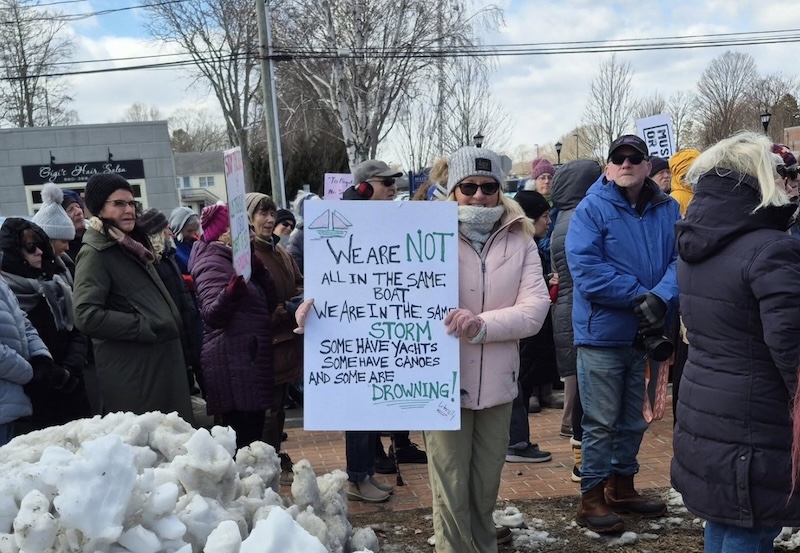
Gathering outside Old Saybrook Town Hall to listen to speeches. All photos by D. Collins.
OLD SAYBROOK—Despite it being a bitterly cold and windy day, hundreds of protesters still gathered on Monday—President’s Day—in front of Old Saybrook’s Town Hall to demonstrate their objections to President Trump and Elon Musk’s actions since taking office.
David Collins of Old Lyme and his wife joined the demonstration.
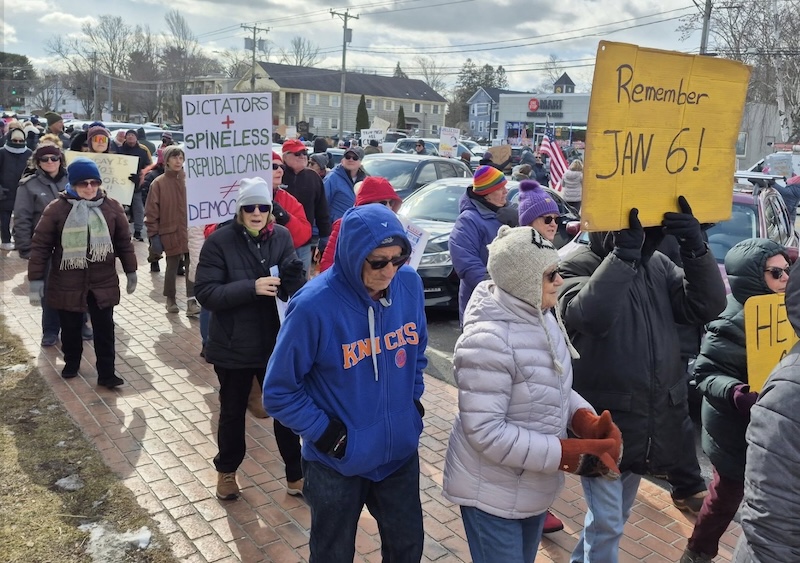
They first listened to impassioned speeches and then marched as a group down Main Street cheerfully chanting slogans like, “This is what democracy looks like” and “Hey Hey, Ho Ho, these oligarchs have got to go.”
Marching down Main Street in Old Saybrook.
There were also larger rallies in New Haven, New London and Hartford on the same day.
There were creative signs galore on display.
All ages were present at the rally.
This youngster had something to say.
Opponents of the rally were small in number.
A Trump-supporting car and another Trump flag-waving individual were spotted.
Feb. 16, 2025—Prologue: I read a fluorescent green flyer Sunday morning that was seeking signatures on an online petition; which I ignored.
The flyer disparaged the Halls Road Overlay District (HROD) and, of course, had no author or organization. It was anonymous; and began “BEWARE!” and then went on saying something about “A WOLF IN SHEEP’s CLOTHING!!” that may have been on the “tip of an iceberg.”
Then, Anonymous speciously claimed that the proposal included “dense housing” — i.e., “eighty bedrooms per acre;” which was false; but has unfortunately also appeared in other similar attacks.
Anonymous continued with a recommended list of websites to visit and “scroll through for pertinent information;” and that may have been “the straw that broke the camel’s back.” Further, the Halls Road Improvements Committee (HRIC) noted last week in LymeLine that “there have been a wave of posts on social media and elsewhere making claims that misrepresent the actual content of the HROD proposal and distort its possible impact on our community. The true facts will not support these assertions, nor the emotional appeals based on horrifying and totally false claims.”
Nonetheless, that flyer and a few Letters to the Editor, comments, and essays in LymeLine inspired me to devote this “View” to the proposed HROD.
I present the project’s key milestones in roughly chronological order in this “View — and rather than a detailed play-by-play on the activities of the HRIC team since its inception (see HRIC section below); I consider their vision, which is detailed in “The Master Plan.”
Note that this essay reflects my observations, opinions, and interpretation of available HRIC documents and materials.
Halls Rd. is a unique thoroughfare within the “friendly confines” of Old Lyme. Located amongst four Interstate 95 entrances and exits and zoned commercial-only, it is Old Lyme’s principal retail and commercial district and has a 1950s and 60s strip mall look, with deep set-backs and large parking lots lining the roadway.
Within the past few decades, Halls Rd. assumed the appearance and function of an interstate service area. Traffic is dense and moves at a very fast pace from traffic light to traffic light on this “Halls Road Raceway.” There are no sidewalks or safe crosswalks. Bicycling is dangerous.
The Halls Road Improvements Committee (HRIC):
In 2015, Old Lyme’s Board of Selectmen (BOS) appointed a committee to address some developing community concerns regarding Halls Rd. The BOS’ charge became complex and has required interaction with several Connecticut agencies and cooperation with many Town commissions and departments.
HRIC Milestones:
In collaboration with the Yale Urban Design Workshop, the HRIC conducted an objective evaluation of the existing conditions on Halls Rd. Several public meetings were held at which the community was encouraged to voice their concerns and wishes; and it was determined that residents wanted the Town’s commercial area to look more like Old Lyme — and specifically, have the “look and feel” of Lyme Street.
Working with the New England-based BSC Group for their expertise in civil and environmental engineering and strategic planning for communities like Old Lyme, the HRIC initiated development of a long-range plan for Halls Rd.
“A formal ‘Master Plan’ is an important tool in seeking grants for work on Halls Rd., for encouraging investment, and for setting budgets” and “broad goals designed to insure the future of Old Lyme’s main shopping district.”
AI Engineers of Middletown, CT developed design and engineering materials for the new “Bow Bridge.” Designs were presented at workshops and residents voted their preference.
Advance CT conducted an economic development study via surveys and workshops in 2020 on behalf of Old Lyme’s Economic Development Commission, and found that, “Over 80 percent of respondents supported additional development in the Halls Rd. area.”
Developed Halls Rd. Overlay District (HROD) Design Guidelines for new construction or updates to current properties. (also see below)
On June 17, 2024, provided a status update to the Old Lyme Board of Selectmen.
On January 10, 2025, the Planning Commission voted unanimously that the proposed zoning overlay was consistent with Old Lyme’s Plan of Conservation and Development, which was adopted in February, 2021
Approvals:
Any work along a state motorway requires a DOT “encroachment permit.” In practice, such permits are usually sought in connection with applications for relevant grants administered by DOT.
Septic and groundwater approvals are regulated by Ledge Light Health District.
The ‘Halls Road Master Plan’ Vision:
Create a walkable, bike-able, mixed-use town center along Halls Rd. — one that is an attractive place to live, work, browse, meet, and do business. The envisioned changes include:
Roadway and sidewalk improvements, including pedestrian lighting, to create safe pedestrian and bike routes along Halls Rd. from Lyme Street to Rte. 156 and the Baldwin Bridge — connecting Halls Rd. to the Arts, Historic and municipal center(s) on Lyme St.
Improvements to existing public green space that could include trails, a riverside park, and new town green.
A new “Bow Bridge” — reminiscent of Childe Hassam’s 1908 impressionist landscape, “Bridge at Old Lyme,” which features the original bridge, spanning the Lieutenant River at the old bridge abutment, connecting to trails through the green space. Note that this pedestrian- and biker-friendly bridge was consistently the single, most popular element suggested in town-wide surveys conducted at the beginning of the planning process.
Further, CT DEEP owns a triangle of property on the east bank of the Lieutenant River and is prepared to deed this property to the Town; but has requested that a fishing pier and 8 parking spots be included in the project. Note that Project design work for the bridge and trails was fully-funded with grants that covered concept design, surveys, permitting, and construction documents.
The Harbor Management Commission has requested that a floating dock be added to the pier.
Residential alternatives for seniors considering a “downsize,” who might otherwise have limited options for remaining in Old Lyme — and/or young people looking to move into the community.
These include small apartments above businesses with first floor retail; but could possibly include town houses. — but that is not a “given.”
New commercial buildings in the HROD must include mixed use with retail/offices on the first floor and residential on the second.
Current property owners can choose to stay put without modification; but if they want to take advantage of the HROD, must include mixed use.
The Jargon:
A mixed-use neighborhood includes both housing and commercial/retail spaces; and often provides housing options and services accessible to all income levels.
It is not uncommon to find pharmacies, restaurants and cafes, delis, dry cleaners, and grocery and hardware stores within walking distance.
Waxing poetic, mixed use neighborhoods offer a lifestyle option for those who do not have a desire to live in the suburbs or in places that are dedicated to residential uses only.
The vibrant nature of mixed use neighborhoods derives from the fact that these areas are more active for more hours of the day, rather than just a few hours in the morning and a few in the evening.
Design Guidelines:
Newguidelines and supportive “Village District” zoning are designed to attract retail and residential investment that will serve the needs of Old Lyme and create a ‘look and feel’ on Halls Rd. that is in keeping with the rest of the town; but stillrequire conformance with current zoning and established architectural standards.
The HROD includes a Design Review Committee as a first step for developers to ensure that the scale and design of any proposed construction is consistent with the aesthetics and character of Old Lyme prior to going before the Zoning Commission for project approval.
Author’s Thoughts:
I was impressed with the depth and detail included in project documents supporting this thoughtful and well-planned initiative.
This is a worthy project and the end result will be important. Nevertheless, I discovered in my research that the discourse on HROD was surprisingly mean-spirited; and I wondered where that attitude was coming from.
I used “the friendly confines,” phrase above to describe Old Lyme; Chicago Cubs fans will recognize that it was coined by Hall of Fame shortstop Ernie Banks as the nickname for Wrigley Field—”Win or lose, it’s always a good afternoon at the Friendly Confines.”
Editor’s Note:This is the opinion of Thomas D. Gotowka.
About the Author: Tom Gotowka is a resident of Old Lyme, whose entire adult career has been in healthcare. He will sit on the Navy side at the Army/Navy football game. He always sit on the crimson side at any Harvard/Yale contest. He enjoys reading historic speeches and considers himself a scholar of the period from FDR through JFK. A child of AM Radio, he probably knows the lyrics of every rock and roll or folk song published since 1960. He hopes these experiences give readers a sense of what he believes “qualify” him to write this column.
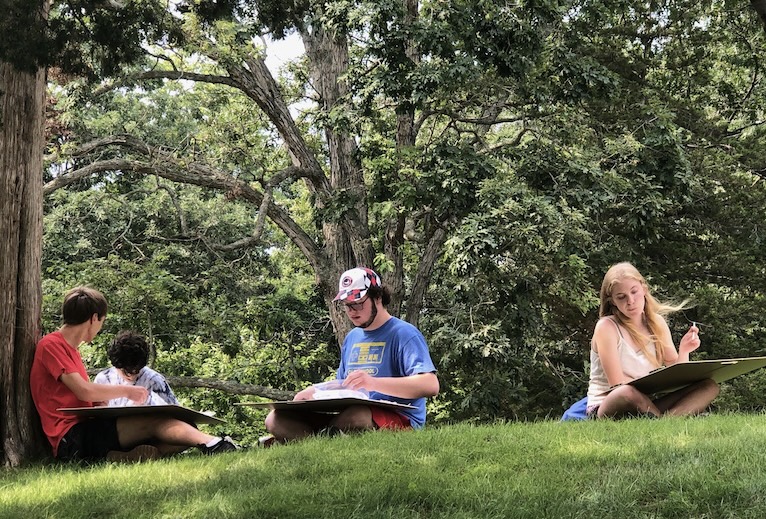
Old Lyme’s Midsummer Festival , which features work by the ‘Fence Artists’ shown above, draws thousands of visitors each year.
Editor’s Note 2/11: ‘USA Today’ has announced that the leaderboard is closed for the final days of voting, saying, “Otherwise, there wouldn’t be any surprises once the winners are announced!” The paper states, “Come back on Wednesday, February 26th at 12:00pm EST to see the results!”
Editor’s Note 2/8: Old Lyme is currently in second place on the Leaderboard, but we are now challenging for the top spot with Vermillion, South Dakota. Let’s all keep voting daily to ensure Old Lyme wins!
OLD LYME—On Jan. 21, 2025, the editors of USA Today announced the 20 finalists for “Best Small Town Arts Scene” … and Old Lyme is included!
Voting is now open and runs until Monday, Feb. 17, at noon ET. Here is the LINK TO VOTEor use the QR code below.
We encourage all our readers to vote for Old Lyme to win this prestigious honor.
Introducing the contest, USA Today states, “Bigger isn’t always better, especially when it comes to these 20 small towns — each with a population of fewer than 30,000 people (as of the last census) — nominated by an expert panel for offering the best arts and culture in the country. What each of these towns lack in size, they make up for with big arts scenes — museums, art galleries, performing arts, and busy event calendars.“
USA Today cited these reasons for including Old Lyme in their finalists:
“This town was once home to a thriving artist colony which later became the Lyme Art Association. The work of many important American artists from the colonial period to today can be found at the Florence Griswold Museum. Both are part of the Old Lyme Arts District, a vibrant central village area with art galleries, live music and the prestigious Lyme Academy of Fine Arts. Artists of all experience levels appreciate painting en plein air in the town’s beautiful natural surroundings. Old Lyme has an annual Midsummer Festival in July that is a celebration of art, music, and classic cars.“
Remember you can vote for your favorite town once per day until the polls close. The winning towns, as determined by the voting, will be announced on Wednesday, Feb. 26.
Art is everywhere in Old Lyme! Photo by Kristen Thornton.
Editor’s Note: The Halls Road Improvement Committee (HRIC) asked us to publish this open statement to the Old Lyme community on their behalf. It is the opinion of the HRIC.
There has been a wave of posts on social media and elsewhere making claims that misrepresent the actual content of the HROD proposal and distort its possible impact on our community. The true facts will not support these assertions, nor the emotional appeals based on horrifying (and totally false) claims.
We expect you will see communications from Old Lyme residents, who oppose HROD, citing these falsehoods in support of their stance. We urge you to take full account of the source and nature of these errors, and disregard objections that are based on false information. Below is a sample of the assertions of this campaign, compared to actual facts.
First, the number of dwelling units allowed under HROD is wildly exaggerated, ‘supported’ by a misleading calculation that ignores the actual HROD regulations. It multiplies the HRIC estimate of “buildable acreage” in the district (~40 acres) by a maximum of 40 dwelling units per acre pulled out of context from HROD section 5.15.6.3.a., resulting in the claim that HROD would “add 1,600 residential units.” This ignores the fact that not every lot within the district can use HROD.
The regulations include a mix of constraints and requirements — lot coverage, parking requirements, limitations on size, scale, massing, etc.—affecting all projects under HROD. We have done the math to calculate maximum possible residential construction following two different methods. The results agree.
Our best estimate of the actual maximum number of dwelling units that could be built on all lots eligible today is closer to 400-450; and that number assumes there are NO restrictions from non-zoning regulations such as septic, environmental, etc. When those factors are taken into account, the number that could actually be built may be 200-225.
Second, these posts typically ignore the HROD limitations on building massing, height, size, placement, appearance, materials, etc. Citing a few upper limits, they suggest building arrangements and densities that are not possible or are expressly disallowed in the actual HROD regulations. They often describe a “wall of buildings” in places where the HROD regulations themselves say no such massive and unvaried structures can be built.
In addition, the HROD includes a Design Review Committee to aid the Zoning Commission in ensuring that the scale and design of any proposed construction is consistent with the aesthetics and character of Old Lyme. HROD does not allow development beyond the scale and scope appropriate to the town center of a small rural town.
Third, issues about environmental concerns are also misguided. The Halls Road area is already fully developed. Much of that development is many decades old, some of it built before the advent of serious environmental protection legislation. Any new development under HROD must adhere to current standards and be more ecologically sensitive and less detrimental to the environment than the existing construction. This would actually be an improvement over existing conditions rather than the disaster portrayed by some of those opposing HROD.
The Halls Road Improvements Committee strongly protests this effort to flood the public forum with error and misinformation. The scale and scope of development possible under HROD is a small fraction of what this opposition campaign claims. The likely and expected impact of HROD on Old Lyme bears no resemblance to the nightmare scenarios presented in social media.
Doing nothing is also an action and, in the case of Halls Road, one with negative consequences for Old Lyme. Current C-30S zoning draws significant investor interest in serving the highway, and very little in any other commercial development. Without allowing a more profitable alternative, Halls Road will increasingly serve the highway, while businesses that serve town residents decline.
The HROD proposal is good for Old Lyme. It is a key element of the Halls Road Master Plan.
Like that plan, HROD was developed with significant input from town residents, stakeholders, and key town committees including Planning, Zoning, Economic Development, and the Board of Selectmen in three administrations. It represents years of volunteer and professional work. We believe it is a well-crafted and sound set of regulations.
Together, HROD and the Master Plan address multiple critical needs of Old Lyme: alternatives to single-family homes, retention of retail that serves Old Lyme (not the highway), safe pedestrian and cyclist access to our shopping area, and allowing the creation of a walkable, mixed-use neighborhood and town center appropriate to the small Town that is Old Lyme. Without HROD, the multi-million-dollar sidewalks of the Master Plan will go to half-empty parking lots, and little more.
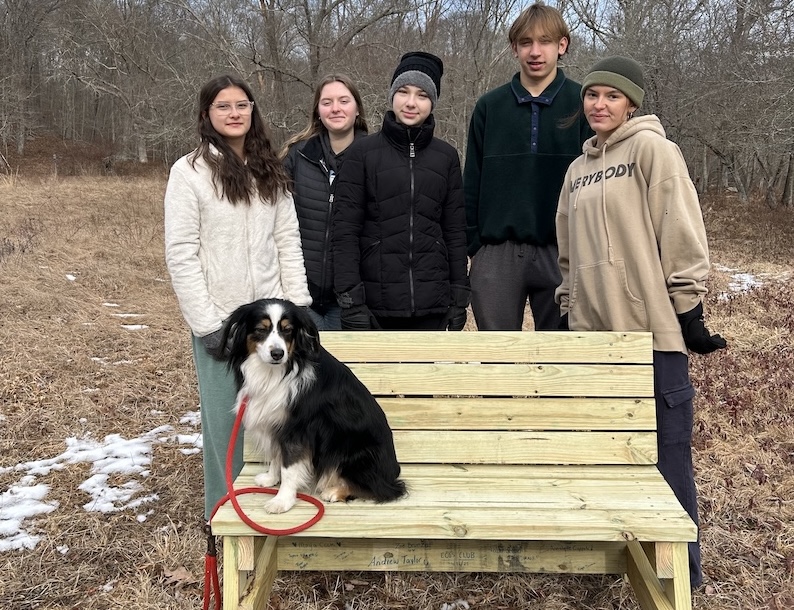
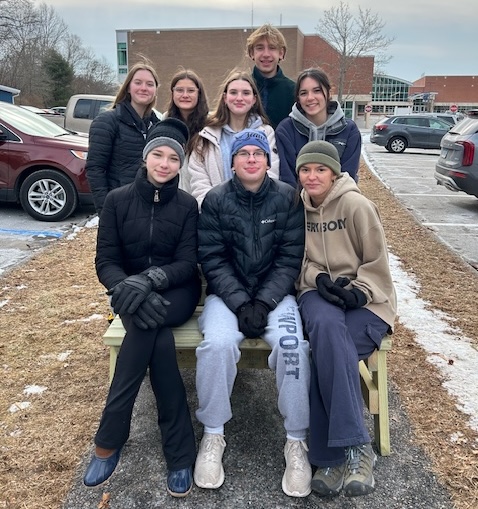
Justifiably proud of their work, these Lyme-Old Lyme High School (LOLHS) students, who are all members of the Environmental Club, stand behind the just-constructed bench in its new location at Rook’s Meadow Open Space in Old Lyme. Fizz, the mini-Australian Shepherd, who sits in pride of place, is owned by Open Space Commission member Andrea Fenton, who assisted with the project. All photos by A. Fenton.
OLD LYME—The Old Lyme Open Space Commission has been busy recently!
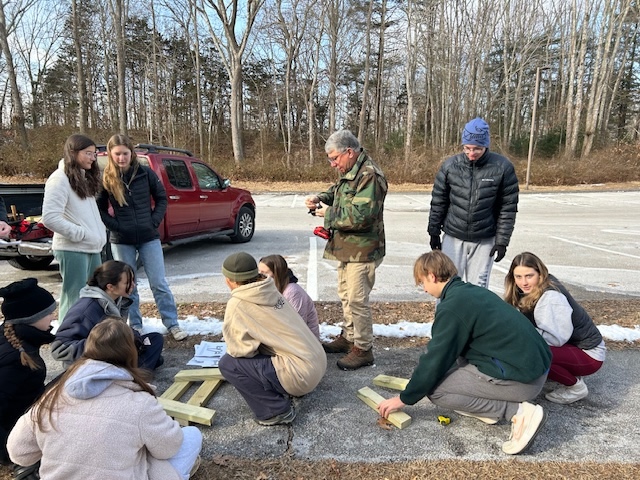
On Jan. 26, some 10 members of the Lyme-Old Lyme High School (LOLHS) Environmental Club assembled a bench following the design of others already constructed on various Old Lyme Land Trust properties. Karen Taylor, who is a tutor at LOLHS, is the advisor for the Environmental Club.
These LOLHS Environmental Club members worked in freezing conditions to assemble the benches.
The students braved 30 degree weather to align and drill frames, which then supported the carefully-measured and spaced bench seat and back.
And they did it! Prior to placing the new seat in its final location at Rook’s Meadow Open Space, these hard-working students posed for a final photo on ‘their’ bench.
Some students helped place the new bench in the Rook’s Meadow Open Space in Old Lyme, where the existing cedar bench is still stable despite having lost its back!