Application Denied for Controversial Smith Neck Rd. House in 5-0 Vote at Monday’s Old Lyme Zoning Meeting

OLD LYME—UPDATED 1/11 at 12:10 pm: The ‘Record of Votes’ related to Monday night’s meeting has now been published. Regarding the Special Permit Application to
replace and construct a new 5-bedroom residence with an attached 2 car garage at 43 Smith Neck Rd., RU-40 Zone, Jeffrey and Emily Merriam, applicants, the Record states, “A motion was made by D. Savageau, seconded by J. Marsh to DENY without prejudice the special permit. The Motion further stated that insufficient evidence had been submitted to allow the Commission to find the proposed activity would have or would be reasonably likely to have the effect of unreasonably polluting, impairing or destroying the public trust in the air, water, or other natural resources of the State of Connecticut.”

UPDATED 1/11 at 1am: The application for the proposed 11,000 sf house at 43 Smith Neck Rd.was denied without prejudice in a unanimous 5-0 vote at Monday night’s Old Lyme Zoning Commission meeting.

Around 50 people attended the meeting.

UPDATED 1/10 at 7pm with corrected number of days for Zoning Commission to deliberate. The proposed 11,000 sf house at 43 Smith Neck Rd. is back on the Old Lyme Zoning Commission’s agenda tonight. Their Regular Meeting starts at 6:30 p.m. in the Meeting Room at Old Lyme Town Hall.

Appearing as the first item under Old Business, the agenda item states, ” 43 Smith’s Neck Road, RU-40 Zone. Special Permit application to replace and construct a new 5-bedroom residence with an attached 2 car garage. Jeffrey and Emily Merriam, applicants.”

The Zoning Commission closed the Public Hearing at the end of the previous Jan 13 meeting. This means no further public comment can be heard on the matter and the Commission cannot ask any additional questions of the applicant.

The Commission must render a decision within 65 days of closing the Public Hearing. Members could vote on the proposed plans tonight but are not obliged to do so. They will, however, deliberate on the proposal this evening in a public setting but cannot entertain any comments from the public or ask any further questions of the applicant or their representatives.

At the Zoning Commission’s Regular Meeting on Jan. 13, some 17 residents offered opinions and concerns during the Public Hearing on the proposal. The comments made by members of the public all expressed a negative point of view towards the proposal.

Those commenting variously asked the Commission outright to deny the application for the 11,000 sq. ft. eight-bedroom, seven-bathroom house with two laundries, a swimming pool, and extensive gardens; or send it back to the Connecticut River Gateway Commission for further review; or to request answers to the numerous still unanswered questions by the applicant; or a number of other questions.

Related articles and letters published on LymeLine.com are as follows:

Letter to the Editor: Residents Urged to Attend ‘Crucial’ Zoning Meeting, Jan. 13 By Elizabeth Karter Published 1/4/2025

Letter to the Editor: Neighbors Question if Well Water Supply Sufficient for Proposed 7-Bathroom House on Smith Neck Rd., Old Lyme Zoning to Discuss at Monday Meeting By Claire and John Griffin Published 1/13/2025

Old Lyme Zoning Meeting Draws Over Capacity Crowd; Halls Rd. Overlay District Item Postponed to New Meeting, Wednesday By Admin Published 1/14/2025

Letter to the Editor: Support Old Lyme Zoning Commission in Enforcing Regulations for Smith Neck House Plan, Reminder That a Hill is Still a Hill By Elizabeth Karter Published 1/18/2025

Letter to the Editor: Smith Neck Rd. Proposed House Poses ‘Serious Threat’ to ‘Natural Beauty’ of CT River Valley By Susan and Thor Kayeum Published 1/20/2025
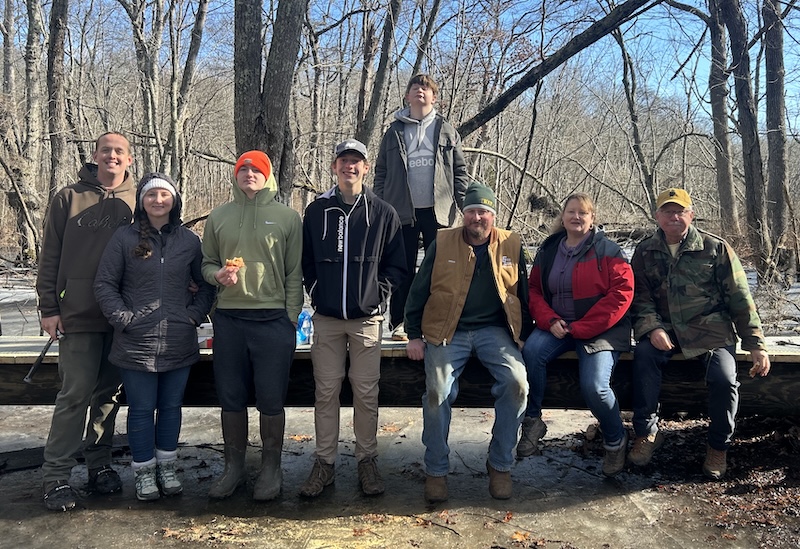

Logan Landry Advances Towards Eagle Scout Status with Bridge Construction in Old Lyme’s Bartholomew Open Space

A job well done—Members of Lyme-Old Lyme Boy Scout Troop 26 relax after completion of the bridge-building project with some of the volunteers who assisted. All photos by Andrea Fenton.

LYME-OLD LYME—As part of his qualifications to gain the prestigious Eagle Scout honor, Logan Landry, a member of Lyme-Old Lyme Boy Scout Troop 26, designed a 25 ft. long bridge to be installed over a flooded—and hence closed—trail in Bartholomew Open Space in Old Lyme.

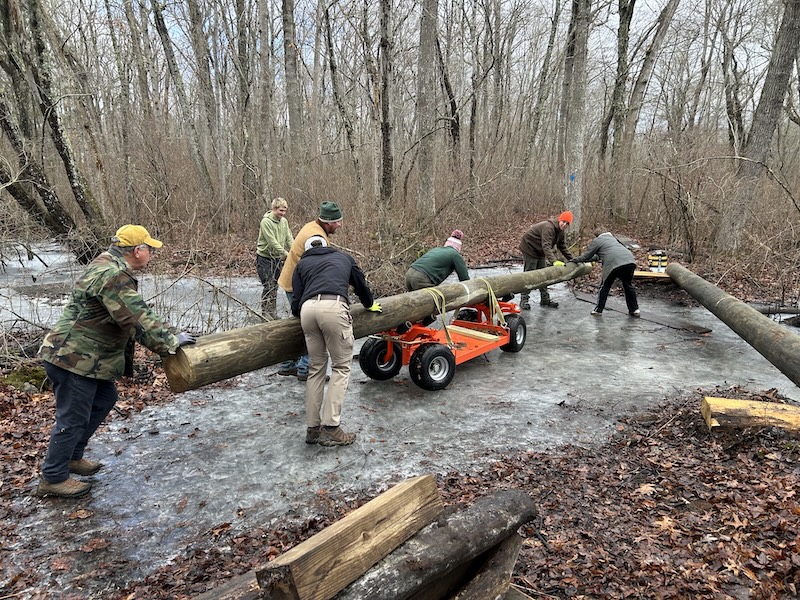
Moving the telegraph poles needed all hands on deck.

On Feb. 1, Landry successfully coordinated construction of the bridge. He was assisted by several older and fellow Troop 26 Scouts including Ryan Ortoleva, who is already an Eagle Scout, and Charlie Zelek. Landry’s family, including his brother Brenden Landry—who is also an Eagle Scout— also assisted.

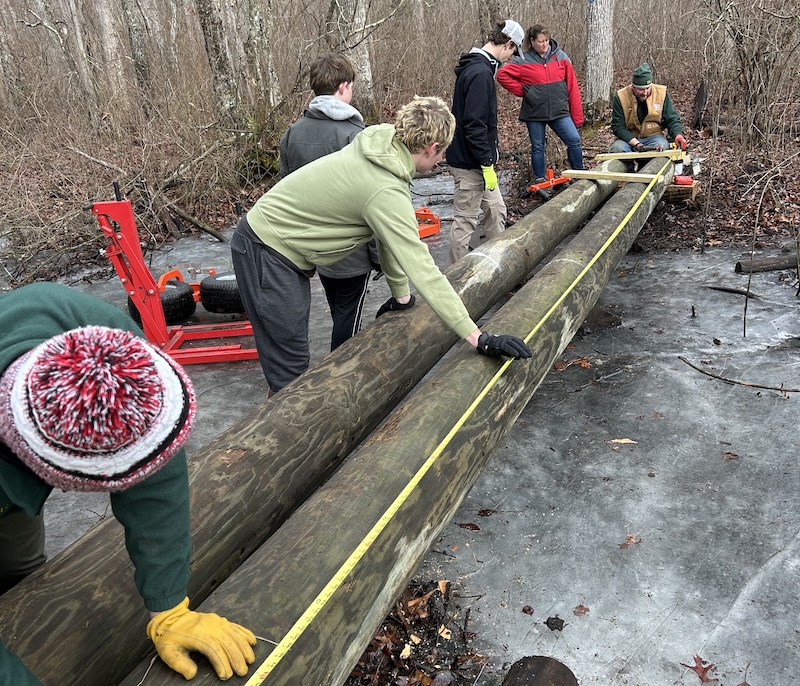
The work continued despite the icy conditions.A great dealmof measuring

Brenden had previously built several foot bridges on Old Lyme Land Trust property off Boggy Hole Rd. in the town.

A great deal of measuring was required to complete the project.

Also in attendance were Open Space Commission members Peter Norris, who serves as Head Steward, Evan Griswold, Joan Meek and Andrea Fenton. Mike Aurelia of the Old Lyme Inlands Wetlands Commission also joined the project.

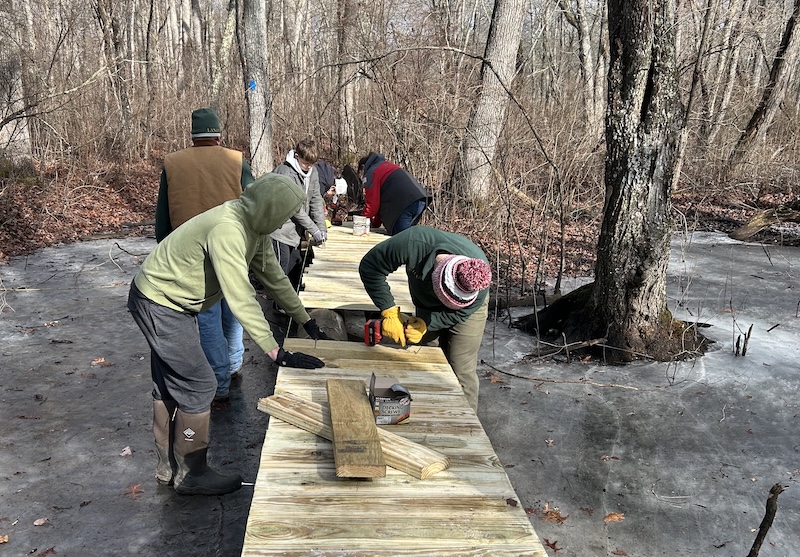
Installing the final horizontal planks was a satisfying moment for all involved.

Material contributions, also coordinated by Logan, were made by Eversource (telephone poles), Middlesex Tree (locust logs), Beard Lumber (wood planks), Gregg Landry Plumbing and Heating, and Teddy’s Pizza (pizza for the crew.)

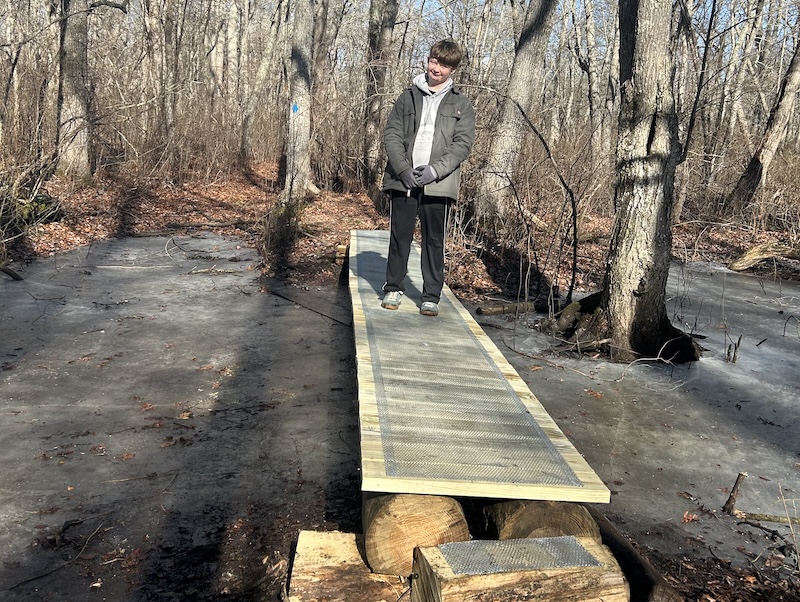
Success! Logan Landry stands atop his just-constructed bridge.

A spokesperson for the Old Lyme Open Space Commission commented, “The Commission is very proud of and grateful to Logan who initiated this project and allowed the Bartholomew Trail to be open once again.”

Op-Ed: Support HROD—Inevitable Halls Rd. Will Change, Optional Overlay Positions Old Lyme to Better Manage Its Future: Other Choice is Leave it to Chance

Editor’s Note: This op-ed is a response by Howard Margules to the op-ed by Jill and Russell Todd, which we published Feb. 5, 2025 on LymeLine.com. Margules is an Old Lyme resident and member of the Halls Road Improvements Committee.

Thank you for your interest in the Halls Road Overlay District (HROD) zoning proposal—I would like to address your concerns:

Developers Overstepping

You indicated that developers will take advantage of the HROD. The opposite is true. The HROD was designed to incorporate strict guidelines that currently do not exist. Large parcels of Halls Road are up for sale and we are likely to see new construction, especially on the very dated Hideaway side of the road. Developers will have to comply with the current zoning regulations, but they will still have significant leeway, and they easily focus on the needs of the highway travelers rather than on the needs of our residents. Halls Road could wind up looking like the sprawl similar to the four corners of East Lyme. The HROD guards against this. Our goal is to ensure new construction will be consistent with the architecture of Lyme Street. The HROD provides strict guidelines and offers an additional layer of protection that currently is absent in our regulations.

Design Review Board

You indicated there is no guard rail for the Design Review Board. The Design Review Board actually is a guard rail. It will consist of professional architects, whose task is to ensure that new construction is consistent with the architecture on Lyme Street, and not some typical cookie-cutter project. Its sole purpose is to provide oversight, and it exists only when the HROD exists. But it only acts in an advisory role to the Zoning Commission. Zoning has the ultimate authority and is the ultimate guard rail.

Zoning Rubber Stamp

The Zoning Commission has been anything but a rubber stamp. The initial HROD application was rejected, and It has now been revised in order to address their multiple concerns. Zoning Commission members have taken their job very seriously and spent a tremendous amount of time and effort delving into the complexities of the HROD. All of the members of the commission are both very experienced and extremely knowledgeable about zoning issues. The HROD has also been scrutinized and approved by the Old Lyme (OL) Board of Selectmen and the OL Planning Commission (who also originally rejected it), as well as receiving the endorsement from the OL Economic Development Commission.

Septic Systems

You are correct that new septic systems might eventually have much greater capacity. But for the foreseeable future, redevelopment will be confined to the larger parcels. Most of the lots fronting Halls Road are only one or two acres and that makes them less attractive to develop. Keep in mind Halls Road is less than a mile in length.

Parking

Parking continues to be a significant restraint to over-development, and I would assert that parking is a major expense. So yes, the HROD does allow free-standing parking garages, provided they are built at least 120′ from the lot’s frontage. They are under the same size limitations as any other building: three (3) stories, 35 ft. max., 20,000 SF footprint max. They are also under the same Design Review Board scrutiny, and must be designed creatively to pass muster. The size is small for a parking garage. It might be profitable in a major city, but it is unlikely to be built in Old Lyme. The cost per space is very, very high at this small scale. Cost considerations can change over time (even car sizes, as some of us know), so garages are permitted, even if currently unlikely. 

Exaggerated Renderings

The renderings you saw at the Open House were used as the basis for creating the overlay zone. We provided Zoning with additional detailed drawings in order to assist them in picturing the actual dimensions. The longest buildings on both Lyme Street and Halls Road range from 147 ft. to 488 ft. Hence a 200-ft. building is in line with the proportions of existing buildings in town.

The Open House renderings were derived from scaled AutoCAD files and generated to envision what a town center could look like, not actual proposals. All new construction will have to conform to the HROD guidelines. The Architectural Review Board will make recommendations and Zoning will make the final decision. We realize there are renderings circulating that depict large “cookie-cutter” buildings. These are not what we are proposing.

Our Future

Halls Road is going to change since large parcels are up for sale. Our choice is to leave it to chance, allowing commercial developers to build projects that serve highway travelers or to provide incentives for future development that meet the commercial and cultural needs of our community, including alternative housing options especially for seniors looking to downsize and young people who cannot afford single family homes.

Introducing the optional overlay will position our town to better manage its future. The HROD proposal contains specific features that the residents told us they desire including: a vibrant, walkable and attractive town center, alternative housing options, a bike trail, safe streets, and a sustainable commercial center focused on the local community.

My guess is we both have the same goals in mind. But feel free to contact me if you still have any questions or concerns.

Old Lyme Town Nurse Office Hours Temporarily Reduced to Tuesday to Thursday

OLD LYME—As of Feb. 3, Town Nurse office hours are temporarily restricted to three days per week while Nurse Denise Piersa is on a scheduled leave. A substitute nurse is available for blood pressure clinics and office hours Tuesday to Thursday from 11 a.m. to 1 p.m. at Christ the King Church in Old Lyme.

For residents, who are sick or convalescing at home, the substitute nurse is also available to make monthly house calls for health assessment and promotion. If skilled care is needed, she can coordinate that care through our partner agency, Yale New Haven Health at Homz Southeast. These skilled services do incur a fee, but the cost is usually covered by Medicare, Medicaid or private insurance.

As always, Town Nurse appointments are open to all residents free of charge. Walk-ins are welcome, but residents are encouraged to call ahead of time.

The Town Nurse’s phone number is 860-434-7808.

Op-Ed: Reject HROD—Don’t Compromise Old Lyme’s Identity: “Thoughtful, Transparent Planning” Needed

Editor’s Note: This op-ed was submitted by Old Lyme residents Jill and Russell Todd.

We write to express our deep concern regarding the Halls Road Overlay District (HROD) proposal recently presented to the [Old Lyme] Zoning Commission and the lack of public scrutiny and acceptance surrounding this plan.   

What was sold to the community as a charming, village-like vision has revealed itself to be a high-density urban blueprint that would fundamentally alter Old Lyme, replacing its historic rural character with the kind of overdevelopment seen along I-95. 

This is not just an interpretation; it is a direct reflection of the allowances in the proposal. A development of 40 units per acre, 200ft frontage buildings with even larger non-frontage buildings, and three-story  parking garages represents a significant shift towards a higher-density model that typically defines urban suburban areas.  

During the last Zoning Commission meeting, the Halls Road Improvement Committee (HRIC) justified these building parameters by claiming this level of density and scale is necessary to attract developers.  However, this change raises serious questions about the long-term vision for our town.  

When challenged by members of the Zoning Commission, the justification changed. Suddenly, the HRIC and their lawyer reassured us that “safeguards” were in place to prevent the very type of overdevelopment that the regulations explicitly permit. This assurance feels contradictory and alarming.  

These are our concerns about the safeguards mentioned: 

1. Zoning Approval will be a rubber stamp – Although zoning approval is necessary for individual  projects under the overlay, what real power will the Zoning Commission realistically hold if the regulations permit high-density residential developments, large-scale retail buildings, and parking garages? If the overlay is approved, developers will undoubtedly seek to take full advantage of its provisions, making it very challenging for the Zoning Commission to deny proposals that meet these criteria. 

2. Design Committee lacks credible oversight – The proposal calls for a pre-application process and establishes a three-person design committee to oversee design guidelines. However, the  committee’s composition, scope of authority, and accountability are unclear, leaving its role ambiguous. 

3. Septic Limitations are temporary – Traditional septic systems can create density constraints.  However, advancements in above-ground alternatives and continuously improving technology could increase septic capacity, thereby reducing this constraint. 

4. Parking Restrictions are gone – Parking, which used to be a significant limiting factor for development, has essentially been removed as a safeguard. Developers can now depend on parking garages to meet parking requirements.

None of these measures provide adequate safeguards against determined developers and their experienced legal teams, which could make high-density urban development in the primary artery of rural Old Lyme a reality. 

We attended many of the HRIC’s “open houses” over the years and came away with the impression that the verbal assurances and visual illustrations presented during those forums aligned with a vision of a  “village feel.” However, the current regulations outlined in the application bear little resemblance to that vision. With over 700 signatures (and counting) on a recent petition opposing this overlay, it’s clear we are not alone in our concerns. 

While we support the idea of responsible development along Halls Road, such development must align with the community’s shared vision and the character of Old Lyme. To ensure this alignment, we recommend the following:  

1. Comprehensive Review: A professional assessment should define appropriate size, scale, and density dimensions driven by the town’s needs, rather than developer imposed. Considerations  should include traffic flow, accessibility, septic system requirements, water usage, water runoff,  environmental impacts, and the overall aesthetics of the town as examples. 

2. Visual Confirmation: Create professional scaled plans and elevation renderings to clearly illustrate the potential impact of the proposed regulations across the entire overlay zone at maximum capacity. 

3. Community Engagement: At a minimum, a town-wide presentation should be held prior to any zoning changes, providing an opportunity for public questions and answers. Ideally, a zoning  change of this magnitude would be put to a vote and decided by the citizens.  

This is not about opposing progress; instead, it is about ensuring that any progress aligns with the community’s collective aspiration for a village-like community in keeping with Old Lyme. 

We urge the Board of Selectmen, Zoning Commission and all town leaders to listen to the growing concerns of Old Lyme residents and businesses and request the Zoning Commission reject the HROD proposal in its current form. The proposed overlay and the associated process need to be reevaluated to ensure they meet the community’s needs and values. Thoughtful, transparent planning and meaningful public engagement will facilitate development that enhances Halls Road without compromising Old Lyme’s identity.