Editor’s Note: The Halls Road Improvement Committee (HRIC) asked us to publish this open statement to the Old Lyme community on their behalf. It is the opinion of the HRIC.
There has been a wave of posts on social media and elsewhere making claims that misrepresent the actual content of the HROD proposal and distort its possible impact on our community. The true facts will not support these assertions, nor the emotional appeals based on horrifying (and totally false) claims.
We expect you will see communications from Old Lyme residents, who oppose HROD, citing these falsehoods in support of their stance. We urge you to take full account of the source and nature of these errors, and disregard objections that are based on false information. Below is a sample of the assertions of this campaign, compared to actual facts.
First, the number of dwelling units allowed under HROD is wildly exaggerated, ‘supported’ by a misleading calculation that ignores the actual HROD regulations. It multiplies the HRIC estimate of “buildable acreage” in the district (~40 acres) by a maximum of 40 dwelling units per acre pulled out of context from HROD section 5.15.6.3.a., resulting in the claim that HROD would “add 1,600 residential units.” This ignores the fact that not every lot within the district can use HROD.
The regulations include a mix of constraints and requirements — lot coverage, parking requirements, limitations on size, scale, massing, etc.—affecting all projects under HROD. We have done the math to calculate maximum possible residential construction following two different methods. The results agree.
Our best estimate of the actual maximum number of dwelling units that could be built on all lots eligible today is closer to 400-450; and that number assumes there are NO restrictions from non-zoning regulations such as septic, environmental, etc. When those factors are taken into account, the number that could actually be built may be 200-225.
Second, these posts typically ignore the HROD limitations on building massing, height, size, placement, appearance, materials, etc. Citing a few upper limits, they suggest building arrangements and densities that are not possible or are expressly disallowed in the actual HROD regulations. They often describe a “wall of buildings” in places where the HROD regulations themselves say no such massive and unvaried structures can be built.
In addition, the HROD includes a Design Review Committee to aid the Zoning Commission in ensuring that the scale and design of any proposed construction is consistent with the aesthetics and character of Old Lyme. HROD does not allow development beyond the scale and scope appropriate to the town center of a small rural town.
Third, issues about environmental concerns are also misguided. The Halls Road area is already fully developed. Much of that development is many decades old, some of it built before the advent of serious environmental protection legislation. Any new development under HROD must adhere to current standards and be more ecologically sensitive and less detrimental to the environment than the existing construction. This would actually be an improvement over existing conditions rather than the disaster portrayed by some of those opposing HROD.
The Halls Road Improvements Committee strongly protests this effort to flood the public forum with error and misinformation. The scale and scope of development possible under HROD is a small fraction of what this opposition campaign claims. The likely and expected impact of HROD on Old Lyme bears no resemblance to the nightmare scenarios presented in social media.
Doing nothing is also an action and, in the case of Halls Road, one with negative consequences for Old Lyme. Current C-30S zoning draws significant investor interest in serving the highway, and very little in any other commercial development. Without allowing a more profitable alternative, Halls Road will increasingly serve the highway, while businesses that serve town residents decline.
The HROD proposal is good for Old Lyme. It is a key element of the Halls Road Master Plan.
Like that plan, HROD was developed with significant input from town residents, stakeholders, and key town committees including Planning, Zoning, Economic Development, and the Board of Selectmen in three administrations. It represents years of volunteer and professional work. We believe it is a well-crafted and sound set of regulations.
Together, HROD and the Master Plan address multiple critical needs of Old Lyme: alternatives to single-family homes, retention of retail that serves Old Lyme (not the highway), safe pedestrian and cyclist access to our shopping area, and allowing the creation of a walkable, mixed-use neighborhood and town center appropriate to the small Town that is Old Lyme. Without HROD, the multi-million-dollar sidewalks of the Master Plan will go to half-empty parking lots, and little more.
Editor’s Note: We thank Halls Road Improvements Committee (HRIC) Chair Edie Twining for sharing the following ‘Spring 2023 Update to the Community’ from the HRIC with us. Since it is such an important topic to the residents of Old Lyme, we are pleased to publish it in its entirety
OLD LYME — On March 27 the Old Lyme Zoning Commission voted 3-2 in favor of creating the Halls Road Overlay District (HROD).
Because the Planning Commission had previously given the HROD a ‘negative referral,’ it required a 4-1 vote to pass, and the measure failed.
The HROD is a significant piece of zoning regulation. It takes significant effort to understand the details. Many of the objections raised were covered by parts of the HROD proposal that apparently were not noticed or were misunderstood.
With the support of the [Old Lyme] Board of Selectmen and the heads of the commissions, we plan to reapply, and to do a better job of explaining the proposal in detail, and answering the objections raised.
The challenges that prompted the effort to make changes along Halls Road still face us.
We need to acknowledge the changing business climate and support our retail businesses in the new environment of the coming decades. The people of Old Lyme want a safer, more attractive, walkable, bike-able, mixed-use town center where they can live, work, and shop.
Smaller-scale housing remains in short supply, and Halls Road is one place where it could be built without using up the remaining open space.
Old Lyme is planning major investments in public improvements, but the Halls Road area also needs to be allowed the optionto change for the better.
Restricting Halls Road to “commercial only” now tends to favor highway services over all other uses—a thing that no one wants. Guiding our future is an important matter for Old Lyme. The HROD creates the optionfor a better future.
In the area of improvements to public infrastructure, the town has hired A. I. Engineers (AIE) to proceed with design development of a new pedestrian/cyclist bridge and trails safely connecting our main commercial district on Halls Road with our Arts District and historic town center on Lyme Street. The bulk of the funding for this project is from the ARPA grant awarded last June.
In February of this year, we also applied for a small grant under the CT Recreational Trails Program to support the bridge and trails. The Halls Road Improvement Committee and the Town of Old Lyme will work on required easements and rights-of-way.
The work of AIE on the project will include an economic analysis, site survey and assessment, and geo-tech investigation leading to preliminary phased designs. AIE will produce three options (with cost estimates) for creating the bridge and trails. AIE’s work will be available for public review, and a final design selected.
Once a final design is approved, AIE will create full construction documents (CDs) for the bridge and trails, and detail the project’s permitting requirements. The CDs will also be used to seek grants to cover the construction costs of the project. AIE will assist in seeking grants, and manage the bidding to move the project to the construction phase.
Last year the BSC Group helped Old Lyme apply for a grant under the Connecticut Department of Transportation (CT-DOT)’s Local Transportation Capital Improvement Program (LOTCIP). The grant could cover a substantial part of the construction costs for the main improvements planned for sidewalks, lighting, landscaping, etc. along Halls Road. (The bridge and trails are a separate matter from CT-DOT’s point of view.)
Our LOTCIP application is also the first formal review of our plans by CT-DOT, and we must wait for their approval to proceed on this part of the plan. The LOTCIP program has many applicants and the waiting list for review is long. This is Old Lyme’s first request under LOTCIP, and we hope to see some action on our application in 2024.
On Monday, January 9th at 6:30 p.m. the Halls Road Improvements Committee (HRIC) will be presenting the Halls Road Overlay District application to the public and the Zoning Commission. We are the third item on the agenda.
Please join us to show your support for this important step in the Halls Road Improvements process. Your verbal support will aid in showing the commission that Old Lyme’s residents are in favor of allowing the additional opportunities available through the new Overlay District. These opportunities include:
· Locating commercial businesses along Halls Road; no more 60 ft. setbacks that create a sea of parking lots
· Greater visibility for stores and restaurants as they move up to the roadway
· Mixed uses with shops on the first floor front and residential or other commercial uses above or beyond Halls Road
· Allowing multi-family residential apartments and town houses to answer the ongoing need in town for smaller living space options
With the introduction of the overlay district, property owners can chose to redevelop their properties for greater return on their investment OR the option to remain with the current C30s District allows owners the flexibility to choose either option.
Additionally HRIC is actively seeking grants to implement the public improvements called for in the Halls Road Master Plan. By providing sidewalks, cross walks, lighting and landscaping future developers can see the town is invested in creating a walkable, shop-able, neighborhood environment along Halls Road.
Please come to this important public meeting and show your support!
We received the following Frequently Asked Questions from BJ Bernblum, the Halls Rd. Improvements Committee Chairman. He asked that we publish them since, in his words, “At the Old Lyme public meeting held on Dec. 6, 2018, and in emailed comments received by the Halls Road Improvements Committee afterwards, a number of questions were raised that need to be answered.”
Bernblum states that this document of Frequently Asked Questions prepared by the committee, dated Jan. 28, and published below, “… attempts to do this.”
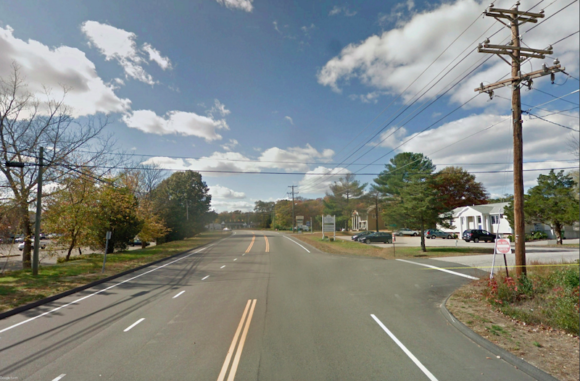
A view of Halls Rd. today looking north. Photo courtesy of the Yale Urban Design Workshop.
We thank the Halls Rd. Improvement Committee for sending us these FAQ’s and, as always, we look forward to hearing reader’s thoughts on them.
Question 1: Why should the town get into the development business? Isn’t that better left to private developers?
Answer: It shouldn’t and yes. We are not suggesting that the town take charge of development on Halls Road but, rather, that we take steps to encourage private parties to develop the neighborhood in a manner and direction that will comply with current requirements (safety, complete streets, ADA accessibility, etc.) and best serve the needs of the community. These steps would include adopting a “master plan” and guidelines for future development, investing limited funds in infrastructure and public spaces, and making appropriate changes to the town’s zoning code and Plan of Conservation and Development, all intended to allow for and encourage private developers to invest in upgrading existing structures and undertaking new construction.
Question 2: Halls Road is fine the way it is—why is the town considering changes?
Answer: Halls Road, our central commercial center, has developed haphazardly over many years. It is inhospitable to pedestrian and bicycle traffic, portions of it are esthetically unattractive or looking tired, and residents currently have to leave town to seek products or services they cannot obtain locally.
If nothing is done, we are concerned that the business environment will deteriorate, businesses will close, and even fewer goods and services will be available. With thoughtful planning and inducements, we should be able to:
i. improve the business environment, thereby assisting existing businesses, attracting new ones, and growing and diversifying the tax base;
ii. create a physically-attractive neighborhood, safe and inviting for pedestrians and bicyclists;
iii. stimulate the development of housing that is inviting to down-sizing residents and to young folks wanting to move to town; and
iv. provide public spaces for civic events and recreation.
The ultimate objective is to create a vibrant town center that has more to offer the citizens of Old Lyme and is one we can be proud of.
Question 3: What is the new plan for Halls Road?
Answer: The plan does not yet exist; it is still developing and is flexible. The goal is to reach majority agreement on what the Halls Road neighborhood might ideally look like. Initially, we held a public meeting to obtain feedback regarding those elements residents would like to see included. The meeting produced many ideas, including the ability to park once and walk the entire road, creation of green space with a community gathering area, development of mixed-use facilities (or a mix of uses), and esthetic enhancements.
We recently held a second public meeting to gain further input, and will hold more meetings in the future. The Yale Urban Design Workshop is assisting us in developing a master plan, but we need substantial input from town residents and stakeholders in order to come up with sound ideas that enjoy widespread support.
Question 4: What is the process for developing a master plan?
Answer: Once we have enough public input to begin to see the outlines of a plan, we will present these ideas to local and state governmental authorities for input and necessary approvals. At the town level, the plan will likely need buy-in from the Board of Selectmen, the Board of Finance, the Zoning Commission and the Planning Commission, as well as amendments to the zoning regulations and the Plan of Conservation and Development.
At the state level, we will need approval from the Department of Transportation, which owns Halls Road. A master plan can be finalized only when it enjoys broad public support and satisfies governmental requirements.
Question 5: What is the anticipated time-frame for implementing the plan?
Answer: The Committee intends to develop a master plan and set of guidelines for the future development of Halls Road. The plan would consist of several phases to be pursued in an orderly sequence over time, so that work done in one phase supports, or at least does not interfere with, improvements to be made in a subsequent phase. Each phase will also be expected to “stand on its own,” in the sense that its completion will add value to the town even if subsequent phases are not pursued.
For example, an initial phase might consist of improving access, such as by adding sidewalks, a bike path, improved signage, and a pedestrian bridge over the Lieutenant River. The timing and exact nature of subsequent phases, and the changes that will be implemented, will of course depend on future events, including available funding and the decisions made by private developers and property-owners.
Hence the timing is unpredictable, but this is surely a multi-year process over which the master plan will evolve, perhaps substantially but consistent with the guidelines, to address changes over time in the town’s commercial and residential needs.
Question 6: Will the plan result in unfettered growth and additional traffic?
Answer: We view this project as a rehabilitation of the Halls Road neighborhood, and any potential growth must be managed to fit the needs and the character of the town. For example, we would encourage architectural design in keeping with the small New England town flavor of Old Lyme.
There is no intent or appetite to change our “town business center” into a dense retail environment but, instead, to attract a limited number of businesses that our neighbors would like to enjoy locally (e.g., a restaurant, coffee shop, bakery, jewelry store), and enhance the patronage for existing businesses. These changes would increase auto traffic somewhat.
However, we intend to limit congestion through a design that encourages folks to park once and then walk the neighborhood, rather than drive from place to place.
Question 7: How can this plan survive the overflow traffic from tie-ups on I-95?
Answer: These tie-ups will not be materially exacerbated by a normal increase in Halls Road traffic, and they occur infrequently enough so that they should not discourage business development along the road, which is currently a pass-through.
The plan might call for locating parking behind the main shopping and business buildings and creating tertiary access roads and walkways, which would mitigate the Halls Road bottleneck. For example, we might explore the construction of a local access road south of the current Old Lyme Marketplace buildings (the Big Y plaza).
Question 8: Will private property owners be required to make changes or invest money?
Answer: No one will be required to do anything. Other than the state right-of-way along Halls Road, the real estate in question is privately owned and changes must be voluntary.
The expectation is that property owners will see the advantages of making changes to their property in order to increase profitability. Alternatively, they may discover that they can sell their property at an attractive price to a motivated developer who is ready to invest in a significant project consistent with the town’s guidelines.
Question 9 How will the plan be financed and how much will it raise property taxes?
Answer: The objective is to have this project be tax neutral or result in a tax rate decrease because of an increase in the tax base. The public infrastructure would hopefully be financed, at least in part, through state and federal grants, and from new tax revenue generated by the new construction, although this might initially require town bonding. The private development will be financed by developers and property owners, who may also help pay for common amenities such as wastewater management, sidewalks and landscaping.
The town might consider creating a Tax Increment Financing (TIF) District like the one just approved in Old Saybrook, under which new tax revenue generated by new construction may be allocated, in whole or in part, to improvements in the district and to financial inducements to developers. In all events, any material town expenditures will have to be approved at a town meeting.
Question 10: What happens if I-95 is widened in the future or the exit or entrance ramps are reconfigured?
Answer: That question is impossible to answer, not knowing what properties the government might want to seize by eminent domain. However, given the current economic condition of the state and the absence of any such plans, we do not think it prudent to forego changes benefitting the town because of a remote, future risk.
Question 11: What do you mean by residential housing on Halls Road and why is it needed?
Answer: We would seek to enable the construction of reasonably-priced rental properties and condominiums. Many concerns have been expressed about young people who want to move to town (perhaps after college) or out of their parents’ homes, and older folks who are retiring or downsizing and would like to remain in Old Lyme, but cannot do so because of the lack of appropriate housing.
The Halls Road neighborhood, as envisioned with expanded resources, offers an ideal location for this housing, since both groups prefer to live in areas where they can walk to stores, restaurants, banks, recreational facilities and other amenities. Furthermore, the retailers in the neighborhood would surely benefit from the presence of these residents.
Question 12: How do you intend to address increased wastewater?
Answer: A good question that must be addressed, but there are solutions other than municipal sewers. For example, it might be feasible to construct a community treatment facility that would process the wastewater to a condition where it can safely be discharged.
Question 13: How can the town validate what types of improvements would be the most successful for the town, its businesses and the tax base?
Answer: One way would be to retain a professional consultant such as CERC (the Connecticut Economic Resource Center) to perform an economic review of Old Lyme and the region, and recommend what improvements would likely be most viable. Such a study would give our residents and businesses guidance on the development possibilities and the impact on taxes. It would also serve as an attraction to serious investors, both for its content and as an indication of the town’s seriousness about supporting the project.
Question 14: How can I have input to the plan or keep updated on the progress?
Answer: There are several ways for you to stay informed and be heard, and we hope you will utilize them. We will hold more public meetings and focus groups, and intend to develop a page on the town’s website where we can provide updates and receive input. You can also send an email to the Halls Road Improvements Committee at hallsroadcommittee@oldlyme-ct.gov, or ask to speak personally with any of us.