Talking Transportation: Pre-Cursor of the Tesla, the Dymaxion Car has Connecticut Roots

Jim Cameron

Did you know that Bridgeport was once the home of “the car of the future”?  It was the Tesla of its era, but only three were ever built.

This mystery vehicle?  The Dymaxion Car.  The designer?  Buckminster Fuller.

Best known for his pioneering 1940s architectural design of the geodesic dome, a decade earlier Fuller was already inventing other things.  It was the 1930s and the country was struggling through the Depression.  Fuller saw the need for innovation, for “doing more with less,” and conceived of a mass-produced, pre-fabricated circular house modeled after a grain silo.

Built with aluminum, Fuller only saw two prototypes of the dwelling constructed and even those weren’t actually built until 1945.  Fuller called his design The Dymaxion House Dy for Dynamic, Max for Maximum and Ion for tension.

It was a major flop.

The Dymaxion Car

Next, Fuller moved on to transportation, conceiving the Dymaxion Car, an 11-person, three-wheeled vehicle that he hoped might one day would even be able to fly using what he called “jet stilts”… and this was decades before the invention of the jet engine.

Indeed, the Dymaxion Car looked a lot like a stubby zeppelin with a forward-facing cockpit and tapered, aerodynamic tail.  Equipped with a rear-mounted engine that could run on alcohol, it could go 90 mph and get 30 miles to the gallon.  The car had dual steel frames while a wooden lattice-work held the outside aluminum panels in place.  The single rear wheel could pivot 90 degrees making parking a breeze.

Bankrolled with $5000 from wealthy investor and socialite Philip Pearson of Philadelphia, Fuller needed a place to build a prototype and ended up at the old Locomobile plant on Atlantic Street in Bridgeport’s Tongue Point neighborhood.  Don’t bother looking for this piece of history.  It’s long gone as the land is now home to the PG&E power plant.

When Fuller set up the auto workshop in March 1933, he hired naval architect Starling Burgess, who recruited 27 workmen, many of them from Rolls Royce, from the 1,000 applications he received.  In just three months, the first prototype was completed and rolled out onto the streets of Bridgeport on Fuller’s 38th birthday.  The car was immediately shipped to Chicago for display at the World Fair.

Sadly, the prototype was totaled after it was involved in a car crash, flipped over and killed its driver and left VIP passengers injured.  Initial orders for the Dymaxion started to evaporate over safety fears even though it turns out the Fuller car had been sideswiped.

A second prototype emerged from the Bridgeport plant six months later.  Fuller had hoped to display the Dymaxion at the 1934 New York Auto Show but pressure from Chrysler locked him out, literally.  Not to be outdone, Fuller parked prototype #2 right by the front door of the show and got more attention than he might have done on the exhibit floor.

Fuller even brought the car back for the last year of the Chicago World Fair in 1934 but public curiosity didn’t turn into sales.  Fuller eventually sold this second prototype to his plant workers while a third model — this one equipped with a stabilizing vertical fin — went to conductor Leopold Stokowski.

Only one of the three Dymaxions survived, car #2, which is now at an auto museum in Reno, NV.  But Bucky Fuller fans have built replicas, some of which are still on the roads today 80 years later.

Posted with permission of Hearst CT Media.

About the author: Jim Cameron is founder of The Commuter Action Group, and a member of the Darien RTM.  The opinions expressed in this column are only his own. You can reach him at CommuterActionGroup@gmail.com  For a full collection of  “Talking Transportation” columns, visit www.talkingtransportation.blogspot.com

A la Carte: A Day for Dauphinois (aka Scalloped Potatoes)

If you are reading this column today, you know that yesterday was Christmas. If you have little ones, they probably woke you up at dawn, to let you know that Santa had arrived.

When our little ones were young, we spent Christmas with my husband’s sister in East Bloomfield, N.Y. We arrived on Christmas Eve, early enough to get to my in-laws’ church in Rochester. There my husband turned the pages of the lovely old pipe organ as my father-in-law played.

After that, we all drove to Roslyn’s house. Our children, our parents and we slept everywhere—kids in sleeping bags in the living room and family room, our parents in the bedrooms upstairs/ Doug and I slept in a Sofabed  two rooms away from the living room (that room, much later, became the bird room, but that’s another long story).

I’m not sure how Ros made this happen, but no presents were open until we had a full breakfast, waffles or pancakes or French toast, bacon and sausage and, for us, gallons of coffee. Then the fun began.

Wrapping paper and bows filled the living room and the kids squealed. We adults opened our gifts one at a time, exclaimed how thrilled we were with every present. We showed each of our treasures to the others. And every year we gave Roslyn a special one—always a gag gift, often naughty. She was supposed to show them to our parents.  Sometimes she didn’t.

Dinner, around 4 p.m., was easy: often prime rib, which came out of the oven as we turned the heat to 450 degrees. Then we placed the pan of Yorkshire pudding, which, of course, is not a pudding at all. Sometimes it was a ham, instead. If it was, there would be scalloped potatoes, which everyone loved. 

Today I am making a big ham for my neighbors, their son and his teenage daughter. If I could have gotten one, it would be a spiral sliced, Honey Baked Ham. It may not be local and it may be overly sweet, but I love that ham. There will be sweet potatoes and mashed potatoes, macaroni and cheese (for my neighbors’ granddaughter), lots of vegetables and for dessert something special—perhaps crème brulee or chocolate pots de crème. The next day I will make a very French scalloped potatoes with slivered left-over ham nestled inside.

I love this recipe! (See below)

Gratin Dauphinois

From A Passion for Potatoes by Lydie Marshall (Harper Perennial, New York, 1992)

1 large garlic clove, peeled and minced
2 pounds Yukon Gold or russet potatoes, peeled and sliced one-eighth- to one-sixteenth-inch thick
1 and one-half teaspoons sat*
1 and one-third cups half-and-half cream
1 tablespoons cold butter
One-half cup heavy cream

Yield: serves 4 to 6 

Preheat oven to 325 degrees. Butter a 2-quart rectangular or oval dish 14 by 8 by 2 inches.  Scatter the minced garlic in the dish.

Overlap 3 layers of potatoes in the pan, sprinkling salt between each layer. Dribble in the half and half, barely covering them. Dot the top with butter.

Bake in the middle of the oven for 45 minutes. Pour the heavy cream on top of the potatoes and tilt the pan to baste the top layer. Bake for 45 minutes more, or until golden brown.

*If you are adding ham to the gratin, leave out the salt in the recipe, but serve with a nice finishing salt at the table.

About the author: Lee White has been writing about restaurants and cooking since 1976 and has been extensively published in the Worcester (Mass.) Magazine, The Day, Norwich Bulletin, and Hartford Courant. She currently writes Nibbles and a cooking column called A La Carte for LymeLine.com, and the Shore Publishing and the Times newspapers, both of which are owned by The Day.

A View from My Porch: The Second Renaissance of Miss ElizabethTashjian (Connecticut’s “Nut Lady”)

Editor’s Note: We are delighted to welcome a new columnist to our LymeLine family today. Tom Gotowka will write an occasional piece under the title, “A View From My Porch,” and we are going to let him introduce both his column and himself in his own words.  We hope you enjoy Tom’s offerings — as always, let us know your thoughts!

Author’s Note: “A View from My Porch” is a new column that will cover a range of subjects that I believe will be of community interest. It might be literature and the arts, an event, or even something to do with healthcare. I may occasionally stray into a political issue, but this column will not be partisan political (Other publications have that more than covered.) In reality, all I see from my porch is my wife’s studio, a red barn, a network of beautiful gardens, and a salt marsh, but, of course, “a view” is so much more than what one actually sees.

To give you a sense of the experiences that “qualify” me to write this column, my entire adult career has been in healthcare. I’ll sit on the Navy side at the Army/Navy football game. I always sit on the crimson side at any Harvard/Yale contest. I enjoy reading historic speeches and consider myself a scholar of the period from FDR through JFK. A child of AM Radio, I probably know the lyrics of every rock and roll or folk song published since 1960.

My first few columns will take a fresh look at some of Old Lyme’s cultural and historic icons. As such, this first essay is titled “The Second Renaissance of Miss ElizabethTashjian”. The second column covers Naval hero Ezra Lee.
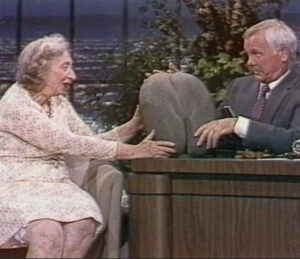
Eliazabeth Tashjian appeared several times on ‘The Tonight Show’ with Johnny Carson.

The Second Renaissance of Miss ElizabethTashjian (Connecticut’s “Nut Lady”)

Connecticut College’s exhibition, “Revisiting the Nut Museum: Visionary Art of Elizabeth Tashjian,” has just closed. I posit that this gallery display of her paintings, drawings, and sculptures, together with the recent Florence Griswold Museum Samuel Thorne Memorial Lecture by Professor Christopher Steiner, “Performing the Nut Museum,” represent the culminating events in this “second Renaissance.” Let me walk you through the facts that led me to this conclusion.

I was introduced to Elizabeth Tashjian more than a quarter century ago (holy cow!) by Colin McEnroe, who now hosts his own show on CT Public Radio and writes a weekly column for Hearst Communications. My wife and I were not yet residents of Old Lyme. This essay begins with a synopsis of her life. However, the crux of this column is my assertion that she became masterful at managing the media, and playing the role of quirky, eccentric artist.

Miss Tashjian was born into privilege in Manhattan in 1912, the daughter of wealthy Armenian immigrants. Her parents divorced when she was 7 years old, and she continued living in Manhattan with her mother. She showed great promise as a concert violinist and pursued music early — and before pursuing her interest in art. She studied at the New York School of Applied Design for Women and the National Academy of Design.

Elizabeth and her mother moved into a 19th century Gothic Revival mansion on Ferry Road in Old Lyme in 1950. Her mother died in 1959 and she continued living there alone. Her father pre-deceased her mother and left no estate.

Nuts were always her passion. This began during her classical arts training in New York City, where she created many paintings of nuts and nutcrackers. These themes would continue throughout her life. She was an active member of Lyme Art Association and frequently displayed her works there.

In 1972, she opened the Nut Museum, which was housed in the dining room on the ground floor of her home. The Nut Museum collection was largely comprised of her own artwork, including over 100 paintings, 20 aluminum sculptures, nut jewelry, and a Nativity scene made completely of nuts. Her art has been described as “visionary”, “avant-garde”, “surrealist”, and/or “outsider.”

She remained unmarried throughout her life. I could not find any reference to any real employment, which allowed her to concentrate wholly on her art. Like her mother, she became a Christian Science healer in mid-life, which may have provided some modest income.

Susan Campbell, writing in the Hartford Courant, described her visit to the Nut Museum: “The first time I met Elizabeth Tashjian, she swooped down the stairs of her Old Lyme mansion to greet me, and I was immediately in her thrall. I remember there was a cape.”

In 1981, Tashjian appeared on Johnny Carson’s “Tonight Show” for the first time. She and Carson “clicked” and her success with him led to many other television appearances, including Letterman, Leno, and others. Her TV appearances usually included one of her songs (e.g., “Nuts Are Beautiful” or the “March of the Nuts.”)

She did not have the same rapport with the other hosts that she had developed in her two appearances with Carson. She often brought a 35-pound coco de mer nut with her to these appearances. The coco de mer, or “nut of the sea” is native to the Seychelles and has an unfortunate resemblance to a woman’s buttocks. She told Carson that “the existence of such a sexually provocative nut utterly refuted Darwin’s “Origin of Species.” Professor Steiner (see below) said “it was arguable whether she was exploited by the media, or exploited it.” His suspicion was that she was the joker, not the joke.

She became known as the “Nut Lady”, which she hated. Preferring words like enthusiast, advocate, culturalist, or visionary.

Miss Tashjian became increasingly reclusive from the mid-1990s through the turn of the century; and her health began to fail. Fortunately, she had found a “champion” in Christopher Steiner, a professor of art history and museum studies at Connecticut College, who was determined to protect her artistic legacy. He remained her supporter and advocate for the rest of her life.

By 2002, she was nearly indigent, in serious debt, and very frail. I won’t provide the terrible details; but she fell into a coma, was declared incompetent, and a ward of the State. The Courts put her house on the market to pay her debts. Despite refusing medical treatment because of her religious beliefs, she recovered, but was confined, apparently against her will, to a nursing home where she died in 2007.

The contents of the Nut Museum had been removed by Professor Steiner while her home was being sold. He had successfully petitioned the Old Lyme Probate Court to recognize the historic and artistic significance of the collection. Unfortunately, Tom Selleck and Henry Winkler were not yet pitching reverse mortgages as financial salvation for the indigent elderly.

And so, begins her “second Renaissance.”  In 2004, the Lyman Allyn Museum in New London launched a show of her work at which she was the guest of honor. Documentary filmmaker Don Bernier completed “In a Nutshell: A Portrait of Elizabeth Tashjian,” a feature-length video about the artist highlighting the diverse roles she assumed during her lifetime, which debuted at Connecticut. College.

Her obituary appeared in the New York Times Food Section in 2007: under the heading,“Elizabeth Tashjian, 94, an Expert on Nuts, dies,” which would have certainly appealed to her sense of irony.

The New Yorker carried “The Nut Lady Returns” in 2005.

The Armenian Weekly provides a detailed account of the Connecticut College exhibition.

Lee Howard’s recent article in The Day, “Reimagining the Nut Lady and her Art,” provides a friend’s perspective:


Reading Uncertainly: ‘The Library Book’ by Susan Orlean

Editor’s Note (i): If you’re still searching for a last-minute gift, then consider this book — it’s the perfect present for book- and library-lovers everywhere! Many thanks to our wonderful and ever faithful book-reviewer Felix Kloman of Lyme for sharing his thoughts on this best-seller, which is described by The New York Times as “a sheer delight…as rich in insight and as varied as the treasures contained on the shelves in any local library” and by USA TODAY as, “a dazzling love letter to a beloved institution and an investigation into one of its greatest mysteries. 

Susan Orlean, a long-time writer for The New Yorker, gives us, at once, a paean to all libraries, a biography of a singular library in Los Angeles, a story of its crippling fire in April, 1986 and its possible arsonist, and, above all, the tale of the devotion and delight of all librarians. It is a love story, too, resonating with all of us enamored of those enticing shelves.

She begins with that fire and its effect on guides and users alike, facing the enormity of the destruction, “This was a shrine to being forgotten; to memories sprinkled like salt, ideas vaporized as if they never had been formed; stories evaporated as if they had no substance and no weight keeping them bound to the earth and to each of us, and, most of all, to the yet-unfolded future”.

What is a library? The author suggests that ”every problem that society has, the library has too,” from homelessness, thievery, fractious adults, uncontrolled children, and waste, yet our librarians manage and smile though it all.  Susan Orlean remains enthralled: “As I stood there, gobsmacked by this serendipity!”

She also wonders about the future of book lending, under the effects of advancing technology, the Internet and social media, concluding with optimism, “Libraries are physical spaces belonging to a community where we gather to share information. … A library is a good place to soften solitude; a place where you feel part of a conversation that has gone on for hundreds and hundreds of year even when you’re all alone. The library is a whispering post. You don’t need to take a book off a shelf to know thee is a voice inside that is waiting to speak to you”.

So off I go to wander through the stacks in Phoebe Griffin Noyes, the Lyme Library, the Acton in Old Saybrook, the Essex Library, and even to Middletown. And everywhere I will find smiling librarians and a veritable profusion of riches.

Editor’s Note (ii): ‘The Library Book’ by Susan Orlean was published by Simon & Schuster, New York 2018.

Felix Kloman

About the Author: Felix Kloman is a sailor, rower, husband, father, grandfather, retired management consultant and, above all, a curious reader and writer. He’s explored how we as human beings and organizations respond to ever-present uncertainty in two books, ‘Mumpsimus Revisited’ (2005) and ‘The Fantods of Risk’ (2008). A 20-year resident of Lyme, he now writes book reviews, mostly of non-fiction, a subject which explores our minds, our behavior, our politics and our history. But he does throw in a novel here and there.
For more than 50 years, he’s put together the 17 syllables that comprise haiku, the traditional Japanese poetry, and now serves as the self-appointed “poet laureate” of Ashlawn Farm Coffee, where he may be seen on Friday mornings. His late wife, Ann, was also a writer, but of mystery novels, all of which begin in a village in midcoast Maine, strangely reminiscent of the town she and her husband visited every summer.

Legal News You Can Use: Do You Know the True Purpose of Alimony?

Alimony is an important protection for some divorcees. If you are divorcing, it might be something you’re looking into seeking, too. Do you know how it’s determined? Do you have any idea about how much you need?

Here’s a little more about alimony, so you can understand what to expect.

1. Alimony is decided by the courts unless you and your spouse agree on an amount

Alimony is decided by the courts, but you and your spouse can decide on an amount yourselves in advance if you’d like. If you want to make up your own mind about how much you need, then you should sit down and budget. Find out how much you need in alimony to make ends meet, and then you and your spouse can talk about an amount that is feasible and how long it should be paid.

2. Alimony is designed to help a lesser-earning spouse and to “pay them back” for their support

Alimony has a few purposes. One purpose may be to help spouses who gave up their careers or who earn less and need time to make up the financial differences caused by moving out. Alimony can also be used as a way to pay them back for financial support while one spouse went to school.

3. Lump-sum alimony helps you avoid long-term obligations

Lump-sum alimony is a good way to avoid long-term obligations. With lump-sum alimony, the payer doles out the whole amount versus monthly installments. With lump-sum alimony, the recipient doesn’t have to worry about payments not being made, and neither the recipient nor payer have to stay in touch (unless for other reasons).

Attorneys at Suisman Shapiro can speak with you more about alimony and answer your questions on the subect. Visit their website or call 800-499-0145 — lines are open 24 hours a day.

Sponsored post on behalf of Suisman Shapiro.