
A View From My Porch: An Appropriate Day to Remember Connecticut Icon William Gillette

Gillette Castle, former home of the iconic movie star and playwright, Connecticut-born William Gillette, who died in 1937.

Editor’s Note: Tom Gotowka sent us this piece last week, but we had always planned to publish it today. By an extraordinary coincidence, we now find — thanks to an article sent to us this morning by our friend and regular correspondent George Ryan — that today is the 90th anniversary of William Gillette’s final performance as Sherlock Holmes, given Feb. 12, 1930 at the popular Parsons Theatre in downtown Hartford.
Timing is everything … so many thanks indeed to George for his gem of information and Tom for his fascinating insight into the life and work of Mr. Gillette.

I am going a few miles upstream in this essay towards East Haddam and its medieval gothic castle to consider William Gillette’s impact on how Sherlock Holmes has been portrayed in movies and television. My goal in these essays is to cover the subject thoroughly enough to either satisfy your curiosity, or to pique your interest to pursue some additional research.

Assuming the editor’s forbearance, I will also review, in a subsequent essay, several of the actors who played Holmes or Watson to judge how true they were to either Gillette’s or Arthur Conan Doyle’s artistic vision.

Gillette was born to a progressive political family in Hartford’s Nook Farm neighborhood where authors Harriet Beecher Stowe, Mark Twain, and Charles Dudley Warner each once resided. His mother was a Hooker, that is a direct descendant of Connecticut Colony co-founder Thomas Hooker. Gillette is most recognized for his on-stage interpretation of Sherlock Holmes. He may have been America’s first matinée idol or to put it another way, the era’s rock star.

The Sherlockian Literature

Sir Arthur Conan Doyle. See below for photo credit.

Sir Arthur Conan Doyle wrote 56 short stories and four novels between the 1880s and the early 20th century that comprise the “canon” of Sherlock Holmes. The stories were first published in Strand Magazine and two of the novels were serialized in that same periodical. 

Holmes defined himself as the world’s first and only “consulting detective.” He shared rooms at 221B Baker Street in London with Dr. John H. Watson, who was a former army surgeon wounded in the Second Afghan War. 

Holmes referred to Watson as his “Boswell” because he chronicled his life and the investigations that they jointly pursued as did 18th century biographer, James Boswell, of Dr. Samuel Johnson.  Watson was described as a typical Victorian-era gentleman and also served as first-person narrator for nearly all of the stories.

Holmes was known for his incredible skills of observation and deduction, and forensic science and logic, all of which he used when investigating cases for his myriad clients, which often included Scotland Yard. He played the violin well and was an expert singlestick player, boxer, and swordsman. He summarized his investigative skills for Watson this way, “Once you have eliminated the impossible, whatever remains, however improbable, must be the truth,” and, “It is my business to know what other people don’t know.”

However, Holmes had shortcomings. He was a very heavy smoker of black shag pipe tobacco, which he kept in the toe of a Persian slipper on the fireplace mantel at 221B. He also smoked cigars and cigarettes. A very difficult problem was called a “three pipe problem.” 

He used cocaine and morphine to provide “stimulation for his overactive brain” during periods when he did not have an interesting case or as an escape from “the dull routine of existence.” This was not really unusual in that period because the sale of opium, laudanum, cocaine, and morphine was legal and often used to self-medicate or for recreation. This habit was worrisome for Dr. Watson, although he once said of Holmes, “He was the best and wisest man whom I have ever known.”

The Holmes stories were immensely popular and Doyle’s last publication in Strand, “The Final Problem,” elicited such public (and Royal Family) outrage, that there were mass subscriber cancellations bringing the magazine to the brink of failure.

William Gillette. See below for photo credit.

Doyle decided to write a stage play about Holmes, set earlier in the detective’s career. He was probably compelled to do so because there already were several Sherlock Holmes on-stage productions, which provided him no income, and were of such poor quality that he felt the need to both protect his character’s legacy and improve his own income stream. 

He drafted the play and shared it with his literary agent, who sent it on to Broadway producer and impresario, Charles Frohman. Frohman reviewed it and said it needed substantial work before anyone would consider production. He suggested that William Gillette be offered the rewriting task. 

At that time, Gillette was already well-known as a talented actor and a successful and prolific playwright. His approach was a significant change from the melodramatic standards in the American theater of the time. He stressed realism in sets, lighting, and sound effects. Holmes Scholar Susan Dahlinger described Gillette’s acting style this way, “He could be thrilling without bombast, or infinitely touching without descending to sentimentality.” 

So, Doyle agreed with Frohman, and Gillette began the project by reading the entire “canon” of Holmes stories and novels. He began drafting the new manuscript while touring in California with the stage production of “Secret Service,” which he had also written.  He exchanged frequent telegrams with Doyle during the process and, with Doyle’s blessing, borrowed some plots and detail from the canon in adapting Doyle’s original manuscript into a four-act play. 

Unfortunately, neither Gillette’s first draft nor Doyle’s original script ever reached stage production. A fire broke out at Gillette’s San Francisco hotel and both manuscripts were lost. So, Gillette began a complete redraft of his lost script, and Doyle was finally able to present a play before the century’s end that he deemed worthy of Sherlock Holmes.

It is worth noting that Frohman perished on the Lusitania in May, 1915, after it had been torpedoed by a German submarine.

In 1899, Gillette was “predictably” cast for the lead role in “Sherlock Holmes A Drama in Four Acts.” Initially presented in previews at the Star Theatre in Buffalo, NY, it opened that November at the Garrick Theatre in New York City, and ran there for more than 260 performances before beginning a tour of the United States and then on to a long run in London, where it received great critical and public acclaim.

He starred in that role for more than 30 years, and about 1,500 productions in the United States and Great Britain. He also starred in the 1916 silent film, “Sherlock Holmes,” which film-historians have called, “the most elaborate of the early movies.”

Playing a role for so many years was not unusual at that time in American Theater. For example, James O’Neill, father of playwright Eugene, played Edmond Dantès, The Count of Monte Cristo, more than 6000 times between 1875 and 1920.

Some Key Elements of Gillette’s Sherlock

Although William Gillette is really no longer a “household name” — except perhaps,here in Southeastern Connecticut, where much of how we imagine Holmes today is still due to his stage portrayal of the great consulting detective. 

Gillette actually bore some resemblance to the Holmes described by Dr. Watson in “A Study in Scarlet.” Watson notes, “His [Holmes’s] very person and appearance were such as to strike the attention of the most casual observer. In height he was rather over six feet, and so excessively lean that he seemed to be considerably taller. His eyes were sharp and piercing, and his thin, hawk-like nose gave his whole expression an air of alertness and decision. His chin, too, had the prominence and squareness which mark the man of determination.” 

Gillette’s Holmes appeared in deerstalker cap and Inverness cape. He smoked a curve-stemmed briar pipe, and carried a magnifying glass.  He crafted a phrase that eventually evolved into one of the most recognized lines in popular culture: “Elementary, my dear Watson.” Gillette’s direct style was said to lend a bit of arrogance to Holmes beyond that which Doyle had depicted —  that arrogance has become a hallmark of Holmes’ portrayal in contemporary movies and television.

And finally, Gillette introduced the page, “Billie,” who had actually been played by a certain 13-year-old Charles Spencer Chaplin during the London engagement. At the end of the run, Chaplin began his career as a Vaudeville comedian, which ultimately took him to the United States and movie stardom as the incomparable Charlie Chaplin. 

Some Final Thoughts

I first learned of William Gillette a few summers ago when I visited his remarkable home, “Gillette Castle” built high above the eastern bank of the Connecticut River. I left that visit impressed with Gillette’s creativity in his design of the doors, light switches, and some of the furniture; wondering about his secret multi-mirror “spying” system, and with the assumption that he was just an eccentric artist who liked trains. 

However, I enjoy the Sherlock Holmes literature; and began reading the “canon” at age twelve. I have certainly re-read many of the stories a few more times. Over the past several years, I began to read several authors who write Sherlock Holmes short stories and novels “in the style of Arthur Conan Doyle.” Some of these “pastiches,” as they are called, are quite accurate in style and continuity of Doyle’s themes. 

In researching this essay, I was surprised with the breadth of scholarly work that is currently available regarding Sherlock and Gillette. There are several national and international literary organizations that have also developed around Doyle’s work.

The Johns Hopkins Center for Talented Youth offers a “Study of Sherlock” course, wherein students engage in critical reading, thinking, and writing by studying the iconic detective.

Our local expert on Holmes is Danna Mancini of Niantic. He has lectured and conducted seminars on The World of “Sherlock Holmes.” He is active in at least two Holmes literary organizations: The Baker Street Irregulars (NYC) and the Speckled Band of Boston.

Of some note, the Special Operations Executive (SOE) tasked by Winston Churchill to “set Europe ablaze” during World War II, had its headquarters at 64 Baker Street and was often called, “The Baker Street Irregulars.”

So, the ‘consulting detective’ continues to inspire novels, movies, and television.

As noted above, I will review several of the actors who played Holmes or Watson in these media in my next essay, and judge how true they were to either Gillette’s or Arthur Conan Doyle’s artistic vision.

Photo credit for the photo of Sir Arthur Conan Doyle is as follows: By Arnold Genthe – PD image from http://www.sru.edu/depts/cisba/compsci/dailey/217students/sgm8660/Final/They got it from: http://www.lib.utexas.edu/photodraw/portraits/,where the source was given as: Current History of the War v.I (December 1914 – March 1915). New York: New York Times Company., Public Domain, https://commons.wikimedia.org/w/index.php?curid=240887

Photo credit for the photo of William Gillette is as follows: Billy Rose Theatre Division, The New York Public Library. William Gillette Retrieved from http://digitalcollections.nypl.org/items/510d47de-e15c-a3d9-e040-e00a18064a99

Tom Gotowka

About the author: Tom Gotowka’s entire adult career has been in healthcare. He’ will sit on the Navy side at the Army/Navy football game. He always sit on the crimson side at any Harvard/Yale contest. He enjoys reading historic speeches and considers himself a scholar of the period from FDR through JFK.

A child of AM Radio, he probably knows the lyrics of every rock and roll or folk song published since 1960. He hopes these experiences give readers a sense of what he believes “qualify” him to write this column.

A la Carte: Pepperoni Pasta is Easy to Prep, Delicious to Eat

The other Sunday, I drove to the Mystic Marriott to judge the chocolate gala to benefit Fairview in Groton, I used to call rest homes like Fairview old persons’ homes.  Now that I am actually an old person, there are other names that sound nicer, like independent or assisted living. Some years ago a friend told me that when she gets old, she wants to be at Fairview, with its gorgeous view of the Thames River. And when her time comes, she said, she wants someone to wheel her down the rolling green hills right into the river.

These days she might have a different take, since Fairview’s many-acred “campus” is gorgeous and has single houses which people buy long before they need any assisting at all. And among the hundreds of people who paid to get a sugar rush that Sunday, Fairview will fund activities for the very active residents there. 

The chocolate was pretty delicious, gorgeous and, for two of the competitors, mighty edgy. The biggest awards went to Franck Iglesias, executive pastry chef at Foxwoods, and Mark Vecchitto at Octagon, housed at the Mystic Marriott. By the way, we three judges (including The Day’s Rick Koster and Maurice Beebe, who was chef/owner of the late North End Deli) did not know whose chocolate we were eating; the establishments were numbered and only at the end did we know who was whom.

As with most dessert contests, by the end of the day I mostly wanted a hamburger. In truth, I got home and ate a tuna sandwich, because there were no leftovers in my refrigerator. With more weather events ahead, food to be make for a friend after surgery, and some dishes to take for a party coming up, it was time to cook.

This is one of my first ever pasta dishes. My nephew made it for me first, about 30 years ago, from Jeff Smith’s first cookbook. I have adapted it so much that I consider it my own. I will double the recipe for my friends and as leftovers for myself. 

Pepperoni Pasta

Yield: serves 4 to 6

2 to 3 tablespoons extra-virgin olive oil
1 medium-sized sweet onion, diced
4 cloves garlic, minced
1 28-ounce can of whole or diced tomatoes
1 or so jigger of vodka (optional)
one-half pound thinly sliced pepperoni (buy the pepperoni sliced at the supermarket’s deli counter)
salt and pepper to taste
one-quarter teaspoon cayenne pepper (more if you like it spicy)
one-quarter cup heavy cream
1 to 2 tablespoons fresh basil, chopped
lots of freshly grated Parmigiano-Reggiano or Romano cheese
1 pound pasta (I like rigatoni or penne, but any pasta will do)

Photo by sheri silver on Unsplash

Place a big stockpot full of water on the stove and bring to a boil.

In the meantime, in a large skillet, warm oil, then add onion and garlic. Cook over medium-low heat until translucent (try not to brown the herbs.) Add the entire can of tomatoes; while warming, mash tomatoes if you are using whole tomatoes rather than diced tomatoes. When hot, add vodka and cook for about four minutes, at which point most of the liquor will have evaporated. Toss in pepperoni and stir; cook for another few minutes. Add salt and pepper, to taste, and beginning adding cayenne pepper, tasting each for amount of spiciness. 

In the meantime, when water is boiling, add quite a bit of sat (a few tablespoons), then add pasta. Stir until water comes back to a boil, drop heat to medium and cook until al dente (a bit of chewiness).

While pasta is cooking, add heavy cream and stir until a pretty coral color. Turn heat to low and cover. When pasta is al dente, drain but keep half a cup of pasta water to add to sauce if necessary. Add pasta to sauce (or vice versa). Toss well, adding pasta water if you want to thin it a bit. Add fresh basil and cheese; serve immediately, with more cheese so people can add more to their bowls.

About the author: Lee White has been writing about restaurants and cooking since 1976 and has been extensively published in the Worcester (Mass.) Magazine, The Day, Norwich Bulletin, and Hartford Courant.  She currently writes a cooking column called A La Carte for LymeLine.com and also for the Shore Publishing and Times newspapers, both of which are owned by The Day. 
Letter From Paris: Brexit Has Happened – An Historic Day Which Sparked Joy, Tears, and Innumerable Challenges

Editor’s Note: The United Kingdom finally left the European Union (EU) at 11 p.m. on Jan 31, 2020, after being a member of the EU for 47 years. Despite a referendum passing in 2016 by a very slim margin that requested the extraction of the UK from the EU, it has been a long three years of butter argument to reach this point. Even now, it is estimated that roughly half of the population are delighted with Brexit and the other half are devastated.  But what are thinking on the other side of the English Channel?  Nicole Prévost Logan is back to give her thoughts from Paris on how the French see the whole business and where we all go from here.

Nicole Prévost Logan

The historic day has finally come … applauded by some and mourned by others.

The United Kingdom has left the European Union (EU).  With emotional tears the deputies of the European Parliament sang Auld Lang Syne – a 1788 Scottish song with a traditional folk tune – and hugged each other.

Now the real work is starting.  The UK has only an 11-month transition period (starting Feb. 1) to negotiate the terms of Brexit.

The extent of the long, drawn-out discussions has been covered many times in the past four years (see my previous article in Letter from Paris dated 12/9/14;  3/2/164/6/1712/29/18;  4/12/19)

On both sides of the English Channel there is, at least for now, a feeling of relief that a decision has been reached.

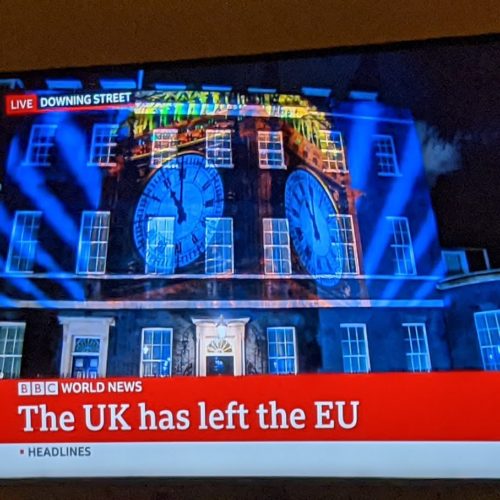
An image of 10 Downing Street — the UK British Prime Minister’s official residence – taken from a BBC broadcast moments after the 11 p.m. deadline on Jan. 31, 2020 when the UK left the EU.

How did Boris Johnson win

The French have been very impressed by the dexterity with which Boris Johnson (BJ) was able out to turn around the majority in the House of Commons: the Tories won 364 seats, an increase of 48 seats while the Labour party took 262, representing a loss of 60.   “Salut l’Artiste” (congratulations to the artist), wrote Françoise Fressoz, Le Monde editorialist  on Jan. 8.  On a radio talk show, a commentator said that BJ has become a model for the French Right: a conservative with social projects. The French feel that BJ, because of his super majority, is going to negotiate from a position  of strength.

A brillant strategist, he put his focus on the less wealthy population of the North of England and the Midlands, who supported Brexit. He undercut the Labour party by proposing a number of social measures such as raising the minimum wage, encouraging apprenticeships, building 40 hospitals and schools, and investing in railroad tracks at the cost of 100s of billions pounds sterling.  How will these projects be carried out?  How they will be paid for?  Not a mention of that in his campaign.

The other part of his strategy was to put pressure on the EU.  It is not clear how he did this, possibly in making concessions.  In a populist fashion, he probably told the Europeans what they wanted to hear.  A French journalist-columnist for The Daily Telegraph said BJ bluffed his way through. His optimism is more appealing that May’s stubbornness.  The French like another trait of his: his culture.  On our TV screens here, we saw him recite The Iliad poem for two and a half hours in classical Greek.

With Brexit both sides will lose, but many feel the UK will lose more.  The UK exports 47 percent of its products to Europe whereas the EU exports only 20 percent.  Some have compared Donald Trump’s attitude toward the EU to Boris Johnson’s.  There is one big difference though: BJ is not trying to destroy Europe.

Immigration has been at the core of Brexit since the beginning.  In this area, there is an inner contradiction.  Although the UK was never part of the Schengen Area (which guarantees freedom of circulation of the people), it still took advantage of the accession of eight new states to the EU in 2004, and 2007, to welcome these new labor forces – particularly from Poland.  It is unknown at this point how this situation will be resolved under Brexit.

The transition period

What’s going to happen during the transition?  Concretely, very little except that the Union Jack will not fly any more at the entrance of the EU HQ.

In the immediate term, ferry boats will continue crossing The Channel and Eurostar will continue to carry passengers and goods.  There will be no custom duties, no tariffs, and no visas required.

However, some changes are going to be immediately painful for the UK. The 73 British deputies at the European Parliament packed their bags on Jan. 31.  The British Commissioners have been gone for a while.  This means that the UK will not participate in the decision-making process, while it will still have to contribute to the EU budget and abide by the decisions of the European Court of Justice.

Michel Barnier from France has been appointed again as chief negotiator.  This is good news for everybody because he is a consensus-making personality.  He will work with a group of deputies from the European Parliament in Strasbourg,  Barnier has always stressed that the EU is not out to punish the UK.  Its only objective is to protect the EU’s interests.  Barnier feels sorry for the British population that was misinformed prior to the 2016 referendum.

The task ahead

In the simplest of terms, it is Herculean.

The UK is party to more than 600 international agreements with around 100 other countries through its EU membership.  As it leaves the EU , the UK will be cut off from these agreements.  However, it can retain its place whenever the UK signed an agreement in its own right.  The undoing of all these agreements is called (delightfully) “detricotage” in French (tricoter is to knit.)

The country has already taken steps to secure continuity in its relationships with other countries.  Examples include a treaty maintaining the UK’s civil nuclear trade; bilateral aviation agreements with the US and Canada; citizens rights agreements with Norway, Iceland, and Switzerland; protection for Scotch and Irish Whiskey exports.

The Lancaster House Bilateral Treaty of 2010 between the UK and France is a good example. It was signed between then French President Sarkozy and then UK Prime Minister Cameron and concerns Defense and Security Cooperation. Nathalie Loiseau, former French minister for European Affairs is the president of  the Commission on Security and Defense of the European Parliament.

One of the greatest fears in Europe is the prospect of a “Singapore-on-Thames.”  This would mean a country disrespectful of social and environmental norms and regulations.  Fiscal dumping will not be tolerated, says Brussels.  “There will not be quotas nor tariff if the UK forgets about dumping” writes the newspaper La Croix.

The first issue to be tackled will be fishing.  The negotiators will sit down around the negotiating table as early as Feb. 3, 2020.  The French fishermen have for years been fishing in 60 percent of the time in British waters.  The problem is that the British fisherman need the huge Single Market of 500 million people to sell their catch … and they already complain about quotas, which are imposed in order to avoid the depletion of fish!

France is one of the closest commercial partners of the UK (its foreign trade with that country has a trade surplus  of 12 billion Euros), which mean that it is particularly exposed to the consequences of the Brexit.  The manufacturing sector, such as the automobile industry, is fully integrated with Europe and relies on spare parts coming from the continent.  Every day 1,100 trucks transport parts back and forth through the Channel.  Aeronautics is facing a huge logistics problems since Air Bus employs 13,500 people in Great Britain.

The pharmaceutical industry, such as Sanofi, prepared for the Brexit by accumulating huge quantities of drugs.  The Total energy company is relocating its treasury department from London to Paris.

The traders of BNP Paribas Paris – the largest European bank in the UK – will have to leave the City of London whenever dealing with European clients. HSBC – the largest bank in the EU – is relocating many of its units to Paris.  One thousand personnel have already moved. Bank of America is now located on Rue de la Boetie in Paris.  J.P. Morgan has also relocated here.

The complicated problem of the border  between Northern Ireland and the Republic of Ireland seems to have been defused.  One hears now that, in the long term, the two Irelands may be reunited.  The border would then go under the Irish Channel and the North Sea.  The idea of a “backstop,” which we heard so much about under Theresa May’s watch, seems to have vanished today.

In a recent debate, Pascal Lamy, Honorary Director of the Jacques Delors Institute (Delors was one of the founding fathers of the EU. He created the Single Market in 1993) made a few remarks about

Prognosis for the future

The more the UK diverges from the EU’s norms, the thicker the wall between them will grow.  The 27 members of the EU are extremely attached to the Single Market, the largest in the world.  It seems likely that BJ will in the end up aligned with Europe.  If BJ carries out his proposed social policy, the public deficit risks will be enormous.  Will there be “Boris Bonds” ?

Recently the populist governments in Denmark and Italy have collapsed.  Johnson’s electoral base is a mismatch between the less wealthy Brexiteers of the North and the rich ones from London. Nicola Sturgeon in Scotland and Arlene Foster in Northern Ireland will have an important role to play in whether there is going to be a break-up of the United Kingdom or not.  The UK will likely remain closer to the EU than the US.

On Dec. 13, 2019, some European leaders stated their position toward Brexit in carefully selected words:

Charles Michel, president of the European Council said, “We are ready.”

German Chancellor Angela Merkel noted, “This will be a challenge.”

French President Emanuel Macron stated: “We welcome a new partner who should be a fair competitor.”

And in a Jan. 30, 2020 interview on French radio, Her Majesty’s Ambassador to France, Baron Llewellyn of Steep, said in the most British of ways,”Let’s have a cup of tea and go to work!”

Editor’s Note: This is the opinion of Nicole Prévost Logan.

Nicole Prévost Logan

About the author: Nicole Prévost Logan divides her time between Essex and Paris, spending summers in the former and winters in the latter. She writes a regular column for us from her Paris home where her topics will include politics, economy, social unrest — mostly in France — but also in other European countries. She also covers a variety of art exhibits and the performing arts in Europe. Logan is the author of ‘Forever on the Road: A Franco-American Family’s Thirty Years in the Foreign Service,’ an autobiography of her life as the wife of an overseas diplomat, who lived in 10 foreign countries on three continents. Her experiences during her foreign service life included being in Lebanon when civil war erupted, excavating a medieval city in Moscow and spending a week under house arrest in Guinea.

A View from My Porch: Lyme Native Ezra Lee was World’s First Commander of an Attack Submarine in Battle

There was a time before our time,
It will not come again,
When the best ships still were wooden ships
But the men were iron men …

Sgt. Ezra Lee, 1749 – 1821, is buried   in the Duck River Cemetery in Old Lyme. Image from Wikipedia Public Domain: painter and engraver unknown, from The Story of the Submarine by Farnham Bishop.

I believe this eloquent verse from Rosemary and Stephen Vincent Benet’s ode to New England’s “Clipper Ships and Captains” can also be used to describe Ezra Lee, the first man to command an attack submarine in battle.

In this essay, I will describe the heroism of this native of Lyme, Conn., and present some key elements of this remarkable period in Connecticut’s history. However, I think that one must have some understanding of his primitive submarine in order to fully appreciate Ezra Lee’s courage.

Bushnell’s Genius

This first submarine, named the Turtle, was designed and built by David Bushnell in what is now Westbrook, Conn.

Bushnell was a farmer, but left the family farm in the care of his brother, Ezra, in 1771 to pursue his education at Yale College. He graduated in 1775. His last year at Yale coincided with the Battles of Lexington and Concord, i.e., the beginning of the American War of Independence.

By that time, several other important events leading to the war with the British had already occurred. They included the Boston Massacre (1770), the Boston Tea Party (1773); and enactment of the Boston Port Act, which was one of five “Intolerable Acts”, implemented in 1774 to punish the colonists after the Tea Party. The law, was enforced by a British naval blockade of Boston harbor, which effectively shut down all commerce and travel in and out of Boston and the Massachusetts colony.

Bushnell was a fervent patriot and felt strongly that defeating the mighty British Navy would require unconventional tactics. He began a collaboration with another member of the Yale community, Phineas Pratt. One of their first projects was the development of an underwater bomb with a mechanical time-delayed detonator – a distant forerunner of contemporary naval mines. It is noteworthy that part of his Yale tenure overlapped with Nathan Hale’s, who graduated in 1773.

Bushnell felt that he could use this underwater explosive against the British if he could develop the means to deliver it to a targeted warship and place it below the waterline.

So, having returned to Westbrook after graduation, Bushnell’s small team, which now included his brother Ezra, turned its attention to developing a vessel that could transport and attach these explosive devices to enemy warships … and the idea of a “sub-marine” was conceived. Bushnell recognized that, to be effective and avoid detection, the vessel would have to be completely submerged for some period of time during the mission; be able to move through the water; and, when ready, return safely to the surface.

Colonial Era Engineering Limitations

With little real successful precedent on which to build, Bushnell’s submarine would be a “true” invention. Clearly, there were many significant engineering and design problems that the team had to resolve. They included building a watertight, pressure-proof, and vertically stable vessel; propulsion – both vertical and horizontal; steering, and vision; and the actual weapons-delivery system.

A key issue was that of developing the means to vary the vessel’s ballast in order to enable submersion and re-surfacing. Bushnell eventually solved these problems and introduced some innovations. For example, he equipped his vessel with an early snorkel-type breathing device and a two-bladed propeller for propulsion.

The Turtle

‘Turtle’ model on dsplay at the Royal Navy Submarine Museum in Gosport, England. The image is published under this license.

I realize that I am over-simplifying here, but I’m trying to avoid getting stuck in the sea-weeds of the Turtle’s design and construction.

The Turtle resembled two tortoise shells, bound together. It was constructed of oak timbers, which were shaped, joined, and caulked at the joints. The vessel was bound with iron bands and covered with tar to ensure water tightness.

It was about 7 ft. long, 4 ft. wide, and 8 ft. from its keel to the top of its brass “conning tower,” which protruded about eight inches out of the water. It had no periscope, but the conning tower contained six glass ports.

The submarine was capable of only carrying one person, who sat upright on a seat roughly resembling a bicycle seat (see photo at left.) Moreover, Turtle was equipped with a depth gauge to measure distance from the surface. a compass for navigating, and a crude ventilator to supply the vessel with fresh air at the surface.

Controls included hand-cranks and pedals for operation of the propellers; a rudder, located behind the operator, controlled by foot; and; an “immersion chamber,” for flooding when additional ballast was required. Turtle submerged and surfaced via brass pumps that took in or expelled seawater as ballast, and 700 pounds of lead weights, which could be let out or retracted as needed.

The Turtle had no real ballast tanks; and the incoming seawater simply flooded the floor of the cabin – leaving the operator knee-deep in water until it was eliminated with the pumps when it was time to surface.

Two tubes, which passed through the conning tower hatch provided fresh air when near the surface. The air supply would last only about 30 minutes, and would soon become foul when the submarine was submerged. The exterior was equipped with a large screw that could be twisted into the planks of a ship’s hull. The screw was tethered by a rope to one of Bushnell’s timed explosive devices.

It is interesting that Bushnell had actually consulted fellow revolutionary, Ben Franklin, to solve the problem of illuminating the Turtle’s interior – who suggested using phosphorescent “foxfire.”

Sea Trials

Turtle was tested after completion of construction in 1775 in the relative safety of the Connecticut River. Ben Franklin observed the initial tests from the shore and was favorably impressed and understood its potential in naval warfare. The Turtle was also recommended to George Washington by Connecticut Governor Jonathan Trumbull. Ezra Bushnell had been trained in operating the Turtle and had assumed that role during testing, and presumably, would also pilot the vessel in battle.

As noted, the Turtle held only a single person, and that person was wholly responsible for bringing the craft to the target and attaching and arming the explosives. That person required substantial physical strength and stamina, incredible focus, and the utter absence of claustrophobia.

There are replicas of the Turtle in Groton’s Submarine Force Museum and the CT River Museum in Essex; which has a cut-away display in which one may experience Turtle’s cabin.

The Bushnell Farm house is located at 1445 Boston Post Rd., Old Saybrook, CT.

The First Mission

The Turtle was ready for deployment by the spring of 1776 – and may have originally been planned for use against the British warships blockading Boston Harbor. However, by that time, the British had ended their blockade and moved their ships north to Halifax, Nova Scotia.

Ezra Lee’s Mission

In July, 1776, a British naval force began to move into New York Harbor, carrying supplies and soldiers. General William Howe and Admiral Richard Howe had essentially shut down western Long Island and New York to the colonists.

The Turtle was transported overland through Connecticut to New York Harbor, which was still in American hands. After arriving in New York, Ezra Bushnell developed a terrible fever, possibly Typhoid, and was unable to carry out any mission.

Brigadier General Samuel Holden Parsons, also from Lyme, then recommended three men to train to pilot the submarine. One of those men was his brother-in-law, Ezra Lee. So, to avoid discovery by the British, David Bushnell returned to Connecticut with the Turtle, and began intensive training of the three recruits. After a month of training, Lee was chosen to make the first attack on a British warship.

General Washington gave permission for Turtle’s first mission on Sept. 6 – an attack on the HMS Eagle, Admiral Howe’s flagship, which was anchored in New York Harbor, south of Manhattan. Near midnight on the 6th, Turtle was towed by a pulling boat from the Battery towards the Eagle. Halfway, Ezra Lee entered the Turtle and secured the hatch over his head. – and a submarine was engaged in battle for the first time against an enemy ship. Later, Lee wrote several letters describing this mission.

It took Lee nearly two hours of pedaling to reach the Eagle. Once there, he took on some ballast, and submerged completely. When he thought he was under his target, he pumped out a small quantity of water from the ballast tank, until a bump indicated he was beneath Eagle, with the auger screw against the ship’s bottom.

Unfortunately, Lee’s attempt to attach the explosive with the auger screw failed, possibly because a metal plate covered the area where he was trying to drill. He was forced to re-surface to replenish his air supply. He submerged again and attempted to drill into another spot in the hull. On that second dive he was unable to stay beneath the ship, and eventually abandoned the attempt.

It is possible that the tide turned during the second attack and Lee was unable to compensate. Lee’s mission was near the southern tip of Manhattan, where the Hudson River and the East River merge. The currents tend to be strong and complex there. So, Turtle would only be able to attack a ship moored in that area during a short period of time when the incoming tide balanced the river currents.

Lee was exhausted, and the outgoing tide threatened to take Turtleout to sea. He ejected all the ballast water and began pedaling with his remaining strength. With the ballast water pumped out, one third of Turtle’s hull stuck out of the water, making it clearly visible in daylight. As the day grew lighter, the British spotted the Turtle, and set out in small boats to confront it.

To divert the patrol and to lighten his craft, Lee released the explosive device that he had tried to attach to Eagle. It drifted towards the East River and soon exploded. In Lee’s words, it, “went off with a tremendous explosion, throwing up large bodies of water to an immense height.” Lee returned safely after several hours on the water and received Washington’s congratulations in person.

Lee did make a second unsuccessful attempt against the British frigate HMS Cereberus, but was discovered and forced to retreat.

An Ignominious Victory

Although Turtle’s missions were unsuccessful in that no damage was inflicted on any British vessel, some historians feel that the venture was, by no means, a failure. They suggest that the explosion led to Admiral Howe ordering the British warships to be repositioned further off the harbor, from which they could no longer maintain their blockade of New York.

Perhaps an intangible psychological victory might also be claimed simply through her use as another unconventional weapon of war employed by the colonists. These also included the guerilla tactics employed by the self-trained and highly mobile militia, which was organized to assemble rapidly and deploy where needed, and aptly named the “Minutemen.”

Note that the National Archives possess a letter that George Washington wrote to Thomas Jefferson in September,1785 about the Turtle, saying, “I then thought, and still think, that it was an effort of genius.”

David Bushnell – After the Attack on Eagle

Bushnell loaded Turtle aboard a fast sloop, hoping that the sloop could slip unnoticed past the British into Long Island Sound and back to Connecticut. A British frigate discovered the sloop, however, and, according to the British, sank her and her cargo. Note that there are many versions of the Turtle’s final days.

In 1778, General Washington proposed the formation of a new military unit to be known as the “Corps of Sappers and Miners” (i.e., combat engineers.) It was organized in the summer of the next year. Bushnell was given command of the Corps with the rank of captain-lieutenant in August, 1779.

Ezra Lee – After the Attack on Eagle

Lee was moved by Washington into the secret service/special forces. He later participated in the Battles of Trenton, Brandywine and Monmouth.

Lee died in 1821. His obituary in the “Commercial Advisor” (November 1821) stated: “Died, at Lyme, on the 29th October Captain Ezra Lee, aged 72, a revolutionary officer. He died without an enemy. It is not a little remarkable, that this officer is the only man, of which it can be said, that he fought the enemy upon land–upon water–and under the water…”

Lee is buried in the Duck River Cemetery in Old Lyme. The inscription on his original grave marker was: “EZRA LEE. / DIED / Aged 72 Years. / He was a Revolutionary / Officer, / and esteemed by / Washington.” Unfortunately, during the colonial era, gravestones were often made from softer types of stone, such as sandstone and slate, which were easier to cut and carve. However, they deteriorated. Lee’s original marker has been replaced with a granite obelisk, but without the full original inscription.

Some Observations by the Author

I am not a native of southeast Connecticut. Rather. I am an émigré from West Simsbury in Connecticut’s northwest hills. I knew almost nothing about David Bushnell and Ezra Lee before visiting the Connecticut River Museum, but I was encouraged to learn more.

Stewart Holbrook, author of “Lost Men of American History,” has claimed that “… had a Longfellow fastened upon him, Ezra Lee would be as well known today as Paul Revere, and it is a pity that he isn’t.”

“Bushnell’s Infernal Machine” sung by New England balladeer Larry Kaplan

This song provides a view of Turtle from the inside. Kaplan is known for his songs of New England and its seas. Visit this link to see the song performed.

Editor’s Note: The author is going a few miles north on the Connecticut River for his next essay to visit William Gillette and review his impact on the cinematic portrayal of Sherlock Holmes.

Tom Gotowka

About the author: Tom Gotowka’s entire adult career has been in healthcare. He’ will sit on the Navy side at the Army/Navy football game. He always sit on the crimson side at any Harvard/Yale contest. He enjoys reading historic speeches and considers himself a scholar of the period from FDR through JFK.

A child of AM Radio, he probably knows the lyrics of every rock and roll or folk song published since 1960. He hopes these experiences give readers a sense of what he believes “qualify” him to write this column.

Talking Transportation: A Conversation With CT DOT Commissioner Giulietti, Part 2

Jim Cameron

Editor’s Note:  This is the second of two articles written by Jim Cameron reporting on his conversation with CDOT Commissioner Joseph Giulietti. Read the first article at this link.

Connecticut’s Department of Transportation (CDOT) Commissioner Joseph Giulietti is about to finish his first year on the job and his plate is more than full.  It’s overflowing with controversy.

In my last column, in part one of an exclusive, no-holds barred interview he spoke of his challenges in speeding up Metro-North, coping with the over-budget, behind-schedule Walk Bridge replacement and ordering new rail cars.

This week, in part two of our conversation he speaks of the biggest issue of all … getting the legislature to pass truck tolls to raise money to replenish the Special Transportation Fund, which pays for transportation in our state.

I asked the Commissioner if Governor Lamont had “bungled” this initiative by his constant flip-flopping on what to toll and where.

Choosing his words very carefully, he said, “The Governor has admitted that there were some things he wished had been done differently.  If it was bungled, it was because he was trying to come up with bipartisan support for a solution everyone could buy into.”

Giulietti said nobody expected how pervasive and organized the opposition forces would be against tolling.

As for Mr. Sasser, leader of the #NoTollsCT movement, “I’ve never met him. This is never a personal issue.” But when the initial tolling plan was unveiled, he said the #NoTollsCT forces “ran with the paranoia.”  But if not tolls: “How do you want to pay for it [transportation]? Connecticut drivers have been subsidizing out of state drivers for years. Tolls are the closest thing we have to a user fee.”

As for the claim that truck tolls will lead to car tolls and the money will be misspent, “The Federal government determines that and that those funds must be spent on the roads [where the tolls would be.]”  Trucks don’t buy gas in Connecticut, so they’re getting a free ride.

On the claim that the CDOT wastes money: “We used to have 5000 people at the CDOT.  Now we have 2700.” Even snow plowing is done with one driver, guided by a computer on where to deploy brine and how to best clear the snow.  One truck can now even handle three lanes of pavement.”

“We’ve always looked how we can be more efficient. That’s the type of department CDOT has become. We always want to be good stewards of the public’s money.”

“I don’t know of a better way [to pay for transportation] than tolls.  The Governor has always said, ‘If you have a better idea, come to me with it,’ so if we’re not going to do tolling, what’s the alternative … gas tax, income tax, sales tax?  But there don’t seem to be any alternate ideas on how to get this thing [funding] through.”

Giulietti says he has a good working relationship with Governor Lamont. “I’m not a politician, I don’t run for office,” he said. “But I know of very honorable people who do the right thing [like voting in favor of tolls] despite the threats of being voted out of their jobs.”

“I’ve worked now for six or seven governors. Lamont is one of the most honest and decent people I’ve worked with … a genuine good guy who truly wants bipartisan support to try and get this thing through.  It makes it easy [for me] to face the criticism because I know he’s trying to do the right thing.”

To which I can only add … Amen!

Posted with permission of Hearst CT Media.

About the author: Jim Cameron is founder of The Commuter Action Group, and a member of the Darien RTM.  The opinions expressed in this column are only his own. You can reach him at CommuterActionGroup@gmail.com  For a full collection of  “Talking Transportation” columns, visit www.talkingtransportation.blogspot.com