While the overall divorce rate has declined steadily over the past few decades, the number of couples over age 50 who decide to end their marriages keeps climbing. So-called ‘gray divorces’ have quadrupled since 1990, according to multiple studies.
Divorce can be an emotional and devastating experience for anyone, and it can be especially challenging for couples who have spent many years together raising a family and sharing many wonderful experiences as well as attaining a certain standard of living.
What are the leading causes of gray divorce?
Getting a divorce doesn’t have the same social stigma it once had, which has no doubt contributed to the surge, but there are many reasons why older couples choose to end their marriages, such as:
Financial management: Disputes over money are some of the most common reasons for divorce. Managing finances can be tricky, especially when one spouse controls the checkbook. Couples who constantly fight about money often decide to split.
Growing apart: Many couples who have been together for a long time say they have lost the spark they once had, especially after their children are grown and have left the house. Others say the relationship is just “not working out.”
Infidelity: Spouses who cheat on their partners are another leading cause of divorce for older couples. Relationship experts say baby boomers tend to be more independent than previous generations putting their needs and happiness ahead of others.
Living longer: Life expectancy is also much higher for baby boomers than it was for their parents and grandparents, and many older people are still healthy. Many who are struggling in their relationships believe that they are not too old to find happiness with another partner.
Addiction: Spouses who develop dependencies for drugs or other negative behaviors, such as gambling or sexual addictions also tend to put their needs ahead of others, and many refuse to get help. Those actions often spell the end for their relationship, even if their spouse has been supportive in the past.
Divorce can be a positive but challenging decision
Gray divorces create significant dilemmas for all members of a family, even if the children are adults. Dividing assets can be complicated, and many couples believe that they will need to go to court to get a fair outcome.
However, a compassionate and experienced family law attorney here in Connecticut understands how the process works. Your lawyer will look to avoid a court battle through mediation or a collaborative process, if it’s in your best interests, but will also fight for you in court if litigation is necessary.
Attorneys at Suisman Shapirocan discuss the divorce process with you and answer your questions on the subect. Visit their website or call 800-499-0145 — lines are open 24 hours a day.
Sponsored post bySuisman Shapiro Attorneys-at-Law.
Wow, three days of watching movies at The Garde:- The Farewell (wonderful) and Jojo Rabbit (which I was wary of seeing but, at the end, fell in love with it). Then I saw Bombshell, but I liked the television adaptation about Roger Ailes/Fox better (The Loudest Voice). The Showtime movie made Russell Crowe (as Ailes) even more of an animal.
It was a busy week, but I found time to get to Shop-Rite and bought a rotisserie chicken, lots of vegetables (two big heads of cauliflower, which I cut into florets to parboil and freeze), green grapes, bananas and apples, along with pork cutlets and hot Italian sausage. When I got home, I wanted something sweet, so I made these blondies, below.
I tasted just one and will take the rest to a meeting. Nothing decadent is left in the house, except four pints of Haagen Dazs and Ben & Jerry’s.
Maple-Apple Blondies
From 100 Best Apple Recipes (Better Homes & Gardens, Meredith Co., 2019)
Yield: 36 bars
Nonstick cooking spray ¾ cup butter 2 medium apples, peeled, cored and chopped (about 1 and ¾ cups) 1 cup packed light brown sugar ½ cup granulated sugar ½ cup pure maple syrup 2 eggs 2 teaspoon pure vanilla extract 2 cups all-purpose flour 1 teaspoon baking powder ½ teaspoon salt ¼ teaspoon baking soda 1 recipe for maple icing
Preheat oven to 350 degrees. Line a 13- by 9-inch pan with foil, extending the foil over edges. Lightly coat foil with cooking spray. In a medium saucepan, melt 1 tablespoon of the butter over medium heat. Add apples and cook about 12 minutes or until tender, stirring occasionally. Remove apples from saucepan and set aside.
In the same saucepan, melt remaining butter over medium heat. Remove from heat and stir in both sugars and maple syrup until smooth. Stir in eggs and vanilla until combined. Stir in flour, baking powder, salt and baking soda. Stir in cooked apples. Spread batter in prepared pan.
Bake 25 to 30 minutes or until evenly browned and edges are puffed. Cool in pan on a wire rack. Spread maple icing over bars. Let stand until icing is set. Use edges of foil to lift uncut bars out of pan. Cut into 36 bars.
Maple Icing
In a small bowl, stir together 2 cups powdered sugar, ¼ cup maple syrup and 2 tablespoons melted butter. Stir in enough milk (about 2 tablespoons) to make a thin spreading consistency.
About the author: Lee White has been writing about restaurants and cooking since 1976 and has been extensively published in the Worcester (Mass.) Magazine, The Day, Norwich Bulletin, and Hartford Courant. She currently writes a cooking column called A La Carte for LymeLine.com and also for the Shore Publishing and Times newspapers, both of which are owned by The Day.
“Buckle up folks. There’s some bumpy air ahead”, said the pilot on a recent flight. No need to remind me; my seatbelt is always fastened as “bumpy air”… a euphemism for air turbulence … is my worst fear in flying. It’s the whole “fear of death” thing.
Intellectually I know that modern aircraft can survive all manner of stress from changing or violent winds, but can I? I’ve been on flights where our aircraft plummeted hundreds of feet without notice, sending passengers, their drinks and laptops flying. There’s not much you can do in a situation like that except, hang on, breathe deeply and pray.
According to the FAA there were 27 passengers and crew injured by turbulence in 2015. In 2016 that number was 42. And with more and more people flying, those numbers will climb.
Only a few years ago, United Airlines offered passengers an in-flight audio channel where they could listen to air traffic control (ATC) handling their and other flights. That was my favorite channel as I heard our flight being cleared to higher altitudes, warned about other aircraft and being guided across the country. It was reassuring to hear the professionalism of the flight crew and ATC. But the channel was only available at the pilot’s discretion. And when it was turned off mid-flight, I always knew something nasty was coming our way.
Pilots regularly ask ATC for “ride reports” from other aircraft at the same altitude and flight path, always seeking the smoothest flight. But sometimes the turbulence is unexpected, the so-called “clear air turbulence.” You can be cruising along at 35,000 feet when, without notice, you get slammed.
On a Turkish Airlines flight to JFK last March, the 777 jetliner encountered clear air turbulence over Maine that sent everything flying. The terror lasted about 10 minutes and when the plane finally landed, 30 passengers were taken to hospital.
That’s why you should always keep your seatbelt fastened so if the plane drops, you don’t crash into the ceiling.
Now there’s new technology that may help us all have a smoother flight.
The International Air Transport Association (IATA) is testing an automatic tracking and reporting system to warn flights of “bumpy air.” So far 15 major airlines are sharing data in the test phase of the program.
Their planes are equipped with a black box measuring changes in the flight’s speed and tilt eight times each second. That data is transmitted to the ground and within 30 seconds, flights in the area can be warned of trouble ahead.
So far the participating airlines are generating 115,000 reports a day to the IATA Turbulence Aware system. The system will be most valuable on long, overseas routes where there are fewer aircraft flying the same corridor.
The Turbulence Aware system should be fully operational this year when airlines will have installed the gear on most of their planes. American Airlines alone hopes to have 800 airliners gathering and reporting data in the coming months.
Meantime … buckle up, friends! There’s bumpy air ahead.
Posted with permission of Hearst CT Media.
About the author: Jim Cameron is founder of The Commuter Action Group, and a member of the Darien RTM. The opinions expressed in this column are only his own. You can reach him at CommuterActionGroup@gmail.com For a full collection of “Talking Transportation” columns, visit www.talkingtransportation.blogspot.com
Dr. Wrangham, a Harvard anthropologist, tackles his subtitle, “The Strange Relationship Between Virtue and Violence in Human Evolution,” by going on to suggest, “We can be the nastiest of species and also the nicest.”
But, he offers, “The key fact about humans is that within our social communities we have a low propensity to fight. Compared to most wild mammals we are very tolerant.” One possible reason for this is “the domestication syndrome,” a process that started over 300,000 years ago, and, incidentally, is also found among some species of dogs and sheep.
Are we going to continue to evolve towards more pacifism, as Steven Pinker also suggests in his The Better Angels of Our Nature (2011), or might we regress?
Will our “progress’ continue or might we revert to once prevalent habits?
Wrangham notes that in 17th century New England, ‘”You could be executed for witchcraft, idolatry, blasphemy, rape, adultery, bestiality, sodomy, and, in New Haven, masturbation.”
Our altruism has continued to evolve within Homo sapiens, as we have delighted in “the sheer cosmological fascination of understanding where we come from,” and recognized that altruism is inherently more successful.
Edward O. Wilson also proposed this idea in Genesis* (2019): groups of altruists always beat aggressive groups. Wrangham also offers the idea that “docility … seems likely to be a vital precondition for advanced cooperation and social learning.” Chimpanzees lack this “docility,” while bonobos (pygmy chimpanzees), who are much closer to we humans in their development, seem to have it.
How will our genes move us in the future?
Might our natural “evolution” towards pacifism stall, and might other creatures move faster in that direction, adopting and encompassing altruism and docility, and therefore survive?
Dr. Wrangham challenges us to think seriously about these questions.
Editor’s Note: ‘The Goodness Paradox’ by Richard Wrangham is published by Pantheon Books, New York 2019.
About the Author: Felix Kloman is a sailor, rower, husband, father, grandfather, retired management consultant and, above all, a curious reader and writer. He’s explored how we as human beings and organizations respond to ever-present uncertainty in two books, ‘Mumpsimus Revisited’ (2005) and ‘The Fantods of Risk’ (2008). A 20-year resident of Lyme, he now writes book reviews, mostly of non-fiction, a subject which explores our minds, our behavior, our politics and our history. But he does throw in a novel here and there.
For more than 50 years, he’s put together the 17 syllables that comprise haiku, the traditional Japanese poetry, and now serves as the self-appointed “poet laureate” of Ashlawn Farm Coffee, where he may be seen on Friday mornings. His late wife, Ann, was also a writer, but of mystery novels, all of which begin in a village in midcoast Maine, strangely reminiscent of the town she and her husband visited every summer.
Reform of the retirement system was at the core of French President Emmanuel Macron’s 2016 campaign. He wanted to simplify the system and make it universal. The reform is so highly sensitive – one might even say explosive – that several prime ministers have fallen in similar attempts (1986, 1995, 2008.) Although close to 60 percent of public opinion is favorable to the reforms, the opposition is orchestrated into an angry movement by the unions and the Left.
In a nutshell, the objective of the reform is two-fold: first, to prevent the system from being in the red in the 2020s and second to achieve social justice. This latter aim is being sought by suppressing the 42 régimes spéciaux (special systems), which grant privileges to certain groups of the population, such as civil servants, train workers (SNCF) bus and subway employees (RATP), personnel of the Paris Opera, members of the two legislative assemblies, etc. Some of these benefits include calculating the amount of retirement after the last six months of employment rather than the last 25 years. And not surprisingly, these régimes spéciaux cost the French government billions every year.
The pension system in France is based on “repartition,” meaning that the active population pays for the retired one. The problem is that in 1950, there were four working people for each retiree. Demography will soon reduce the ratio to 1 to 1. In the US, the retirement system is based on “capitalization,” that is, individuals are free to invest their accumulated capital in a pension fund or other types of investment as they wish. The Scandinavian countries use both systems – “capitalization” and “repartition”- simultaneously.
For an American reader, it must be hard to comprehend the over-regulated retirement system in France, which applies not only to the 5.6 million civil servants but also to the private sector. A special dispensation is even required for retirees to be allowed to work.
The Macron plan is based on a points system. Throughout one’s professional life, each hour’s work is translated into “points.” Variables – such as the political or economic environment – may impact the points’ value. Employers and unions will determine together the value of each point. Hence the anxiety of the people regarding this unfamiliar system.
France has the most generous retirement pension in Europe but it’s costing the country dearly. Photo by Hans Ripa on Unsplash.
France is the ‘Etat-providence’ (Welfare State) par excellence and the most generous in Europe. The retirement age is 62 in France as compared to 65 in the UK. It can be as low as 52 as in the case of train conductors. More than 13 percent of the Gross Domestic Product is devoted to funding pensions.
The French government announced its plan to reform pensions on Dec. 5, 2019. The reaction was immediate:- a general strike of all public transport. That meant no subway in Paris, except for two lines (which are automated), no buses, and very few trains. That ordeal lasted for weeks without even a respite during the Christmas and New Year vacations. Life for working people, who had to commute from the suburbs, became a pure nightmare. Videos showed stampede scenes at stations.
On Jan. 28, 2020 the Gare de Lyon was packed as usual with passengers waiting for TGVs and suburban trains. Suddenly a deafening sound resonated under the glass and steel structure. Several explosions followed and pink smoke filled the station. It turned out that dozens of the men getting off the train, wearing black parkas with yellow stripes, were firefighters on their way to join a demonstration at the Bastille. They were just getting warmed up, using their talents with pyrotechnics to blast powerful fire-crackers.
After 50 days, the strikes had partially stopped. The street demonstrations continued and have become a way of life in the city. The left-wing unions and radical groups keep the momentum going and direct their actions to strategic areas such as blocking the main ports or shutting down oil refineries .
Tens of thousands people in black robes marched near the Bastille on Feb. 3. They were some of France’s 70,000 lawyers, who have been on strike for five weeks – an absolute first. The atmosphere was peaceful. Not a single policeman in sight, no police vans nor water guns.
I went down to take pictures. ‘Why are you on strike?’ I asked a young lawyer. ‘We have our own retirement system,’ she answered, ‘which is autonomous and, furthermore, has a surplus. Now the government has announced that the contributions toward the pension fund will double from 14 to 28 percent.’ Actually, what she said is not entirely accurate — the increase will be gradual: it will not start until the late 2020s and will not apply to all equally.
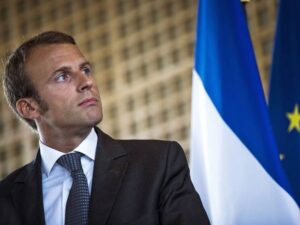
French President Emmanuel Macron.
The launching of this crucial pension reform is like stepping into an anthill. Wherever the government goes, it cuts into well-entrenched benefits, provoking an outpouring of protests. Every time the government helps one group financially, this assistance has to be paid for by depriving another group. This in turn feeds the popular mistrust for the government .
After consultation with all the unions at the Hotel Matignon (seat of the Executive Power), an agreement was reached with the CFDT (Confederation Française Democratique du Travail), the most reformist of the unions. For Laurent Berger, the CFDT leader, the “age pivot” (retirement age) of 64 was a “red line” not to be crossed. The Prime Minister agreed to pull back from it and replace it with a “cocktail of measures” to generate 12 billion Euros in order to balance the pension system.
A parliamentary commission of 80 deputies from all parties from the RN (Rassemblement National of Marine LePen) to LFI (La France Insoumise of Jean-Luc Melanchon) was appointed. The government’s proposal was met with a ridiculous number of 22,000 amendments, (19,000 by LFI alone.) Their obvious strategy was total obstruction of the process. A general debate in the Parliament will follow. If time runs out because of the municipal elections in 36,000 towns on March 15, the Prime Minister may resort to Executive Orders.
In this crisis, I believe both sides are to blame: the government’s project may not have been prepared well enough and appeared confusing. The opposition consistently refuses to enter any dialogue. It is a French cultural trait:- first you flex your muscles then – possibly – you may be willing to come to the negotiating table. But keep in mind that compromise is a dirty word in France.
The proposed retirement reform has somehow triggered other requests. Seeing an opportunity, demands for higher wages and benefits are snowballing. Some teachers in public schools are striking for pay raises. These school students take their cue from their teachers and march in the street, or block their classrooms to protect their future pension rights — an odd sight indeed for 12- or 13-year olds!
The unrest (accompanied by violence) is dragging on. There does not seem to be an end to it.
France appears to be functioning on two different levels — on the one hand, there is a France of angry people, who feel very sorry for themselves. On the other, there is a dynamic France doing rather well, which has become economically attractive to foreign investors thanks primarily to labor market reforms.
At the same time, Macron has chosen to keep above the in-fighting and focus on his role as the president of the only nuclear power of Europe, strengthening its defense and security while seeking a more integrated European Union.
Editor’s Note: This is the opinion of Nicole Prévost Logan.
Nicole Prévost Logan
About the author: Nicole Prévost Logan divides her time between Essex and Paris, spending summers in the former and winters in the latter. She writes a regular column for us from her Paris home where her topics will include politics, economy, social unrest — mostly in France — but also in other European countries. She also covers a variety of art exhibits and the performing arts in Europe. Logan is the author of ‘Forever on the Road: A Franco-American Family’s Thirty Years in the Foreign Service,’ an autobiography of her life as the wife of an overseas diplomat, who lived in 10 foreign countries on three continents. Her experiences during her foreign service life included being in Lebanon when civil war erupted, excavating a medieval city in Moscow and spending a week under house arrest in Guinea.

 Preheat oven to 350 degrees. Line a 13- by 9-inch pan with foil, extending the foil over edges. Lightly coat foil with cooking spray. In a medium saucepan, melt 1 tablespoon of the butter over medium heat. Add apples and cook about 12 minutes or until tender, stirring occasionally. Remove apples from saucepan and set aside.
 About the author: Lee White has been writing about restaurants and cooking since 1976 and has been extensively published in the Worcester (Mass.) Magazine, The Day, Norwich Bulletin, and Hartford Courant. She currently writes a cooking column called A La Carte for LymeLine.com and also for the Shore Publishing and Times newspapers, both of which are owned by The Day.
 My goodness … we are indeed a strange species!