

Talking Transportation: Overnight Travel From Worst to First

Jim Cameron

There’s something very satisfying about the efficiency of overnight travel.  In the best of conditions you make your journey and awake, refreshed, at your destination.  But how well you sleep depends a lot on how you travel.

Here’s my list of overnight travel options, from worst to first:

DRIVING ALL NIGHT: In my carefree youth I once drove all night from Chicago to NYC.  Tired and wired (on a lot of coffee) I encountered no traffic and made really good time but arrived exhausted.  Not a good option … and probably not safe.

SLEEPING IN THE AIRPORT: This one doesn’t really count, as you’re not really traveling.  And those not-so-comfy chairs at the gate don’t really allow much sleep.

The good news is that many airports (ATL, DFW, JFK) now offer Minute Suites with daybeds and showers. You can book them for an hour ($48) or for an eight-hour overnight ($175).

SLEEPING ON THE PLANE: It’s not by chance that overnight flights are called “red eyes”.  Sure, flying overnight is fast, but if you’re sitting in coach on a crowded plane, good luck with any shut-eye.  This is why I hate flying to Europe.  You arrive jet-lagged, in a different time zone and anxious to just sleep, not go sight-seeing.

Now, if you’re in Business Class, rest is possible … at a price.  And if money is no object, there are ultra-luxe accommodations like on Air France’s La Premiere, a private suite 10-ft. square with three-star gourmet meals curated by Michelin-starred chefs, served on porcelain with Christofle cutlery … and a full bed.  Roundtrip fare JFK-Paris, about $20,000.

TAKING THE BUS: “Riding the dog” (Greyhound) is not my idea of fun anytime, but there are some private companies re-thinking bus travel with much comfier accommodations. In Texas, Vonlane offers “luxury motor coaches” with Business Class seating.  Similar service between NYC and DC is offered by private carriers but not on the overnights.

TRAVEL BY SHIP: Alas, not many options here aside from cruising or crossing the Atlantic.  But in the old days, there were steamboats plying the waters between Hartford and New York City.  As I wrote a few months back, the 14-18 hour journey had both “deck class” and cabin class accommodations.

TRAVEL BY TRAIN: Not surprising that this is my favorite option.  But as with flying, if you’re stuck in coach class your slumber may be less than optional.  Amtrak offers bedrooms … from Roomettes to Bedroom Suites … but they’re always booked weeks in advance and are far too expensive.

There are several start-ups looking to offer much nicer (and affordable) sleeping cars, like Dreamstar, which hopes to launch next year between San Francisco and LA.  And Lunatrain, running NYC to Atlanta and Chicago.

We’ll have to see if either company is successful in its launch, modeled after the highly popular NightJet train service you’ll find throughout Europe. Even in Japan, the country that launched true high-speed rail 50 years ago, there are sleeper trains offering everything from cabins to tatami mats.

So, as you plan your summer travels, check out these options.  You’ll save on hotel rooms and maybe have an adventure!

Editor’s Notes: i) Jim Cameron is the founder of the Commuter Action Group and advocates for Connecticut rail riders. He writes a weekly column called ‘Talking Transportation,’ which is published by a number of publications in the state.
ii) ”Talking Transportation” recently won first place in the general column/commentary category in the Connecticut Society of Professional Journalists Excellence in Journalism Contest.

Talking Transportation: Out-of-State License Plate Fraud is Top Form of Tax Evasion in CT

Jim Cameron

“This is the number one form of tax evasion in CT. Connecticut is losing millions annually and our DMV does not care.”

So says Stonington Tax Assessor Jennifer Lineaweaver, President of the state association for her profession (the CCAO). She’s speaking of CT residents who register their cars in other states to avoid local property taxes. “CT is also losing money on registrations, emissions, insurance and unpaid parking tickets that cannot be enforced,” she says.

It’s super easy to get Maine plates for your vehicles… without even traveling to the state or having an address there. You can even register in Montana, a scheme especially popular with expensive motor home owners.

A couple of years ago Vermont admitted there were 3600 cars registered in that state by Connecticut residents. In Maine there were 1400. In Bridgeport, City Councilman Alfredo Castillo was even caught with five cars registered next door in Shelton, trying to save himself $1300 in property tax.

“I am absolutely certain that those numbers are extremely low,” says Assessor Lineaweaver.  So the losses are even worse than you might think.

The problem is there’s almost no enforcement of Connecticut laws.

“Connecticut DMV says that ‘taxation’ is not their issue,” she says. “A few years ago, we had the law changed so that DMV would have to look up any out-of-state plate that the assessor requests and DMV had the law reversed a year later.  During the one year [the law] was in place, DMV refused to comply with the law and said they would have the law repealed the next year, which they did.”

Not getting much help from DMV, some cities have hired private firms to help. In 2022, Danbury contracted Capital Tax Recovery to scan license plates throughout the city. Over 8,000 vehicles were under investigation. The firm pocketed 40% of the additional tax revenue collected as their fee, with no upfront cost to the city. In Waterbury they caught 4000 cars. In Stamford almost 8000 cars were caught, bringing that city $1.3 million.

Many towns allow anonymous reporting of scofflaws. If your neighbor has Montana plates you can also wish them good luck getting a town dump sticker or beach pass requiring proof of local residence.

Connecticut DMV Commissioner Tony Guerrera tells me the problem with out-of-state plates is that drivers often claim legal residence in another state, like Florida.  “If they live there 6 months and a day, they’re considered legal residents [of Florida]” he told me.  

But Connecticut law mandates that vehicles “garaged” in a municipality—meaning regularly parked overnight, even on the street—must be taxed there, regardless of where they may be officially registered.  Spend your winter in the Sunshine State but more than 90 days each summer in Connecticut, and you have to pay, even with those Florida plates. The penalty is a $1000 fine.

In Connecticut, the vehicle property tax is a significant source of revenue for municipalities: $1 billion a year.  But why does a car in New Britain pay four times the tax than the same vehicle in Greenwich? These inequities just encourage tax avoidance which is, apparently, rampant and unchecked.

“We don’t have the staff [to enforce this],” the DMV Commissioner laments. His agency has its own sworn, gun-carrying police force, but Guerrera says they only work on truck inspections… even though “registration compliance” is, according to law, one of their duties.

How is our legislature handling this problem?  With a “task force” which met seven times in 2023 considering reforms.  But never reached a consensus and never approved their final report.  In any case, their draft recommendations were given a thumbs-down by CT Dept of Revenue Service Commissioner and former mayor of Danbury Mark Boughton.  

So, what’s a car owner to do?  Well, I hear that Montana is a nice place to visit in the summer.

Editor’s Notes: i) Jim Cameron is the founder of the Commuter Action Group and advocates for Connecticut rail riders. He writes a weekly column called ‘Talking Transportation,’ which is published by a number of publications in the state.
ii) ”Talking Transportation” recently won first place in the general column/commentary category in the Connecticut Society of Professional Journalists Excellence in Journalism Contest.

Talking Transportation: Transit-Oriented Recreation

Jim Cameron

The recent cool and weather aside, it’s officially summer!  Time to get out and enjoy our state’s wonderful parks and beaches and take advantage of TOR.

You know what TOD is, right?  Transit Oriented Development … building homes and offices near mass transit facilities.  Well, I’m going to suggest you think about TOR… Transit Oriented Recreation.

Did you know you can travel to many state parks and beaches by train and a connecting bus shuttle?  Details on this year’s program are still to come, but CDOT and DEEP have partnered since 2021 to offer ParkConneCT from Memorial Day through Labor Day.

In years past, beach and park shuttles meeting in-coming trains have been free on weekends and holidays, taking you to places like Sleeping Giant State Park in Hamden or Hammonasset Beach State Park in Madison.

While many state parks close their gates on weekends when their parking lots are full of cars, the shuttle buses can still deliver you to Mother Nature without the hassles.

The state’s modest marketing efforts to attract tourists seem to be working as the number of visitors was up 2% last year.  Officials say tourism brings Connecticut $18.5 billion each year … more than what’s seen in Maine, which bills itself as “Vacationland”.

And it’s clearly our beaches that are a main draw.  Who needs to endure I-95 when you can take the train to visit …

Sherwood Island State Park in Westport:  Just take Metro-North to Westport Station and grab the Sherwood Island Shuttle from the station to the park to enjoy swimming, picnicking and great views of LI Sound.

Silver Sands State Park in Milford:  Metro-North gets you to Milford Station where a walk or bike ride to the beach presents newly refurbished boardwalks, pristine beaches and bird-watching spots.

Bluff Point State Park in Groton:  Take Shore Line East or Amtrak to New London Station, then grab the SEAT (Southeast Area Transit) Rte. 11 bus to the beach where you can enjoy walks along the coast, biking and fishing.

Beyond TOR, how about TOE … Transit Oriented Entertainment?

You wouldn’t think of driving to NYC to see a Knicks or Rangers game.  You’d take the train, right?  Well, you can take Metro-North directly to Yankee Stadium too.  Or to Bridgeport to see Ringo Starr at the Hartford HealthCare Amphitheater … also walking distance from Amtrak and the Port Jeff Ferry.

Going to see a play at The Shubert in New Haven or Andrea Bocelli at the XL Center in Hartford?  Ditch the car and try mass transit.

And if you’re a railfan, visit the Essex Steam Train & Riverboat by training to Old Saybrook and hopping into a cab for the quick ride back into history.

If you’re city-bound, check out Metro-North’s “MTA Away” packages—train and event tickets, often at a discount—for venues both in NYC and the ‘burbs.  You can go star gazing or catch an outdoor concert in Forest Hills without a car.

Whatever your destination for summer fun, think twice before enduring the traffic and maybe consider taking mass transit.

Editor’s Notes: i) Jim Cameron is the founder of the Commuter Action Group and advocates for Connecticut rail riders. He writes a weekly column called ‘Talking Transportation,’ which is published by a number of publications in the state.
ii) ”Talking Transportation” recently won first place in the general column/commentary category in the Connecticut Society of Professional Journalists Excellence in Journalism Contest.

Talking Transportation: Some ‘Fun Facts’

Jim Cameron

Over the twenty years I’ve been writing this column, I’ve come across some “fun facts” about transportation. Try dazzling friends at your next BBQ with some of these gems.

HIGHWAYS:

  • The average distance driven on I-95 in Connecticut is 11 miles.

Some 180,000 vehicles drive all or part of the 112 miles that I-95 runs through our state.  But even factoring in true interstate drivers (think Florida to Maine), the average distance driven in Connecticut is tiny.  Why? Because we use I-95 like a local road to avoid Route 1, not just for interstate travel.

  • Trucks are banned from the Merritt Parkway.  But in 1943 trucks were allowed on that roadway as part of the war effort.

But trucks in those days were much lower, easily clearing the bridges.

AVIATION:

  • The supersonic Concorde was a real gas-guzzler.  In the 15 minutes from leaving the gate until takeoff, the jet burned two metric tons of Jet A gas… enough to fly a conventional jet for an hour to Paris.

Carrying just 100 passengers, The Concorde would burn about a ton of fuel per passenger crossing the Atlantic.

  • The busiest airport in the world is Atlanta’s Hartsfield International (ATL), handling 108 million passengers last year…almost 296,000 a day.

And most of them fly Delta, which hosts 165 of the airport’s 192 gates, a 86% share of the capacity.

METRO-NORTH:

  • Did you know that a fully loaded eight-car train on Metro-North can carry over 1000 passengers…more than double the capacity of a fully loaded 747.
  • The 24-mile-long Danbury branch line used to be electrified.  But the wires were ripped out in 1961 to save money by running diesels. The copper was sold as scrap.
  • Grand Central Terminal has 67 tracks and 44 platforms, more than any station in the world.

And never call it “Grand Central Station.” That’s the name of the post office and subway station nearby.

HIGH SPEED RAIL:

  • America’s only “high speed train” (Acela) can go up to 160 mph. But the average speed it runs traveling 456 miles from Washington DC to Boston is just 70 mph.
  • China has the largest high speed network in the world covering more than 29,000 miles and carrying 4 billion passenger trips.  Its trains run as fast as 260 mph.

TRANSIT FARES:

  • In Portland Oregon the trains don’t have “Senior” fares. Instead, seniors, veterans, active-duty military personnel, handicapped and low-income residents are called “Honored Citizens” and get 50 – 75% off regular fares.

SHIPPING:

  • The biggest container ships sailing today can carry over 24,000 containers. But those mega-ships are too big for the Panama Canal…but not for the Suez Canal, which has no locks.
  • New York’s Staten Island Ferry can carry over 6000 passengers per trip.  That added up to 25 million passengers in 2019…more than double the population of Greece.

And yes, the Staten Island Ferry is free. The old 50-cent fare was dropped in 1997 in a nod to the city’s efforts to make access to the tiny borough more affordable.

Talking Transportation: On Air Pollution and Transportation

Jim Cameron

Our air stinks. In fact, Fairfield County ranks in the top 25 of most polluted areas in the US, mostly due to ozone levels.

And while much of those noxious gases drift our way from New Jersey and New York City,  a large part of our pollution is home-grown:  it’s due to heavy volumes of traffic, especially diesel trucks, which emit nitrogen oxides (NOx) and volatile organic compounds (VOCs)—key ingredients in ozone formation.

Yes:  I-95 is hazardous to your health.

And all of this gets worse in the summer due to the heat which increases ozone production, often trapping it over our heads due to temperature inversions. By one estimate, almost 200 Connecticut residents die each year due to our air quality.

We will all remember back to June of 2023 when our sky turned orange due to smoke from Canadian wildfires. That created truly hazardous conditions that literally made breathing bad for you.  With global warming, we’ll see things like this happening again.

So, what does any of this have to do with transportation? Mother nature’s pains (like the Canadian wildfires) notwithstanding, it is transportation’s pollution that is the #1 source in our state, EPA blaming it for half of all our bad air.

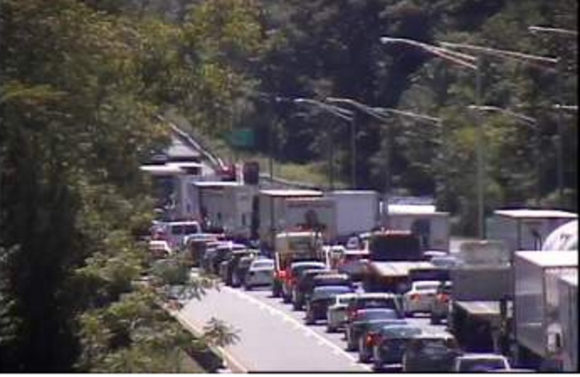
Trucks on I-91. Photo from CT DOT.

Trucks:
These are the vehicles responsible for most of our air pollution.  While medium to large trucks represent only 6% of traffic they cause 53% of nitrogen oxide (NOx) emissions, 45% of fine particulate matter (PM2.5), linked to respiratory and cardiovascular health issues, and 25% of greenhouse gas emissions.

Better air filters may help as does burning biodiesel and enforcing no-idling rules. But the real solution will be electric-powered trucks.  However, the Trump administration has slashed tax credits for new buyers and frozen plans for the rollout of charging stations.

Take the Train:
Riding Metro-North is five to six times more fuel efficient than driving.  Those electric trains’ power-generation gives them the equivalent of 125-160 mpg.  And that’s improved further by the trains’ regenerative braking which means that, even when stopping, they generate more power.

Getting more folks on the train also reduces highway traffic, making those vehicles more fuel efficient because they’re not spewing exhaust in stop-and-go traffic.

But our diesel locomotives (which run on the Danbury, Waterbury and Hartford lines) are a different matter.  For their runs in Connecticut they are big polluters, just like trucks.  The World Health Organization and EPA call diesel exhaust a Class 1 carcinogen, right up there with tobacco and asbestos.  New locomotives that are on order will improve that with battery operation and improved filtration.

Ships:
Yes, both commercial and pleasure craft contribute to air (and in this case noise and water) pollution, again because of their diesel engines.  It’s not by chance that wind-powered sailors refer to powerboaters as “stink potters” and “blow boaters”.  There are some electric-powered boats under development, but they’re more expensive and don’t offer the same range.

So, whether your travels take you on the open waters or (hopefully) open roads, remember that there’s more to the cost of your trip than fuel: there’s the cost to our shared environment. 

Editor’s Notes: i) Jim Cameron is the founder of the Commuter Action Group and advocates for Connecticut rail riders. He writes a weekly column called ‘Talking Transportation,’ which is published by a number of publications in the state.
ii)”Talking Transportation” recently won first place in the general column/commentary category in the Connecticut Society of Professional Journalists Excellence in Journalism Contest.