

Talking Transportation: Don’t Believe the Hype

Jim Cameron

Don’t believe everything you read or see in the media. 

Sage advice on any topic, but especially when it comes to coverage of transportation.  A couple of recent stories illustrate my point.

Improved Cell Service on Metro-North

The Governor and Connecticut Department of Transportation (CDOT) Commissioner held a media event recently in Stamford to promote the fact that AT&T has improved its cell coverage along the New Haven line. That telco spent $6 million installing 30 high-powered macro towers and small cell nodes, some of them on CDOT land, in a public-private partnership. Many are specifically aimed at dead-spots in service on the trains.

This is good news…if you are an AT&T subscriber.  If you use Verizon or T-Mobile and find an area with no cell coverage on your commute, this won’t help you. The AT&T enhancements are for its customers only.

There is no word from the other companies on how they might be filling holes in their service. But… it’s a start.

However if you read the media coverage, you’d think every commuter’s cellphone coverage had been improved!  “Cellphone service to get upgrade on Metro-North rail line,” proclaimed the Hearst papers. “Wireless service upgrades coming to New Haven line for CT commuters,” said WSHU public radio.

Improved cell coverage is a crucial issue for commuters looking to be more productive during train-time. But attention-grabbing headlines such as these may lead to a perception of better service. The more you’re told “cell service is getting better” the more you’ll think it is.  Or so they hope.  

But… don’t believe the hype.

Faster Than Acela?

In April another media event, this time at Grand Central, celebrated faster train service from New Haven: three early morning (5 – 7 am) super-express trains, one of them cutting ten minutes off its old running time, making that single train “faster than Acela”.

Great news… if you’re a pre-dawn-commuter from New Haven. Again, kudos to Metro-North for much needed signal and infrastructure improvements. But has the average commute to Grand Central really improved?  Not really. The exception is not the rule.

With limited stops these super-express trains still average only 52 mph. Regular express trains get about 46 mph and locals run just 38 mph.  Remember: the M-8 cars on Metro-North are capable of 80 mph.

How Did the Media Portray These Improvements?

“New Metro-North schedule, with shorter trips on New Haven line, now in effect,” trumpeted the Hearst papers. “Metro-North Is Faster Than Acela,” promised Bloomberg (quoting MTA chairman and CEO Janno Lieber).

The “faster than Acela” claim is technically true…for one Metro-North train. Keep in mind that New Haven to Grand Central is 73 miles but to Penn Station (on Amtrak) is 75 miles. But not wanting to always sound like a grouch, I say good for Metro-North.

What worries me is the media coverage which over generalizes and lacks the caveats I’ve cited. Telling commuters repeatedly that their trains are running faster, when they are not, may be persuasive but it is not accurate.

So, take media coverage of transportation with a grain of salt.  The headlines don’t always tell the full story. And don’t believe the hype.

Editor’s Notes: i) This article has been updated to reflect a correction sent by the author regarding AT&T’s investment in new cell towers, which he had incorrectly stated as $60 million, rather than $6 million.
ii) Jim Cameron is the founder of the Commuter Action Group and advocates for Connecticut rail riders. He writes a weekly column called ‘Talking Transportation,’ which is published by a number of publications in the state.
iii)”Talking Transportation” recently won first place in the general column/commentary category in the Connecticut Society of Professional Journalists Excellence in Journalism Contest.

Talking Transportation: Enjoying the View

Commuting can be “Oh so boring”, especially if you’re driving. But when you’re on the train, you’ve got plenty of time to do work, read a book, take a nap or just look out the window.

Enjoying the view from the train is one of the perks of being car-free, and some parts of the ride are especially beautiful.

Traveling along the coast, especially east of New Haven (on Shore Line East or Amtrak) the water views are spectacular. Even on the wetlands side, there’s often wildlife to be seen… egrets, ospreys and such.

Crossing the soon-to-be-replaced, 125 year-old Walk Bridge in Norwalk, there’s a nice view out to the water or into downtown South Norwalk. Westport’s Saugatuck River Bridge (known as Saga) is also a delight. Same thing in Greenwich crossing the Mianus River where a glimpse to the north brings back memories of the collapse of the I-95 bridge in 1983 that took three lives.

But my favorite part of the ride into New York City on Metro-North is between Portchester and New Rochelle, that nine-mile straight section of track that engineers call “The Raceway”. Running right alongside I-95, the trains used to have a speed limit of 80 mph, and they’d do it.

Is there anything more satisfying than whipping past drivers on that busy interstate, showing them that the train is a faster choice? I’ve even been known to wave as we hurtle past.

Just south of Westchester County, as trains enter The Bronx (near Woodlawn), is where the New Haven and Harlem lines converge, complete with a soaring rail overpass. Again, a great view for a railfan such as myself.

Another favorite of mine is crossing the Harlem River into Manhattan as the trains traverse the Park Avenue Bridge. There’s a great view of the city skyline and brief
views down the avenues.

Some stations are also memorable, even when passed at high speed. Just who was Greens Farms named after? And just why doesn’t the stylish new Fairfield Metro station have a waiting room? But special mention goes to Milford where the usual advertising posters on the platform have been replaced with huge photos of the beautiful town itself. Nice promotion.

A nice as those views are, there’s much of the ride which is far less scenic. The seemingly bombed out factories of Bridgeport hold such memories… and promise. And Portchester’s old Lifesaver building, complete with its terracotta candies as ornamentation, remind us of the whimsy of architecture.

Railroads are built around business, and looking into the backside of industrial sites along the right of way ain’t exactly pretty. Even in corporate office buildings, it’s funny how landlords spend so much adorning their street-facing façade but forget that thousands see only the backs of the building, covered with graffiti and neglect.

And much of the trackside, strewn with debris, old rail ties and rusting equipment, could also use some TLC.

What’s your favorite “view from the train”? Share your thoughts at CommuterActionGroup@gmail.com.

Editor’s Note: We are delighted to welcome transport guru Jim Cameron back to LymeLine. He was wrote for us regularly for almost 10 years starting in 2011 and his columns were always popular with our readers. He is the founder of the Commuter Action Group and advocates for Connecticut rail riders. He writes a weekly column called ‘Talking Transportation,’ which is published by a number of publications in the state.

‘Talking Transportation’ is Back! Five Worst Ideas for Solving Traffic Congestion

Editor’s Note: We are delighted to welcome transport guru Jim Cameron , pictured left, back to LymeLine. He was wrote for us regularly for almost 10 years starting in 2011 and his columns were always popular with our readers. He is the founder of the Commuter Action Group and advocates for Connecticut rail riders. He writes a weekly column called ‘Talking Transportation,’ which is published by a number of publications in the state. Here is the inaugural column of his second season with us.

Five Worst Ideas for Solving Traffic Congestion

While I’m on vacation this week I thought I’d revisit a commentary I wrote in 2014.  Judge for yourself how little has changed in 11 years.

Everybody loves to complain about our traffic.  And for some, the solutions are simple, if impractical.  If there were easy answers to our woes, they’d have been implemented by now.  

Look … this is really a matter of supply and demand: too much demand (highway traffic) and not enough supply (space on those roads).  I think the solution is to manage the demand.  But others say it’s a “supply side” issue. 

So here are a few of the crazier ideas for fixing our traffic that I’ve seen proposed over the  years:

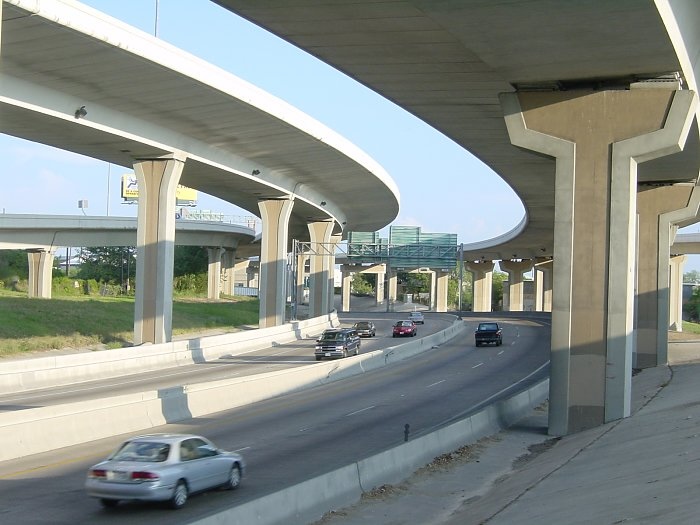
The photo shows a double-decker highway in Texas. Photo credit: TexasFreeway.com

1)    DOUBLE-DECK I-95:        
Seriously, this was once proposed by the Stamford Chamber of Commerce.  Can you imagine the decades of construction and billions in cost, with “upper level” roads having to soar hundreds of feet over existing bridges?

2)    ALLOW TRUCKS ON THE MERRITT PARKWAY:       
There are two words to explain why this can’t happen:  low bridges.

3)    BAN TRUCKS FROM OUR INTERSTATES:          
This was once suggested to me by a Fairfield County First Selectman.  But as I reminded him … trucks are high-occupancy vehicles delivering goods to the stores where you drive your single-occupancy vehicle to shop.  No trucks, no goods, no shopping.

4)    DRIVE IN THE BREAK-DOWN LANE: 
This was then-Governor Rowland’s idea in 2000 and he even wasted a million dollars studying it.  But if you think of that far right-hand lane instead as the “emergency rescue lane”, you’ll see why this doesn’t make sense.  This plan would also require re-striping the road to create narrower lanes, making driving even more dangerous.

5)    WIDENING I-95 TO FOUR LANES:       
Again, billions in cost and decades of construction.  And if you build it, they will come.  The immutable law of “induced demand” means that traffic will expand to fill available space.  Then what, a fifth lane?

There are better ways to manage congestion, some of them already being implemented:

OPERATIONAL LANES:     
Adding a fourth lane from on-ramps to the next off-ramps gives traffic a better chance of merging on and off the highway without blocking the through-lanes.

WIDENING CHOKE-POINTS:      
For example, the exit 14-15 bottleneck in Norwalk.  But this widening project (for less than one mile) cost $50 million and took three years.  The I-84 / Route 8 “Mixmaster” rebuild in Waterbury took six years and cost $253 million.  Both projects were funded mostly with Federal funds, but it’s anyone’s guess what will happen to that money pot under the new administration’s budget cutting.

ADD A ZIPPER LANE:      
Sure, this may require highway widening, but just one lane that’s reversible depending on demand, a system that was used successfully on the Tappan Zee Bridge before its reconstruction.  By moving the extra lane, capacity can be added to the direction where there’s the most traffic.

CHANGE COMMUTING HOURS: 
Does everyone really need to work 9 am – 5 pm?  How about starting earlier or later and spreading out the traffic?  Your employer should understand and you’ll be happier and more productive.

And the very best idea of all:  IMPROVE MASS TRANSIT TO ENCOURAGE DRIVERS to get off of the roads.

As I say, there are no simple solutions to highway congestion.  So when anyone says he or she has one, be skeptical.  It’s easy to identify the problems.  But fixing them will always be hard … and usually expensive.

Editor’s Note: Contact Jim at TalkingTransportationCT@gmail.com.

Talking Transportation: Is Commuting Dead?

Jim Cameron

These columns run in some publications under the title “Getting There.” Am I going to have to change that name to “NOT Getting There”?

That’s what Governor Lamont says. Post-COVID he predicts the end of daily commuting as we know it.  Lamont told Bloomberg that his New York business buddies tell him they’re saving so much money by having people work from their homes they may cut office space in the city by 30 percent.

“The old idea of the commuter going into New York City five days a week may be an idea that’s behind us,” Lamont said. “Maybe you have a great job that seems to be geographically located in New York City, you can do it two-thirds of the time from your home in Stamford.”

Or maybe you don’t need to ever go into the city.  Twitter has told its tech workers they can work from home forever, assuming they can stand it.

That means more time with the family and a lot less time and money spent on the train.  If you add up monthly train tickets and station parking, you’re looking at least $500 to $600 a month in savings.

Not only does that leave Metro-North looking at a huge deficit, but also the towns and cities that rely on parking revenue.  And as we are discovering now, during budget-writing time, belts are getting pulled tighter and tighter.

To save money, Stamford residents may have to bag their own leaves for collection this fall.  Oh, the humanity of it all!  And Darien is looking to use empty parking lots as tented al fresco dining areas.

But wait ‘til the evacuating New Yorkers hit Fairfield County.  Our media-centric governor told CNBC that “the phones are ringing off the hook at real estate offices in Southern Connecticut.”  More families means more kids in our local schools further straining already-cut budgets.

But what if your New York jobs tells you to come back, even a few days a week.  How are you going to commute?

Probably not by train and subway.  A recent survey showed that 48 percent of respondents said they would totally avoid mass transit after NY’ers are allowed to leave their homes.  

The New York Stock Exchange says it hopes to reopen its trading floor, but only to traders and employees who did not arrive on Wall Street by mass transit.  Good luck with that traffic nightmare.

Transitioning to biking or walking to work may be viable if you live in Manhattan, but not if you’re coming from Connecticut. The best (or only other) option will be your car.

So it’s not surprising that a local car wash chain (reopened May 20) is offering a proprietary 15-minute “No-Vid Fogger Disinfection” treatment for only $54.99, “EPA certified to kill 99.99 percent of the emerging pathogens in your car”.  Yes, you too can stay in the safety bubble of your own car on your drive to work, however long it may take.

You think rush hour on the Merritt or I-95 was bad in the pre-COVID days?  Wait til we see the newly “disinfected” post-COVID commute-by-car crowd hit the roads.  Those highways are already getting crowded and we still haven’t officially fully re-opened yet.

PS:  If your New York City boss tells you to come back to the office, ask if he’ll also cover your tolls and Manhattan parking costs (about $50 a day).

Posted with permission of Hearst CT Media

About the author: Jim Cameron is founder of The Commuter Action Group, and a member of the Darien RTM. The opinions expressed in this column are only his own.You can reach him at CommuterActionGroup@gmail.com For a full collection of  “Talking Transportation” columns, visit www.talkingtransportation.blogspot.com.

Talking Transportation: The Road Ahead … for Rail Commuters: Will They Ever Go Back To Metro-North?

Jim Cameron

The road ahead for commuters may be less crowded … or maybe more.

One theory has it that, as people gradually return to work, they will shun mass transit out of safety concerns and commute, instead, by car.  That could create problems on our roads if people try to drive five days a week.

The other speculation is that the “new normal” will mean less commuting overall as people have found they can be just as productive from home and will commute less than the normal five days a week.

Work hours may also be staggered, asking employees to go to their jobs every other day to avoid crowding in the office.  And some New York City based companies may opt for adding suburban “satellite office” space, again changing the normal commute.

But for all of these scenarios, Metro-North will be the big loser.

“It will be years, if ever, before ridership gets back to pre-COVID-19 levels,” Catherine Rinaldi, President of Metro-North told me.

Ridership is already down 95 percent and service has been cut substantially to just one train per hour.  So far, cheaper off-peak tickets are valid on all trains, even at rush hour.  That seems unlikely to change.  Why give potential returning riders any excuse to not come back?

Because Metro-North charges the highest fares of any commuter railroad in the US, fares cover more of the railroad’s operating expenses than on any other railroad.  On Metro-North, 75 percent of the cost of running the trains is covered by fares compared to only 20 percent by MBTA in Boston (where fares are heavily subsidized to encourage ridership.)

Monthly commutation passes give riders a 50 percent discount over one-way fares.  But if people aren’t commuting five days a week, monthly tickets won’t make sense so maybe they’ll go for 10-trip tickets (still, a 30 – 40 percent discount over buying single tickets.)

The railroad’s parent, MTA, says it is expecting almost $6 billion in lost revenue, a $1.7 billion cut in tax revenue and $800 million in additional costs for employee safety.

The MTA will receive $3.9 billion from the Federal Government in aid, but that comes nowhere near what will be needed.

If ridership doesn’t come back strong and fast, the losses will only worsen.

With reduced ridership and fewer trains, the railroad may have to do something more to reduce costs … but layoffs and furloughs are not being considered, I’m told.  The MTA wants to keep those staffers close so they can be put back on trains if demand increases as some hope.

“We will have to be nimble and improvise, depending on how quickly passengers return,” says Rinaldi.

As CDOT is doing with our highways, Metro-North is taking advantage of this lull to accelerate infrastructure repairs.  The Waterbury branch, which has reverted to bussing, has seen 5500 railroad ties replaced, bridge timbers upgraded and signal work moving apace.

President Rinaldi gives a big “shout out” to her 6600 employees.  “I’m so proud of their amazing dedication” coming to work and keeping the railroad running.

And to riders, past and future, Rinaldi’s message is simple:

“Thank you for staying home and staying protected.  We want you to come back and we will do everything we can to keep you safe.”

Posted with permission of Hearst CT Media.

About the author: Jim Cameron is founder of The Commuter Action Group, and a member of the Darien RTM. The opinions expressed in this column are only his own.You can reach him at CommuterActionGroup@gmail.com For a full collection of  “Talking Transportation” columns, visit www.talkingtransportation.blogspot.com.