
Talking Transportation: Congress Giveth (Renewed Life to AM Radio), But Also Taketh Away (Cutting PBS, NPR)

Jim Cameron

Remember when commuting was fun because you could listen to the radio? 

Earlier in my career I may have been the guy you heard, both on WHCN / Hartford and later on NBC. When I started in radio in 1967, AM Top 40 was king and FM was just getting started. But in 1961 the FCC decreed that all radios should have both AM and FM bands … and that FM should broadcast in stereo. And no longer could station owners just simulcast their AM programs on their FM stations: FM programming had to be different.

Thus was born “Progressive Album Rock” on FM, usually programmed by long-haired LP fans.  That was me, again. Within years, radio listening went from predominantly AM to majority FM thanks to better audio quality and changing musical tastes.

Today the AM band is filled with syndicated political talk, foreign language shows and sports.  Only a handful of stations have real news departments (think WTIC, WICC here in Connecticut.)

Then came the all-electric car.  Because of their wiring Teslas and such could not have AM radios due to interference. What to do?

Well, Congress is expected to pass a law requiring AM radios in all cars. The bill has hundreds of co-sponsors, including the entire Connecticut delegation. No wonder: pols love being interviewed on AM stations.

“But AM radio is effectively aging out, with less than a 20% market share.  And many news / talk stations have transitioned to FM where there are far more listeners,” (think WINS in NYC) says former station consultant Steve Goldstein of Westport.

Goldstein left radio years 10 years ago to become a podcasting consultant. He also teaches at NYU and says not one of his students listens to AM. Most don’t listen to FM, either, preferring streaming services like Pandora and Spotify or on-demand media like podcasts. “AM radio is going the way of the phone booth and fax machine”, he laments.

So why save AM radio in the car when folks aren’t listening? And what will be left on FM to tune into?

If your listening habits tend toward the NPR stations at the lower end of the FM band, you’re in for disappointment. Congress has just voted to claw back (“rescind”) $1.1 billion from funds previously allocated to CPB, the Corporation for Public Broadcasting, which funds both PBS television and NPR radio stations.

In the case of Connecticut Public Radio (WNPR) we’re talking about a 10+% budget cut. That will probably mean layoffs and less local programming for shows like “Colin McEnroe.”  

At WSHU they say they’ll need to raise an additional $500,000 to make up for the loss. Elsewhere in the US it’s estimated that as many as 80 NPR stations will just go dark.

Your mail is already crowded with funding appeals, not just from public broadcasters but from other non-profits also losing federal funding.  With so many hands outstretched, how will donors prioritize their gifts? Feeding the hungry or keeping the airwaves alive?

So Congress giveth (renewed life to AM radio) and taketh away (cutting PBS and NPR). The media world (and listeners) will adapt.  

Now, if only I could find my old eight-track tape player.

Talking Transportation: The Inevitable Fare Increase

Jim Cameron

Sorry. You’re too late. You missed your chance: the deadline has passed for offering “public comment” on the upcoming fare hikes on Metro-North.

Not that anything you might have said would have made a difference to the inevitable:  a 5% fare hike on September 1st of this year and another 5% jump in July of 2026. But don’t blame the railroad or CDOT.

You should really blame the legislature. The budget they wrote this year practically required a fare increase as they under-funded the CDOT’s operating budget requests for our trains … Metro-North, Shore Line East and The Hartford Line.

So these recent hearings on a “proposed” fare increase were really for show, required by law, but mostly “political theater” (as I described it 12 years ago).

I’ve been through this charade before, attending and testifying at many, many such hearings over the past 25 years… all with the same outcome:  what was proposed was always what happened. This round, I didn’t even bother.

So why does the agency even go to the time and expense of this exercise when we know the inevitable?

Why do they prepare a 25-page Service Equity Analysis (in two languages) explaining the impact of the increased ticket costs on the poor and minorities?

Why does a team of CDOT managers travel across the state, holding these fare hearings in-person and online, basically signaling to the few people who show up to testify that they’ve wasted their time … that anything they might say can’t stop what’s coming down the track?

That seems like such a waste of the agency’s talents. These CDOT managers want to run a good railroad but aren’t adequately funded by lawmakers. The railroad takes the heat but shouldn’t take the blame as they were given no real choice but to raise the fares.

Sure, alternatively, they could cut service, but nobody wants that.  

While the CDOT staff did not share any analysis of the effect of higher fares on ridership, they did remind us that in the last seven years fares have only gone up 14% while inflation has hit us with a 28% jump.

If fares must go up, what riders would really want would be more service and faster trains, maybe even a Quiet Car.  But the CDOT can’t deliver on those dreams.

The problem is that fares don’t even come close to covering the cost of running a railroad. Pre-pandemic Metro-North boasted a 70+% “farebox return”, meaning that most of the operating costs for the trains were covered by ticket revenue.

But we all know what happened to ridership in the past five years.  And while it is slowly building back up (it’s up 6% in the past six months since congestion pricing began), the farebox return today is only about 38%. Someone has to make up the difference: us riders.

And those millions of dollars being collected in tolls from drivers in midtown Manhattan? Those can only be spent on capital improvements, not subsidies for operating costs, i.e. lowering fares.

For NYC-bound commuters, there’s little choice. They’re a captive audience of 23,000 daily riders dealing with a monopoly that can raise prices without really losing customers.

Driving isn’t an option, especially with an additional $9 toll now added to your daily drive into Manhattan. And work from home was great, while it lasted. But now you have to show up at the office in person at least a few days a week.

The CDOT now will analyze the testimony from the hearings and issue a final recommendation to the Commissioner, who will make the fare hike official.

So when your ticket price jumps, don’t blame the conductor. Blame your elected officials for under-funding this crucial transportation resource.

Editor’s Notes: i) Jim Cameron is the founder of the Commuter Action Group and advocates for Connecticut rail riders. He writes a weekly column called ‘Talking Transportation,’ which is published by a number of publications in the state.
ii) ”Talking Transportation” recently won first place in the general column/commentary category in the Connecticut Society of Professional Journalists Excellence in Journalism Contest.

Talking Transportation: Connecticut and Monorails—A One Track Mind

Jim Cameron

While taking a summertime break this week, here’s a column I wrote awhile back.

What is this fascination that people have with monorails?  I can’t tell you how often people suggest them as “the answer” to our state’s clogged roads.

“Why don’t we build a monorail down the middle of The Merritt Parkway?,” asked an architect at a recent meeting.  To my astonishment, such an idea was once studied!

As lore has it, back in the mid-1980’s local tech giant Sikorsky was asked by CTDOT if a monorail could be built and a plan was submitted.  Sure, such a system could be built, they concluded, but where would you put the stations and the necessary parking? 

Since hearing of this white-whale of a tale, shared by Merritt Parkway Conservancy Executive Director Wes Haynes, I have been on a relentless search for details of the proposal, but I’ve come up empty.  Sikorsky has no record of the plan.  CTDOT said “Huh?”

Digging through the archives of the Stamford Advocate, I found articles from 1985 discussing the idea—a $700 million monorail down the median of the Merritt Parkway from Greenwich to Trumbull as an alternative to Bridgeport developer Francis D’Addario’s idea of widening the parkway to eight lanes … or double-decking I-95.

Motorists were surveyed and CTDOT apparently spent $250,000 for a study.

The amazing research librarians at the State Library dug through their dusty files and came up with a CTDOT report from 1987 pooh-poohing the idea, not only on grounds of impracticality but because it would compete with existing rail service.  Heavens no!

In 1998 a monorail was once proposed for Hartford, connecting downtown to Rentschler Field in East Hartford.  It was to cost only $33 million and the cost was supposedly to be paid by the Feds.  It never happened.  The idea was revived again in 2006 when the Adriaen’s Landing convention complex was opened, but again, nothing.

A pseudo-monorail “People Mover” system was built at Hartford’s Bradley Airport in 1976 connecting the remote parking to the main terminal, all of seven-tenths of a mile away.  The fixed-guideway system, with cars designed by Ford Motor Company, cost $4 million but never operated because the $250,000 annual operating cost was deemed impractical.  In 1984 it was dismantled, though you can still see one of the original cars at the Connecticut Trolley Museum in East Windsor.

Whatever your fantasies are about space-age travel by monorail, let me dispel your dreams with some facts.

Monorails are not fast. The Disneyworld monorail, built by a Japanese company, has a top speed of 55 mph but usually just averages 40 mph.  Even on a bad day Metro-North can better that.  The 3.9 mile long Las Vegas monorail does about 50 mph shuttling losers from casino to casino.

Monorails are expensive.  The Vegas system, opened in 2004, cost $654 million.  That’s why existing monorails like Disney’s have never been extended.

Monorails are not Maglevs.  Don’t confuse the single-track, rubber-tired monorails with the magnetic-levitation technology in use in Shanghai and being tested for passenger trains in Japan.  The Shanghai maglev can travel over 250 mph, the Japanese test trains have hit 374 mph.

No, monorails are not in Connecticut’s future and are not the answer to our woes.

Editor’s Notes: i) Jim Cameron is the founder of the Commuter Action Group and advocates for Connecticut rail riders. He writes a weekly column called ‘Talking Transportation,’ which is published by a number of publications in the state.
ii) ”Talking Transportation” recently won first place in the general column/commentary category in the Connecticut Society of Professional Journalists Excellence in Journalism Contest.

Talking Transportation: The Health Risks of Flying

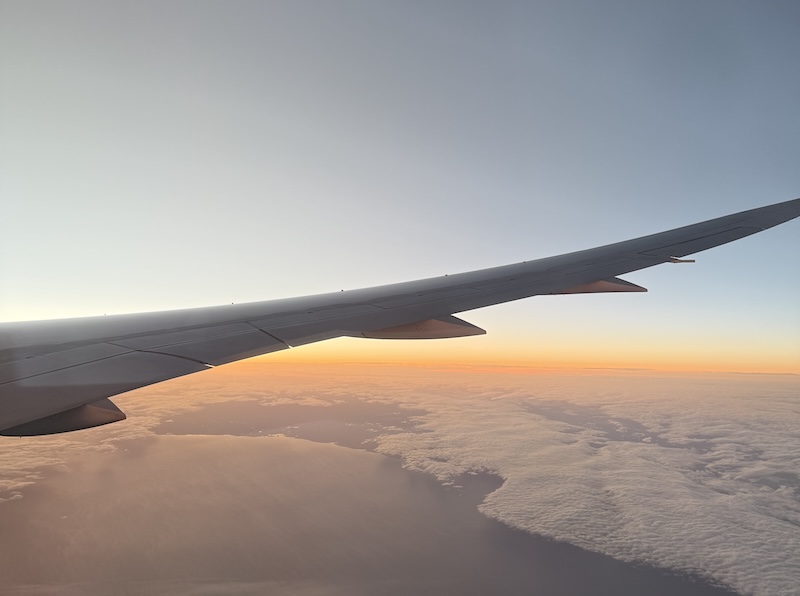
The views out of an airplane window can be spectacular but have you ever considered the effects of flying on your body? LymeLine file photo.
Jim Cameron

Think air travel is just about delays and lost luggage?  Your body has other plans. 

Forget plane crashes and fights about who gets the armrest.  If you survive TSA, a middle seat, and boarding group 9, now you have to make it through the flight itself without your body unraveling like cheap luggage on a baggage carousel. 

Let’s start with Deep Vein Thrombosis (DVT), or what they call the “Deadly Window Seat Special.”  You sit there for five hours without moving (thanks, beverage cart), and your blood turns sluggish, like airport Wi-Fi during a gate change.  Congratulations — you’re now flying DVT Airlines. The longer the flight, the better your odds of a one-way ticket to the ER.  Solution: get up every hour or so and walk.  And drink lots of water.

Feeling thirsty? You should be.  Aircraft cabins at altitude are drier than the pretzels in coach. Humidity in-flight hovers around 10%, meaning your eyeballs are shriveling and your skin is turning into parchment.  Lubricating eye-drops and moisturizer should help.

Speaking of airplane air, did you know the cabin is pressurized only to the altitude of Denver?  That’s great but only if you’re a bighorn sheep (the 787, A350 and A380 jets are an exception.)  For the rest of us, the lower oxygen can make you woozy or give your heart a surprise cardio session.  Got COPD or anemia?  Check with your doctor before flying.

Then there’s the inflight ear torture, courtesy of barotrauma.  This is why babies start crying before landing.  As the plane descends, your ears feel clogged as the pressure builds. Pop. Crackle. Pain.  But don’t worry … chewing gum, awkward jaw-stretching exercises or giving babies a bottle will probably help.  Or buy yourself a pair of EarPlane earplugs.

Crossing several time zones? Get ready for jet lag, also known as time-travel-induced dopiness.  Your body thinks it’s 3 a.m. in Hartford, but you’re eating airport sushi in Tokyo.  They say it takes one day of adjustment for each time zone you cross.

And for you frequent fliers: congratulations on your élite status … and cumulative cosmic radiation exposure.  One transatlantic flight gives you about as much radiation as one or two dental x-rays.  Not glowing, but not nothing.  Trans-polar flights leave you the most vulnerable.

Add in poor air circulation, recycled germs, and some guy sneezing in row 13 — and suddenly that N95 mask doesn’t seem so paranoid.  Still feeling like a little nosh?  Too bad.  Your guts are rebelling too. Gas expands at altitude, so avoid the bean salad.

Flying doesn’t just take you places. It slowly breaks down your body in a pressurized metal tube full of crying babies and funky air.  But hey, at least your suitcase made it to Cleveland.

PS:  While train travel is my preferred mode, extended sitting en route is still a problem.  But at least you can get up at will and stroll to the Café Car for some over-priced AmFood.  Try the cheeseburger.  It’s actually pretty good.

Editor’s Notes: i) Jim Cameron is the founder of the Commuter Action Group and advocates for Connecticut rail riders. He writes a weekly column called ‘Talking Transportation,’ which is published by a number of publications in the state.
ii) ”Talking Transportation” recently won first place in the general column/commentary category in the Connecticut Society of Professional Journalists Excellence in Journalism Contest.

Talking Transportation: There’s Still Some Unfinished Business

Jim Cameron

The end of June has a sense of finality. School wraps up, celebratory parties are held and everyone looks forward to the summer. But there’s a lot of unfinished business on the transportation front worth remembering.

AMTRAK AVELIA:
Whatever happened to Amtrak’s promise to have the new Acela trains in service “by the spring”? The initial contract for 28 train sets was signed in 2016 with the first prototype of the sleek nine-car sets delivered for testing in 2020. The plan was for all the new trains to be running between Washington and Boston by 2022.

Computer simulations found problems as real life testing continued. By 2024 the hope was for the new trains to be running by now. But we’re still waiting. Amtrak’s only explanation for the latest delays is “crew testing.”

The new trains have been sighted in New Jersey (where maximum speeds of 160 mph are possible on short stretches of track) but I’ve not seen Avelia on Connecticut tracks … yet.

DIGITAL DRIVERS LICENSES:
In September 2021 the Connecticut DMV and Governor Lamont announced that ours would be among the first states to allow smartphone users to show a digital version of their driver’s license on their devices. To date, 17 states offer such options. But still not Connecticut.

When I last asked DMV what was delaying the launch, their PR team gave me some boilerplate answer about “testing” and “security”… but no announced date for the launch.

How can California have solved those issues but we can’t?

WALK BRIDGE:
Built in 1896, this crucial rail bridge in South Norwalk has a history of problems. In one year alone the bridge was stuck 16 out of 271 times it opened. Now it’s undergoing a $1.5 billion rebuild, not just of the bridge but its supports and nearby tracks. The IMAX theater in the adjacent Maritime Museum was demolished to make way, but work on the bridge structure itself is still years away. The removal of the existing tower structure for overhead wires is scheduled to begin in 2026 with the new bridge (finally!) being finished in 2029.

DARIEN TRAIN STATION:
Last rebuilt in 2003, the station’s platforms were starting to crumble. By 2018 it was clear that CDOT would have to replace them. The $40 million contract called for first-of-their-kind heated platforms, obviating the need for corrosive salt to melt ice and snow. Half of the platforms were removed and the station waiting room was closed.

But now, years later, construction delays and problems with the electrical system have slowed the work, initially promised to be done by now. It’s hoped the first half of the new platforms may be ready later this summer. Then the other half of the platforms will be demolished and rebuilt. By March 2026 the work will (hopefully) be done and the station’s 1800+ daily commuters will be able to use the new station platforms.

Engineering projects take time. But with every ceremony celebrating the launch of a new project there are overly-optimistic promises of speedy completion. The pols take the credit while we just wait and grow more cynical watching the costs rise.

Editor’s Notes: i) Jim Cameron is the founder of the Commuter Action Group and advocates for Connecticut rail riders. He writes a weekly column called ‘Talking Transportation,’ which is published by a number of publications in the state.
ii) ”Talking Transportation” recently won first place in the general column/commentary category in the Connecticut Society of Professional Journalists Excellence in Journalism Contest.