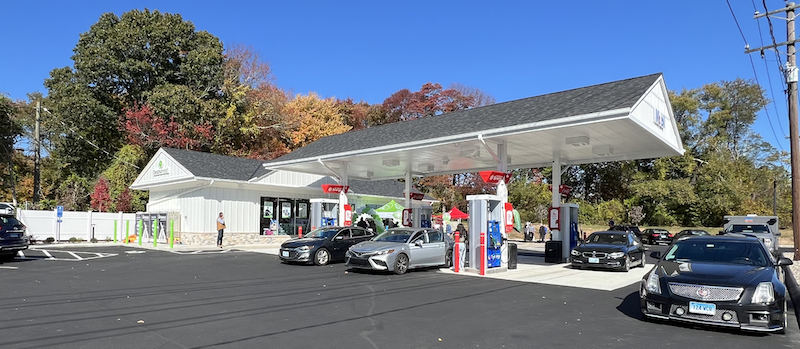
The exterior of the renovated Chestnut Market at 85 Halls Rd. in Old Lyme as seen in a 2024 file photo.
OLD LYME–Gas stations will be officially excised from the local zoning regulations, effective Aug. 11.
The Zoning Commission on Monday voted unanimously to amend the regulations to strike gas stations from the list of businesses that can operate in town.
Land Use Coordinator Eric Knapp said that means the existing four gas stations in town will remain, but no more will be allowed.
Gas stations were previously confined to Halls Road and certain parts of Shore Road.
Applications for new or improved gas stations are controversial in a town where residents have long objected to development that would entice drivers to get off Interstate 95 rather than continuing on to points north or south.
There was no comment at Monday evening’s public hearing.
The Planning Commission in a unanimous vote last month found the move consistent with the town’s Plan of Conservation and Development. The document, updated every 10 years, is meant to guide the community’s growth based on the vision of those who live there.
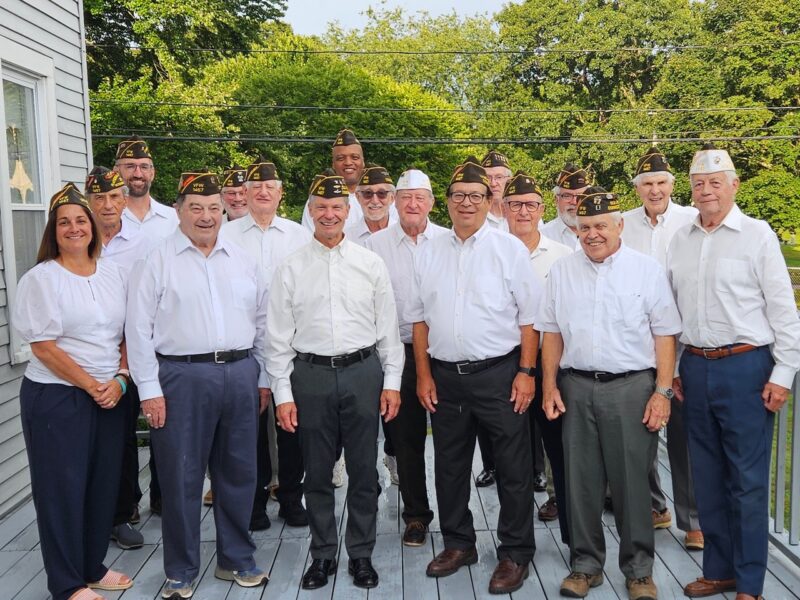
Members of VFW Post 1467 gather for a photo. Post Membership Chairman Ed Shilosky stands in second row at left, Post Trustee and former Commander David Griswold stands at right. Photo submitted.
LYME/OLD LYME–For this Veterans of Foreign Wars (VFW) Post with no bar and no building, the focus remains on helping veterans wherever they can be found.
VFW Post 1467 trustee and former commander David Griswold said the group has helped 142 veterans since an anonymous donor handed him a check for $10,000 over a cup of coffee back in 2012.
Griswold, a veteran of the U.S. Marine Corps, whose service included a year in Vietnam as a company commander, recounted the exchange during an interview last week at the Old Lyme Phoebe Griffin Noyes Library. He said the donor had two requests—that his name remain anonymous and that the money be used to help veterans.
“You can’t go out and buy a pool table or have a beer party,” Griswold recalled the man saying.
It was an easy commitment for an organization that had long eschewed the smoky, wood-paneled VFW canteens popularized in the post-World War II era. Instead, they’ve met predominantly at the Lymes’ Senior Center.
“And not having a bar has really helped us,” Griswold said. “These bars, they sprung to life after the war in the 50s, 60s. They’re old buildings, a lot of them. They’re beat up. They’re a horrible expense to keep up. Insurance is terrible.”
Post 1467 Membership Chairman Ed Shilosky, who is credited with the “No Bar, No Building, Just Good Works” motto, said not having to worry about building upkeep has allowed them to put more resources toward helping veterans in need and helped draw more members.
Shilosky, who was in the Army for 23 years, served on active duty in Vietnam and then in the reserves.
“The main reason people join us now is they want to get away from VFWs that don’t do anything, either for the community or for veterans, because they’re weighed down by other expenses,” Shilosky said.
Griswold pointed to changing societal attitudes that have made the group’s ethos all the more relevant.
“Back after World War II, going out and drinking heavy was kind of expected, but it’s not now,” he said. “And let’s say you have a young person that gets back from Iraq or Afghanistan, maybe he has some drinking issues. Saying, ‘Let’s join the VFW, you can get drunk every day’ isn’t helping the person.”
The post’s membership roster of roughly 80 people includes veterans from Lyme, Old Lyme and beyond. The only membership requirement is honorable, verifiable service in a combat zone.
The Vets in Need program, which Shilosky said has grown out of that unexpected donation to fund about $105,000 in one-time needs, covers expenses including food, rent, utilities, home and car repairs, travel and accessibility upgrades.
The program helped pay for three funerals. Used cars, most of them provided at cost by All Pro Automotive in Old Lyme, add up to 10. Thirteen veterans received specialized equipment or furniture to accommodate their medical needs.
The group has also given more than $60,000 to statewide initiatives administered through Connecticut Veterans Affairs.
The first veteran to benefit from the Vets in Need program was an elderly man living in a converted garage with a bucket as a chamber pot, according to Shilosky. Another needed help relocating to Las Vegas to live with a daughter when his wife got sick. One struggling veteran whose paintings lined his apartment ended up with an art show at St. John’s Episcopal Church in Essex after Post 1467 got involved.
“Those are the kinds of things that are so gratifying,” Shilosky said.
Griswold said the group’s strength is its ability to react quickly when emergencies arise. In the case of veterans who cannot afford utility payments during the winter, Post 1467 members can get the furnace restarted and two months of heating bills paid before state and federal resources can be secured for a more long-term solution.
Each case needs sign-off from the post’s service officer, trustees and membership, he said.
He likened the group’s role to that of a military medic.
“We’re running out there and getting an immediate fix,” he said. “And then it can be turned over to other organizations.”
Former Old Lyme First Selectman Tim Griswold, a previous commander of the VFW post and cousin of David Griswold, said the group has expanded its outreach beyond Lyme and Old Lyme.
“It was apparent that there were other individuals not within our border that had needs,” he said. “And so we’re willing to help people regardless.”
If that sometimes means stepping outside of their jurisdiction into the realm of other VFW posts, Tim Griswold wasn’t too worried about it. He said any lingering concerns were assuaged by a visit from a national VFW commander a couple years ago.
“He was very well pleased with us, saying, ‘This is how a post should be,’” he recalled. “You don’t necessarily have to have little fiefdoms. You can help veterans that are in need, and that’s a good thing.”
The three men said the communities of Lyme and Old Lyme are uniquely situated to give back to veterans.
David Griswold recognized the area at the confluence of the Connecticut River and the Long Island Sound as a place where some very accomplished people from all over the world have landed.
“And a lot of them have done well financially and are very generous,” he said. “I’ve heard people say, ‘Well, they can afford it.’ But that doesn’t mean they’re going to do it. I know some wealthy people, who wouldn’t give you a dime.”
For Shilosky, it all goes back to an overarching sense of service and gratitude that comes from veterans who look outward together – and the community who supports them.
He said the Post 1467 mantra has grown from “Small but Mighty” to the oft-repeated “No Bar, No Building, Just Good Works.”
“And I think we’ve lived up to that,” he said.
Editor’s Note: Lyme-Old Lyme (LOL) VFW Post 1467 reminds all local Veterans and Veteran families in need that they can reach out to the Post to request a great variety of types of assistance. All that is required is the Veteran’s DDForm214 Record of Military Service and a call to Services Officer, Navy Rtd. Captain Larry Olsen at 607-220-7137. The Services Officer will then respond, assess the need, and assist as appropriate.
This photo was taken September 2020 during an inspection of Whalebone Cove in Lyme, in which it was found 60 to 70% of the waterways were clogged with hydrilla vines.
State Legislators say “There has been false and misleading information on social media” about use of herbicide diquat to combat Hydrilla growth in CT River
LYME, CT—Reactions to the use of herbicides in the fight against hydrilla along the lower Connecticut River have only recently begun to spread across social media, but the topic is old news to local property owners long concerned with the pernicious water weed.
Joe Standart, a Selden Cove resident, said the herbicide treatment applied last year as part of a U.S. Army Corps of Engineers (USACE) project worked “beautifully” to rid the cove of a strain of hydrilla unique to the Connecticut River.
“There’s no trace of hydrilla at the moment,” he said in a phone interview Wednesday. For four years prior, fast-growing and thick mats of the aquatic weed had rendered the water body impassable to power boats and inhospitable to many fish and native plants during the height of summer.
Efforts to plan the next phase of the Connecticut River Hydrilla Research and Demonstration Project are ongoing despite federal funding limitations exacerbated this year by the threat of a government shutdown and related costcutting measures.
Keith Hannon, USACE Project Manager, said Selden Cove may get another treatment this summer using money approved by lawmakers in the previous budget. But a proposal to add Hamburg Cove and Joshua Creek to the treatment mix, along with additional chemicals, will not happen this year.
Meanwhile, critics of the state and federal effort to bring hydrilla under control – including a rap artist originally from Fairfield County, whose online petition has amassed 18,839 signatures to date – have gone viral with concerns about toxicity and a lack of government transparency.
The petition calls on authorities to discontinue the use of the herbicide diquat dibromide while focusing on “non-toxic, mechanical and biological alternatives” to manage the plant.
Documents from USACE engineers show the treatment last year in Selden Cove consisted of Dipotassium salt of endothall, while sites in four other towns along the river were treated with chemicals including diquat.
A proposal for 12 additional sites currently under review specifies diquat is slated to be used in Hamburg Cove and Joshua Creek.
Diquat is approved by the U.S. Environmental Protection Agency (EPA) and state Department of Energy and Environmental Protection (CT DEEP), according to Hannon. He said EPA approvals are based on field and laboratory studies that show the active ingredient doesn’t cause unreasonable risk to humans or the environment.
He said the threat of the genetically distinct strain of hydrilla is real.
“It spreads quickly and aggressively, forms dense monoculture mats of the plant that block light which native plants need, prevents fish passage and boat traffic during the summer months, threatens native aquatic plant species by displacing them, and threatens the local river tourism and recreation economy, among other negative effects,” Hannon said.
It can also lower property values and increase an area’s flood risk, the USACE said in a statement.
A Public Statement issued July 8, led by State Representative Renee LaMark Muir and signed by 18 state legislators states, “There has been false and misleading information on social media that has triggered fear among residents about the use of the herbicide diquat to combat the growth of Hydrilla in the Connecticut River.”
The Statement continues, “If we do not act now, the ecosystems of the Connecticut River will be changed forever, and the river may never recover. Understandably, the use of any chemical in our environment causes concern. If we do nothing, the Hydrilla problem will worsen, and other invasives will proliferate.”
Congress allocated $5 million in 2024 and $6 million in 2023 to address hydrilla in Lake Champlain and the Connecticut River, and in 2022 authorized $1 million for the Connecticut River.
At the state level, the Office of Aquatic Invasive Species was created in 2022 with roughly $600,000 in funding annually.
Selden Cove, Pameacha Pond in Middletown and Petzold’s Chester Boat Basin remain the only sites that may be treated this year amid budget constraints, according to Hannon. A public notice will be posted to the project website once a treatment schedule has been determined.
The project, overseen by the USACE in partnership with the Connecticut Agricultural Experiment Station and other organizations, began several years ago to figure out which aquatic herbicides ― and how much of them ― are best suited to fighting off the uniquely pernicious aquatic species.
Scientists in 2023 applied red dye to Selden Cove to mimic the flow of herbicide. It was a precursor to last year’s treatment meant to gauge the safest, least toxic way to stem the problem.
Standart, who has spoken with scientists from his property at Selden Cove and has looked into the issue himself, said he was assured herbicides are carefully chosen based on the characteristics of each water body. He has also come to see it as the only effective option.
He said pulling out hydrilla by hand doesn’t work because roots remain in the sediment and broken fragments can rapidly sprout new plants in new locations.
Hannon pointed to the limitations of other natural options.
He said introducing fish like grass carp – which he described as difficult to control, monitor and remove from the system – means beneficial native plants would be consumed in the process. And installing man-made mats to block the light would also kill off native plants – if it were feasible to cover such large areas, which Hannon said it is not.
“Other methods to control the plant have been considered, but they do not work to effectively control hydrilla,” Hammon said.
Standart said all signs of hydrilla disappeared within about a week of the herbicide application last August. But other forms of vegetation beneficial to the cove remained.
“It’s still a very healthy ecosystem with wild rice and other things,” he said.
(ii) The statement signed by the legislators states, “We can all help slow down the spread of this invasive and highly transmissible strain of Hydrilla and other invasive plants. CT DEEP and USACE recommend the best way is to “Clean, Drain, Dry” your boats and any type of watercraft and fishing gear after removal from the river or a lake. Report any sightings of the strain to DEEP at this link or to the Connecticut River Conservancy at this link.”
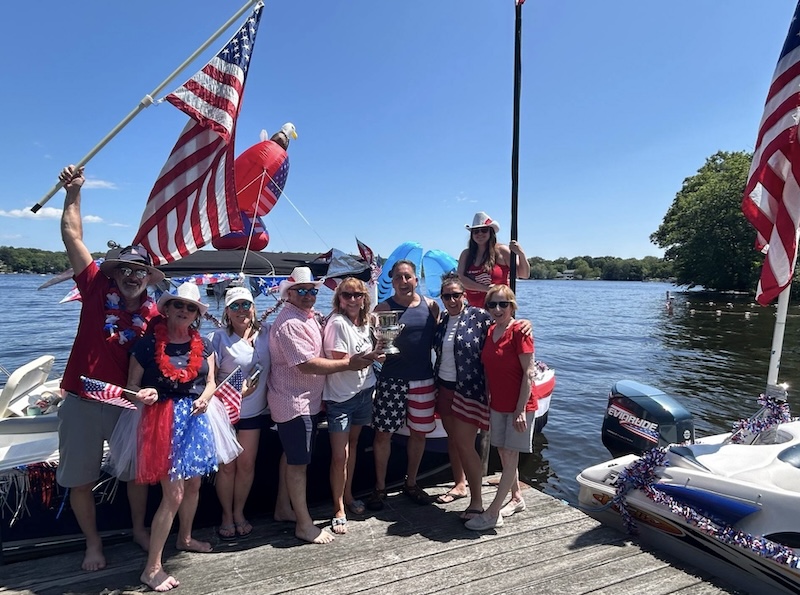
Jim and Christine Levasseur and family floated away with the 2025 Rogers Lake Boat Parade trophy.
OLD LYME—There are new Independence Day champions on Rogers Lake.
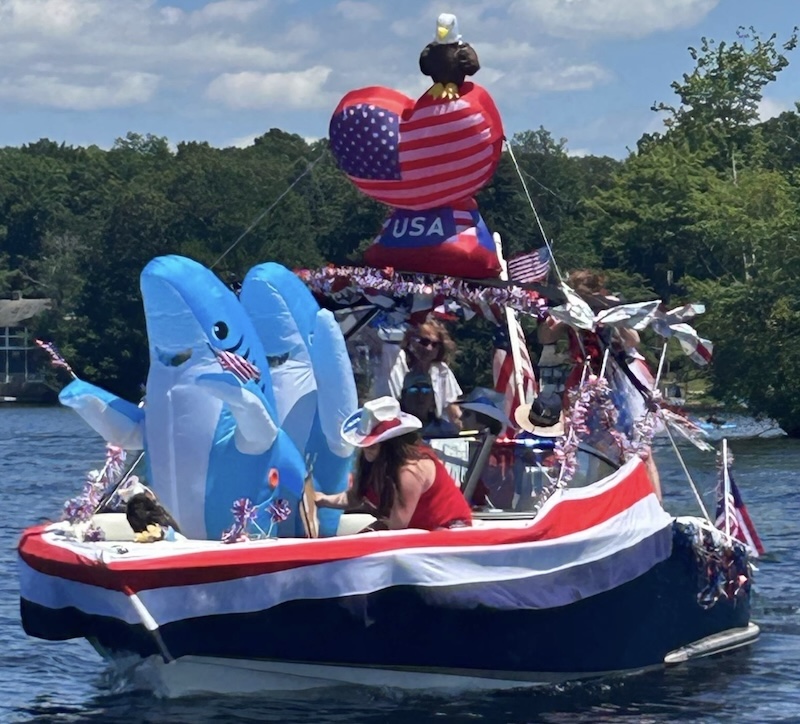
Rogers Lake Boat Parade organizers Christina and Dave Evers in an email said this year’s trophy for the “most enthusiastic, patriotic, and best decorated” boat has been awarded to Jim and Christine Levasseur and family.
The Evers said the family’s enthusiasm put them over the top during Friday afternoon’s parade around the lake.
“They never stopped dancing,” the organizers said. “There was a close second place winner, but the Levasseur family really brought that energy!”
The Levasseur family was recognized for their enthusiasm during the parade, as well as for their decorations.
Judges were placed randomly along the water.
The winners keep the trophy for 12 months and then return it to be presented to next year’s winner. The Levasseurs took the title from the King family.
This year marked the sixth annual boat parade. The trophy added friendly competition to the festivities in 2022.
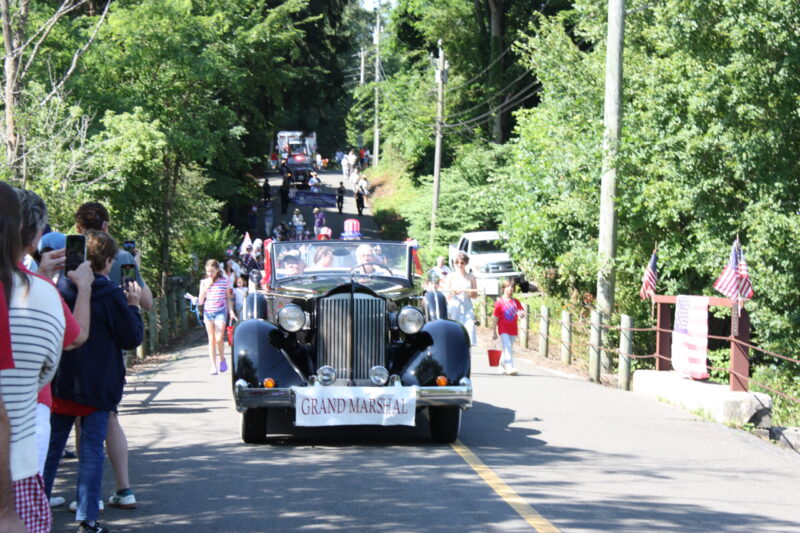
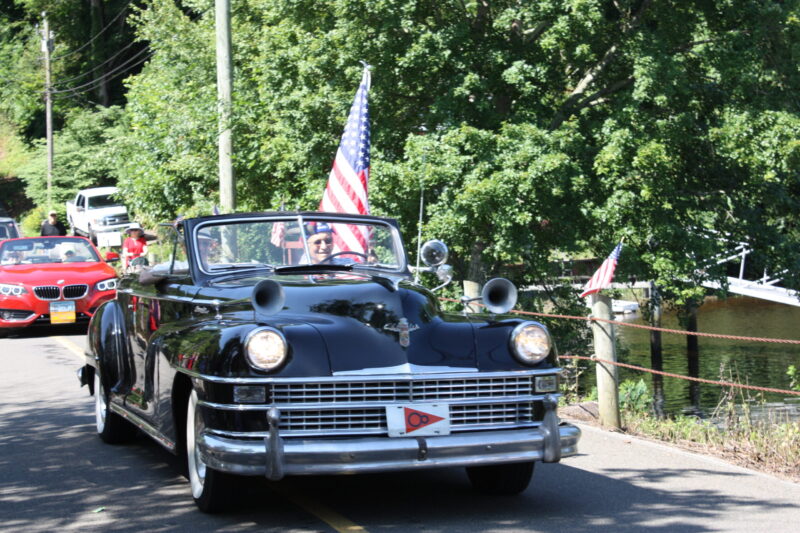
And so it begins again— the Grand Marshal’s car leads the Lyme Independence Day Parade down Cove Rd.
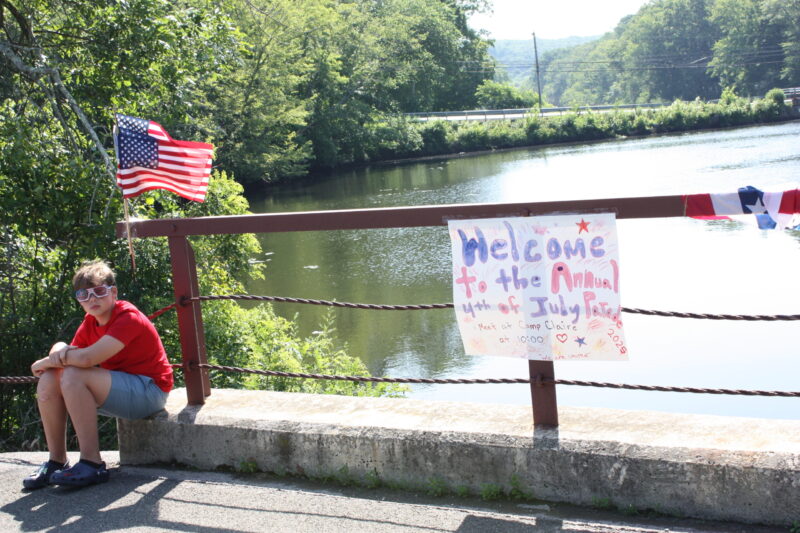
LYME—The parade that began over 60 years ago with a beloved doctor’s pot-and-pan band remains a short and timeless tradition.
There’s not much in the way of rules at Lyme’s Fourth of July Parade, and the clock is more of a suggestion than an absolute. You could even say time stops for this simple slice of Americana.
But nobody told that to Lyme Selectman John Kiker.
“We’re running five minutes late,” he said shortly before the scheduled 10 a.m. start.
The first vintage car set off not much later from the apex of Cove Road with Grand Marshal Bill Hawthorne in the seat of honor. Less than a quarter of an hour later, the final MINI truck cleared the Esther and Bill Irving Bridge below.
Trailing the MINI across the 10-foot span over the cove, Kiker had the answer for those wondering just how much time had elapsed.
“Twelve minutes,” he said.
Lyme First Selectman David Lahm put it this way: “Don’t blink.”
Parade founder Dr. William D. Irving was memorialized in his obituary 10 years ago for starting the tradition “on a whim” in 1958. He stepped down as grand marshal in 2008.
For a half century, Irving maintained the parade “starts promptly at about 11 a.m.”
This time around, the annual town wide celebration got underway promptly at about 10 a.m.
Grand Marshal Bill Hawthorne, 88, served as the town’s treasurer for 26 years and treasurer of the Lyme Fire Company for 15 years. The lifetime resident was a volunteer firefighter from the age of 16 until his 50s. George Willauer served as Hawthorne’s chauffeur.
The Hamburg Fair contingent of Lyme’s Fourth of July Parade prepares to toss candy into the crowds lining Cove Rd. and Rte. 156.
The Lyme Parks and Recreation group brought along candy for paradegoers.
Kids from Camp Claire have been a mainstay in the parade since Irving’s time. The beloved Old Saybrook pediatrician also served as the camp physician.
Campers could be heard singing along to songs like Miley Cyrus’ Party in the USA and chanting “USA” along the parade route.
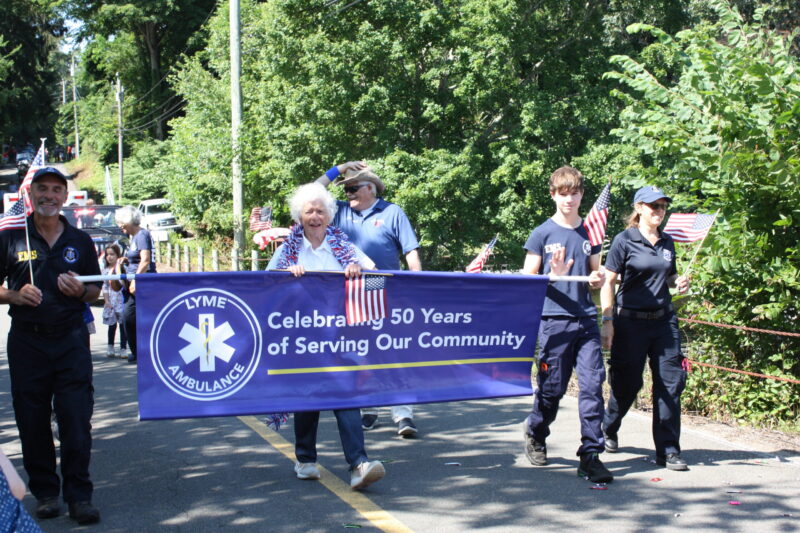
Lyme Ambulance filled out a heavy contingent of first responders as part of the town’s volunteer tradition.
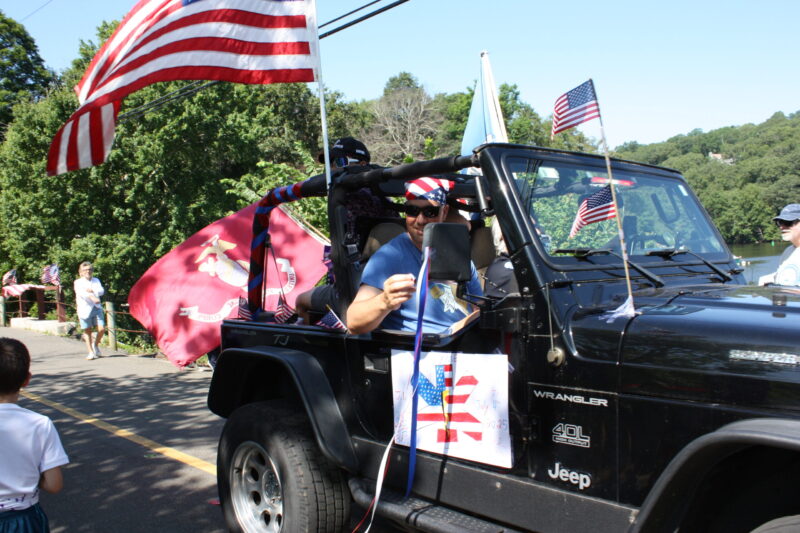
Ambulance volunteers from the back of this Jeep broadcast the message “Lyme Ambulance thanks you for your support” throughout the parade route.
Nancy Kalal, known for working with oxen at her Cranberry Meadow Farm in East Lyme, brought a livestock contingent to the parade. Kalal said it was the first time out in public for Red, a 400-lb, 4-month-old red Holstein in training to be an ox. “Red behaved admirably,” she said afterward in an email. “He seemed to enjoy all the attention, and still pull the cart on my commands.”
Members of Lyme Pollinator Pathway represented butterflies, bees and other pollinators at the parade.
While kids all along the parade route dove into the road for candy, adults looked forward to bulbs of fresh garlic that were handed out again this year.
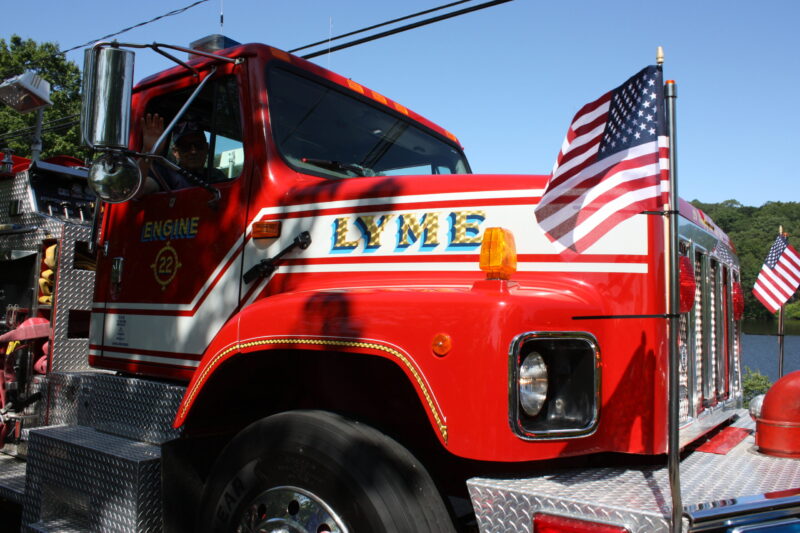
The Lyme Fire Department came out in force as a perpetual highlight in the community parade.
Enthusiastic honks and beeps reverberated across the cove as this vintage Chrysler brought up the rear of the parade.
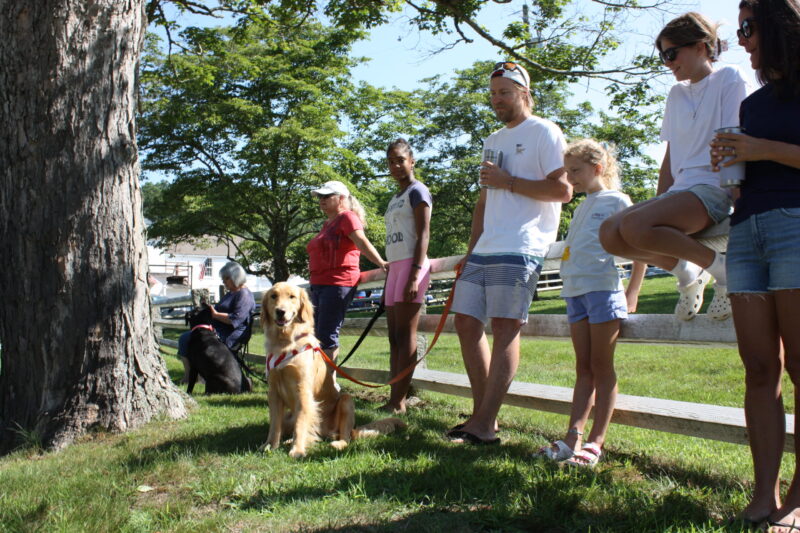
Paradegoers on the sunny morning included those of the four-legged variety.
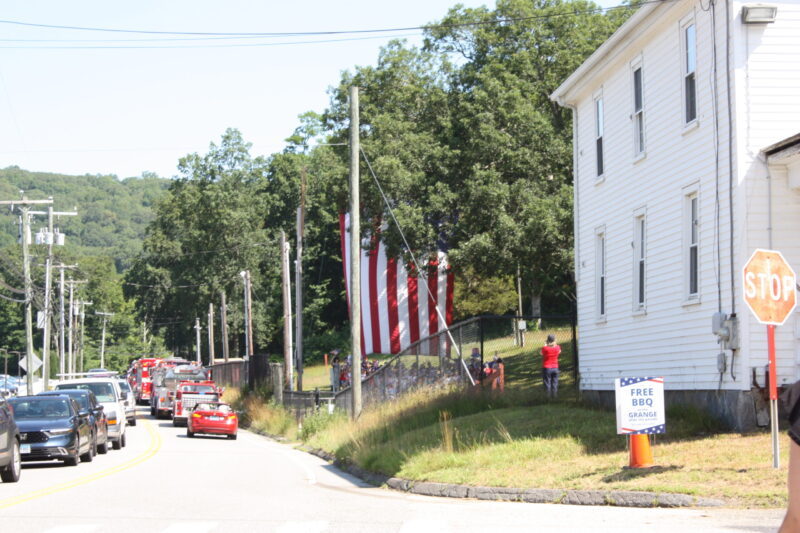
Fire apparatus prepared for the right turn into the Hamburg Fairgrounds as traffic resumed on Route 156, which was closed for the brief duration of the parade.
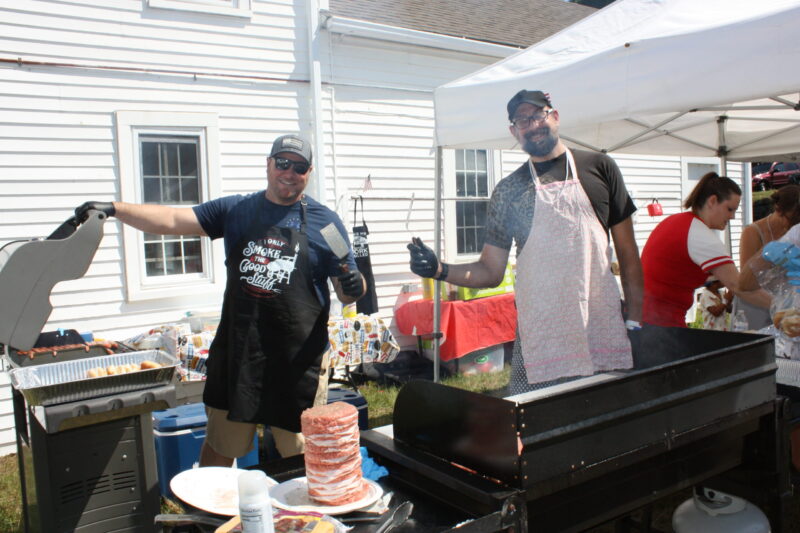
While Dr. Irving was known to hand out popsicles after the parade, members of the Lyme Recreation Commission laid out free hot dogs, hamburgers, chips and drinks at the Grange.
And that’s it until next year.
Editor’s Note: This article was updated with more information about Red, the ox-in-training.