

Talking Transportation: Travel Now, Talk or Text Later

Jim Cameron

How many of you remember “Car Talk”, the wildly popular NPR show with Tom and Ray Magliozzi, also known as “Click and Clack, the Tappet Brothers”? Not only were they brothers, but both graduated from MIT. They were walking encyclopedias of automotive wisdom. And common sense.

To them, car safety meant more than just mechanics. It meant drivers should be smart about their motoring. Their popular bumper sticker read “Drive Now, Talk Later”.

They meant talking on cellphones, of course. But to update their mantra you could add “Text Later.”

That’s actually the law in Connecticut: All drivers must use hands-free devices for phone calls, and it is illegal to text or use any hand-held mobile device while operating a motor vehicle. If you’re under age 18 you’re not allowed to use any cell phone, hands-free or otherwise, while driving.

Last year’s “Put the phone away or pay” campaign in East Hartford and Manchester saw 365 tickets issued in a single month while State Police tallied almost 600 citations in the same period. And we’re talking a $200 to $625 fine.

But I see it every day … people can’t put down their phones. I’m behind a guy at a red light. It changes to green and he doesn’t move, obviously checking his phone. A slight tap on the horn (after a very patient 10 seconds) and he finally takes off.

Are we all so addicted? I honestly wonder what parents with an SUV full of kids are thinking when they drive down busy streets juggling a latte in one hand and a cellphone in the other.

Once, when stuck in crawling traffic on I-95, I actually saw a guy reading a book. I’ve seen other drivers shaving or putting on make-up. Give me a break!

But I’d carry that message of attentive commuting to other travel environments as well, especially on the train.

Several years ago, while serving on the CT Rail Commuter Council, I tried to persuade Metro-North to establish “Quiet Cars” on their trains … cellphone free environments where riders seeking peace wouldn’t need to hear some self-centered hedge-fund dealer yelling at his trading desk in a voice that carries through the entire car.

“Hey. It’s me.” Who cares? “I’m on the train”. Yeah, I know. “Just thought I’d check in on that last trade.” I wish I could check out.

Years after Amtrak and other commuter rail systems adopted “Quiet Cars,” Metro-North finally agreed to give it a try in 2011. But they never enforced the rules and dropped the plan, using COVID as the excuse.

If we used to have smoking and non-smoking cars, why can’t we have “Quiet Cars” as well? The problems of annoying chatter persist. A ticket on the train buys you transportation, not the right to annoy your fellow passengers with a recitation of your woes.

A friend on Metro-North says she was seated next to a woman on the phone complaining to a friend about her day and a splitting headache. When she hung up my friend asked if she needed a Tylenol. Cell-lady gave her a “Hrumph” and accused her of eavesdropping.

What’s the proper etiquette for cellphone use on the train?

Try to make the call short and at a low speaking volume, and cup your hand around the mouthpiece. If a longer call is necessary, get out of your seat and talk in the vestibule. And to make sure that incoming calls don’t bother anyone, leave your phone on vibrate.

It’s just a matter of consideration of your fellow riders.

Editor’s Notes: i) Jim Cameron is the founder of the Commuter Action Group and advocates for Connecticut rail riders. He writes a weekly column called ‘Talking Transportation,’ which is published by a number of publications in the state.
ii) ”Talking Transportation” recently won first place in the general column/commentary category in the Connecticut Society of Professional Journalists Excellence in Journalism Contest.

Death Announced of Stephen Auguste Theodore Basil, 92, of Lyme; Known to SE CT Fishing Fleet as ‘Captain Bob’

LYME — Stephen Auguste Theodore Basil, known to the Southeast Connecticut fishing fleet as Captain Bob, died peacefully Thursday, Sept. 18, 2025 at his home in Lyme. He was 92 years old …

… he worked in sales for many years before moving to Connecticut to start his commercial charter fishing business. He built his wooden hull fishing boat, the Capt. Bob II, with Seth Persson in Old Saybrook …

The Captain is survived by his wife, Susan Roberts Basil; and his two daughters and son-in-law, Laurie Beth Roberts of Branford, and Kathi Roberts Constantinou and Anthony Constantinou of Lakewood Ranch, Fla.; and three grandchildren, Briana Constantinou and her fiance Adham Makki of Tampa, Fla.; Brooke Constantinou Lieberman and her husband Peter Lieberman Jr., of Tampa, Fla.; and Christopher Constantinou and his wife Teresa Tripodi Constantinou, of Lakewood Ranch, Fla.

Services will be private. The family asks that if so inclined, please make donations in memory of Mr. Stephen Basil to the Shoreline Soup Kitchens & Pantries, P.O.Box 804, Essex, CT 06426.

Editor’s Note: Visit this link to read the full obituary published by ‘The Day’ on Sep. 21, 2025.

Soccer Roundup: Lyme-Old Lyme Girls Notch Impressive Win

Lyme-Old Lyme High School girls soccer finished the week with a 9-1 win over North Branford.

On Thursday, Brooke Burgess, Hailey Suisman , and Reagan Christopher each scored two goals. Olivia Lovendale, Adrian Raby, and Emily Bonatti contributed a goal each. Avery Spooner notched an assist.

Goalkeeper Grace Osborne delivered four saves.

North Branford’s lone goal came from Kaydence Caporale. Goalkeeper Sofia Ludington finished with four saves.

The girls are now 3-3-2 overall and 3-3-0 in the Shoreline Conference. They next play Haddam-Killingworth High School at 4 p.m. on Friday in Old Lyme.

On Sept. 16, Old Saybrook High School bested Old Lyme 4-2.

On the Old Lyme side, the team’s two goals came from Anna Bussmann and Addy Morosky. Vivian Boller provided an assist. Grace Osborne made 12 saves.

For Old Saybrook, Nadia Roslonek delivered three goals and Jameli Jara scored one. One assist each came from Annalise Sarette and Carmen Vercillo. Emerson Cooke made a pair of saves.

Old Lyme Library Hosts Talk on “The Pirates of Penzance,’ Sept. 27

Salt Marsh Opera to present ‘Pirates,’ Oct. 17 & 19 in OS

James Kuslan.

OLD LYME— On Saturday, Sept. 27, from 11 a.m. to 12 p.m., James Kuslan will present a special talk titled, ‘The Pirates of Penzance: Flying the Flag of Fun‘ at the Old Lyme Phoebe Griffin Noyes Library. The talk will take place in the Community Room at the library, 2 Library Lane, Old Lyme, CT, 06371.

This talk is co-sponsored by TheGuild of Salt Marsh Opera, who will present The Pirates of Penzance at The Kate in Old Saybrook on Oct. 17 and 19.

The Gilbert and Sullivan operettas are unique in the Anglosphere for the often exalted music of Sullivan and the wit of Gilbert’s dialogue whose DNA indicates Restoration comedy paternity.

The Pirates of Penzance is not the most musically profound of the Savoy operettas. Neither is it Gilbert’s wittiest libretto.

What Pirates is is a masterpiece of a particularly English kind of silliness which sends up the conventions of grand opera while indulging itself in them at the same time.

All are welcome. The talk is free but registration is appreciated. Register to attend at this link.

‘Witness Stones Project’ Merges with Massachusetts-based Preservation Group

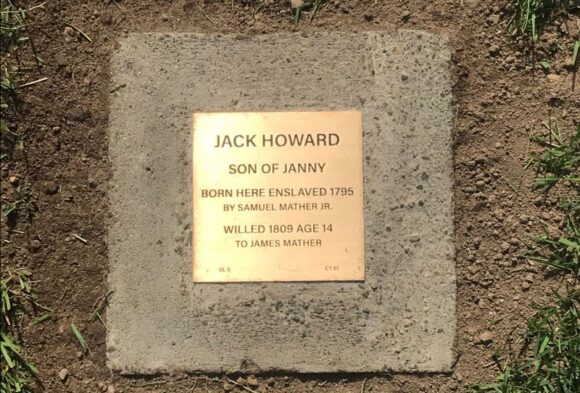
This Witness Stones plaque commemorating the life of the enslaved Jack Howard is located at 5 Lyme Street, the parsonage of the First Congregational Church of Old Lyme.

HAVERHILL, MA–Two organizations committed to recovering hidden histories, commemorating enslaved individuals and fostering a deeper understanding of the country’s complex past have joined forces. 

The Connecticut-based Witness Stones Project, which includes an active presence in Lyme and Old Lyme, has been absorbed by Historic New England, a preservation organization out of Massachusetts that goes back to 1910. 

The merger was announced Thursday in a press release from Historic New England. It brings the Witness Stones Project under the banner of Historic New England’s Stopping Stones initiative, which honors enslaved Americans through the installation of permanent markers and community ceremonies. 

Both the Witness Stones Project and Stopping Stones use small plaques in the ground to mark sites of enslavement – including 300 Witness Stones in seven states and more than 90 Stopping Stones from Vermont to Texas – but only the Witness Stones program incorporates a robust educational component. 

The Witness Stones Project in a website announcement said former Witness Stones Director of Operations Liz Lightfoot, of Lyme, will take on the role of Stopping Stones school and youth program manager. She will continue to use Witness Stone’s trademarked curriculum to help students explore historical records and to tell the stories of forgotten individuals, the group said. 

The Witness Stones announcement said schools, churches, and community organizations involved locally can rest assured their work is being preserved and will serve as a foundational part of the expanded effort. 

“And for the communities where we are currently working and will work in the future, the important research, education, and installations will proceed with the full backing of Historic New England’s resources,” the group said.

The Witness Stones Project was founded in 2017 by Dennis Culliton of Guilford. Stopping Stones, which is part of Historic New England’s Engagement Arts Fund, began in 2020 under the leadership of Paul Growald. 

Growald said joining with the Witness Stones Project enables his group to add a “powerful educational dimension” to the physical markers. 

“I have long envisioned curriculum components that accompany our memorials, inviting participants of all ages into this work,” he said. “This partnership fulfills that vision, aligning remembrance with education and community dialogue in a way that can truly transform how America reckons with its history.”

The expanded Stopping Stones team is led by director Pat Wilson Pheanious, a ninth-generation descendant of enslaved individuals in Guilford whose family history was among the first researched by the Witness Stones Project eight years ago. She is the founding chairman and a former executive director of the Witness Stones Project. 

“Embracing the past is vital to shaping America’s future,” Pheanious said in the Historic New England release. “This collaboration ensures that the work of these programs will remain strong, protected, and accessible to communities everywhere.” 

Historic New England CEO Vin Cipolla said the new collaboration will allow both groups to expand their reach nationwide by pairing memorial installations with classroom learning and community dialogue. 

“By uniting the Witness Stones curriculum with the national reach of the Stopping Stones program, we can ensure that the lives and legacies of enslaved people are recognized, remembered, and taught to future generations,” he said. 

Both initiatives are inspired by Germany’s Stolpersteine Project, which commemorates Holocaust victims with “micro-monuments” placed in public spaces. 

The merged groups will operate as part of Historic New England’s Recovering New England Voices (RNEV) initiative. RNEV supports research, storytelling, and public engagement to elevate underrepresented histories, including those of Indigenous people, women, immigrants, LGBTQ communities, and enslaved individuals. 

The public is invited to join the conversation at the Historic New England Summit, Nov.13–14. 

More information on the transition is available on the Witness Stones and Stopping Stones websites.