Eleanor Frey Counselman of Lexington, MA and Old Lyme, CT formerly of Belmont, MA died September 4, 2025.
Born in Oakland, CA on January 6, 1946 Eleanor was the daughter of Boyd Gallatin Frey and Eleanor Marie (Horning) Frey. Raised in Baltimore, MD, Eleanor attended the Bryn Mawr School. She received a BA in Psychology from Wellesley College and an Ed.D. from Boston University.
Eleanor was a practicing Psychologist until her retirement in 2023. She was an Assistant Professor of Psychiatry at Harvard Medical School where she worked with Third Year Residents to help find Work/Life balance through therapy. She was named a Distinguished Fellow by the American Group Psychotherapy Association.
Eleanor spent her life helping people through her work and her countless volunteer positions, both personal and professional. Eleanor was President of the Northeastern Society for Group Psychotherapy, President of the American Group Psychotherapy Association, President of the Boston Institute for Psychotherapy, a Town Meeting Member for the Town of Belmont, served on the Board of Belmont Day School, taught Sunday School, served on the Church Vestry, and still somehow found time to cook dinner every night and bake hundreds of cookies for Christmas. After her retirement and relocation to Lexington she dove head first into volunteerism at Brookhaven, joined the Social Committee and was nominated as Secretary of the Board.
Eleanor is survived by her husband of 59 years, Charles C Counselman III. They met in 1959 at Mrs Farber’s Dancing School in Baltimore and reconnected as undergraduates at Wellesley and MIT. Their fathers were classmates at Johns Hopkins University.
She is also survived by her daughter Catherine Catucci and husband Ryan of Old Lyme, CT, her son Charlie Counselman and wife Linh Pham of Morrisville, NC, her beloved Grandchildren Jameson and Olivia Catucci of Old Lyme, CT, and her sister Mikal Frey of Sarasota, FL.
Eleanor also leaves behind her Sister in Law Susan Healy and husband Tom of Richmond, VA, Brother in Law Skip Counselman and wife Margie of Cockeysville, MD, and Sister in Law Cathy Kelly and husband Charlie of Sewickley, PA , cousin Leslie Vestrich and husband Mark of San Francisco, CA as well as many nieces and nephews she adored.
Eleanor was a connector and loved to bring people together. She stayed in touch with lifelong friends including her Wellesley College Suitemates, The Caz Group who held a bi-monthly Zoom. She hosted a Christmas Tea every December and invited women from all aspects of her life; she had a way of making everyone feel welcome. Eleanor loved to hike, travel, cook, quilt, and read. She was an avid runner until her 60s. Of all the roles in her life Eleanor was most suited for being Grammie. She made the best pancakes, shared childhood stories and never minded when she woke up with a child or two in her bed.
NIANTIC — Surrounded by family, Norman B. Peck Jr. of Niantic passed away peacefully on Wednesday September 17th at the age of 96 at the Lawrence and Memorial Hospital. Born in New London, CT on May 1, 1929 to Norman and Esther Peck, Norm married Ann (Bonafede) Peck on August 11, 1951. They shared a full life together for nearly seventy years.
Norman was predeceased by his mother and father, his sister Anne Calkins and his wife Ann B. Peck. He is survived by his brother Thomas O. Peck and his three children: son Norman B. Peck III, wife Patricia Avery and their children Tyler Engleberg, Hayley (Adam) McCaffery and great-granddaughter Miller; son David A. Peck, wife Nina and their children Sarah (Harper) Williams, LCDR Charlie (Danielle) Peck and Dave Peck; and a daughter Diane P. Rothman, husband Peter and their children Matthew and Nicholas Rothman.
A 1947 graduate of The Bulkeley School in New London, Norm attended his 78th class reunion only 12 days before his death. This was also slated to be the last reunion for this beloved local school.
Norm was actively involved in civic affairs. He was the past president of the East Lyme Historical Society for 27 years, devoting that time to the preservation of the Thomas Lee House. He was past chairman of the East Lyme Planning Board, VP of the Chamber of Commerce of Southeastern CT, a lifelong member of the Niantic Fire Department, a member of the East Lyme Charter Revision Committee, instrumental in the formation of the Southeastern CT Council of Government, and a member of the East Lyme Library Association. As a history buff with particular interest in the Civil War, he was a member of the Connecticut 5th Infantry, a re-enactment group, where he attended both the 125th and 135th anniversary of the Battle of Gettysburg. Norm served in the U.S. Naval Reserve.
After a sixty-four-year career with Smith Insurance, Norm retired on his 89th birthday on May 1, 2018. He served as a President and owner of Smith, previously one of the largest independently owned agencies in Connecticut. Customer care and employee concern were always his focus.
Norm was passionate about his hobbies. He was a past Commodore of the Niantic Bay Yacht Club with extensive involvement in the development and growth of the Club throughout his life. He skippered his Atlantic Class sailboat to 16 national titles from 1973 until securing his last one at the age of 81. He was a member of the Off Soundings Club and won several Club events with his family aboard his Morgan 36T, the Spirit. Norm inspired his children to sail and ski. The family would race boats together until he was nearly 90 years old. At the age of 35, encouraged by his sister, Norm became an avid skier and continued skiing with his family and friends until age 85, primarily at Magic Mountain, Vermont, where his extended family spent many happy winter weekends at the family ski house. His love of sailing and skiing bridged the generations, providing endless enjoyment and cherished memories for himself, children and grandchildren. He will be missed.
A funeral service will be held at 10:45 a.m. Saturday, September 27th, at St. Ann’s Episcopal Church in Old Lyme. Interment will follow at Union Cemetery in Niantic. There are no calling hours. A special thank you to Norm’s medical doctors, particularly Dr. Constantine Manthous for his outstanding care and counsel during the final years. In lieu of flowers, a donation can be made in memory of Norman and Ann Peck, payable to: East Lyme Scholarship Association, P.O. Box 190, Niantic, CT 06357.
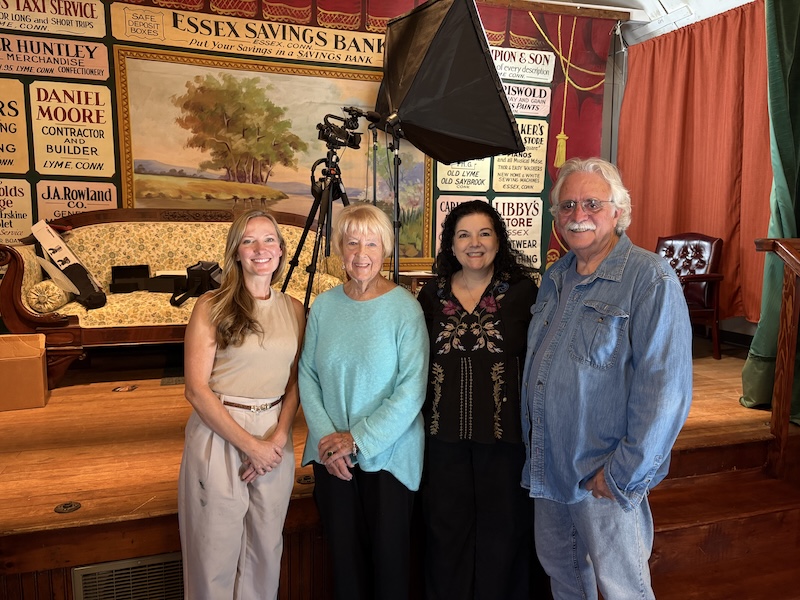
Standing together in the Old Lyme Historical Society’s building on Lyme Street are Oral History Project Chair and film editor Jaymie Nickerson-Buckmaster, Joan Childs Clarke, Michaelle Pearson (interviewer), and James Meehan (camera and sound.) Photo by Beth Stewart.
OLD LYME—On Saturday, Sept. 20, the Old Lyme Historical Society (OLHS) interviewed Joan Childs Clarke to kick off their 2025-26 Oral History Project.
The Old Lyme Historical Society undertakes oral histories to preserve the voices and memories of people whose experiences bring the past to life. These first-hand accounts capture details of everyday life, community traditions, and significant events that may not appear in written records.
By recording and sharing personal stories, the OLHS help ensure that future generations can connect with and learn from the lived experiences of those who came before.
“Life starts all over again when it gets crisp in the fall.” – F. Scott Fitzgerald, The Great Gatsby
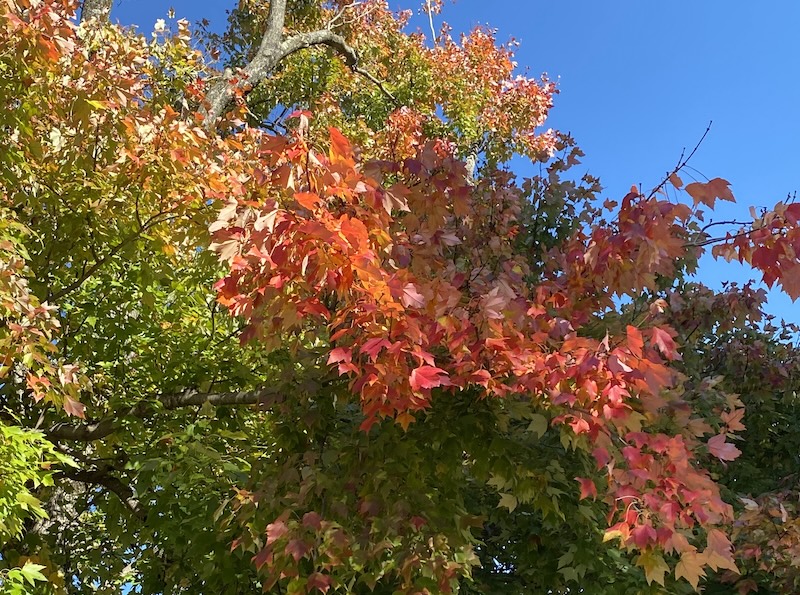
The colors of fall will soon be all around us. LymeLine photo.
Rain through August has been rather sparse. That said, our gardens need rain.
In the meantime, if you are planting evergreens this month; September is the best time to plant evergreens in our zone. Evergreens planted now can begin to establish strong roots before winter and it is important to give the new evergreens a good amount of water. I suggest you make a hole in the soil with an iron stake or other piercing instrument, then feed the hose into the hole and allow water to reach the roots slowly for at least a half hour and continue with this method a few times a week until the ground freezes in November.
Cover the earth around the plants with a light layer of composted manure and mulch. Do not apply mulch right up to the trunks of the plants as this encourages rodents to gnaw on the bark of the plants.
Hydrangeas
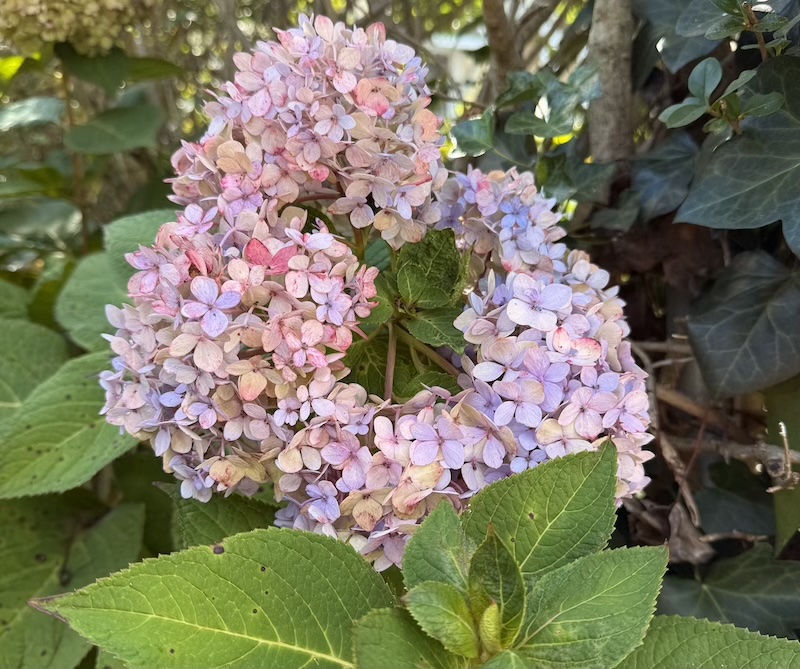
Hydrangeas do not appreciate being transplanted. LymeLine photo.
I am often asked questions regarding the pruning of hydrangeas, with fellow gardeners asking, “Maureen, why did my Hydrangeas not bloom this year”? The reason that hydrangeas do not bloom is that gardeners prune them at the wrong time. If you feel that your Hydrangea macrophylla has become too large and require pruning, prune them by mid-September.
The reason is that hydrangeas set their buds for next season by late September; pruning any later will cut off those buds, which will negate any chance of bloom for next season or even the following season.
How to accomplish pruning successfully: This month, prune any old woody stems that have not bloomed well and any weak new shoots. After pruning, apply a few inches of composted manure, and some peat, followed by a top dressing of natural brown bark mulch. Peat aids acidity in the soil, which is necessary as Hydrangeas may become chlorotic if the soil is too alkaline. Chlorotic means abnormal reduction or loss of normal green coloration of the leaves of the plants.
Another important note on this plant is that hydrangeas do not like to be transplanted; transplanting them can result in little to no bloom for many seasons. For that reason, I suggest when planting new hydrangeas, make sure they are at least five feet apart, so they have room to grow, receive adequate ventilation and will therefore never need to be transplanted.
Take a Break to Contemplate
This fall, as you contemplate your landscape, think about the past season and what worked for you in your garden and what you will never try again.
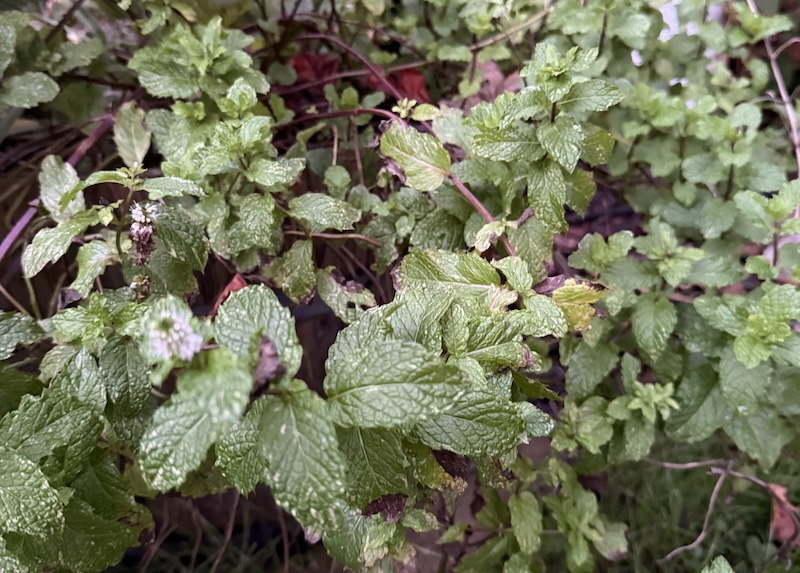
One thing I will never forget is that mint took over the border beneath my Franklinia tree. Many years ago, my friend Roz, was kindly lending a hand in the garden and planted mint in the garden instead of a large container that I placed for that very purpose.
Mint grows vigorously wherever it is planted. It is always best to control its growth by planting it in a container. LymeLine photo.
I was busy with other garden chores, so by the time I noticed the error six months later, the mint was running rampant among the blue myrtle edging the borders. So, folks please take note that mint is extremely invasive and should only be planted in containers where its wayward habits can be controlled.
‘It is said that ‘a gardener’s work is never done’, but now with the season’s hard labor behind you, take a break. Sit outside and inhale the late garden fragrances and allow Mother Nature to anchor and relax you.
In the early morning, I enjoy sitting on my patio near the herb garden, inhaling the fragrance of the sage, which I will snip later to take indoors for drying and use in my recipes. I will also gather extra sage and lavender, which I will tie with string into small bunches to hang in my closets, which is a natural moth repellent. Some of the Lavender bunches I tuck into my drawers to keep moths from devouring my woolen garments, this works well as insects do not like fragrance.
In the less hectic pace of fall, early autumn is the time to re-think your gardens. The garden’s pre-winter grooming will wait for a few weeks. You may feel that you would like to have professional design as you have noticed that your borders are not up to your expectations.
If that is so, then contact someone that you trust to create a plan in the fall and winter, which can be phased in beginning next spring. Engage someone who will listen to your thoughts and stay within your budget. That being said, I respectfully offer a suggestion for a plantsman, whose company and website is LandscapesByIan.com. In the interests of full transparency, he is my son and I am confident you would enjoy speaking with him.
In your vegetable garden, sow spinach for spring harvest and sow a cover crop like winter rye, which can be dug in next spring together with composted manure as green manure. Green manure produces a rich growing environment for next year’s vegetables.
Now is the time to get your fall compost pile cooking with the last of the grass clippings, spent perennials, leaves and small woody twigs.
Perennials
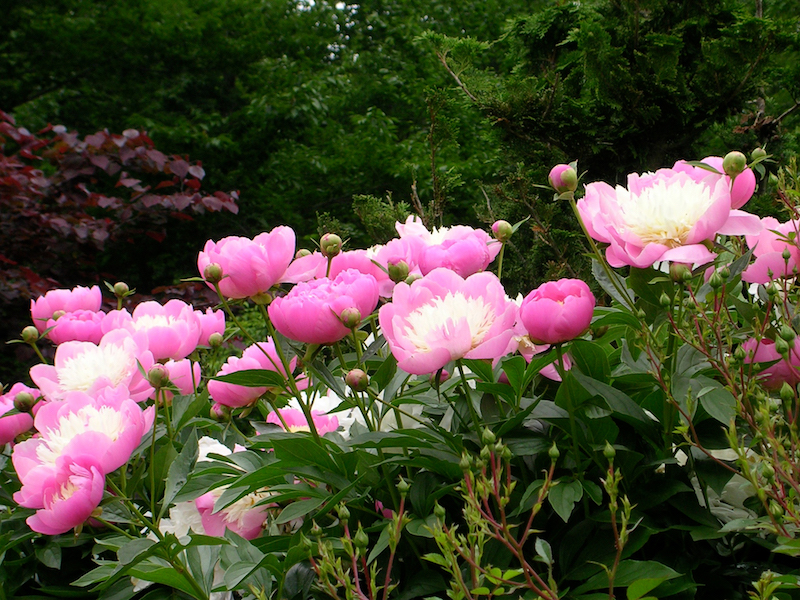
Peonies need careful attention to create a stunning display like this. September is the month to plant and transplant them.
Also in September, dig up, divide and replant overgrown perennials. Follow this method every three to four years to ensure vibrant bloom from these plants. Never plant or transplant any division or transplant any deeper in the soil than it is now or any deeper than the plant sits in the pot.
September is the month to plant and transplant peonies. Do not plant them deeply or they will not bloom, that means having just enough soil to hold them erect with the ‘pink eyes’ on the roots barely covered. Plant them with a light application of composted manure around the plant. Then in November, following the first hard frost cut down the peony foliage to about four inches from the ground.
Fall’s brilliant autumn finery is the last hurrah, before winter sets in. LymeLine photo.
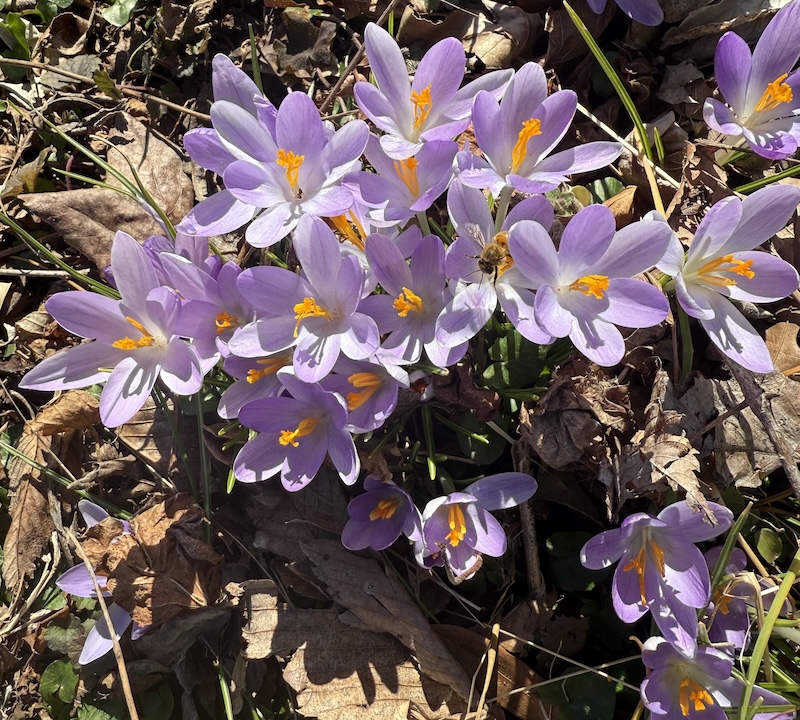
In a few weeks, the bright vibrancy of autumn color will appear on the maples. Fall’s brilliant autumn finery is the last hurrah, before winter sets in. Climbing up the red milk shed near the barn, the buds on the autumn clematis are beginning to unfurl and in the herb garden, autumn crocus, asters and sedum will take their curtain calls.
For your soil to remain healthy, add a light layer of composted manure to all the borders now or in early October, together with a two-inch layer of fine bark mulch around to all newly planted and transplanted perennials and shrubs. With the application of the manure and mulch you are continuing to build the humus component, which will ensure a rich growing environment for spring and protect the plants from winter’s harsh conditions.
I do not cut down my spent perennials but leave them up for the birds; the ripened seed heads are a delicious treat for them to peck at. Following the vibrancy of summer bloom, I enjoy the softer subtle colors of gray, brown and yellow of spent perennials and ornamental grasses blending naturally with the muted winter landscape, which to me offers a resting of the senses.
Early to mid October is a great time to be planting. The benefits of fall planting for trees, shrubs and perennials gives them a head start with root development over those planted in the spring. This is especially so when we experience late spring when planting cannot begin until late April. In New England’s fall, the cooler temperatures and still warm soil encourage the plants to direct their energy into producing strong roots.
The following trees are not good candidates for fall planting: birches, larches, gingko, oaks, magnolia, and all flowering fruit and flowering trees as well as the Eastern red cedar. These trees have fleshy roots, and their feeder roots are not large when young and take time to establish and are susceptible to frost heave.
Some perennials that do not like to be planted in fall are Artemisia, Lambs Ears, Foxglove, Penstemon, Anemone, Campanula, Kniphofia, Lupines, Scabiosa, ferns and grasses.
Plant garlic this month for harvest next June. Garlic is the antibiotic of the garden. Plant it under fruit trees to avoid scab and root disease, near to ponds or standing water to control mosquito larvae or pour garlic water into ponds, bird baths and fountains to deter adult mosquitoes.
End-of-Season Bargains
This is a good time to pick up end of season plant bargains. Most nurseries and garden centers have lowered their prices, so they do not have to winter plants over in the nursery. If you do purchase a few plants, keep your eyes open for the following problems:
Potbound pots
Check the bottom of the pot to see if the roots are growing through the holes. If not, gently tap the plant out of the container to see if it has a network of overlapping roots that wrap around the root ball. It is possible to salvage a root-bound plant, which is suffering from water and nutrient deficiencies over the summer, but it will be slow to root.
Before you plant this one in your garden, cut the encircling roots – the roots will now be shorter but will take root easier.
Diseased Plants
Plants that have been in containers all summer and have been fed high nitrogen fertilizers are easy targets for pests and diseases. Check for spots on the foliage, wilted or curling leaves and discolored roots. As well as visible signs of pest damage and infestation such as webbing or sticky residue on foliage. Not only would these plants do poorly in the garden but could infect your other plants and the soil. Soil-borne diseases are the most difficult to deal with.
Badly shaped plants
Badly shaped plants are the Charlie Brown Christmas trees of the plant world, the unwanted orphans that have been passed over year after year; these are the runts of the litter! Do not set yourself up for disappointment looking at an ugly tree or shrub just to save a few dollars.
Mislabeled plants
At the end of the season many plant tags have been lost or mixed up, which means you are likely to get a perennial with flowers that are not the color you expected. Or you may buy a deciduous tree or shrub when you are looking for an evergreen variety. Stick to the plants that are part of large displays of identically labeled plants or with labels so firmly attached that look like they have been there for a while.
With all the above-mentioned plants – always add composted manure around the plant and do not plant any deeper than it is in its pot or burlap wrapping. Always wear gloves when working with manure; there is bacteria in the manure – great for the soil but not healthy for you.
Please note that the bargain you get is often not worth the discount price.
New Lawn or Patch Seeding
September is an excellent time to plant new grass so the young grass plants will have the advantage over weeds. Do not buy cheap seed, you reap what you sow!
Gently de-thatch the areas that you wish to overseed or patch. Do not use the large thatching machines, which can damage existing grass. Add some composted manure to the area, broadcast the seed and cover the newly seeded grass area with salt hay (free from weed seed). Do not allow the soil surface to dry out; keep it moist. Water gently, and do not saturate the area or the seed will wash away.
When the grass appears, stay off it. Do not mow and leave the salt hay to rot. Next spring, a healthy lawn will emerge and if there are a few bare patches in April, you can fill in the bare spots.
In terms of bulb planning, The English Lady recommends, “Go for masses of a single color for the greatest impact.”
I hope your spring bulb orders are in by now. Be adventurous this year and go for masses of a single color for the greatest impact. No matter how small your planting area, it is the intensity that counts, with two or three dozen red tulips or a hundred daffodils planted on your woodland edge.
Buying daffodils in large numbers is less expensive. The bulbs are usually smaller, but this is not a problem as daffodil bulbs grow larger each year. Even though many say the spacing between these larger bulbs should be six inches, there is no reason they cannot touch.
Put some composted manure or bulb food on the soil where the bulbs are planted. Make sure you plant the daffodils eight inches below the frost line, with the pointed end up. Wear gloves when you plant bulbs as they have a skin irritant, which may cause a rash.
If you cannot plant your bulbs when you receive them, store them in a cool, dry place in paper bags. The best time to plant spring bulbs in the Northeast is the end of October to the middle of November.
Lily of the Valley can be transplanted this month but wear gloves because there is toxicity in this plant.
Dig up your gladioli corms, calla bulbs, elephant ear bulbs and dahlia tubers when the foliage turns yellow. Lay them in the sun to “cure” and store them in a cool, dry dark place. When you dig the dahlia tubers, do not pull them, as pulling can break the tubers.
In September after their summer sojourn outdoors, take your houseplants indoors and wash the foliage gently and repot with new potting soil into a clean container. Repot those plants that have outgrown their pots to a clean container that is only one size larger.
Fall and early winter is a great time to do stonework – dry laid paths, walls and patios. As well as repairing fences, arbors and pergolas and building decks. Paint wooden outdoor furniture with eco conscious paint before putting them undercover for winter.
September is a gardener’s paradise; the air is cooler, the soil easy to work and you will not overheat with the effort. Stay awhile in your garden; enjoy the comforting fragrance of fall.
About the author: Maureen Haseley-Jones is a member of a family of renowned horticultural artisans, whose landscaping heritage dates back to the 17th century. She is one of the founders, together with her son Ian, of The English Lady Landscape and Home Company. Maureen and Ian are landscape designers and garden experts who believe that everyone deserves to live in an eco-conscious environment and enjoy the pleasure that it brings. Maureen learned her design skills from both her mother and grandmother, and honed her horticultural and construction skills while working in the family nursery and landscape business in the U.K. Her formal horticultural training was undertaken at the Royal Botanic Gardens at Kew in Surrey.
“He has created a land and characters that instantly feel familiar.“
Like Faulkner, I was raised at the knee of a storyteller and read everything in every conceivable accent to my children. Some of us were more often amused (me) than others (them) but, I wouldn’t hesitate to do it again.
Nothing. Absolutely nothing beats a story. A tale. A yarn. A ballad … so I was, naturally, very excited about this one.
Any storyteller knows a tale about an island is a boon. The islands of northern Great Britain especially are remote and historically, literarily magical; a perfect step into The Ballad of Innes of Skara Skaill.
Skara Skaill is an island, fictional, off the coast of Scotland. It should feel barren and cold and unwelcoming.
It doesn’t.
This is Hunt’s talent, I think. He has created a land and characters that instantly feel familiar. Likable, as maybe vestiges of classic literature or amalgamations of people we relate to; his characters are tangible.
Obviously his work as a screenwriter comes into play (puns away) but not uncomfortably so. It’s more an auditory or visual hint that stands quietly off to the side. It stands just so as a lovely book and we aren’t just flipping through a script waiting for Colin Farrell to step in on screen.
The setting and the characters are so organic it just flows. The smoke and fog and moss; It’s so quintessentially Scottish island moor yet not brow-beatenly gratuitous. It feels fresh, which is a feat.
It’s also fun.
The four main characters—Hamish, Innes, Rory and Tito—find each other in a plot to unearth and profit from the treasure mentioned in the legend of Skara Skaill. No ordinary ballad this. King Harald mentions a hoard and a hoard there be. It isn’t an ethically ambiguous plot. Each of the four is a good person with well-intentioned desires.
The bad guys are the opposite.
Like any ballad worth its salt; there are solid moral boundaries.
With a mix of Robert Louis Stevenson meets a tamer Trainspotting (in a good way), the truth outs and I was hooked. The cast of minor characters is also excellent. Hermits, barmaids, conniving mules—Hunt paints a brilliant portrait.
Hunt has taken many familiar parts of literature and made something new. I was so comfortable to be on Skara Skaill. I was so happy to be with these people. It felt so natural and unrestrained that I mention it only because I’m suddenly aware of how rarely, as a reader, I do feel that way. I’d simply never noticed.
This does not feel like a first novel.
If I had to guess, Faulkner has been writing it in his head for years.
Lucky us that he put pen to paper.
Jennifer Petty Hilger
About the author: Jen Petty Hilger grew up in New York and London, England, but finds herself happily quiet living by the water in Old Lyme.
She and her husband have six children between them and a myriad of rescued animals.