OLD LYME – Linda Joyce (McElroy) Savago (Lola), formerly of Mystic and Old Lyme, passed away at home with her family in Omaha, NE, on August 23, 2025, at 82. She had shown remarkable strength throughout her year-long fight with cancer, and she maintained her sense of humor, kindness, and compassion right to the end.
Born in New London, CT, to Dorothy Mae Partelow of Hope Valley, RI, and Irving “Patrick” McElroy of Exeter, RI, Linda spent her childhood on Groton’s “town farm,” an almshouse that cared for the town’s poor until it closed in 1952 …
Linda was preceded in death by three husbands-Ronnie Lagrua, Gerald T. Lawlor, and Samuel Savago; two sons-Gerald T. Lawlor III and Brian Patrick Lawlor; and her brothers Wayne and Patrick.
She is survived by her son Andrew Lawlor of Omaha, Nebraska; two nieces … five grandchildren … and four great grandchildren …
A private Celebration of Life will be held later in Omaha.
Freakier Friday is a sequel worth the 22-year delay. Everyone is back and the comedy of errors is as unpredictable as the original.
I planned this review with low expectations. I’ve always said sequels are generally not well-received (especially when they’re released decades after the original). No mass marketing campaign can atone for the desperation to catch lightning in a bottle.
I only saw the original Freaky Friday once when it was released in 2003. I knew if I wanted to give this a proper review, I should refresh my memory by watching it again.
To my surprise, I enjoyed it. This gave me hope because I watched it as an adult with critical thinking skills, not nostalgia goggles. I even read that Mary Rodgers, the author of the original 1972 novel, hailed it as the best adaptation because of its authenticity.
The storyline is not original, it’s a body-swap movie.
But this sequel turns it up a notch. Anna (Lindsay Lohan) prepares to marry Eric (Manny Jacinto), but her teenage daughter, Harper, and her soon-to-be worldly stepsister, Lily, struggle to accept each other. Not only has this tension caused Anna and Tess to experience a second body-swap, but it now includes Harper and Lily.
A double-body-swap with double the chaos. They’ll all find that just because it’s the second time around doesn’t mean it can be solved any easier.
It’s the 2003 movie on steroids.
Like any sequel (especially ones that are long delayed) there are Easter Eggs that not only pay tribute to the first movie but go beyond the original material. The wedding is scheduled for October 3rd (a nod to another Lohan movie, Mean Girls.)
And we can also appreciate all the generational jokes in between both movies.
Disney clearly meant business with Freakier Friday, bringing back most characters for the sequel. This includes those who seldom act nowadays, such as Ryan Malgarini (Anna’s little brother, Harry). There are Anna’s friends, Maddie and Peg from their band Pink Slip; and even Anna’s love interest, Jake (still rocking the same hair 20 years later).
My favorite reprisal was the spiteful Mr. Bates (played by legendary character actor Stephen Tobolowsky), still working since the school district’s retirement was sunk in crypto.
All the performances are superb. We loved Jamie Lee Curtis’ performance as a teenager back in 2003, but she takes it even further in her second round as a wannabe social media influencer.
I particularly loved Manny Jacinto’s performance as the thoughtful and well-spoken Eric, contrasting with his role as Jason, the idiotic Florida-Man on The Good Place.
But above all, I was happiest with Lindsay Lohan’s return as Anna. She stepped away from the spotlight for her well-being, and it appears to have worked. Watching this movie, you would think she never stopped acting. This was clearly made for her comeback. Disney knew that she still has a lot to offer. Why else would they go to great lengths to bring back almost every cast member of the original?
Maybe this is a new starting point for Lohan to get back to her craft without the scrutiny of the paparazzi? If the original Freaky Friday is a family classic, then Freakier Friday belongs there, too.
It continues the spirit of authenticity and lessons about family and love. With a theatrical-only release, it’s a perfect family outing that reminds us of one of the best ways to connect with youth is to share the stories that shaped us.
This warm, heartfelt, and funny sequel is worth checking out.
About the Author: Having lived in Old Lyme and Lyme since the age of three, Kevin Ganey has always had a passion for movies that is beyond simply watching, but understanding the craft of cinema and and experiencing films as if they were a musical album. Kevin also has his own website devoted to movie analysis, CityOfCinema.com, and also co-hosts a podcast, Moviehouse Mystics, with Koda Uhl (available on Apple Podcasts, Spotify, and YouTube.)
Editor’s Note: Linda Ahnert wrote this article for LymeLine back in 2008. As summer draws to close, we decided to republish it today to celebrate the anniversary of a very memorable event at which both Linda and I were present. Much has changed since that day—the Inn is no longer an Inn, several of the people mentioned in Linda’s story have sadly passed away (read Linda’s epilogue at the end of the article for more on that), but the game of boules—or pétanque depending on which part of France you come from—goes on and is still enthusiastically played in many locales in Connecticut. If you are not familiar with the game, Linda explains all.
The former Bee and Thistle was still in business as an Inn back in August 2008 when the boules extravaganza described in this article took place.
On Sunday, August 24, the 2008 Summer Olympic Games in Beijing ended.
On that same day, another sports competition took place in Old Lyme. Like the closing ceremonies in China, the event here went on for hours and there was much celebrating. But unlike the Olympian feats, the local contest had nothing to do with speed or strength. Or even with athletic prowess.
The opposing teams gathered, courtside, behind the Bee and Thistle Inn, to play a challenge match of boules. (For the correct pronunciation, think of the Yale fight song “Boola, boola”—just drop the “a” and—voilà—you have “bool.”) This outdoor sport is popular throughout France where it is played in city parks or in village squares. In the south of France, it is called pétanque (pronounced “pay-TONK.”)
It is similar to Italian bocce, although bocce is more of a bowling game and pétanque involves more tossing, like horseshoes. On this late summer afternoon, players from the Bee (l’Abeille in French) were competing against the Boules des dimanches (Sunday boules) team.
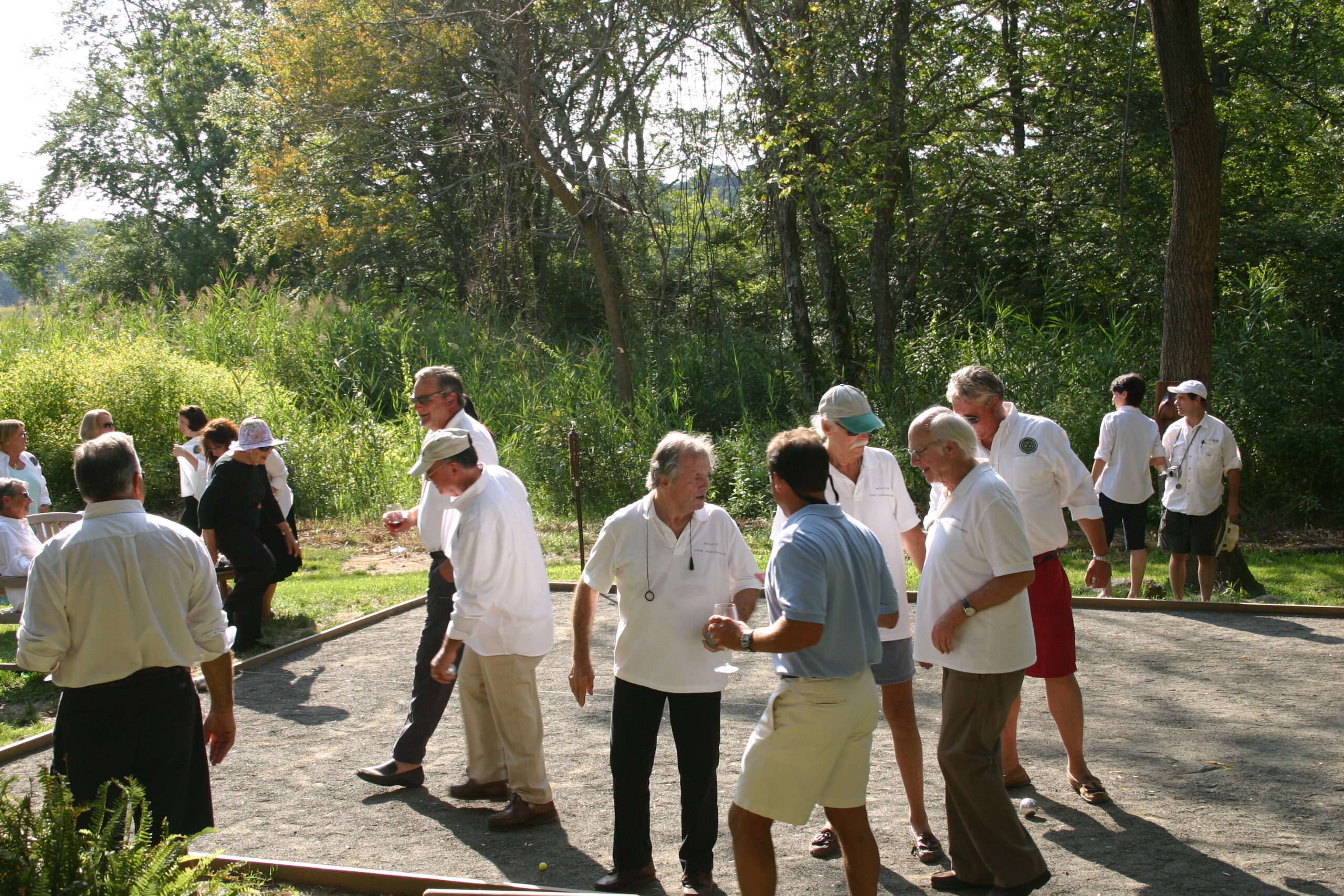
Jacques Pépin (center facing camera, in white shirt) discusses a vital game decision with other team members.
By issuing the challenge, the “Bees” were playing in the big leagues because their opponents were no mere Sunday players. In fact, the visiting team included some Frenchmen who grew up playing pétanque. One of them is Jacques Pépin, who lives just down the shoreline in Madison. The superstar chef and cookbook author is also a pétanque player par excellence.
Another member on Pépin’s team was food writer Lee White, an Old Lyme resident (and LymeLine contributor.) She and her husband Doug first played boules at Pépin’s house and became members of the group, which gets together on Sundays throughout the summer. Lee said there are about 30 players in the league and that “it’s a lot of fun playing and getting to know each other.”
The team’s roster also includes other gastronomic all-stars. There’s Priscilla Martel and Charles van Over, formerly of the Restaurant du Village in Chester, and the restaurant’s current owner/chefs, Cynthia and Michel Keller; Jean Pierre Vuillermet, owner/chef of the Union League Café in New Haven and its general manager, Jean Michel Gammariello; and Claude Martin, former owner/chef of Métro Bis in Simsbury.
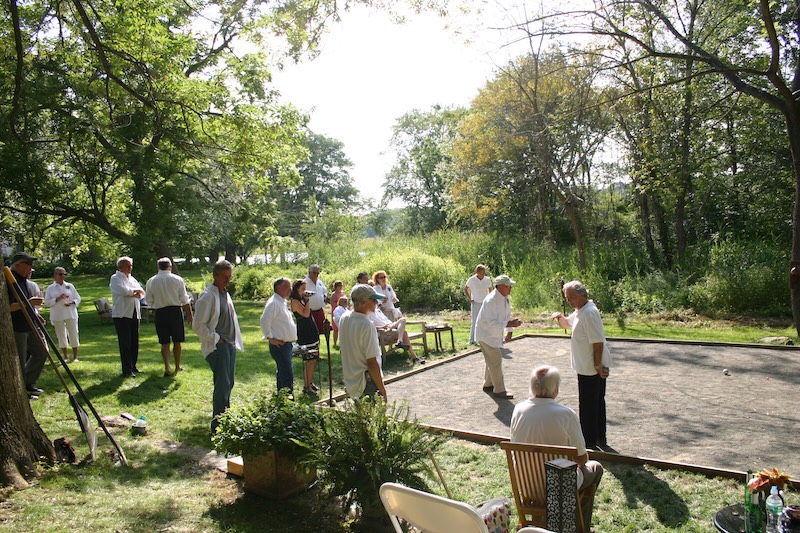
The Bee and Thistle’s lawn slopes away from the boules court and gently down to the Lieutenant River.
In addition to the professional chefs, Lee White noted that there are other “amazing cooks” who are on the team. And CBS correspondent Morley Safer, a huge fan of the game and who has a pétanque court at his home in Chester, also plays with the group when he is in Connecticut.
Lee White explained that last year she and Doug invited Linnea and David Rufo, owners of the Bee and Thistle Inn, to their house for a meal. Afterwards, Lee suggested a game of boules to her guests. “They fell in love with it,” Lee said and, within a month, the Rufos had installed a pétanque court at the inn. And they began hosting “Boules at the Bee” on Thursday nights.
This summer Linnea literally threw down the gauntlet to the veteran players on Pépin’s team. And she did it with panache—she sent a white leather glove on a satin pillow to Pépin, challenging him to a match at the Bee and Thistle.
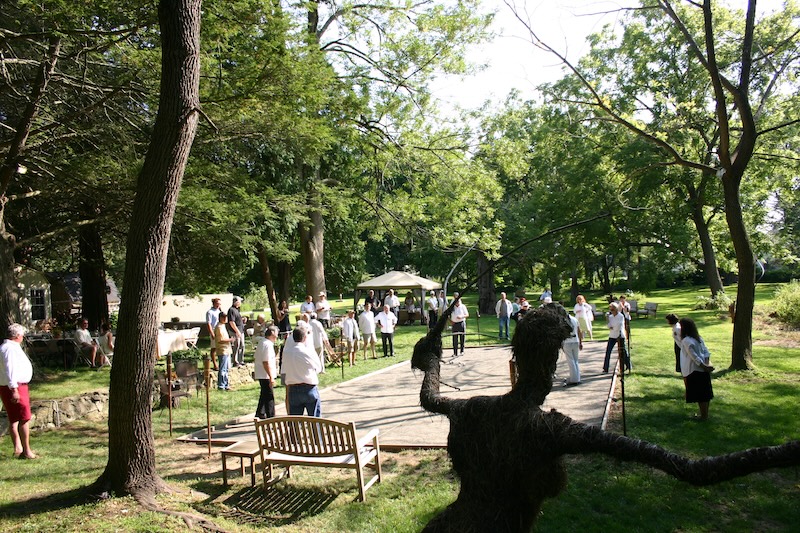
One of the sculptures on the grounds (foreground) looks over the boules court at the Bee and Thistle Inn.
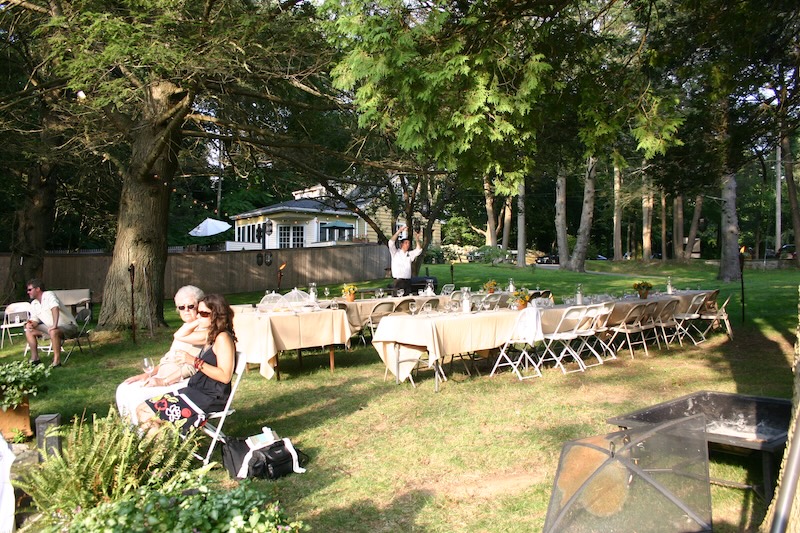
The weather was spectacular the day of the showdown and the players began arriving at 3 p.m. The setting actually looked more like an English garden party—the green lawns sloping down to the Lieutenant River, the sculpture on the grounds, and the tables set for an al fresco feast.
But once the games began, you could easily have imagined yourself to be in the French countryside. There was the clacking sound of the boules (which are made of steel), the whoops of exuberance when someone made a particularly good shot, and the good-natured bantering among the players.
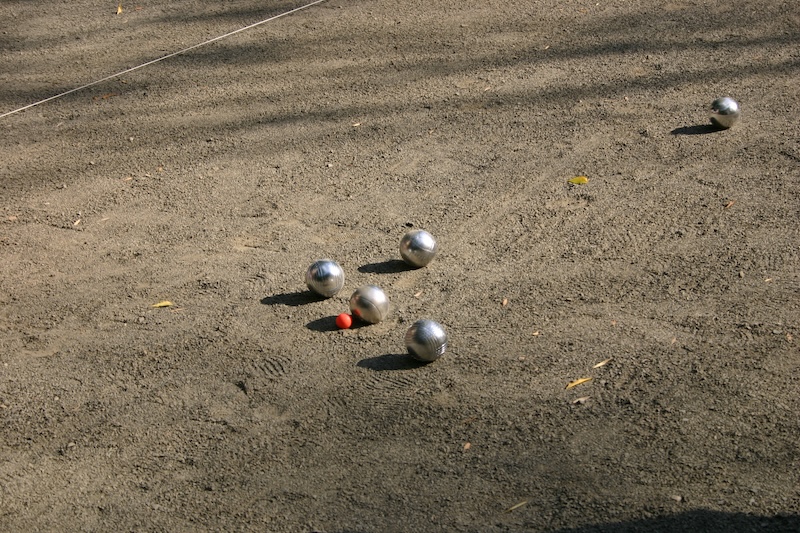
The winning boule in any game is the one nearest to the (in this case, red) cochonnet after the final throw in the game has been played.
The basic rules of the game are deceptively simple. There’s a small wooden ball called a cochonnet (which means piglet.) The goal for the teams is to toss their boules as close as possible to the cochonnet. But the game can change on a dime when an opponent knocks one of your boules out of the way or if the cochonnet itself is hit.
Or, as one of Pépin’s compatriots, Claude Martin, summed it all up, “You see, this is totally screwed up because it’s French.”
Even if you’ve never been to France, you may have read about pétanque in Peter Mayle’s bestselling books. An Englishman who moves to Provence, Mayle becomes smitten with the game and quickly masters its unwritten rules. Number one is “Anyone playing without a drink is disqualified.”
The traditional pétanque-playing drink in the south of France is pastis, a licorice-flavored liqueur. But here in southern Connecticut, the beverage of choice is wine. Underneath a canopy on the lawn, large garden urns served as chillers for bottles of wine.
The tables were set for the upcoming feast.
And what is good wine without good food?—especially with so many gastronomes on the playing field. Across from that outdoor wine bar, there was an oyster bar where a professional shucked oysters throughout the afternoon. Not to mention the gravlax, the cheese platter, and the lamb sausage in lettuce wraps … During a break in the play, Pépin himself was grilling the lamb.
Lee White said that whoever is hosting the event on any given Sunday is responsible for providing the food but, with so many chefs on the team, there is plenty of expert help in the kitchen. She also marveled that the French “eat and drink a lot, but they don’t get fat.”
After about three hours of playing as well as eating and drinking, Linnea invited everyone to sit down to dinner. And she had prepared quite a spread—roasted pork with a spice rub, grilled vegetables, tomato bread pudding, and salads. Members of Pépin’s team supplied some of the to-die-for desserts.
Sometimes the players needed to take a break from the action.
Pépin’s Boules des dimanches team defeated the rookies from the Bee. Afterwards, Lee White confessed that “we were nervous and were very excited to win.” And when the ceremonial plaque was presented, the ever gallant Pépin requested that the award remain at the Bee and Thistle for a rematch next summer.
But the day was far from over. As twilight descended, lights illuminated the court and play resumed. And it would go on for hours, as it always does with pétanque enthusiasts.
Editor’s note: LymeLine heard through the grapevine that the party at the Bee and Thistle lasted until 1 a.m. And, as the French say—c’est normal!
Epilogue and Author Comments:
Seventeen years have passed since I wrote about the “Boules Bash” in Old Lyme.
It was so much fun remembering that day, but there was some bittersweetness, too. Lee and Doug White as well as David Rufo and Morley Safer have passed away. Two beloved restaurants—the Bee & Thistle Inn and the Restaurant du Village in Chester have closed. And Peter Mayle, whose best-selling books about life in Provence introduced readers to the wonderful world of boules, died in 2018.
Since I am a Francophile and also love to cook, it was a thrill to meet Jacques Pépin. After drinking a few glasses of wine, I even summoned up the courage to start our conversation en français! I was already a fan—over the years I had watched his cooking shows and read his books.
During the pandemic, Pépin began posting short daily videos on Facebook, which I still follow.
A few weeks ago, there was a wonderful spread of photos—a group of players on a pétanque court; mouth-watering close-ups of a roast chicken, parslied potatoes . . . and a picture of Pépin and his daughter Claudine at the table. Pépin’s comment: “We had a great weekend of friends, food, and boules.”
First Predominantly African-American Labor Union Formed in August 1925
Jim Cameron
In the history of American transportation, there is one crucial intersection between the railroads and civil rights: the formation, exactly 100 years ago this week in August 1925, of the Brotherhood of Sleeping Car Porters by A. Phillip Randolph. This was the first predominantly African-American labor union in the US.
Pullman Cars
It was in 1862 that George Pullman launched the first deluxe railroad sleeping cars bearing his name. They were an instant hit, offering middle and upper-class passengers the comforts of home while on the rails.
All of the Pullman Car conductors were white but the porters (who tended to the passengers) were black. Many of them were former slaves. Pullman theorized they would be used to the subservient roles of lugging baggage, making up the sleeping berths and serving the white passengers’ every whim.
After they retired for the night, passengers could place their shoes in a small compartment accessible from the corridor where the porters would retrieve and shine them while passengers slept.
Long Hours, Low Pay
Pullman’s porters had to be on call 20 hours a day, serving passengers and tending to boardings at intermediate stations
Porters worked 400 hours per month with their time off being uncompensated. They had to pay for their own uniforms, meals and shoe shine kits. Between runs, even away from home, they paid for their own lodging. The hours they spent before and after each trip preparing and cleaning the car were also unpaid … much like some present day flight attendants.
In 1926, the average porter earned $72 a month in wages and got about $58 a month in tips. In contrast, Pullman’s white conductors (who had a union) earned $150 for a 240-hour-month, plus benefits and a pension.
Still, Pullman’s black porters made a good income compared to other black workers, allowing many to enter the middle class in railroad hub cities like Chicago and St Louis.
As one historian put it, a Pullman porter had the best job in his community and the worst job on the train. There was no room for promotion. Passengers often referred to Pullman porters by demeaning names like “boy”, or “George”, applying the first name of the Pullman cars’ owner.
Unionization
In 1925, A. Phillip Randolph started organizing The Brotherhood of Sleeping Car Porters under the rallying cry “Fight or be slaves”. It took a decade of court battles and the threat of a national strike before the union was recognized in 1937, giving porters a big wage hike and a 240 hour per month work schedule.
Randolph and others in the Brotherhood went on to become leaders of the civil rights movement. One porter, Edgar D. Nixon, helped organize the Montgomery Alabama bus boycott after Rosa Parks’ arrest in 1955.
Among other famous Pullman porters were future US Supreme Court Justice Thurgood Marshall, activist Malcolm X and photographer Gordon Parks.
By the 1950’s, train service was in decline and in 1959, Pullman closed up its sleeping car business. Some porters went on to work with the legacy railroads and a few were still around when Amtrak took over.
In 1981 when the Pullman company delivered its last Superliner sleeping car, it was named after George Pullman. Years later, after Randolph had passed away, another Amtrak sleeping car was named in his honor.
Editor’s Notes:i) Jim Cameron is the founder of the Commuter Action Group and advocates for Connecticut rail riders. He writes a weekly column called ‘Talking Transportation,’ which is published by a number of publications in the state. ii) ”Talking Transportation” recently won first place in the general column/commentary category in the Connecticut Society of Professional Journalists Excellence in Journalism Contest.
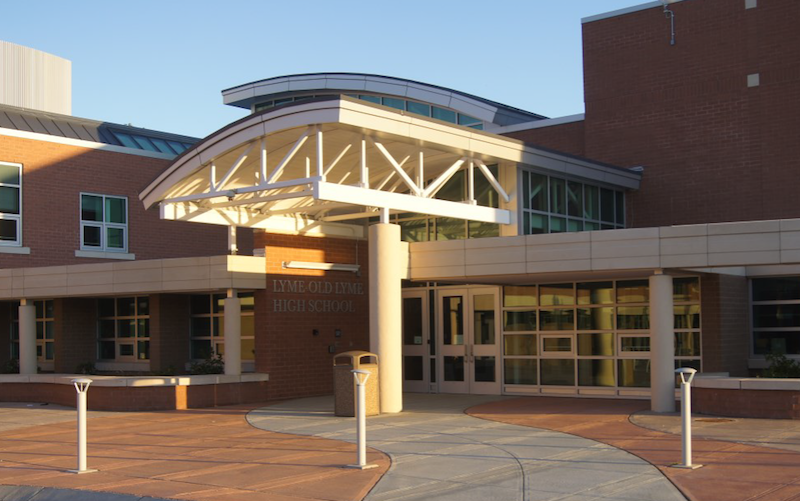
The entrance to Lyme-Old Lyme High School. LymeLine file photo.
OLD LYME—Lyme-Old Lyme High School (LOLHS) is among the Top 10 high schools in Connecticut and the Top 500 in the nation, according to U.S. News & World Report.
The school earned eighth place on the Best High Schools list released this week. The rankings are compiled annually based on state-required test scores, graduation rates and how well each school prepares students for college.
Lyme-Old Lyme High School ranked 415 out of nearly 18,000 public high schools across the country.
Superintendent of Lyme-Old Lyme Schools Ian Neviaser on Friday welcomed the news.
“This recognition reflects the hard work and dedication of our students, the expertise and commitment of our teachers and staff, and the strong support of our families and community,” he said.
Neviaser added, “We will continue to challenge ourselves to provide an exceptional education for every student while preparing them for success in college, careers, and life beyond Lyme-Old Lyme.”
The Top 10 Best High Schools in Connecticut identified by U.S. News & World Report are:
1. Connecticut IB Academy, East Hartford
2. New Canaan High School
3. Weston High School
4. Darien High School
5. Wilton High School
6. Staples High School, Westport
7. Marine Science Magnet High School of Southeastern Connecticut, Groton
8. Lyme-Old Lyme High School
9. Greenwich High School
10. Hall High School, West Hartford
Lyme-Old Lyme High School and Marine Science Magnet High School are the only schools in New London County to break the Top 10.
Here’s how other local area schools stacked up:
17. East Lyme High School
20. Stonington High School
31. Haddam-Killingworth High School
45. Wheeler High School, N. Stonington
49. Valley Regional High School, Deep River
50. Westbrook High School
51. Waterford High School
52. Old Saybrook High School
54. The Morgan School, Clinton
68. Bacon Academy, Colchester
76. Robert E. Fitch High School, Groton
77. Montville High School
88. Ledyard High School
91. Science and Technology Magnet Pathway for High School Grades, New London
102. Lyman Memorial High School, Lebanon
105. Griswold High School
115. Nathan Hale-Ray High School, East Haddam
135. Norwich Free Academy
144. Three Rivers Middle College Magnet School, Norwich
154. Norwich Technical High School
158. Ella T. Grasso Southeastern Technical High School, Groton
160. New London High School
171. New London Visual and Performing Arts Magnet School
The 2025 rankings are based on three-year old data described by US News& World Report in a press releaseas the most recent state and federal figures available.
Data shows 67% of Lyme-Old Lyme’s 392 students at the time took at least one Advanced Placement (AP) exam, with 62% passing. The graduation rate was 98%.
The media company said schools are evaluated on how effectively they serve all students, including underserved populations, with college readiness measured through student participation and performance on AP and International Baccalaureate exams.
Seventeen percent of LOLHS students at the time identified as Black, Hispanic, Asian or biracial, according to the report. About 14% of students were considered economically disadvantaged.
Lyme-Old Lyme High School ranked 13th in the 2024 rankings and 34th the year prior.
Editor’s Note: This article was updated with a quote from Superintendent Neviaser.