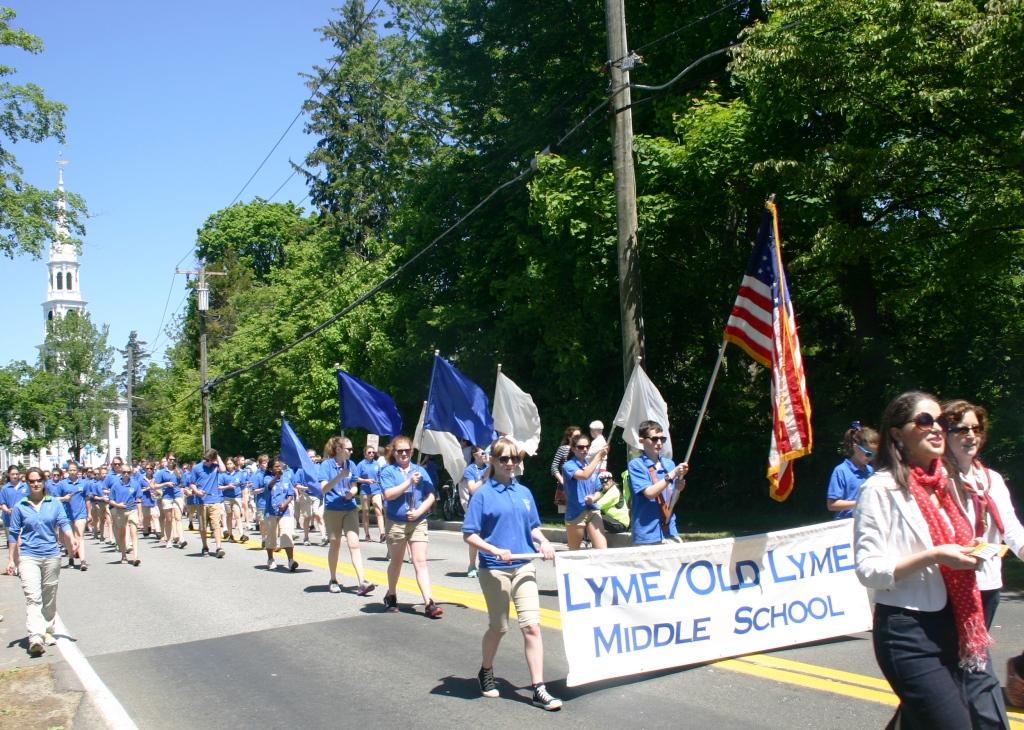
Once again the Democrats can’t see past their nose.
Setting up a campaign tent on Memorial Day is standard procedure for the Democrats on a day dedicated to pay respect to those who died protecting our freedom(s).
Free speech you say? This is a travesty and an insult to those who are deserving of the utmost respect! Shame on you!
Compost Benefits Farm, Lyme Residents, Town’s Bottom Line … and Doesn’t Stink!
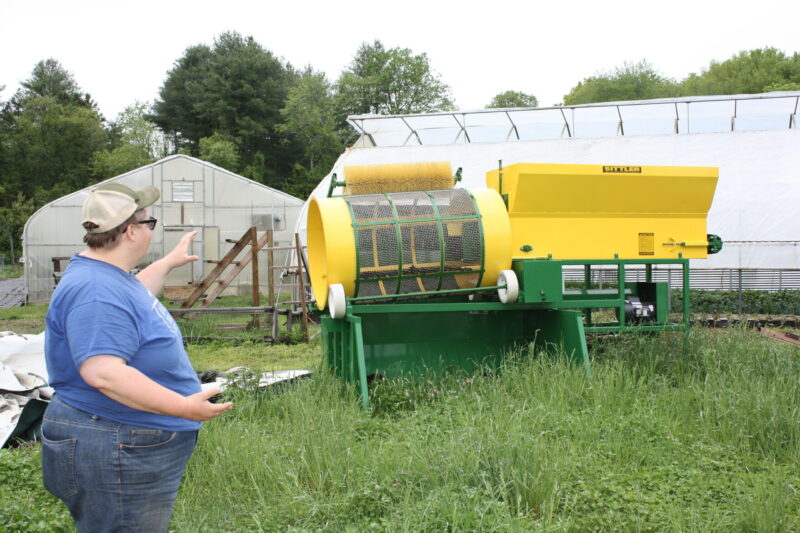
Long Table Farm’s Baylee Drown points out the importance of the trommel screener in sifting through compost to ensure the purest product. All photos by E. Regan.
LYME, CT—Long Table Farm owner Baylee Drown last week stood alongside several carefully-tended compost piles adjacent to the vegetable fields as food scraps carried in from all over town cooked down in a natural process that she hopes will bring the community-supported agriculture operation into a new era of sustainability.
Common fears about the stench of rotting food and the rodents it attracts were unfounded on that damp Thursday morning as Drown and Lyme Selectwoman Kristina White looked out from the crushed stone pad separating the compost piles from the earth below. Drown said wood chips spread over the piles is a simple and effective way to manage odors.
“My farm does not stink,” she said. “And I don’t want it to stink. I live here. I have a vested interest in it not stinking.”
Drown, who speaks passionately about carbon sequestration and has been known to refer to farm animals as “manure production,” said it’s her goal to be able to turn one million pounds of food scraps and other organic material into 2,000 cubic yards of compost annually.
She currently produces 200 cubic yards per year of compost, which returns to the farm as fertilizer for a wide array of vegetables that have become more abundant because of it.
Drown and her partner, Ryan Quinn, established Long Table Farm 11 years ago. They initially leased the site before purchasing it in 2018. She credited an agricultural conservation easement, which permanently prohibits the land from being developed and thus reduces the appraised value, with keeping the farm affordable to small business owners like them.
Drown said staff members from Lyme Consolidated School have been dropping off two five-gallon buckets of food scraps per day since 2022. The Town of Lyme last year began selling green-lidded, brightly labeled buckets at cost to residents interested in hauling their organic refuse to the farm.
White said the program benefits the farm, the residents of Lyme, and the town’s bottom line.
She noted 20-25% of the weight of solid waste comes from food.
“So if we can reduce the amount of food waste in the solid waste stream, then our costs for the town go down. And it’s probably going to be mandated eventually by the state,” she said.
She counted 40 of the specially-produced buckets that have been sold so far by the town. Drown added that about 140 people drop off scraps in their own buckets.
White said bringing food scraps to the farm is a good option even for those who do their own composting at home. That’s because items like bones, fats, oils and other organics that don’t break down as well in a backyard compost pile are welcome at the farm.
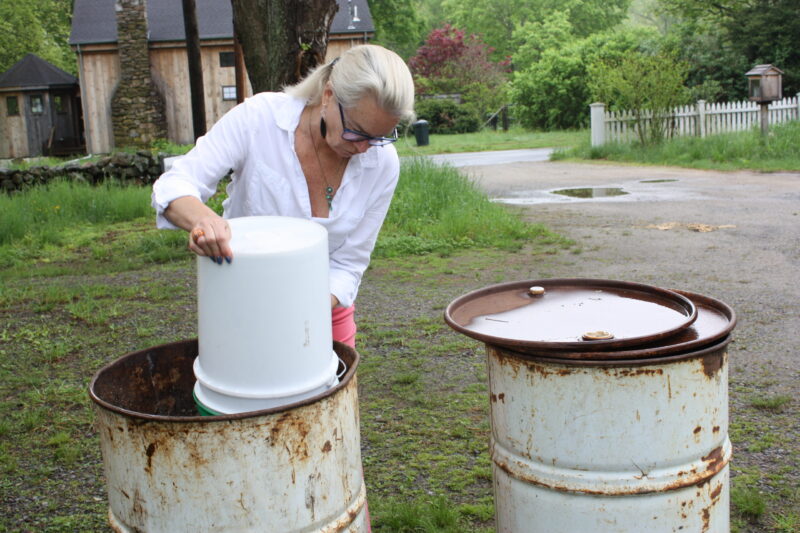
Selectwoman Kristina White dumps a bucket of food scraps from her home into a barrel at Long Table Farm to be turned into compost.
“What we’re trying to say is, ‘Yeah, please compost. Continue to compost in your backyard. But all that other stuff that you’re throwing in the garbage, put it in this bucket,’” she said.
Drown hopes to expand the program through a grant from the state Department of Energy and Environmental Protection as she looks to include Old Lyme in the mix. She said some new farm equipment and expansion of the crushed stone pad would allow the farm to meet the organic recycling needs of both towns, assuming 50% of residents brought in their food scraps.
She also hopes to install collection barrels at places like the transfer station and recycling center.
Drown is asking for $350,000 to $375,000 in funding from the state, combined with in-kind help from the two towns in marketing the composting program and providing educational opportunities.
She told the Lyme Board of Selectpeople at a meeting this week that the grant application has to come from a municipality or the regional Council of Governments since private entities alone are not authorized to apply.
First Selectman David Lahm encouraged Drown to explore a partnership that includes both Lyme and Old Lyme.
“The state government is pushing regionalization,” he said. “So if you can show it’s more than one town, it’s easier to get money.”
Drown said she will be meeting with Lyme-Old Lyme Schools Superintendent Ian Neviaser next week and is lining up a meeting with Old Lyme First Selectwoman Martha Shoemaker.
An Expanded ‘Beta Test’
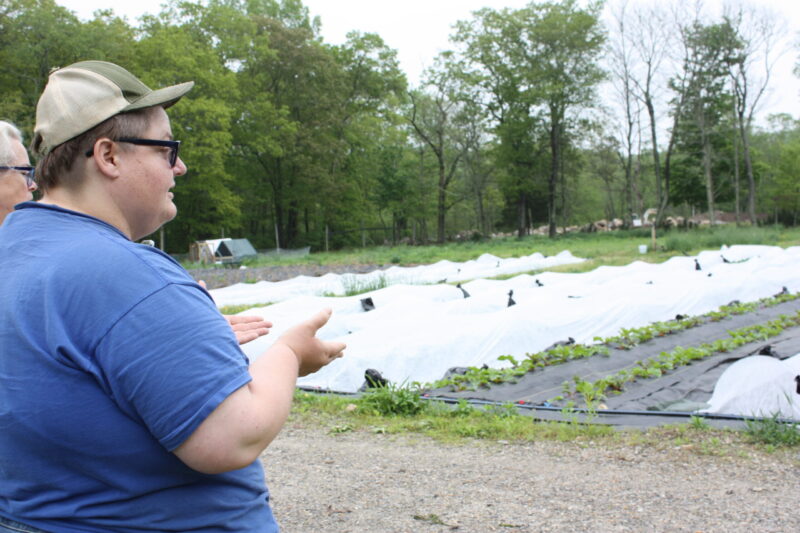
Long Table Farm owner Baylee Drown points to abundant Swiss chard that grows with the help of compost produced at the farm.
Back at the farm, Drown described the program as a “beta test” as the farmers work to scale up production to meet demands coming down the pike now that the state is mandating more businesses and organizations recycle their food scraps.
“I think it’s a good system to have a starter program that’s optional. And then get people kind of used to the idea before the mandate comes out,” Drown said.
It’s also a beta test for the public.
Anyone in the area is invited to drop off their scraps Wednesday through Sunday from dawn to dusk in two barrels at the farm entrance.
In addition to the scraps, compost at Long Table Farm comprises leaves, wood chips, animal bedding and manure. Drown and Quinn use their blue farm tractor to haul the collection barrels from the parking area to the piles arranged atop the stone pad.
She said she’s hopeful grant money can cover a grabbing mechanism to tip the barrels from the tractor into the pile so the farmers don’t have to do it by hand.
“Right now, it’s messy and gross,” she said. “But we’re tough.”
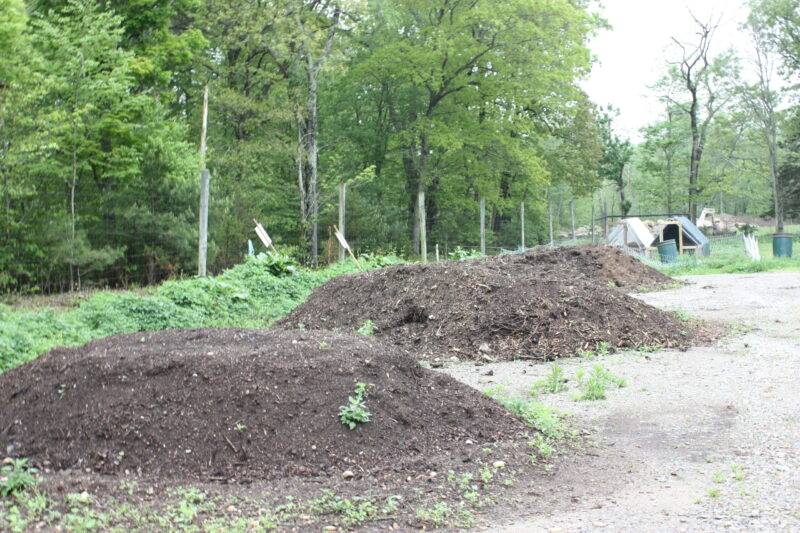
Drown said the composting happens as the large piles “cook,” with bacteria and fungi breaking down the material so that heat is released as a byproduct.
The magic number is 131 degrees, according to Drown. That’s the temperature at which pathogens are killed and weed seeds become sterile.
After a trip through the farm’s rotating screener, properly cooked compost emerges as a clean, high quality fertilizer that she said her friends in the farming community are “champing at the bit” to purchase.
She said Connecticut and Rhode Island don’t have a reliable supplier of high-grade compost and potting soil to supply small scale vegetable farmers in the region.
“I’ve made two batches that were totally weed seed free, but not all my batches are that way yet,” she said. “I’m making good compost, but it’s not perfect yet for vegetable farms.”
Drown was optimistic that will change.
“And that’s another part of why this beta testing process is really helpful,” she said. “Because I’m learning by doing.”
She also sees the pilot program as a way to work toward a sustainable model that will eventually include tipping fees like those the town currently pays the Materials Innovation and Recycling Authority to haul solid waste out of town.
Piles of compost “cook” at Long Table Farm.
In the meantime, Drown said she’s happy to donate the labor and materials she estimated at $3,000 per year to handle food scraps for the town. Her grant application to the state commits to another $50,000 in labor to develop the infrastructure to grow the program.
“And I’m learning how to be a good composter. I took a certificate course so I can operate a compost facility legally that’s recognized in multiple states,” she said. “At some point, the money that’s being given to waste companies needs to be given to farmers.”
White, who also serves as Executive Director of the Lyme Land Trust, was confident the town would start looking into reimbursing farmers for their work when recycling organic material becomes the law.
“Because we’re going to have to pay someone to do it,” she said.
She described the initiative as one that fits into Lyme’s unique, deeply-rooted and pervasive commitment to open space.
“Part of our mission is supporting local farmers and keeping farmland, versus that farmland turning into more development,” she said. “In Lyme, everything is intertwined.”
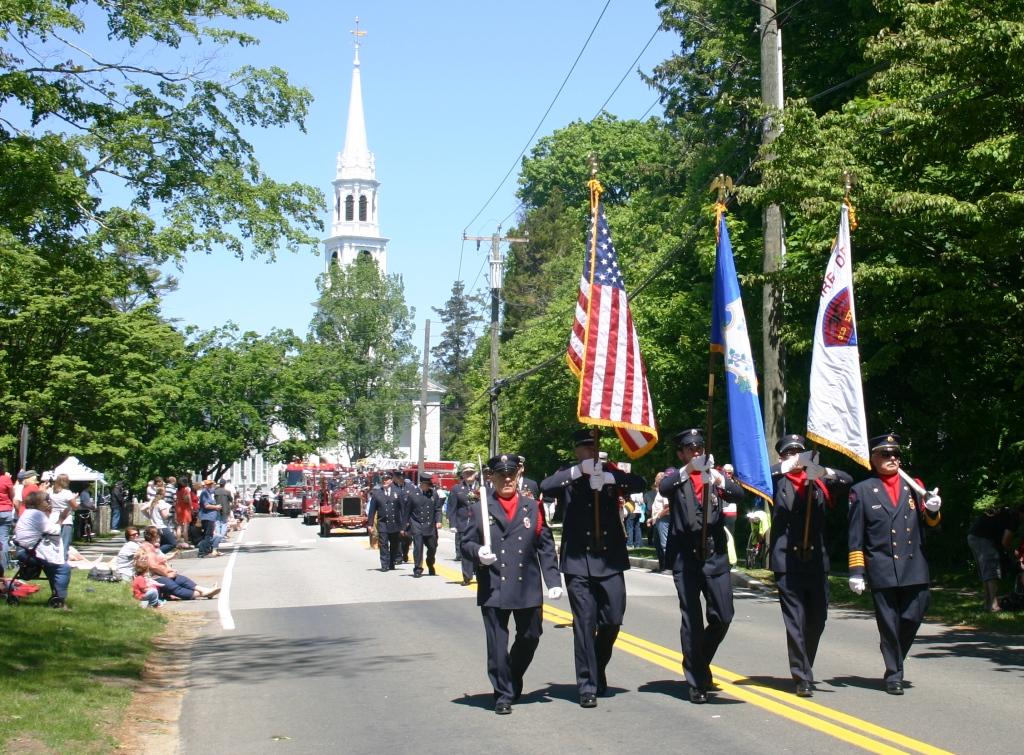
The well-organized parade heads down McCurdy towards the cemetery. LymeLine file photo.
OLD LYME–Old Lyme’s Memorial Day Parade is brought to you by two behind-the-scenes guys named Tony.
The annual tradition, marked by the rumble of a military C-130 airplane overhead and hundreds of marchers pounding the Lyme Street pavement, has been mustered for years by Old Lyme Fire Department members Tony Hendriks and Tony Vallombroso.
On this coming Monday, May 26, at 11 a.m., the parade route will fill with participants from more than 30 local organizations on their trek from the Old Lyme Fire Department headquarters to the Duck River Cemetery for a ceremony hosted by Veterans of Foreign Wars Post 1467.
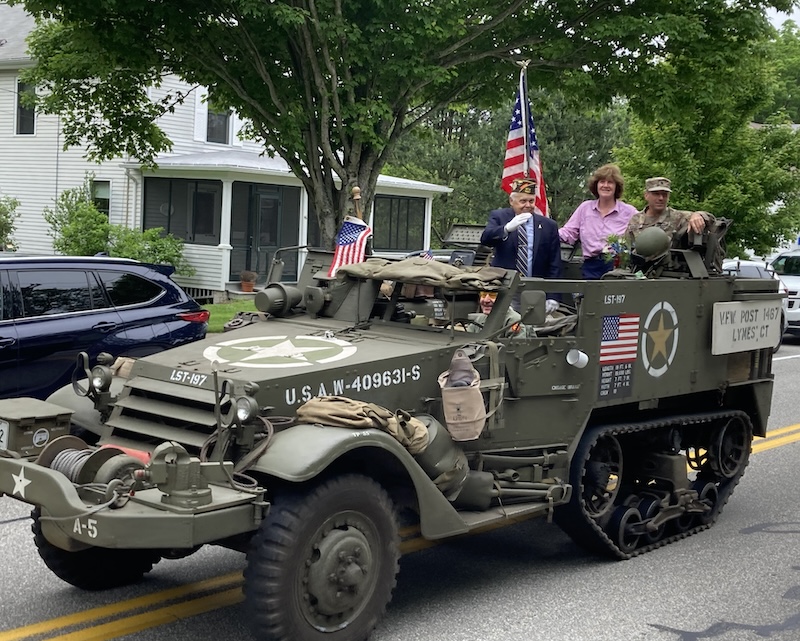
The Memorial Day Parade for many years has included the US Army half-track vehicle belonging to Bruce Noyes, which he drove in 2024 with wife Tammy and veterans atop. LymeLine file photo.
In separate phone interviews this week, Hendriks said he has been leading the organizational aspects of the parade for roughly three decades while Vallombroso recounted coming on board in 2012.
Positions in the parade and at the ceremony are carefully mapped by Hendriks, a land surveyor by profession.
The duo’s work entails “a lot of things that people really don’t see,” according to Vallombroso. Tasks range from filing paperwork for the military flyover, to mailing out invitations, to ordering flowers from Old Lyme Landscape in the form of bouquets placed in firefighters’ ceremonial trumpets and a wreath laid at the ceremony.
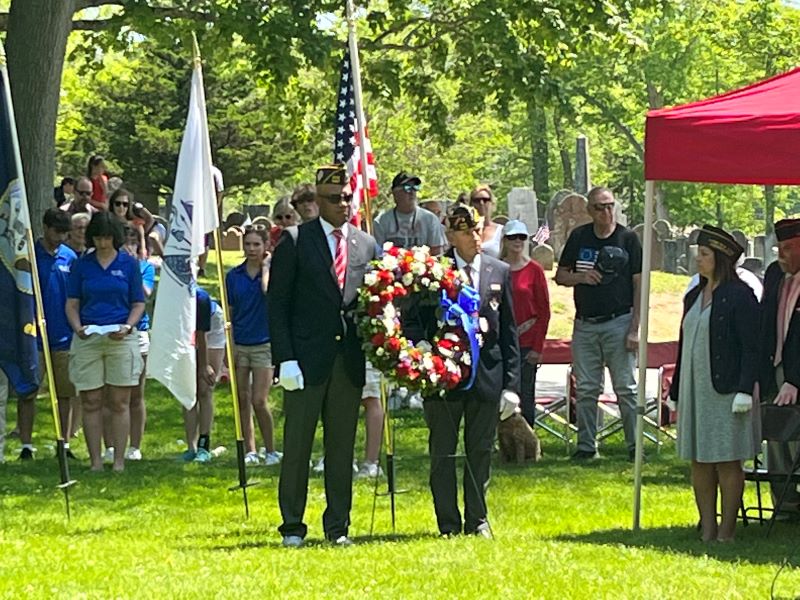
When all the parade participants have assembled in the Duck River Cemetery, a wreath is laid at the memorial to honor all our fallen heroes. LymeLine file photo.
Vallombroso described the parade as relatively short. It takes about a half hour from its start at the Lyme Street fire station to the cemetery finish.
“It takes a lot longer to plan it than it does to execute it,” he said. “But that’s okay.”
The work starts in January with one of the most labor-intensive aspects of the parade: securing the military flyover.
Vallombroso said the request must go through the U.S. Air Force and the Federal Aviation Administration to be approved as a mission. From there, paperwork gets picked up by the Connecticut Air National Guard.
Vallombroso’s own military service included 38 years in the National Guard before he retired in 2003. As one of the town’s Veterans Representatives, he acts as a liaison to help connect those who have served in the military with available resources at the state and federal level.
The flyover by the Air National Guard is complemented on the ground by vehicles from the Army National Guard under the coordination of Major General Francis J. Evon Jr., according to Vallombroso.
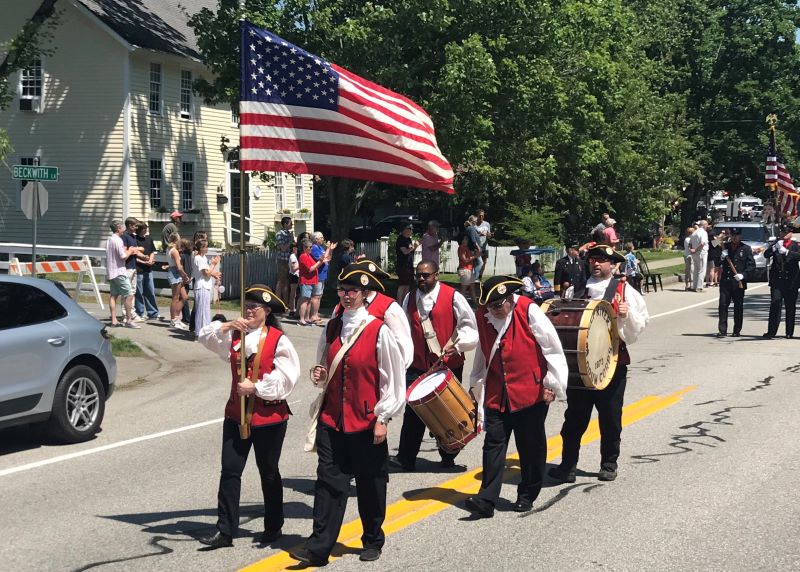
The Deep River Fife & Drum Corps play lively tunes as they march down Lyme Street in the parade. Photo by Michele Dickey.
The parade coincides with the installation of 48 United States flags on Lyme Street, where they will remain until after Veterans Day. That’s when they’ll be cleaned, reassembled on the poles, and put away in preparation for the following year.
Vallombroso said he helped launch the flag program after the idea was broached several years ago by senior fire department member John “Mick” McCarthy. He credited the likes of then-First Selectwoman Bonnie Reemsnyder, Eversource Energy and the Old Lyme Historical Society for working together to make it happen.
“And McCarthy’s dream of flags down Lyme Street was able to be done,” he said.
Hendriks described the day of the event as a hectic one.
“There’s always something at the last minute,” he said.
He said he is actively searching for “new blood” to help organize the parade.
“I’m trying to retire,” he said. “But every time I leave the room, I get renominated.”
The Lyme-Old Lyme Middle and High School bands always form a popular part of the parade. LymeLine file photo.
First Selectwoman Martha Shoemaker this week said the two Tonys will be difficult to replace.
“I am not sure if the residents of this town know how lucky we are to have Tony Hendriks and Tony Vallombroso,” she said. “Their dedication to this parade goes above and beyond our expectations.”
She likened the parade to a scene from a Norman Rockwell painting of idyllic, small town American life.
“It’s a good feeling day for this town,” she said.
She expressed hope that someone will step up to train for the volunteer role before Hendriks and Vallombroso choose to retire.
The men, for their part, ascribed their quiet service to hometown pride and patriotism.
Hendriks put it this way: “I’m just a humble servant of the town. Just helping out.”
The recent cool and weather aside, it’s officially summer! Time to get out and enjoy our state’s wonderful parks and beaches and take advantage of TOR.
You know what TOD is, right? Transit Oriented Development … building homes and offices near mass transit facilities. Well, I’m going to suggest you think about TOR… Transit Oriented Recreation.
Did you know you can travel to many state parks and beaches by train and a connecting bus shuttle? Details on this year’s program are still to come, but CDOT and DEEP have partnered since 2021 to offer ParkConneCT from Memorial Day through Labor Day.
While many state parks close their gates on weekends when their parking lots are full of cars, the shuttle buses can still deliver you to Mother Nature without the hassles.
The state’s modest marketing efforts to attract tourists seem to be working as the number of visitors was up 2% last year. Officials say tourism brings Connecticut $18.5 billion each year … more than what’s seen in Maine, which bills itself as “Vacationland”.
And it’s clearly our beaches that are a main draw. Who needs to endure I-95 when you can take the train to visit …
Sherwood Island State Park in Westport: Just take Metro-North to Westport Station and grab the Sherwood Island Shuttle from the station to the park to enjoy swimming, picnicking and great views of LI Sound.
Silver Sands State Park in Milford: Metro-North gets you to Milford Station where a walk or bike ride to the beach presents newly refurbished boardwalks, pristine beaches and bird-watching spots.
Bluff Point State Park in Groton: Take Shore Line East or Amtrak to New London Station, then grab the SEAT (Southeast Area Transit) Rte. 11 bus to the beach where you can enjoy walks along the coast, biking and fishing.
Beyond TOR, how about TOE … Transit Oriented Entertainment?
You wouldn’t think of driving to NYC to see a Knicks or Rangers game. You’d take the train, right? Well, you can take Metro-North directly to Yankee Stadium too. Or to Bridgeport to see Ringo Starr at the Hartford HealthCare Amphitheater … also walking distance from Amtrak and the Port Jeff Ferry.
Going to see a play at The Shubert in New Haven or Andrea Bocelli at the XL Center in Hartford? Ditch the car and try mass transit.
And if you’re a railfan, visit the Essex Steam Train & Riverboat by training to Old Saybrook and hopping into a cab for the quick ride back into history.
If you’re city-bound, check out Metro-North’s “MTA Away” packages—train and event tickets, often at a discount—for venues both in NYC and the ‘burbs. You can go star gazing or catch an outdoor concert in Forest Hills without a car.
Whatever your destination for summer fun, think twice before enduring the traffic and maybe consider taking mass transit.
Editor’s Notes: i) Jim Cameron is the founder of the Commuter Action Group and advocates for Connecticut rail riders. He writes a weekly column called ‘Talking Transportation,’ which is published by a number of publications in the state. ii) ”Talking Transportation” recently won first place in the general column/commentary category in the Connecticut Society of Professional Journalists Excellence in Journalism Contest.