
Early Fall Gardening Tips from The English Lady—’Take Time to Sit and Watch the Leaves Change’

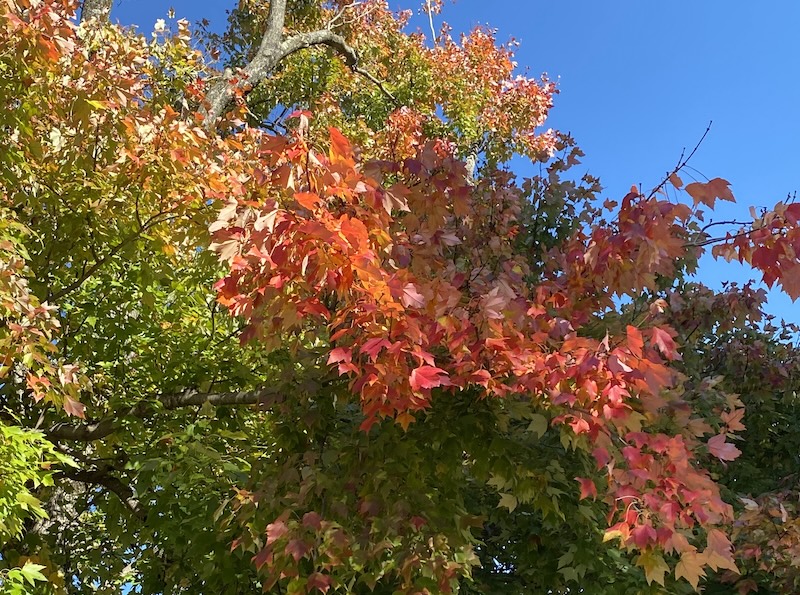
The colors of fall never cease to delight. LymeLine file photo.

Birches, Larches, Gingko, Oaks, Magnolia, and all flowering fruit and flowering trees as well as the Eastern Red Cedar.  These trees have fleshy roots, and their feeder roots are not large when young and therefore take time to establish and are susceptible to frost heave. 

Perennials that do not like to be planted in fall are Artemisia, Lambs Ears, Foxglove, Penstemon, Anemone, Campanula, Kniphofia, Lupines, Scabiosa, Ferns and Grasses.  

Plant garlic this fall – garlic is the antibiotic of the garden. Plant garlic under fruit trees to avoid scab and root disease. Also, plant garlic near to ponds or standing water to control mosquito larvae or pour garlic water into ponds, bird baths and fountains to deter adult mosquitoes.  

At this point I want to reiterate what Franklin D Roosevelt said in 1937; ‘the nation that destroys its soil destroys itself’. America has not heeded that warning. Precious soils in this country and around the world are being destroyed by dangerous practices in industrialized agriculture and poisonous chemicals, which completely disrupt our eco system and poison all living things. 

THE HUMUS COMPONENT

To begin the process of humus, add composted manure like that pictured above, three times through the year. LymeLine file photo.

Good news for organic gardeners – in your own garden you can build and retain a rich growing environment by building the Humus component. We are all carbon-based creatures as is all life on earth. Not only humans but also our soil microbes need carbon to flourish.  To attract carbon from the atmosphere is needed to build the humus component.  

To begin the process of humus – add composted manure three times through the year – early May, July and now in October. Manure builds soil structure and provides a rich planting environment for the following season by encouraging the millions of soil animals down below to manufacture nutrients for the roots of the plants.  

Plus add mulch in the form of natural brown fine bark mulch or wood chips that you produce from your garden – aged wood chips with a combo of leaves, twigs and branches.  

With manure and fine bark mulch, you are building the humus component.  The manure and mulch attract carbon from the air, which builds the richest organic planting environment – the humus component.  

Mulching the garden, and particularly any plants planted, divided or transplanted this fall with two inches of fine bark mulch, when the ground to cools in late October, the mulch will keep warmth and moisture in the soil and protect the roots of your plants through the winter. 

You are probably asking what are the benefits of humus? 

Humus acts like a sponge and holds 90% of its weight in water. 

Because of its negative charge – plant nutrients stick to humus with nitrogen, calcium, phosphorus and other elements, which prevents these from washing away, and acts as nature’s slow- release fertilizer. 

Humus improves soil structure, making it loose and friable, which helps plant roots move through the soil which makes for better access to nutrients, water and oxygen. 

Humus also helps filter’ toxic chemicals from the soil, much like carbon-based water filtration systems that filter toxins from your water.  

We cannot control industrialized agricultural practices – but in your own garden you can make a difference.   Grow the soil organically and the soil will grow the plants.  

Mulch and peat provide acidity, which is particularly important for any newly planted broadleaf evergreens installed in September. As previously mentioned, evergreens are shallow rooted and can heave above ground in hard frost.  I suggest that you store a few bags of topsoil and mulch in the shed or garage.  When you see exposed roots after frost heave, cover them with the soil and mulch until the plant can be resettled next spring.        

THE VEGETABLE GARDEN

This splendid vegetable garden was featured on an Old Lyme Garden Tour several years ago. LymeLine file photo.

Now let’s look at what should be done right now in the vegetable, first focusing on cover crops.  Last week I cut down the finished crops in the vegetable garden and incorporated them lightly into the soil.  

This year, my choice for a cover crop in one area of my vegetable garden is Alfalfa, which has 3.4% nitrogen content. On the opposite side of the garden, I will plant Buckwheat, which has 1.4% nitrogen content which provides nectar for beneficial insects. Then I cover the seeds with organic composted manure.  

There are many cover crops to choose from; I use white clover and rye grass in alternate years.  In spring when the earth is workable that is, not too wet or cold, the cover crop is turned into the earth as ‘green manure’.   

There is nothing better than your own homegrown organic vegetables – good for you and for the environment.  

The less hectic pace of fall provides an opportunity to rethink your gardens. The garden’s pre-winter grooming can wait for a few weeks.  You may feel that you would like a professional design, having thrown good money after bad and nothing looks right.  

If that is so then contact someone that you trust to work with you to create a plan in the fall and winter, which can be phased in next spring.  Engage someone who will listen to your wants and will stay within your budget.  My son, Ian of Landscapes by Ian.com, always says ‘it is not what you do in the garden, but how it makes you feel’.  

SPRING BULBS  

Early November is the time to plant spring bulbs. When purchasing Daffodils, choose early, mid- season and late blooming Daffodils, by doing so you will have a succession of bloom.  Be adventurous this year and go for masses of a single color for the greatest impact. No matter how small your planting area, it is the intensity that counts, with two or three dozen red Tulips or a hundred Daffodils planted on your woodland edge.  

Buying daffodils in large numbers is less expensive, it’s true the bulbs are usually smaller but that is not a problem because daffodil bulbs grow larger each year they are in the ground. Even though many say that the bulbs should be spaced six inches apart, there is no reason they cannot touch one another.  

Apply some composted manure or bulb food on the soil where bulbs are planted.  Wear gloves when you plant bulbs as they contain a skin irritant, which may cause a rash.  

The general rule is to plant bulbs about three times as deep as the bulb is tall and with the pointed end up.  This method is appropriate for most bulbs although tulips should be planted about twelve inches down if you want to produce bloom for a second year. 

Daffodils should be planted no less than nine inches down, which is below the frost line.  I suggest that you do not plant the bulbs singly for the most colorful impact, but plant in groups of odd numbers, 5,7 or 9 bulbs as odd numbers are harmonious in nature.  

Think Spring! Plant bulbs now to enjoy a display like this one next year. LymeLine file photo.

Small bulbs like crocus can be tossed gently into a shallow trench with composted manure on the bottom of the trench, about three inches deep and plant them where they land, pointed side up. For larger bulbs like tulips and daffodils dig a trench about nine inches deep and three or four feet long with  composted manure as the base and scatter these larger bulbs in the trench, also so that the pointed end of the bulb faces up!  

Personally, I treat Tulips as annuals because their first year’s bloom is the best, after that first year the bloom is never as full and vibrant; the only exception to this is the parrot tulip, which I find, flourishes for years.   

 A word of caution -Tulips are the ‘caviar’ of the bulb family. The best method to prevent them from becoming tasty items on the rodent’s menu is to soak them in an organic deer repellent, which also repels rodents. Allow the tulip bulbs to dry before planting.  

If you are unable to plant your bulbs immediately when purchased, keep them in a cool, dry place in paper bags.  The best time to plant spring bulbs in the Northeast is in mid- November. 

Observe Mother Nature; plants in nature do not grow in straight lines but in gentle curves that connect harmoniously with the earth.   

TREE WORK

Ghoose a licensed arborist. This work is much less expensive to have done in the fall after the foliage has fallen, then the arborist is able to see more clearly what needs to be done and the work goes faster – meaning less labor time and therefore is less expensive.  

If you have deep shade and want more sunlight in an area, ask the arborist to thin out the tree’s canopy and prune lower branches to make for a sunnier area, this will give you more choice of plants, that grow in dappled rather than deep shade.   

If you have a badly damaged tree, meaning over 50% damaged or diseased, then have it removed, which may allow for a sun garden or perhaps the vegetable garden you have always wanted.   

PERENNIALS

I do not cut my spent perennials to the ground in fall but leave them up so that I am able to enjoy the browns, grays, yellows and faded greens, which blend gently with winter’s muted landscape. The seed heads of the perennials are also wonderful snacks for the birds and in the dead of winter, what better sight than a red cardinal on the Winterberry bush in the snow.   

Also wait until next April to cut down ornamental grasses; their graceful foliage is lovely to enjoy with the icicles on them shining in the pale winter sun.  

However, on perennials, any spent perennials that show disease should be cut down but if the plant is more than one third diseased it should be dug up and discarded. Then throw the diseased material in the garbage not in the compost. Clean up any fallen plant debris from the soil and ONLY if it is disease and weed free, can it be added to the compost pile. 
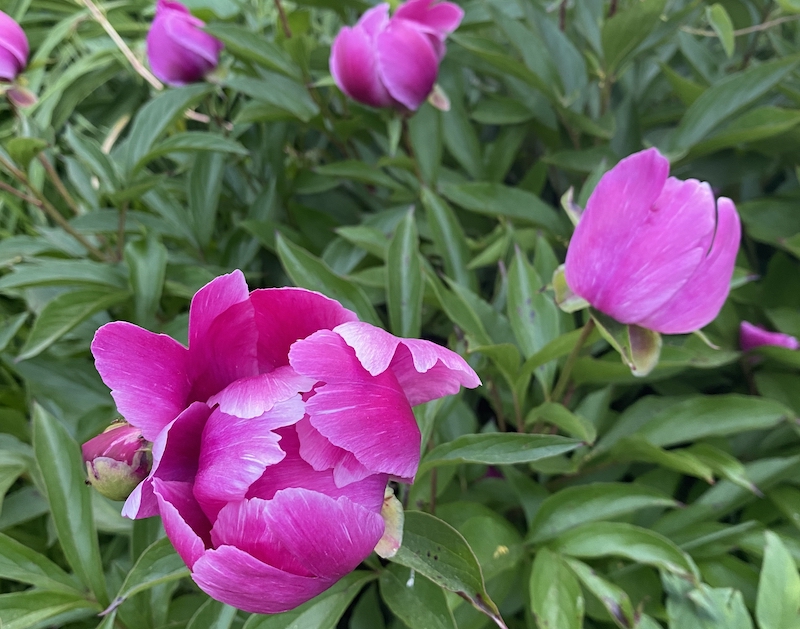
Prune peonies in November to enjoy blooms like these next May. LymeLine file photo.

Peonies – In November after the first hard frost, cut down peonies to within six inches from the ground and add some composted manure around the base of the plant. 

SIGNS OF FROST

You can foretell a hard frost when you notice the afternoon temperature falling fast under a clear sky.  Assess the wind by taking a long strip of plastic, like a shopping bag from the supermarket, and hanging it from a tree branch. If the bag flutters about a foot in either direction, you do not have to worry about frost, but if it blows vigorously then frost is on the way.  If you still have plants in the garden that are of concern, cover them with salt hay, newspapers or lightweight old quilts and put a brown paper bag from the grocery store over smaller plants like herbs, anchored down with rocks.       

Your houseplants should be indoors now. After their summer sojourn outdoors, wash the pots thoroughly and add fresh potting soil.  Then replant the plant at the same depth it was at originally and into the sink or shower and allow water to wash the foliage and water the plant well.  If the plant has outgrown its pot, transplant it to the next size clean pot, only one and a half inches larger. 

Enjoy the pleasant Fall weather and if you have any gardening questions, feel free to email me at MaureenHaseleyJones@gmail.com and I will see you in your garden in November. 

About the author: Maureen Haseley-Jones is a member of a family of renowned horticultural artisans, whose landscaping heritage dates back to the 17th century. She is one of the founders, together with her son Ian, of The English Lady Landscape and Home Company. Maureen and Ian are landscape designers and garden experts who believe that everyone deserves to live in an eco-conscious environment and enjoy the pleasure that it brings. Maureen learned her design skills from both her mother and grandmother, and honed her horticultural and construction skills while working in the family nursery and landscape business in the U.K. Her formal horticultural training was undertaken at the Royal Botanic Gardens at Kew in Surrey.

Shoemaker Wins Top Spot in Old Lyme, Lampos and Mesham Join Her on Board of Selectmen

Martha Shoemaker. LymeLine file photo.

OLD LYME—In unconfirmed results, incumbent Democrat Martha Shoemaker held her First Selectwoman seat fighting off a strong campiagn by Republican challenger John Mesham. Shoemaker’s running mate Jim Lampos also held his seat and the third seat on the board will be taken by Mesham. Jude Read (R) lost her seat as a Selectwoman.

We do not yet have any detailed numbers on the Selectmen’s race nor results from any of the other races. We will share them as soon as we receive them.

TOP STORY: Election Day Turnout Steady in Lyme, Old Lyme as Poll Workers Roll Out New Voting Tabulators

Lyme Registrars of Voters Dottie Wells, D, and Judith Davies, R, said 374 voters had come out to vote on Election Day as of 1:20 p.m. All photos by olwenonline.com/.

LYME-OLD LYME–Voting officials in Lyme and Old Lyme on Election Day reported happy voters despite a glitch with one of the new tabulators in Lyme.

Lyme Registrars of Voters Dottie Wells, D, and Judith Davies, R, said there didn’t seem to be any problems with the Election Day tabulator in a previous test run or during the first hour of Election Day. But the machine around 7:20 a.m. spit back a ballot inserted face down by a voter, which was unusual because the machines are supposed to accept ballots inserted in any direction.

The problem ultimately affected four voters, though they were able to successfully cast their votes by inserting the ballots face up.

Officials tried to address the problem locally before calling in the tabulator’s vendor, Election Systems and Software (ES&S). A representative stationed in the area arrived at the Town Hall by 8 a.m., Wells said. Officials by midday did not know the cause of the problem, but were instructing all voters to insert their ballots face up as a workaround.

There are separate tabulators for early voting, absentee, same day and Election Day ballots. There is also a backup tabulator, Wells said.

The tabulator is one of about 2,500 new tabulators that replaced old scanners across the state this year as part of a $20 million package, according to reporting from CT News Junkie.

Wells said the first voter to experience the problem was understanding about having to wait for the poll workers to figure out what was going on.

“The voter was patient, and our staff was patient,” she said.

Lyme poll workers Liz Frankel, D, (left) and Leslie Lewis, R, handcounted early voting ballots on Election Day.

Wells and Davies described Election Day turnout as steady.

“People are happy to be here and doing their civic duty,” Wells said.

She said poll workers added two privacy booths to the six booths originally set up in the Town Hall meeting room in order to meet the demand.

Combined with early voting totals, turnout by 1:20 p.m. was at roughly 47% of total registered voters.

Lyme Registrar of Voters Judith Davies and Dottie Wells said early voting brought in 531 ballots from 253 Democrats, 165 unaffiliated voters, 103 Republicans and 9 minor party voters. While a breakdown of the affiliations of all registered voters wasn’t immediately available on Tuesday, data from Thomas’ office as of Oct. 17 shows there were 734 unaffiliated voters, 717 Democrats, 444 Republicans and 31 minor party voters, for a total of 1,926 voters.

Wells said 31 absentee ballots had been received as of Monday.

By 2 p.m., Old Lyme Head Moderator Fred Verillo said 1,040 voters had come out since the polls opened at 6 a.m. on Election Day.

Over at Lyme-Old Lyme Middle School, Old Lyme Head Moderator Fred Verillo came back from guiding a resident with a disability through the process of using the town’s accessible voting system – which allowed the voter to listen to an audio version of the ballot while using a touchscreen – to describe “a robust turnout” at the polls. By 2 p.m., he said 1,040 voters had filed through the town’s one polling place.

“I’m happy because our voters are happy,” he said.

He said the new tabulators were running efficiently with no problems. He predicted they would make the overall tabulation process go more quickly and quietly.

The machines use paper ballots and are not connected to the internet, according to CT News Junkie.

“It’s so much better,” Verillo said. “I think we’re serving our community very well.”

Early voting brought in 1,553 ballots and absentee voters accounted for 155 ballots, according to Deputy Registrar of Voters Katherine Thuma.

Old Lyme poll workers Michael Reiter (left) and Patrice Scavone handcount early voting ballots on Election Day.

Thuma around midday said the total number of registrations in town, including two same-day registrations filed on Tuesday, amounted to 2,546 unaffiliated voters, 1,963 Democrats, 1,644 Republicans and 97 minor party voters.

Between the start of early voting and 2 p.m. Tuesday, about 28% of those registered voters had come out to vote.

Still Deciding? Here Are All Our Lyme/Old Lyme-Related Election Articles, Candidate Q & A’s, and Letters to Help

Incumbent First Selectwoman Martha Shoemaker (left to right) is running against Republican John Mesham in Old Lyme, while Republican Tom St. Louis challenges unaffiliated, Democrat-backed candidate Christy Zelek in Lyme.

LYME/OLD LYME–Still making up your mind how to cat your vote? We’ve compiled all our election coverage in one place to help you make an informed decision.

If you haven’t already voted, don’t forget to cast that ballot before the clock runs out. Get the details here

Read on to explore the candidates and issues through our original reporting, the candidates’ own voices, and perspectives from neighbors across Lyme and Old Lyme.

Election Reporting

Rare First Selectman Contest in Lyme Pits Corporate Experience Against Volunteer Approach

Focus on Kids and Community—Not Politics—Dominates Region 18 Candidates’ Friendly Forum

Shoemaker, Mesham Back for Another First Selectman Run in Old Lyme

Failed Halls Road Overlay Makes Way for Election Day in Old Lyme

With Democrats Absent, Republican Couple Takes Center Stage at Lyme Candidate Forum

‘It Matters That You Vote’: Lyme Residents Turn Out Early for Familiar Election Day Ritual

Old Lyme Democrats Announce First Selectwoman Martha Shoemaker’s Bid for Reelection

Old Lyme Republicans Announce Nomination of John Mesham in Rematch for First Selectman

Lyme Republicans Endorse Tom St. Louis for First Selectman

Lyme Democrats Support Unaffiliated Petitioning Candidate Christy Zelek for First Selectman

Candidate Q&A Series 

Old Lyme Board of Selectmen Candidates Respond to Our Questions

Lyme Board of Selectpeople Candidates Respond to Our Questions

Region 18 Board of Education Candidates Respond to Our Questions

Old Lyme Zoning Commission Candidates Respond to Our Questions

Letters to the Editor

William J. Belluzzi: Fogliano Will Use Analytic, Research Skills Gained as Career Scientist to Benefit Old Lyme Zoning Commission

Tom Beyer: LymeLine Editor Criticized for Publishing Gencarella Letter Accusing Zelek of Plagiarism

Alice Burbank: Response by Then-Selectwoman Shoemaker Leads to Support for her Current First Selectman Challenger

Bud Canaday: Don’t Reelect HROD Advocates Shoemaker, Lampos; Vote Row B

Joe Carpentino: Fogliano is ‘Fair-minded, Collaborative and Knowledgeable’ Zoning Candidate

Danielle Chesebrough: Looking for Steady Leadership for Old Lyme’s Future? Behringer Deserves Your Vote

Kevin Clougherty: Reader Questions Kelsey’s Position on Halls Road ‘Political Football’

Sarah Crisp: Checks and Balances are Important for Lyme

Mary Daley: Martha and Jim Roll Up Their Sleeves for the People

Suzanne Derry: Old Lyme is a Functioning Democracy, No Need for ‘Venom’ Being Injected Into Local Campaign Rhetoric

George Finley: Why Won’t Old Lyme Republicans Participate in a Debate?

Michael Fogliano: Fogliano, Candidate for Old Lyme Zoning Commission, Explains His Reasons for Running

Allan Dodds Frank: Lyme Deserves Better

Stephen Olbrys Gencarella: Plagiarism is No Way to Start a Campaign

Christina J and Thomas D Gotowka: Shoemaker/Lampos Supporters Say ‘If it Isn’t Broken, Don’t Fix It’

Rebecca Griffin: With Trump in Charge Nationally, Only Defense is to Limit Republican Role Locally, so Vote Democrat

Timothy Griswold: Former First Selectman Griswold Endorses Mesham, Read for Old Lyme Board of Selectmen

Betsy Groth: Danenhower Disrespected Due Process on Zoning Commission, Elect Alternate Fogliano to Full Term

Lucinda Hautaniemi: Behringer, Linderman, Walsh Support Fiscal Responsibility

Anna B. James and Gavin Lodge: Lyme School Board Rep’s Endorse Zelek as ‘Uniter’

John Kiker: Lyme Democrats Choose Conversation Over Confrontation

Jim Lampos: An Open Letter to the Citizens of Old Lyme from Selectman Lampos

Howard Margules: The Missing Word on Old Lyme Campaign Signs, and a Simple Question

Fred McCullough: Writer ‘Disheartened’ by Old Lyme Republican Postcard; Requests Civility, Absence of Divisiveness 

Carolyn Miranda: Shoemaker Keeps Her Promises

Mary Jo Nosal: Shoemaker, Lampos Have Achieved Much in Short Time, Deserve Re-election

Tom Ortoleva: Elect Fogliano to Old Lyme Zoning Commission to Benefit From His ‘Deep Knowledge … Open Mind’

Phyllis Ross: Contrary to RTC Mailer Statement, Lyme Affordable Housing Commission (AHC) Member Says AHC Does Not Believe in High-density Housing

Michael Reiter: Reiter Reminds Readers to Exercise Caution When Deciding Who to Vote for in November

David Rubino: Democracy is on the Ballot … Even Here in Old Lyme

Sandra Y. Rueb: Vote Kimberly Thompson for Responsible Fiscal Leadership in Old Lyme

Andy Russell: Veteran Old Lyme Board of Finance (BOF) Member Endorses ‘Capable … Deeply Committed’ Republican Slate of BOF Candidates

Martha Shoemaker: An Open Letter to the Residents of Old Lyme from First Selectwoman Shoemaker

Ed Shyloski: Old Lyme Republican Pledges Support for Democratic BOE Candidate Shyloski

Joseph G. Soucie: When Voting Nov. 4, Remember Old Lyme Board of Finance D’s, R’s Disagree Deeply on Town Surplus 

Steve Spooner: Endorsing J. David Kelsey—a ‘Generous Supporter of All Things Old Lyme’—for Board of Finance

Thomas St. Louis: Residents Deserve to Hear From Candidates in Open Forum

Leanne Viola: Attendance Records for Old Lyme Board of Finance Candidates Thompson, Kelsey Differ Sharply

Jonathan B. Wilder: If Political Campaign Banners are OK in Old Lyme, National Flags Should be OK Too

Op-Eds

Rick Drake: Tuesday, November 4th & the HROD

George Frampton Jr: The Not-Secret and Completely Transparent Facts About Tantummaheag Landing

Stephen Olbrys Gencarella: Why Plagiarism Matters in Our Local Election

‘The Estuary’ Invites Holiday Shoppers to Buy Local at Holiday Craft Fair, Nov. 22

The Estuary’s Holiday Craft Sale promises to be a festive introduction to the season much like last year’s event, pictured here.

OLD SAYBROOK–The Estuary invites shoppers to get a jump start on the gift-giving season at its Annual Holiday Craft Fair, Nov. 22.

The event will run from 9 a.m. to 2 p.m. at The Estuary, 200 Main St., Old Saybrook.

The craft fair promises over 30 artisans and vendors displaying their hand-crafted items – plus a visit from Santa Claus.

The group in a press release advised shoppers to have a camera on hand when Santa and one of his elves makes an appearance from 11 a.m. to noon “to visit with young and old.”

Baked goods as well as breakfast sandwiches, home fries, coffee and tea will be available for purchase.

The Estuary provides programs and services for adults 50 and older from Lyme and Old Lyme, as well as Chester, Clinton, Deep River, Essex, Killingworth, Old Saybrook, and Westbrook.