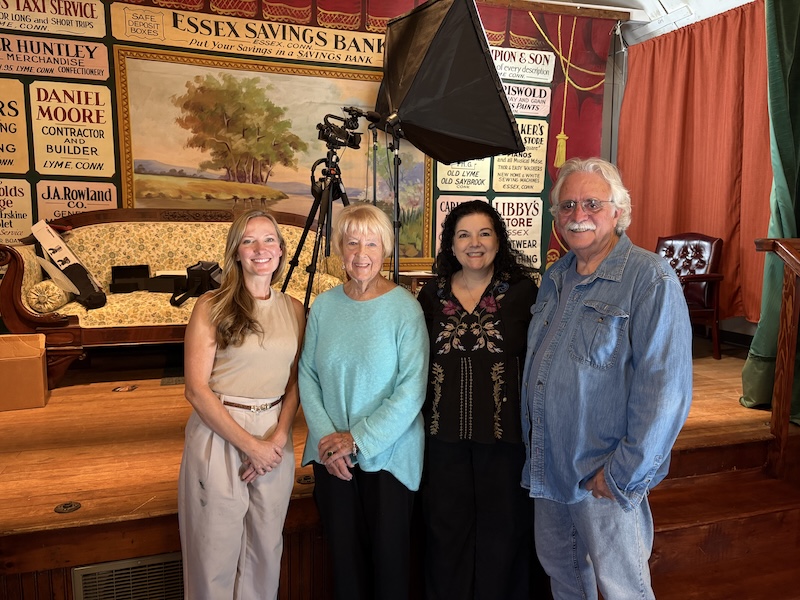
Standing together in the Old Lyme Historical Society’s building on Lyme Street are Oral History Project Chair and film editor Jaymie Nickerson-Buckmaster, Joan Childs Clarke, Michaelle Pearson (interviewer), and James Meehan (camera and sound.) Photo by Beth Stewart.
OLD LYME—On Saturday, Sept. 20, the Old Lyme Historical Society (OLHS) interviewed Joan Childs Clarke to kick off their 2025-26 Oral History Project.
The Old Lyme Historical Society undertakes oral histories to preserve the voices and memories of people whose experiences bring the past to life. These first-hand accounts capture details of everyday life, community traditions, and significant events that may not appear in written records.
By recording and sharing personal stories, the OLHS help ensure that future generations can connect with and learn from the lived experiences of those who came before.
OLD LYME—Animal Control Officer Lynn Philemon told the Board of Selectmen at their regular meeting on Monday that the weeks following the July seizure of 20 dogs, five birds and two chinchillas have been exhausting but important.
“I have no sleep at all, no vacation … and I’m glad I did it because I’ve been trying to get those poor animals away from those people for two years,” she said.
Her job over the past few months has included writing a search warrant, seizing the animals from the small home on Miami Avenue where they were allegedly hoarded, taking them for extensive and frequent medical appointments, and lining up foster homes where they can recuperate before finding their permanent families.
It’s a job she takes home with her.
Among the animals living with Philemon currently are a dam (the female parent of litter of puppies) and a couple of older dogs seized from the property. The latter all require medical attention and the mom is “going to pop any minute” with an expected litter of four puppies, she said.
The 27 animals were seized after concerns were brought to Philemon in late June about an animal hoarding situation in Cheshire with ties to the Old Lyme house, according to civil court documents. Repeated welfare checks conducted at the beach area bungalow went unanswered before resident Nancy Guest allowed Philemon and a local police officer to come inside.
The documents described officers finding up to 20 dogs covered in urine and feces amid “deplorable” conditions.
After the search and seizure warrant was executed on July 28, court documents show the Ledge Light Health District deemed the residence unfit for habitation.
No arrests have been made yet in connection with the Old Lyme case. In Cheshire, the state’s judicial website shows Guest and two others were arrested and charged Sept. 10 with 19 counts of animal cruelty.
When Shoemaker described Philemon’s new skills compiling search warrant and arrest warrant as a resumé builder, the animal control officer agreed.
“That was the first time I’ve ever had to do that in my 21 years, believe it or not,” she said.
Five of the dogs initially signed over to the town have been adopted, according to Philemon. The remainder of the dogs are in foster homes because of severe medical needs that need to be addressed before they can be adopted.
There are also three five-week old puppies and two three-week old puppies from two dams.
“A lot of them are not housebroken. They were let out twice a day. There was 20 of them in a small house,” she said.
Though she recounted hundreds of calls coming in to the animal control facility from would-be adopters, she told selectmen many of the animals aren’t ready yet.
“They need time to decompress and everything,” she said. “I’m not going to put them in a bad situation.”
Two of the birds have been placed in new homes, while one remains hospitalized. The two chinchillas on Monday went to stay with a veterinarian for exotic animals who she said is in the process of adopting them.
First Selectwoman Martha Shoemaker said medical bills amounted to roughly $11,000 to $14,000 before Guest surrendered the dogs to the town. The town will look to recoup the costs through the legal process.
“If we have to do a lien, we’ll do a lien,” she said.
Now, Philemon is coordinating donations from concerned individuals and organizations and is planning an Oct. 4 fundraiser to cover ongoing medical expenses. She cited heart issues, mammary tumors, hernia removal and extensive dental treatments as some examples.
“Every single one of those poor dogs had black teeth. Even the young ones,” Philemon said. “It’s bad. I’ve never seen anything like it.”
She said coverage during the shelter’s most crowded period following the seizure required three shifts of two people each, including the assistant animal control officer and temporary help hired by the town.
Then there were the day-to-day situations, such as roaming dogs found in the streets, that tested the already strapped operation as staff members looked for space in the hallways and back room surrounding the kennels.
“It was nuts,” she said. “Just nuts.”
The Oct. 4 PAWtoberfest fundraiser from 10 a.m. to 3 p.m. at the Machnik Drive animal shelter includes a live band, Lyme-Old Lyme Lions Club food tent, local vendors and raffles. Application forms to adopt some of the dogs will be available at the event.
Dogs are invited to attend the event, which will also benefit the Presents for Paws nonprofit organization distributing pet food and supplies to animal shelters across the state.
Editor’s Note: This article has been corrected to reflect information received from Lynn Philemon regarding where some of the dogsare currently housed.
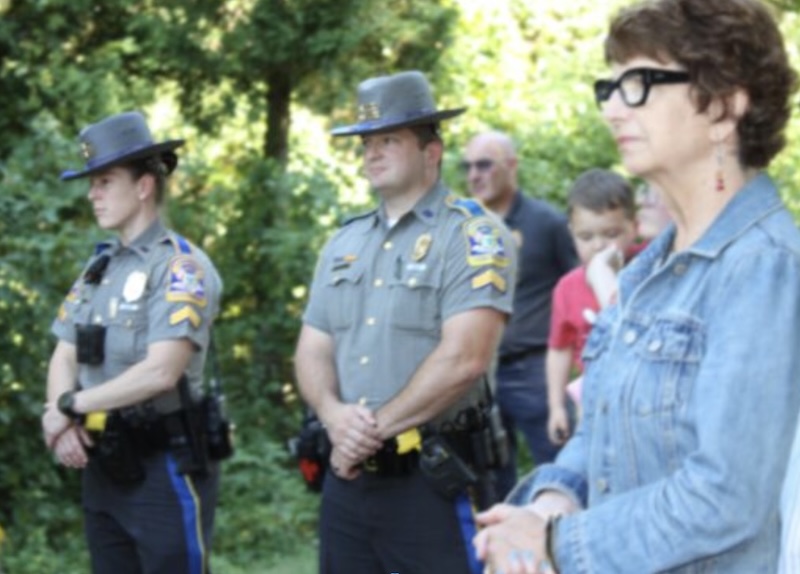
OLD LYME–Two state troopers recognized for helping a distressed woman off the side of the Baldwin Bridge in 2023 joined a group of suicide awareness advocates on Friday to commemorate the installation of new signs reminding everyone that help is out there.
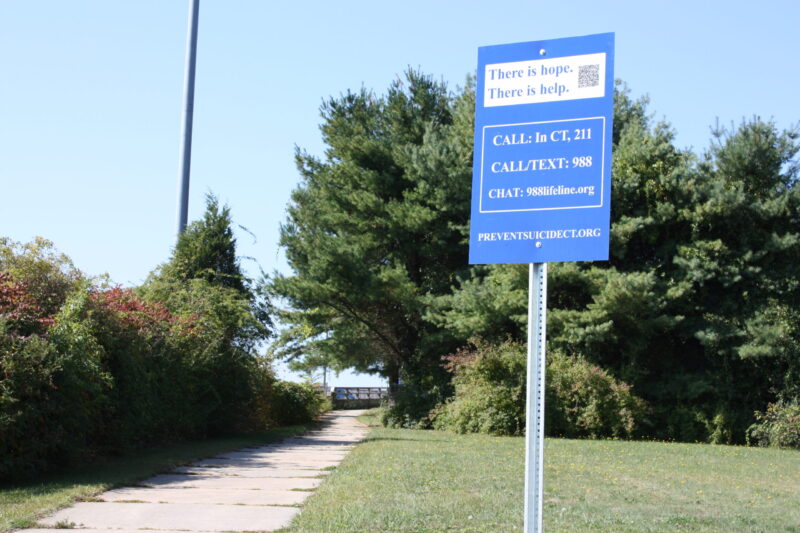
The four plain blue signs, installed on Old Lyme and Old Saybrook ends of the sidewalk along the bridge’s southbound span, direct those who have lost hope to the 988 Suicide & Crisis Lifeline.
Lymes’ Youth Service Bureau Director Mary Seidner during a ceremony on the Baldwin Bridge trail credited Sergeants Ashley Harkins and Matthew Belz with inspiring her to get the signs installed. A group of local, regional and state leaders made it happen.
Belz and Harkins on Friday morning recalled for reporters the day over a year and a half ago when they found the woman perched atop a 5-inch ledge on the river side of a tall metal fence. Several 911 calls had alerted police to the despondent woman.
“I made the connection with her,” Belz said, describing his position on the sidewalk as Harkins navigated the grooves of metal mesh in uniform boots to get herself up and over the fence to the woman’s side.
Harkins remembered having difficulty at first scaling the fence in her uniform and thick boots.
“Then I kind of took a quick second and reevaluated it, and I was like, ‘OK, this is what we’re doing. I’m doing this,’” she said. “And then I just did it.”
For Harkins and Belz, helping people at risk of suicide is first and foremost about connection.
“Showing that you care is a big step,” Belz said.
State police shared the emotional and harrowing body camera footage shortly after the incident to call attention to the troopers’ quick, decisive actions. Harkins could be seen on the narrow shelf, one or two hands gripping the fence at all times, while she kept the woman close to the fence with her body.
The sergeants coaxed the woman onto Harkins’ bent legs so troopers on the other side could pull her to safety. She was taken by ambulance for treatment, according to state police.
Friday’s ceremony included a presentation by State Rep. Devin Carney, R-Old Lyme, of a citation from the state legislature to the troopers for “heroic actions saving a life in crisis.” The recognition was introduced in Hartford by Carney and State Sens. Martha Marx, D-New London, and Norm Needleman, D-Essex.
“You saved a life. You saved a family’s heartache,” he said. “You gave someone an opportunity for the future.”
Sergeants Ashley Harkins and Matthew Belz were honored Friday for helping a distressed woman off the side of the Baldwin Bridge in 2023, an action credited with inspiring the placement of suicide prevention signs on the span.
Seidner told the audience of roughly 50 people that she started researching signs after she heard about the rescue. That’s when she engaged Old Saybrook Youth and Family Services Director Heather McNeil in the process.
“I know some [bridges] have signs, but ours did not,” she said.
Southeast Regional Action Council (SERAC) Director Mark Irons said the effort in technical terms comes down to “lethal means prevention.”
“What can we do when someone’s choice leads them to potentially making a lethal decision? In the case of high places and bridges, we have the opportunity to use signage,” he said.
The signs were funded with SERAC dollars through the state Department of Mental Health and Addiction Services and manufactured by incarcerated individuals in the state correction system.
“There’s a notion that a crisis can be momentary, and we’re looking for some small breaks or opportunities to intervene,” Irons said. “In the case of seeing a sign, the message of hope and support can really make a difference.”
He said the signs can, and have, made a difference for people who stop to call or text the hotline number to find someone on the other side.
“Connection is prevention,” he said. “And that’s what’s happening here.”
Danielle Amaral, a facilitator with Eastern Connecticut Suicide Advisory Board, pointed to statistics showing 49,000 people die by suicide every year, or one every 11 minutes.
According to data from the U.S. Centers for Disease Control (CDC), 356 people in Connecticut died by suicide in 2023, marking one of the lowest suicide rates in the country.
“In Connecticut, we’re talking about it more,” Amaral said. “And that’s what it takes … talking about it.”
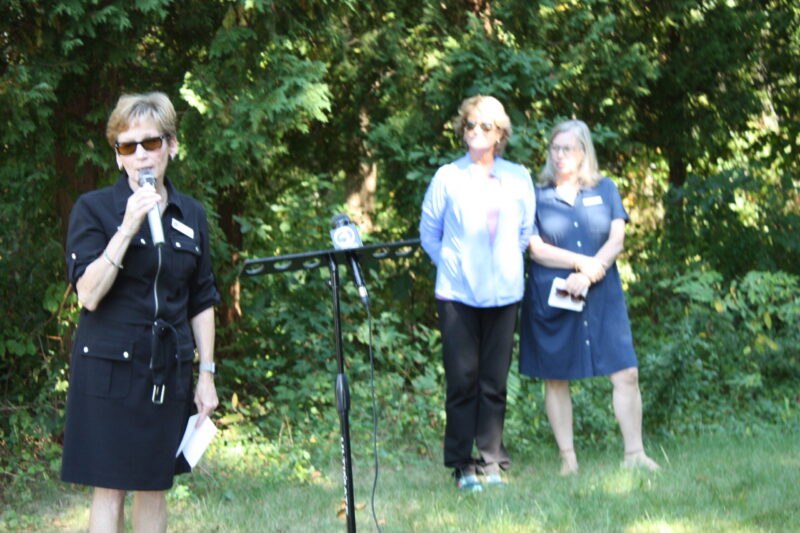
Ann Dagle addresses a crowd of roughly 50 people at a ceremony to commemorate new suicide prevention awareness signs on the Baldwin Bridge. Looking on are Old Saybrook Youth and Family Services Director Heather McNeil (left) and Lymes’ Youth Service Bureau Director Mary Seidner.
Ann Dagle, a grief counselor and founder of the Brian’s Healing Hearts center in East Lyme, said September is a difficult and immersive time for many prevention advocates. Her work during Suicide Awareness Month is consumed with presentations, training sessions and outreach for 30 days straight.
Dagle’s son, Brian, died by suicide in 2011 while in his sophomore year of college.
“It’s challenging to work in this space all the time, but days like this give us hope,” she said. “They give us hope that we can make a difference. They give us hope that we can save lives.”
If you or someone you know is in crisis, please reach out to the 988 Suicide & Crisis Lifeline or text “HELLO” to 741741 for free, confidential support at any time.
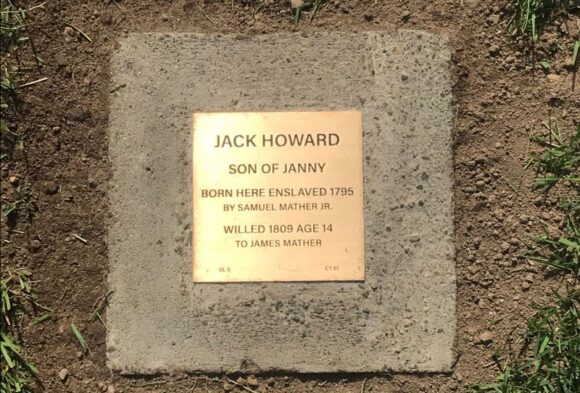
This Witness Stones plaque commemorating the life of the enslaved Jack Howard is located at 5 Lyme Street, the parsonage of the First Congregational Church of Old Lyme.
HAVERHILL, MA–Two organizations committed to recovering hidden histories, commemorating enslaved individuals and fostering a deeper understanding of the country’s complex past have joined forces.
The Connecticut-based Witness Stones Project, which includes an active presence in Lyme and Old Lyme, has been absorbed by Historic New England, a preservation organization out of Massachusetts that goes back to 1910.
The merger was announced Thursday in a press release from Historic New England. It brings the Witness Stones Project under the banner of Historic New England’s Stopping Stones initiative, which honors enslaved Americans through the installation of permanent markers and community ceremonies.
Both the Witness Stones Project and Stopping Stones use small plaques in the ground to mark sites of enslavement – including 300 Witness Stones in seven states and more than 90 Stopping Stones from Vermont to Texas – but only the Witness Stones program incorporates a robust educational component.
The Witness Stones Project in a website announcement said former Witness Stones Director of Operations Liz Lightfoot, of Lyme, will take on the role of Stopping Stones school and youth program manager. She will continue to use Witness Stone’s trademarked curriculum to help students explore historical records and to tell the stories of forgotten individuals, the group said.
The Witness Stones announcement said schools, churches, and community organizations involved locally can rest assured their work is being preserved and will serve as a foundational part of the expanded effort.
“And for the communities where we are currently working and will work in the future, the important research, education, and installations will proceed with the full backing of Historic New England’s resources,” the group said.
The Witness Stones Project was founded in 2017 by Dennis Culliton of Guilford. Stopping Stones, which is part of Historic New England’s Engagement Arts Fund, began in 2020 under the leadership of Paul Growald.
Growald said joining with the Witness Stones Project enables his group to add a “powerful educational dimension” to the physical markers.
“I have long envisioned curriculum components that accompany our memorials, inviting participants of all ages into this work,” he said. “This partnership fulfills that vision, aligning remembrance with education and community dialogue in a way that can truly transform how America reckons with its history.”
The expanded Stopping Stones team is led by director Pat Wilson Pheanious, a ninth-generation descendant of enslaved individuals in Guilford whose family history was among the first researched by the Witness Stones Project eight years ago. She is the founding chairman and a former executive director of the Witness Stones Project.
“Embracing the past is vital to shaping America’s future,” Pheanious said in the Historic New England release. “This collaboration ensures that the work of these programs will remain strong, protected, and accessible to communities everywhere.”
Historic New England CEO Vin Cipolla said the new collaboration will allow both groups to expand their reach nationwide by pairing memorial installations with classroom learning and community dialogue.
“By uniting the Witness Stones curriculum with the national reach of the Stopping Stones program, we can ensure that the lives and legacies of enslaved people are recognized, remembered, and taught to future generations,” he said.
Both initiatives are inspired by Germany’s Stolpersteine Project, which commemorates Holocaust victims with “micro-monuments” placed in public spaces.
The merged groups will operate as part of Historic New England’s Recovering New England Voices (RNEV) initiative. RNEV supports research, storytelling, and public engagement to elevate underrepresented histories, including those of Indigenous people, women, immigrants, LGBTQ communities, and enslaved individuals.
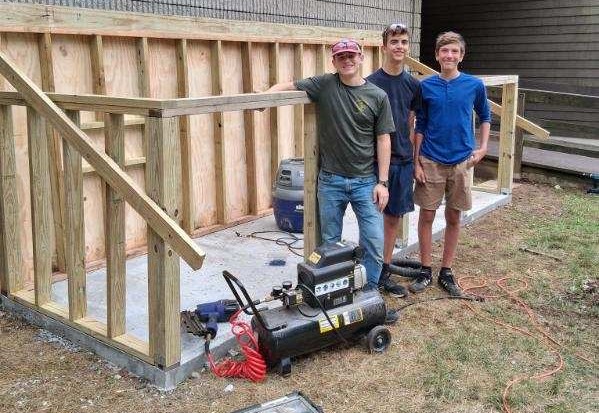
Henry Kyle recruited several friends to help him build a beach wheelchair shed at Rocky Neck State Park as part of his Eagle Scout project for the Boy Scouts of America. Left to right are Alex Glaras, Noah Brant and Kyle.
EAST LYME–A new beach wheelchair shed for Rocky Neck State Park is in place thanks to a soon-to-be Eagle Scout from Old Lyme.
Boy Scout Henry Kyle of Troop 26, the son of Chris and Kate Kyle, assembled a crew of four Scouts and some of their parents to help protect beach wheelchairs from the elements. Project supporter Jolene Brant shared the details about the effort, which she described as ambitious from the start.
An Eagle Scout project, usually completed in a day or two with the help of volunteers, is a community service effort carried out by a Boy Scout to earn the rank of Eagle. It is touted by the Boy Scouts of America as a demonstration of leadership, planning, and problem-solving.
Kyle, a sophomore student at Lyme-Old Lyme High School, is set to receive his Eagle Scout recognition at the end of the month.
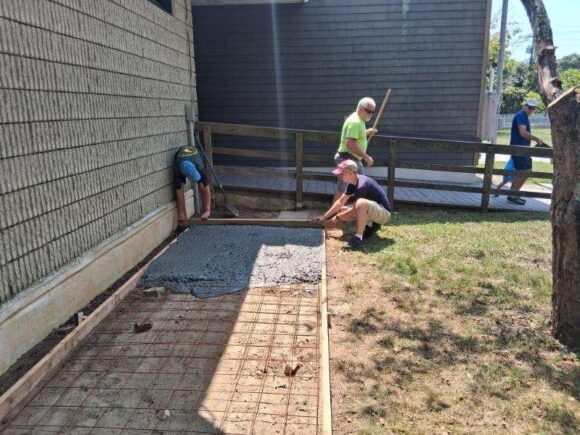
Henry Kyle and Alex Glaras work with Steve Urbowicz to lay concrete.
Kyle chose the Rocky Neck project after he saw the need for the enclosure, which was affirmed when a state park employee told him it would be helpful if a Boy Scout could do the work as an Eagle project. He thought it over and decided he was the person that could take the lead on it, Brant said.
The project required approval from the Connecticut Department of Energy and Environmental Protection (CT DEEP), which took about three months. Meanwhile, Kyle had to pivot after the concrete contractor he initially secured fell through due to health issues. That’s when Kyle’s Boy Scout connections led him to Steve Urbowicz of the Branford-based Concrete Connections.
Urbowicz donated the concrete, the delivery, and his time to teach the Boy Scouts how to pour and finish concrete.
The project was also supported by Park Supervisor Marcella Hube, maintainers David Leiper, Cody Mullen, and Brett Lewis, as well as previous Park Supervisor John Guglielmoni.