
Legal News You Can Use: Is My Case a Personal Injury or Worker’s Compensation Claim?

WorkersCompAs an attorney who practices both Worker’s Compensation and Personal Injury Law, I find that many people are confused as to if and where these systems overlap. Although there are many similarities between these two areas of law, there are a number of significant differences that make the representation of clients in either scenario unique.

Personal injury claims fall under the broad area of law called torts, and arise out of what is known as the “common law.” The “common law” is derived from the English legal system and is essentially a set of laws and rules that have developed over hundreds of years of court and appellate decisions.

It is a body of law that is constantly changing as courts review prior decisions and either affirm, or modify the decisions that came before. Although there are certain statutes (written laws passed by the State and Federal Legislatures) that govern personal injury actions, by and large most personal injury actions are based on common law decisions.

Specific to personal injury actions, it is the law of the land that all individuals or entities (like businesses) owe a duty to all members of society to act in a way that is reasonable and does not intrude on anyone else’s safety. If a person or entity breaches that duty and someone gets injured, that someone (who is now a potential plaintiff) has a cause of actions against the breaching party (now a potential defendant). In these claims the plaintiff must prove that the defendant is at fault. If they win, they are entitled to recover money for both economic damages (medical bills, lost wages, etc.) and non-economic damages (including pain and suffering).

In Connecticut these claims can be brought in court if the parties cannot agree to a settlement.  There the claims can either be tried before a judge or a jury of six. In the alternative, if the parties agree, the claims can be privately mediated outside the court system. If the plaintiff prevails in his or her claim, most often the damages are awarded all in one shot. No matter what though, eventually every case comes to an end by way of settlement or trial and verdict and very rarely will a plaintiff receive any type of compensation until the case is over.

Although a form of lawsuit, Worker’s Compensation is the exclusive remedy for injuries that occur on the job. Claims are brought before the Worker’s Compensation Commissioner and an injured worker cannot sue their employer at common law.  Why? Because around the turn of 20th Century, with industrial production in America in full bloom, workers injured on the job had the right to sue their employers for injuries on the job. As the advent of the contingency fee allowed people who could never afford it before, access to the courts, and employers pressured the legal system to come up with theories to limit recovery, something had to give.

It was actually employers (who wanted to be able to cap their potential exposure in the event they were sued) who pushed for Worker’s Compensation laws. Under virtually every Worker’s Compensation scheme injured workers are entitled to both economic and non-economic damages. However, a big difference between Worker’s Comp and personal injury is that Comp is a “no-fault” system. An injured worker need not prove that his/her employer was at fault for his/her injuries. He/she need only prove that they were injured while in the scope and course of their employment. How it happened is relatively unimportant.

If the injured worker can establish that, then they are entitled to benefits. But unlike personal injury, what the injured worker is entitled to is entirely dictated by statute rather than the common law. In addition, because it is “no-fault,” whatever they are entitled to, they receive as soon as it becomes due. The trade-off is that there are built in caps on these statutory benefits.

For example, there is a maximum weekly compensation rate you can receive regardless of how much money you make, and irrespective of how badly you are hurt. Likewise, there are statutory rules governing exactly how much pain and suffering you can receive based on a scheme too complex to explain in this brief article. However, unlike a personal injury suit, a Worker’s Compensation case never has to come to an end. Although Comp cases are often permanently settled, neither side is obligated to do so and the claim could remain open until the death of the claimant.

Regardless of which system you are looking at, as someone who has practiced in both areas for almost 25 years, they represent a good faith attempt to make whole those individuals who unfortunately need to avail themselves of these laws. Although far from perfect, they are part of the fairest and most accessible legal system on the planet.

About the author: Attorney Robert B. Keville is a Director at Suisman Shapiro Attorneys-at-Law, the largest law firm in eastern Connecticut.  If you have questions about these topics or other injury matters, he can be reached via email at rkeville@sswbgg.com or by phone at (860) 442-4416.


Opinion: “The Menace in our Midst:” Comments Closed to FRA on Old Lyme Proposed Railtrack, But Still Open on LymeLine!

Old Lyme First Selectwoman Bonnie Reemsnyder stands at the podium at Wednesday's press conference at the Florence Griswold Museum. State officials and some of the signatories of a letter to the FRA denouncing Alternative 1 stand around her.

Old Lyme First Selectwoman Bonnie Reemsnyder stands at the podium at Wednesday’s press conference at the Florence Griswold Museum. State officials and some of the signatories of a letter to the FRA denouncing Alternative 1 stand around her.

Screen Shot 2016-02-11 at 2.28.57 AMIn the space of just a few short weeks, the residents of Old Lyme have become aware of a menace in their midst. Most unusually for these same residents, their response has been to a man (or woman) identical.  When that happens in this town — unquestionably, a rare event — you can be sure that, ‘Something is rotten (to misquote Hamlet) in the state of Old Lyme.’
The ‘menace’ in this case is Alternative 1 of the three high-speed railtrack routes proposed by the Federal Railroad Authority (FRA) in their Northeast Corridor (NEC) Future plan.

But let’s backtrack for a second — why is the FRA proposing these new routes? Their objective is, “to improve the reliability, capacity, connectivity, performance, and resiliency of future passenger rail service … while promoting environmental sustainability and continued economic growth.”  Let’s say right away that we are fully supportive of this objective — we are huge fans of rail-travel — you cannot grow up in Europe without taking rail travel for granted.  The trains there are fast, clean and efficient … they are a way of life.  We absolutely wish it were the same in the US.

So what is the difference here?  Why has the reaction to Alternative 1 been so strong, so united, so passionate?  In case you are unaware, Alternative 1 calls for the high speed rail track to cross the Connecticut River over a new bridge a little higher up the river than at present and then travel to the center of Old Lyme bisecting Lyme Street by eliminating both the western and eastern campuses of Lyme Academy College of Fine Arts before turning north and crossing I-95.  The 1817 John Sill House, currently owned by the Academy and situated on its campus, would likely be acquired by the FRA by eminent domain and then demolished.

The impact of a high-speed railtrack through that sector of town would be totally devastating for our community, effectively destroying its very heart.

This editorial could now run for pages to explain the full spectrum of impact to Old Lyme of this proposal.

We could discuss the horrific effects on our incredible local environment — one which has inspired artists for generations including some of the greatest impressionist painters in American history and one officially designated as a “Last Great Place.”

We could talk about the untold damage to the storied structures on Lyme Street and list the irreplaceable buildings that will either be completely destroyed or permanently scarred by this new train track construction, many of which are either National Historic Landmarks or on the National Historic Register.

We could mention that Lyme Street is the joyful, bustling hub of our little town — it has a unique personality and touches every aspect of our community life.  It is home to our town hall, our public schools, our daycare, our youth services, our library, our churches, our village shops, our art college, our art association (the oldest in the country), and the Florence Griswold Museum (a national institution.)  Can you even begin to imagine Lyme Street with a high speed railroad running across it?

And let’s just consider for a minute what this proposal, if implemented, would achieve?  Bearing in mind that you can already travel from London to Paris (286 miles) in 2 hours and 15 minutes, would we be able to hop on a train in Old Saybrook and be in Washington DC (334 miles) roughly two hours and 45 minutes later?  No, the current travel time of six hours would be reduced by a grand total of 30 minutes to 5 hours and 30 minutes.  Unbelievable.

As we said, we could go on for pages but others have kindly taken care of that for us.  There was a splendid press conference yesterday, which spelled out the craziness of Alternative 1 from every angle — coldly, clinically and objectively.  The Old Lyme-Phoebe Griffin Noyes Library has a full print copy of the NEC Future tome if you care to read it in its entirety.  There are links galore on the Old Lyme Town website to the statement and attachments submitted yesterday (Feb. 10) on behalf of some 20 local organizations to the FRA.

So please read and educate yourself on Alternative 1, but most importantly, please, please write to the FRA with your thoughts.  There are many questions as to why and how this proposal was able to be presented without a single public hearing being held closer than 30 miles away from a town on which it was having such a major impact.  But that is history now …

The comment period was originally only until Jan. 31, but there was such a huge outcry as the reality of Alternative 1 began to be fully understood that it has been extended to next Tuesday, Feb. 16.  The FRA needs to hear from each and every one of us — you don’t need to write an essay, you don’t need to write eloquently, in fact, you don’t really need to write much at all, but you do need to write — today or tomorrow, even the next day, but if you have anything to say about Alternative 1 and want your voice to be heard, you absolutely must write.

There are three ways to contact the FRA:

Online through the NEC website: Submit your comment directly at http://www.necfuture.com/get_involved/

Email: Send comments with attachments to comment@necfuture.com

Snail-mail: Mail your comments to:
NEC Future
U.S. DOT Federal Railroad Administration
One Bowling Green, Suite 429
New York, NY 10004

We sincerely hope that there will soon be a public forum of some sort where people can ask questions and comment in person but, in the meantime, we say again, PLEASE, PLEASE WRITE TO THE FRA!

Lyme-Old Lyme HS Alum Chris Bugbee Captures Video of Only Known Wild Jaguar in US

Conservation CATalyst and the Center for Biological Diversity released new video today of the only known wild jaguar currently in the United States. Captured on remote sensor cameras in the Santa Rita Mountains just outside Tucson, the dramatic footage provides a glimpse of the secretive life of one of nature’s most majestic and charismatic creatures. This is the first ever publicly released video of the jaguar, and it comes at a critical point in this cat’s conservation.

El Jefe video

The camera project is part of ongoing efforts to monitor mountain ranges in southeastern Arizona for endangered jaguar and ocelot. Chris Bugbee, a graduate of Lyme-Old Lyme High School and now a biologist with Conservation CATalyst, has been collecting data on the Santa Rita jaguar for the past three years (formerly through the University of Arizona).  Bugbee is the son of Old Lyme’s Parks and Recreation Director Don Bugbee and the Rev. Rebecca Crosby, Minister for Haitian Outreach at the First Congregational Church of Old Lyme.

“Studying these elusive cats anywhere is extremely difficult, but following the only known individual in the U.S. is especially challenging,” said Bugbee. “We use our specially trained scat detection dog and spent three years tracking in rugged mountains, collecting data and refining camera sites; these videos represent the peak of our efforts.”

“These glimpses into his behavior offer the keys to unlocking the mysteries of these cryptic cats” said Aletris Neils, executive director of Conservation CATalyst. “We are able to determine he is an adult male jaguar, currently in prime condition. Every new piece of information is important for conserving northern jaguars and we look forward to building upon on these data so that we can collectively make better decisions on how to manage these fascinating and endangered cats.”

“Jaguars have always occurred in Arizona and yet we know so little about them in the northern portion of their range. Arizona should be poised to harbor and protect both jaguars and ocelots as they continue to disperse out from Sonora,” said Bugbee, who now lives in Tucson, Ariz.

Bugbee was featured in an article about the video of the jaguar by William Yardley titled, “He roams alone: El Jefe may be the last wild jaguar in the U.S.” and published in the Los Angeles Times on Wednesday, Feb. 3.

“Just knowing that this amazing cat is right out there, just 25 miles from downtown Tucson, is a big thrill,” said Randy Serraglio, conservation advocate with the Center. “El Jefe has been living more or less in our backyard for more than three years now. It’s our job to make sure that his home is protected and he can get what he needs to survive.”

El Jefe, as he has come to be known in Tucson, has been photographed repeatedly by remote sensor cameras in the Santa Ritas over the past few years. He is the only verified jaguar in the United States since Macho B was euthanized as a result of capture-related injuries in March 2009. “Jaguars are solitary cats that only tolerate each other for reproduction,” said Neils.

But a huge conflict is brewing that threatens to destroy El Jefe’s home. A Canadian mining company is pushing to develop a massive open-pit copper mine right in the middle of the big cat’s territory. The mile-wide open pit and 800-foot-high piles of toxic mine waste would permanently destroy thousands of acres of occupied, federally protected jaguar habitat where this jaguar lives.

“Clearly, the Santa Rita Mountains are a vital part of this cat’s home range,” said Bugbee. “This jaguar has been photographed in every month of the year in these mountains — there are more than 100 detections of him in the Santa Ritas since 2013 — how could anyone argue the importance of these mountains?”

“The Rosemont Mine would destroy El Jefe’s home and severely hamstring recovery of jaguars in the United States,” said Serraglio. “At ground zero for the mine is the intersection of three major wildlife corridors that are essential for jaguars moving back into the U.S. to reclaim lost territory. The Santa Rita Mountains are critically important to jaguar recovery in this country, and they must be protected.”

In October the rare cat was named “El Jefe,” which means “the boss” in Spanish, after a vote by Tucson school kids and others. The Tucson-based Center for Biological Diversity has been working for decades to save jaguars in the United States, with the hope that El Jefe will soon be joined by more jaguars that wander up from Mexico. In 2014 the Center secured more than 750,000 acres of federally protected critical habitat for U.S. jaguar recovery.

Jaguars — the third-largest cats in the world after tigers and lions — once lived throughout the American Southwest, with historical reports on the South Rim of the Grand Canyon, the mountains of Southern California and as far east as Louisiana. Jaguars disappeared from their U.S. range over the past 150 years, primarily due to habitat loss and historic government predator control programs intended to protect the livestock industry. The last verified female jaguar in the country was shot by a hunter in 1963 in Arizona’s Mogollon Rim.

This research builds upon a three-year project (2012- 2015) from the University of Arizona surveying jaguars and ocelots throughout southern Arizona and New Mexico.

Editor’s Notes: i) The Center for Biological Diversity is a national, nonprofit conservation organization with more than 990,000 members and online activists dedicated to the protection of endangered species and wild places.

ii) Conservation CATalyst is a Tucson-based nonprofit organization specializing in conducting scientific research on cats that are in conflict with people.

Letter from Paris: Marmottan Monet Museum Offers Rare Glimpse of Villa Flora’s ‘Enchanting Times’

Nicole Prévost Logan

Nicole Prévost Logan

It is a well kept secret that Switzerland’s private foundations own a wealth of  art works.  Swiss law does not require them to be registered commercially and offers them favorable tax and legal conditions, creating thus a “paradise” for art collectors.  The Villa Flora, in Winterthur near Zurich, is one of the richest of these family foundations.  Since the museum is under renovation this winter, its contents found a temporary home at the Marmottan Monet museum in Paris and currently form the Villa Flora exhibition subtitled, “A Time of Enchantment.”

In 1898  Hedy Hahnloser inherited from her father, a well-to-do textile  industrialist, a large house and moved in with Arthur, her husband.  For a short time, Arthur practiced ophthalmology in the clinic he installed on the property but soon the couple became fully engaged in the passion of their life, which was to create long-lasting friendships with painters and to collect their works.

Over the years, the rambling house was turned into a studio and an art gallery — every available space was used to place the paintings.  Hedy had always been interested in arts and crafts and in the English movement by that name.  She decorated her house’s parquets and wainscots with the geometric designs characteristic  of the 1897 “Viennese Recession” led by Gustav Klimt.

A trip to Paris in 1908 was for the couple a total immersion into the frantic artistic scene of the French capital.  Braque and Picasso were experimenting with cubism, while the Fauvist movement was at its pinnacle.  The natural flair of the Hahnlosers in selecting art work was sharpened by their contacts with art merchants like Ambroise Vollard and Gaston Bernheim.

During that trip they met and struck up a friendship with Felix Valloton (1865-1925), who became a close friend, spent much time at the Villa Flora and also introduced them to the artistic circles of Paris.  They remained friends until his death.  For the Swiss couple to welcome artists and hold Tuesday coffees became a way of life.

One can compare their creative and welcoming home with the boarding house in Old Lyme, Conn., where Florence Griswold invited American Impressionists.  Or consider Gertrude Stein and her brother Leo who, like Arthur and Hedy, opened their “salon” on 27 rue de Fleurus to artists and writers.  And in yet another example, in the late 19th century, Russia also had its own artist colonies, which grew around enlightened members of the nobility.  The best known was Abramtsevo, near Moscow, created by  the industrialist Savva Mamontov.

Pierre Bonnard, Débarcadère (or L’Embarcadère) de Cannes, 1928-1934

Pierre Bonnard, Débarcadère (or L’Embarcadère)
de Cannes, 1928-1934

The Hahnlosers’ collection contained works by Cezanne, Van Gogh,  Manet, Renoir, Matisse, Toulouse-Lautrec, the symbolist Odilon Redon and many others. But it is the abundance of  Nabis’ art, which made  it quite unique.

It was a post-impressionist movement in the mid 1890s.  “Nabi” means prophet in Hebrew and Arabic.  The leading members of this group — Maurice Denis, Felix Vallotton , Pierre Bonnard, Edouard Vuillard — considered themselves as the prophets of a new era in the arts.  Each one had his distinctive style, but there was always a message behind their way of depicting reality, whether it was religious, intellectual or emotional.  They were versatile artists, working in oil, and also lithography, wood cuts, satirical drawings, and book or poster illustration.

Vallotton stylized his subjects and used the technique of  “aplats” or flat areas of contrasting colors with sharp outlines.  There is a feeling of enigmatic  emptiness in his works. “La Charette” or cart drives away on a deserted dirt road, two slender umbrella pines contrast with the darker mass of trees bordering the road.

man&woman
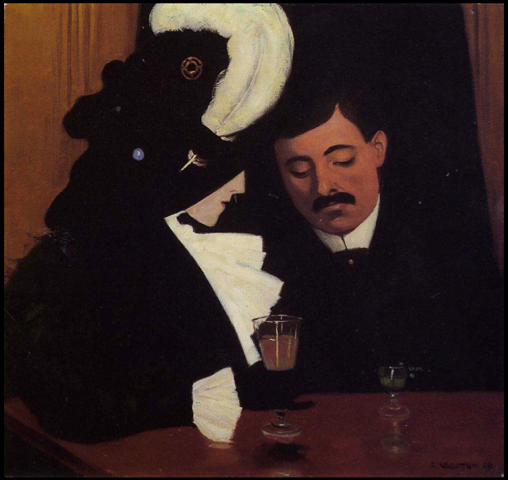
Le provincial,” pictured above, shows a couple in a cafe.  One barely sees  the profile of the elegant woman wearing a huge hat.  The feather on the hat and the ruffled blouse are the only bright notes in this scene of a non-communicating couple in the male chauvinistic society at the turn of the 20th century.

Vallotton’ masterpiece is “La Blanche et la Noire”  (The White and the Black).  A white woman is lying, unabashedly naked, on a bed while a black woman is staring at her with insolence and a sort of inappropriate familiarity, a cigarette is sticking out of  her mouth. The painting is reminiscent of  the “Olympia” by Manet but with a different underlying story.

At the opposite end of the spectrum, Bonnard’s paintings have an effusive and warm quality.  His colors are luminous, his brush strokes seem unbridled, full of life.  He is inspired by the intimacy of domestic scenes — “Le Tub” is a picture within a picture thanks to the mirror placed at the center of the composition.   A plunging angle reveals Marthe, his wife and beloved model, near the tub.

Pierre Bonnard, Le Thé, 1917

Pierre Bonnard, Le Thé, 1917

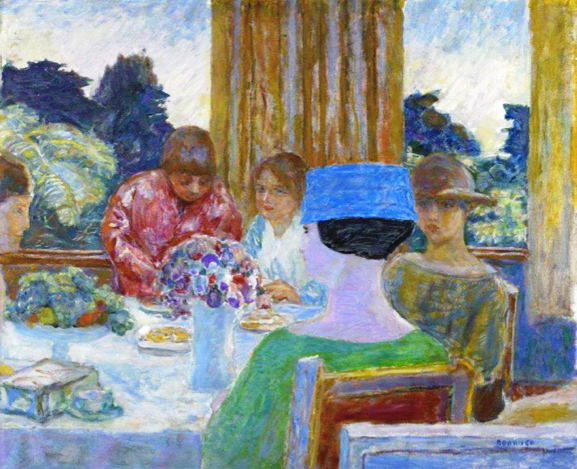
Bonnard cherished his villa in the Var, not far from Cannes.  “Le Thé” is a peaceful scene of young women having tea . He plays with an array of hat colors.  The vegetation seems to overflow into the porch.  On “Le Debarcadère” or pier,  young people lean over a railing, as if frozen in the contemplation of the rough Mediterranean waters.

This is indeed a rare opportunity to see an exceptional private art collection created by two extraordinary citizens, who according to the exhibition’s guide, lived their lives by following a simple mantra, “Living for art. Collecting. Such was the raison d’être of [this] couple.”

Nicole Prévost LoganAbout the author: Nicole Prévost Logan divides her time between Essex and Paris, spending summers in the former and winters in the latter. She writes a regular column for us from her Paris home where her topics will include politics, economy, social unrest — mostly in France — but also in other European countries. She also covers a variety of art exhibits and the performing arts in Europe. Logan is the author of ‘Forever on the Road: A Franco-American Family’s Thirty Years in the Foreign Service,’ an autobiography of her life as the wife of an overseas diplomat, who lived in 10 foreign countries on three continents. Her experiences during her foreign service life included being in Lebanon when civil war erupted, excavating a medieval city in Moscow and spending a week under house arrest in Guinea.



Carney, Linares to Hold Office Hours in Westbrook, Feb. 9

State Representative Devin Carney (R-23rd)

State Representative Devin Carney (R-23rd)

State Rep. Devin Carney (R-23rd) will hold pre-session office hours in Old Saybrook at the Saybrook Point Pavilion on Monday, Jan. 25, starting at 6 p.m., in Old Lyme at the Phoebe Griffin Noyes Library on Wednesday, Jan. 27, starting at 6 p.m., and in Westbrook at the Westbrook Town Hall on Feb. 9, starting at 6:30 p.m.

Carney will be joined in Old Saybrook on Jan. 25 by State Senators Art Linares (R-33rd) and Paul Formica (R-20th).

At the Old Lyme event, Carney will be joined by State Senator Paul Formica: State Representative Jesse MacLachlan (R-35th) and Linares will join Carney at the Westbrook event.

State Senator Paul Formica (R-33rd)

State Senator Paul Formica (R-33rd)

These sessions will provide constituents with an opportunity to ask questions or share their ideas and concerns about state government. Anyone with questions about the event can contact Carney’s office at 800-842-1423 or devin.carney@housegop.ct.gov.

Carney represents the 23rd General Assembly District that includes Lyme, Old Lyme, Old Saybrook and part of Westbrook.

State Senator Art Linares

State Senator Art Linares (R-20th)

Formica represents the 20th District comprising  Old Lyme, along with Bozrah, East Lyme, Montville, New London,Old Saybrook, Salem and Waterford.

Linares represents the 33rd District comprising Lyme along with Chester, Clinton, Colchester, Deep River, East Haddam, East Hampton, Essex, Haddam,  Old Saybrook, Portland and Westbrook