Letter From Paris: Welcome ‘Le Grand Paris!’ New Geographical Region Becomes a Reality

Nicole Prévost Logan

Nicole Prévost Logan

On January 1st, 2016 the “Metropole du Grand Paris” became official .  This new territorial organization, named Etablissement Public de Cooperation Intercommunale (EPCI),  includes Paris plus parts of three departements Hauts de Seine, Seine St Denis and Val de Marne– with seven millions inhabitants.

What is the Grand Paris ?  Why is it a necessity?  Is it a decisive step forward? Does it have models in other countries?  What are the  problems it is facing ?  Anyone curious to learn how France works and what lies in the future might be interested in having a look at this new concept.

The project was born in 2007 under President Sarkozy’s mandate.  When the Socialists came to power in 2012, they immediately modified the initial proposal.  But the authors of the project kept plodding away.  Its official status represents a progress toward the long term objective, which is to be ready for the Olympic Games in 2024 and the 2025 World Fair, in the event Paris is chosen.

The French capital is choking inside the beltway and something had to be done:  the town of Paris is too small and too expensive even to accommodate the middle class; suburbia, which used to provide a labor force in the former industrial economy, is hit today by unemployment ; this same suburbia feels isolated because of inadequate public transport (if you drive into work you might spend hours in bouchons or traffic jams on the highway).  The RERs (Regional Rapid Transit) are overcrowded and often unsafe.
reseau-de-transport-grand-paris-1

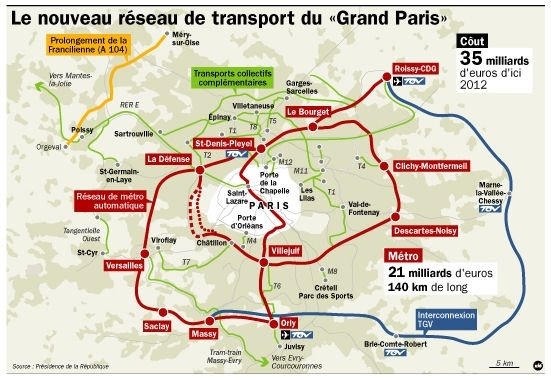
In the new project (see map above), the backbone of public transport will be the Grand Paris Express, six new lines of totally automated trains circling the Paris agglomeration  and connecting, for the first time, the suburbs.  For instance it will be possible to go directly from Boulogne at the west of Paris to Marne la Vallée  (the location of Euro-Disney) in the east.

Until now any change has been hampered by administrative complexity – layer upon layer of  authorities, like a millefeuille  – (a well known and sinful pastry).

The Grand Paris will  include 132 communes.  Mayors wield enormous power in France.  That power is particularly obvious at election time when building permits seem to multiply.  The mayors will have to learn how to live together and adapt to the new administrative structure, which now includes other layers of the bureaucratic millefeuille, namely the departements and the regions (this year they have been reduced from 22 to 13), piled on top.

France is essentially a centralized state.  Culture, finance, education of the elite,  research and development, luxury shops,  are heavily concentrated in Paris and the Ile de France.  Napoleon, Baron Haussmann, General De Gaulle are the great historical figures who left their imprint in the centralization process.  What we are witnessing today is an explosion of the center.  It is even likely that the boundaries of the Grand Paris may expand.

The Grand Paris will be made of ‘clusters’ (in English in the French text) to bring Paris to par with New York , London or Tokyo.  According to the official description of the project, “Greater Paris relies on seven thematic competitive clusters.”  The list includes : Air Space, Trade, Sustainable City, Digital Creation, International Trade, and Life Sciences.  A financial center already exists in the Defense district, which looks like a mini-Manhattan. ,

Saclay, 20 kilometers south of Paris, is the most impressive and modernistic of these clusters.  Until recently an agricultural land, it is now the hub of Research and Development.  Many élite Grandes Ecoles, like Polytechnique,  have  moved there, as well as 23 universities and the headquarters of major companies.  Its emblematic building, spreading over the fields like a giant flying saucer, is the Synchroton Soleil with its accelerators to study light.  Pierre Veltz, an engineer and former head of Saclay, is confident that it will become an European Silicon Valley.

Nicole Prévost LoganAbout the author: Nicole Prévost Logan divides her time between Essex and Paris, spending summers in the former and winters in the latter. She writes a regular column for us from her Paris home where her topics will include politics, economy, social unrest — mostly in France — but also in other European countries. She also covers a variety of art exhibits and the performing arts in Europe. Logan is the author of ‘Forever on the Road: A Franco-American Family’s Thirty Years in the Foreign Service,’ an autobiography of her life as the wife of an overseas diplomat, who lived in 10 foreign countries on three continents. Her experiences during her foreign service life included being in Lebanon when civil war erupted, excavating a medieval city in Moscow and spending a week under house arrest in Guinea.

The Movie Man: Latest ‘Star Wars’ Extravaganza Forcefully Rebukes Critics

SW-THE-FORCE-AWAKENS
A long time ago in a galaxy far, far away …

A young and ambitious filmmaker named George Lucas created Star Wars, which changed the face of the movie industry forever. Since its release in 1977, the Star Wars universe has expanded into other forms of media, such as books, video games, television, music, toys, and more. It spawned two sequels, which were received as well as the first film, and eventually spawned a prequel trilogy, which, well, did not fare so well, mainly due to poor stories, poor acting, and overemphasis on green screen visual effects.

And three years ago, when George Lucas’ studio, LucasFilm, was sold to Disney, and its new owner announced more movies to come, many of us groaned. How could they take this galaxy to an even lower level after Jar-Jar Binks, and shoddy acting by Hayden Christensen as a young Darth Vader?

This past week changed our opinions. On Dec. 17, the United Kingdom got the first glance at Star Wars, Episode VII- The Force Awakens, directed by big and small screen legend J. J. Abrams. To play on the immortal words of Sir Alec Guinness as Obi-Wan Kenobi: “I felt a great disturbance in the force, as if millions of Disney haters were suddenly silenced …”

Yes, The Force Awakens can be honorably added to the Star Wars saga, not out of necessity to tell the backstory of the legendary Darth Vader. Now we get to see the continuity of our heroes Han Solo, Princess – sorry, General – Leia Organa, and Luke Skywalker. There are also newcomers to the story, with Oscar Isaac as pilot Poe Dameron, Daisy Ridley as Rey, and John Boyega as Finn, and last but not least, Adam Driver as villain Kylo Ren.

All performers do not disappoint … although it is very unlikely in the first place, I would have nominated them for a Screen Actors Guild Ensemble award. And who can forget the new droid, BB-8, who caught our attention the moment we saw him in the teaser trailer released last Thanksgiving?

What’s even more amazing is that BB-8 is not CGI, he is, in fact, built as a real robot. Which is another theme in this film, being that those behind The Force Awakens only used CGI effects when necessary, preferring to use practical effects — similar to those used in the original trilogy — in order to give it a more believable visual feel (the major mistake George Lucas made from The Phantom Menace to Revenge of the Sith was using the computers as much as possible).

And, of course, there returns the music legend John Williams to conduct the score

But the big question we have been asking since the second trailer was released this past April is: where is Luke Skywalker? He has not appeared in the trailers since, and is not on the poster for the film? This has spawned many fan theories that he is, in fact, the villain, Kylo Ren, who wears a mask, or that he is dead. When asked by Jimmy Kimmel the reason behind Luke’s absence (on the poster), Harrison Ford quipped, “They ran out of room.”

Readers, your questions will be answered right away upon screening. And you will see that there are many similar events that took place all the way back with A New Hope. You will perhaps see them as foreshadowing events, or even tributes, since the only way one could dislike this film would be if one is a Holden Caulfield hipster, who is critical of anything mainstream.

The film will not disappoint. And (cue the hand wave) you will return to see it multiple times.

And I can state unequivocally, I will return to see it multiple times … 

(Heads up: I already saw it twice within 36 hours)

Kevin Ganey

Kevin Ganey

About the Author:  Kevin Ganey has lived in the Lyme/Old Lyme area since he was three-years-old, attended Xavier High School in Middletown and recently graduated from Quinnipiac University with a degree in Media Studies. Prior to his involvement here at LymeLine.com, he worked for Hall Radio in Norwich, as well as interned under the Director of Communications at High Hopes Therapeutic Riding Center. Kevin has a passion for movies, literature, baseball, and all things New England-based … especially chowder.

Old Lyme’s Fairfield-Sonn Named All-American by D3Football.com

All American Jimmy Fairfield-Sonn stands with his proud parents, Lynn and Jim Fairfield-Sonn of Old Lyme.

D3Football.com All-American footballer Jimmy Fairfield-Sonn stands with his proud parents, Lynn and Jim Fairfield-Sonn of Old Lyme.

Old Lyme resident Jimmy Fairfield-Sonn, who graduated from Lyme-Old Lyme High School in 2012 and now attends Amherst College where he is a senior safety on the College’s football team, was named to the 2015 D3football.com All-America team, and earned recognition on the Third Team Defense.  Fairfield-Sonn played a key role on the Valley-Old Lyme Co-op football team while attending high school in Old Lyme.

Fairfield-Sonn became the fifth member of the Amherst football team to garner All-America praise from D3football.com. In addition to his most recent accolade, Fairfield-Sonn was also named to the D3football.com All-East Region First Team Defense, the New England Writers Division II/III All-New England Team and the NESCAC All-Conference First Team Defense.

Fairfield-Sonn also picked up two yearly awards and was named the NESCAC Defensive Player of the Year, while also claiming the Joseph P. Zabilski award – which is announced by the Gridiron Club of Greater Boston and recognizes New England’s top offensive and defensive players for Division II and III.

Congratulations, Jimmy!

Click here to read the full article on which this article is based. The original article was first published on the Athletics section of the Amherst College website.


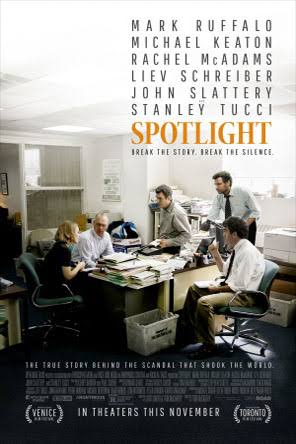
The Movie Man: “Spotlight” Explores How “Globe” Reporters Exposed Priest Sex Scandal

Spotlight_movieTonight, I look back to a scandal that has rocked the institution that preserved Western Civilization in the Dark Ages, transformed hospitals, and, believe it or not, science. Thirteen years ago, the Boston Globe revealed a series of stories to the public, and many in the world began to distrust her. What I speak of is the Catholic Church, and the priest sex scandal.

This is a New England film, as many big parts of New England life are displayed throughout it via product placement. Dunkin’ Donuts, W. B. Mason, and other familiar logos are seen throughout it. For those of us who know Boston well, many popular, yet not mainstream popular, or, rather “hipster” streets are seen and spoken about through dialogue.

We begin in 1976, in which a bishop visits a Boston Police station in regards to a priest who abused a young boy, and he assures the boy and his parents they will never hear from the priest again, and the bishop and the priest then drive off. Twenty-five years later, members of the Boston Globe have a goodbye party for one of their editors who is stepping down after the New York Times bought out the newspaper.

New editor Marty Baron (Liev Schreiber) comes in from Miami and expresses interest in going deeper into a case involving a priest, who severely abused countless children, as he feels there is something that is being hidden from the public.

How could somebody take on a church? This is the basic theme that is dealt with as the journalists from the Globe’s Spotlight section begin to dig deeper and deeper into this horrible scandal. A member of a survivor group, SNAP, comes to them, having previously tried to contact the paper many years prior. While his organization is small, comprised of only 10 members, Spotlight eventually catches on and realizes there has to be a scandal in their midst.

While they are presented with the same facts that we are today when we discuss the scandal, that perhaps only a very small percentage of ordained priests have engaged in such awful activities, they realize they need to take action because there are numerous victims out there with stories to be heard.

Several scenes take place in which the journalists meet with the survivors (as one asserts they are survivors because some ended up taking their lives) and they tell their stories. It is a completely heart-wrenching ordeal to listen to, as they describe being initially excited that their parish priest took an interest in them, only to violate the in the most unimaginable way.

Cardinal Bernard Law, the Archbishop of Boston at the time, is our enemy, despite his cheerful and outgoing personality. The stories of Church corruption in the Middle Ages suddenly return to 21st century America. Cardinal Law is reaching out to officials, taking advantage of loopholes to keep legal documents confirming his corruption away from the public’s eyes.

And though he only appears in three or four scenes, he does not have the lasting effect of the antagonizing villain that we see in other films, such as Anthony Hopkins’ portrayal of Dr. Hannibal Lecter in The Silence of the Lambs consisting of only 16 minutes of screen time, but earning the Academy Award for Best Actor in a Leading Role, and being ranked by the American Film Institute as the greatest villain in the history of film.

Many interesting points are made, as people bring up that these stories were brought to the newspapers on many occasions, but turned down. Michael Keaton’s character, Walter “Robby” Robinson, notes that he originally shot down the claims when he worked for a different section of the Globe 20 years prior, and another brings up that we all stumble around in the dark and only realize what has happened when the light enters. Boston is a tightly-knit community, one character says, pointing out that if it’s true it takes a village to raise a child, as he quips, it also takes a village to [destroy him].

I will not post a disclaimer to share that I am a lifelong Catholic, myself, and have been brought up in the Church in a very intimate manner. Baptism, CCD, First Communion and Reconciliation, Confirmation, Catholic high school, and even participated in campus ministry as a student at Quinnipiac. I do not intend to bash Catholicism, as journalists such as Christopher Hitchens might have done  when reviewing a film like this, nor do I seek to engage in apologies, but rather to show the honest side of the faith.

This film has been received well by the Church, of all viewers, especially by Seán Cardinal O’Malley, Law’s replacement as Archbishop of Boston, who claimed the investigation by the Globe prompted the Church “to deal with what was shameful and what was hidden.” Vatican Radio also shared similar words, calling the film honest and compelling. Anyone who is involved with their local church can describe how there is now a zero-tolerance policy for things of this nature, and how Popes Benedict XVI and Francis have made these events a main focus during their papacies.

I will close with a reference to Dante Alighieri’s epic poem, The Divine Comedy, since I read all three volumes this summer … to my surprise. Plus, who doesn’t feel super smart when they close an article with a quote from a piece of classical literature?

(Dante addresses a pope who is confined to be buried face down into a furnace, who is guilty of simony [buying of sacred things])

And were it not that I am still constrained by the reverence I owe to the Great Keys [1] you held in life, I should not have refrained from using other words and sharper still; for this avarice of yours grieves all the world, tramples the virtuous, and exalts the evil.

Of such as you was the Evangelist’s vision when he saw She Who Sits upon the Waters locked with the Kings of the earth in fornication.[2] Gold and silver are the gods you adore! In what are you different from the idolator, Save that he worships one, and you a score?

Inferno, Canto XIX

[1] Papacy, the “Keys to the Kingdom of Heaven” given to St. Peter by Christ.

[2] The Whore of Babylon, from Revelation 17-18

Kevin Ganey

Kevin Ganey

About the Author:  Kevin Ganey has lived in the Lyme/Old Lyme area since he was three-years-old, attended Xavier High School in Middletown and recently graduated from Quinnipiac University with a degree in Media Studies. Prior to his involvement here at LymeLine.com, he worked for Hall Radio in Norwich, as well as interned under the Director of Communications at High Hopes Therapeutic Riding Center. Kevin has a passion for movies, literature, baseball, and all things New England-based … especially chowder.

Talking Transportation: Saving Money on Metro North

MTA logoWith the holidays upon us, let’s review some money-saving tips for riding Metro-North into the city for commuters and day-trippers alike:
TRANSITCHEK: See if your employer subscribes to this great service, which allows workers to buy up to $130 per month in transit using pre-tax dollars.  If you’re in the upper tax brackets, that’s a huge savings on commutation.  A recent survey shows that 45 percent of all New York City companies offer TransitChek, which can be used on trains, subways and even ferries. 

GO OFF-PEAK: If you can arrive at Grand Central weekdays after 10 a.m. and can avoid the 4 to 8 p.m. peak return hours, you can save 25 percent.  Off-peak’s also in effect on weekends and holidays.  These tickets are good for 60 days after purchase.

BUY TICKETS IN ADVANCE: If you buy your ticket on the train you’ll pay the conductor a $5.75 – $6.50 “service charge”… a mistake you’ll make only once !  (Seniors: don’t worry, you’re exempt and can buy on-board anytime without penalty.) There are ticket machines at most stations, but the cheapest tickets are those bought online.  And go for the ten-trip tickets (Peak or Off-Peak) to save an additional 15 percent.  They can be shared among passengers and are good for six months.

KIDS, FAMILY & SENIOR FARES:   Buy tickets for your kids (ages 5 – 11) in advance and save 50 percent over adult fares.  Or pay $1 per kid on board (up to four kids traveling with an adult, but not in morning peak hours).  Seniors, the disabled and those on Medicare get 50 percent off the one-way peak fare.  But you must have proper ID and you can’t go in the morning rush hours.

FREE STATION PARKING: Even stations that require weekday parking permits usually offer free parking after 5 pm, on nights and weekends.  Check with your local town. 

METROCARDS: Forget about the old subway tokens.  These nifty cards can be bought at most stations (even combined with your Metro-North ticket) and offer some good deals:  put $5.50 on a card (bought with cash, credit or debit card) and you get a 5% bonus.  Swipe your card to ride the subway and you’ll get a free transfer to a connecting bus, or vice versa.  You can buy unlimited ride MetroCards for a week ($31) or a month ($116.50). 

BUT IS IT CHEAPER TO DRIVE?: Despite being a mass transit advocate, I’m the first to admit that there may be times when it’s truly cheaper to drive to Manhattan than to take the train, especially with three or more passengers.  You can avoid bridge tolls by taking the Major Deegan to the Willis / Third Ave. bridge, but I can’t help you with the traffic you’ll have to endure.  Check out www.bestparking.com to find a great list of parking lots and their rates close to your destination.   Or drive to Shea Stadium and take the # 7 subway from there.

The bottom line is that it isn’t cheap going into “the city”.  But with a little planning and some insider tips, you can still save money.  Happy Holidays!

Jim Cameron

Jim Cameron

Jim Cameron is founder of The Commuter Action Group, and a member of the Darien RTM.  The opinions expressed in this column are only his own.  You can reach him at CommuterActionGroup@gmail.com   For a full collection of “Talking Transportation” columns, see www.talkingtransportation.blogspot.com