
Many readers have contacted us to inquire what has happened — as well as a sea of other questions — to the Federal Rail Administration’s (FRA) proposal to route a high speed rail track through the center of Old Lyme bifurcating Lyme Street just to the south of the I-95 bridge. The ‘comment period’ closed Feb. 15 and so we feel the questions raised by our readers — many of whom submitted comments — are entirely justified.
We turned to Gregory Stroud to seek some answers.
Stroud, an Old Lyme resident, has taken a deep and enduring interest in the FRA’s proposal and has, in the process, become extremely knowledgeable on the complexities of the project. For regular readers, you will recall that Stroud wrote the original editorial on LymeLine.com that sparked an avalanche of interest in and concern about the FRA’s proposal. He graciously agreed to respond to our questions and we are planning to publish his responses — question by question — in a series starting today.
Stroud has also created a Facebook page titled SECoast at Old Lyme where readers can glean a plethora of information about the project and be kept current on developments.
And if you ready to be shocked, take a look at the rendering below to get a sense of how the railroad will intrude into our quiet, relatively reclusive life in Old Lyme … and we stress, this image is to scale.
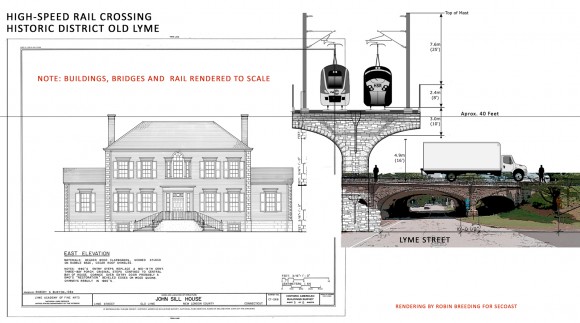
Rendering by Robin Breeding of the high-speed train in Old Lyme drawn/created to scale.
Here’s our first question:
Question (LymeLine.com ): What has happened since the “Comment” period was closed?
Answer (Gregory Stroud): Great question. But first, let me offer a little background. The Federal Railroad Administration actually outsources the planning process to a contractor, a huge multinational based out of Montreal, called Parsons Brinckerhoff. They specialize in this sort of project. They worked on The Big Dig up in Boston. They are same people who planned the Baldwin Bridge, and who electrified the rail lines to our east a few years ago. Parsons Brinckerhoff knows Old Lyme. They’ve faced local community activists before. And they’ve won.
So … with two weeks to go before the comment deadline, Parsons Brinckerhoff was reading a lazy stream of public comment, averaging just a comment every other day for a few years, and suddenly all heck breaks loose. Comments start pouring in from Old Lyme—1,200 comments out of 3,000 received from every town and city from Washington to Boston. Those numbers pretty much guarantee that more people cared enough to comment in Old Lyme, than in Manhattan, or Boston, or even Baltimore, which has its own contentious tunnel project. Add in the outreach to Hartford and Washington, and suddenly Old Lyme is on the map.
The good news is that the contractor has actually reached out to Old Lyme First Selectwoman Bonnie Reemsnyder, to Daniel Mackay at Connecticut Trust for Historic Preservation, and others. Parsons Brinckerhoff is making cordial, if maybe grudging, efforts to respond to the local outcry. You have to understand, as a contractor, they are in a tough place. They need to get this done by the end of the summer. They want to make their bosses at the Federal Railroad Administration happy. They have to make the people funding this in the Senate and Congress happy. It has to be something that Hartford can swallow.
In this grand balancing act, Old Lyme is a bit of a nuisance. I don’t get the sense that Stamford or New Haven or Hartford are somehow secretly plotting to send high-speed rail through Old Lyme. It’s not malicious. From what I understand, nearly everyone in-state would actually prefer Alternative 2, connecting Hartford to Boston. Parsons Brinckerhoff just wants to get this done. Right now they are busy with their statutory obligation of weighing every one of those 1200 comments.
That said, no one really wants a small town at the mouth of the Connecticut river to upset the tea cart. If at the end of the day, Washington and Hartford decide that a train has to run through Old Lyme, then they plan to run a train through Old Lyme. I think it’s fair to say that pretty much everyone wants us to pipe down and behave.
So, of course, they start telling us what they think we want to hear. Most importantly, for the first time the idea of tunnel is floated, privately, details to be determined at some uncertain date, perhaps 2 billion dollars added the price tag—quite an accomplishment for a few weeks work! But don’t believe it for a second.
At Tier 1, the current planning stage, these vague promises mean almost nothing. Sure, they can relabel the purple line running through Old Lyme, and call it a tunnel. But it’s the purple line that really matters. In two years they can just decide that a tunnel is too expensive or impractical, and it’s a bridge all over again. To be clear, no one has actually carried out engineering or environmental studies on a tunnel. In this planning process, the decisions are coming before the studies. The cart before the horse.
So, where are we now in the process? Everyone should understand that the Federal Railroad Administration is replacing their master plan for the Northeast. The current plan dates back to 1978. The next plan will reshape rail in the Northeast for the next 25 years.
A decision will be made, probably in August. The choice will be announced around September 1. And if the Federal Railroad Administration chooses Alternative 1, and Alternative 1 still has a purple line running through Old Lyme, then we are in for the fight of a lifetime. We have a once-a-generation chance to shape federal plans for Old Lyme, and we need to get this right.
Editor’s Note: This is the opinion of Gregory Stroud.
 A revocable living trust (or RLT) is a widely used estate planning device, often promoted in magazine articles and at seminars. There is no doubt that individuals and couples can achieve substantial benefits, both tax and non-tax, through the use of revocable living trusts. It is important, however, that people considering making a revocable living trust part of their estate plans have a clear understanding of what the revocable living trust can and cannot accomplish.

 About the author: Nicole Prévost Logan divides her time between Essex and Paris, spending summers in the former and winters in the latter. She writes a regular column for us from her Paris home where her topics will include politics, economy, social unrest — mostly in France — but also in other European countries. She also covers a variety of art exhibits and the performing arts in Europe. Logan is the author of ‘Forever on the Road: A Franco-American Family’s Thirty Years in the Foreign Service,’ an autobiography of her life as the wife of an overseas diplomat, who lived in 10 foreign countries on three continents. Her experiences during her foreign service life included being in Lebanon when civil war erupted, excavating a medieval city in Moscow and spending a week under house arrest in Guinea.
 Last year, at our son’s suggestion, I read and reviewed with enthusiasm Robert Macfarlane’s The Old Ways (2012), his recounting of extensive walks in Great Britain, Spain, Palestine, and Tibet (see LymeLine.com review of Oct. 12, 2014.) That led me to his Landmarks (2015) and now to an earlier work, The Wild Places.
 About the Author: Felix Kloman is a sailor, rower, husband, father, grandfather, retired management consultant and, above all, a curious reader and writer. He’s explored how we as human beings and organizations respond to ever-present uncertainty in two books, ‘Mumpsimus Revisited’ (2005) and ‘The Fantods of Risk’ (2008). A 20-year resident of Lyme, he now writes book reviews, mostly of non-fiction that explores our minds, our behavior, our politics and our history. But he does throw in a novel here and there. For more than 50 years, he’s put together the 17 syllables that comprise haiku, the traditional Japanese poetry, and now serves as the self-appointed “poet laureate” of Ashlawn Farms Coffee, where he may be seen on Friday mornings. His wife, Ann, is also a writer, but of mystery novels, all of which begin in a bubbling village in midcoast Maine, strangely reminiscent of the town she and her husband visit every summer.