
Letter From Paris: Madrid and the Incredible Wealth of its Museums

Nicole Prévost Logan

Nicole Prévost Logan

The silent crowd stands with emotion as it would in a cathedral, keeping respectfully a few feet away from “Guernica” – the huge (11 by 27 ft. ) scene painted by Pablo Picasso in 1937 after the bombings by the Nationalist forces led by General Franco of the Basque village of Guernica.

A weekend spent stomping the art collections of Madrid is mind-boggling.  Spend six hours a day and you will only have a glimpse at the Thyssen museum, the Prado, the house studio of Sorolla and the Reina Sofia modern art museum.

Baron Hans Heinrich Thyssen-Bornemisza and his son Heinrich had an unusual flair when they selected outstanding works of art in the 1920s and 1930s to create one of the world’s richest private collections at the Thyssen.

Some of the early masterpieces there include, “The portrait of Giovanna degli Albizzi Tornabuoni” (1480), which is a beautiful example of the work of Florence Quattrocento, showing the idealized profile of a woman. “A young man in a landscape” was painted by Vittore Carpaccio, probably from the Venetian school.  Nature is codified with each animal having a symbolic meaning related to good and evil.

In his “Jesus among the doctors” (1506), Albrecht Dürer – the most important representative of the German Renaissance – depicts the 12-year-old Jesus surrounded by a group of old men.  Some of them have been touched by grace while others have sin written all over their ugly faces, hands like claws threatening the child.   In The “Portrait of a lady” (1530?) painted by Hans Baldung Grien – the remarkable disciple of Dürer – the influence of Cranach the Elder is noticeable in the rendering of the decorative elements of the dress, necklaces and large hat with feathers of a supremely elegant model.

Flanders – or modern Belgium and Netherlands – was part of Spain in medieval times and the Prado has many Flemish paintings, which reflect the highly sophisticated culture of trading towns like Ghent or Bruges.  Jan van Eyck, Rogier van der Weyden, Gerard David or Hans Memling are the best representatives the 15th century “Northern Renaissance.”

Contacts were frequent between artists who traveled from the “Low Countries” of Northern Europe to Italy.  Unlike the Italians who painted with tempura and an egg base applied over a thin layer of wet plaster called “gesso,” Flemish painters used oil directly on panels of wood without knots, such as mahogany or oak.
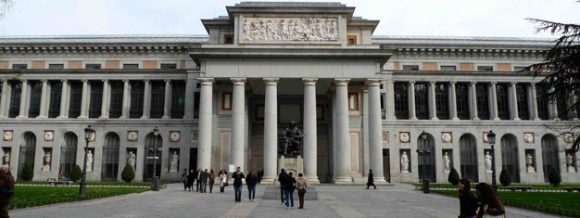
The Prado Museum in Madrid, Spain.

The Prado Museum in Madrid, Spain.

The “Garden of Delights” by Hieronymous Bosch is one of the highlights of the Prado — it is a display of amusing, bawdy or frightening details intended to give a didactic message to the population of his time.  The Flemish landscape painter Joachim Patinir (1480-525) offered panoramic views, with details at some times naturalistic, and at others, fantastic.  Instead of using linear perspective, which Florentine artists had mastered at that time, his way of showing distance was by drowning the landscape in bluish colors.

One room of the Prado is turned into a gallery of family portraits of the Spanish dynasty of the Habsburgs.  An equestrian painting by Titian of Charles V (1500-1558) at the battle of Mulhberg shows the most powerful sovereign in the world.  His kingdom went from the North Sea to the Mediterranean.  Velasquez painted many of his descendants: Philip II, Philip III, Philip IV and his son, the young prince Balthazar Carlos, riding a frisky horse.  His death, at age 17 from smallpox was a tragedy.  And there is poor Charles II, the end of the Habsburg dynasty, who was a total mental and physical disaster because of repeated consanguine marriages.

“Las Meninas”  (ladies in waiting), also by Velasquez, is one the most famous paintings ever.  It is a complex composition, which has puzzled art historians through the centuries.  At the center stands the five-year-old infanta Margareta Teresa, Philip IV’s daughter. Velasquez is looking at us and working on a huge painting, which he never painted.  The infanta’s parents are not far away and we see their reflection in a mirror.  There are two sources of light, which is quite unusual.  In 1957, inspired by the masters of the past, Picasso tackled the deconstruction of “Las Meninas,” particularly of the dog.

Velasquez (1599-1660) was the leading painter of the Spanish “Golden Age,”  during the Baroque age which lasted until 1690.  As a court painter, he had an immense influence living and working in the el-Escorial palace and was not only honored as an artist but also as the curator of the Kings’ art collections.

The love for animals is strong in Spanish painting.  Just two examples:  “Agnus Dei”, by Zurbaran (1640) showing a lamb with its  four legs garroted is probably the most heartbreaking sight in the Prado, with the animal accepting his fate.  The other one is a dog by Goya.  In an undefined brownish background of sand and sky, a dog is looking in panic at his master as he is being pulled down by quicksand.

It was not until 1840 that Spanish art began to be known in France.  The Pyrenees constituted an insurmountable barrier separating Spain from the rest of Europe.  In 1835, French King Louis Philippe sent Baron Isidore Taylor to Spain to acquire some Spanish paintings intended for the future Galerie Espagnole or Spanish Gallery at the Louvre.  After his visit to Spain in 1865, Manet said, “the scales fell off my eyes.”  The Spanish influence on Manet and Courbet is clear, especially their use of black.

Beside the works of the well-known artists like Miro, Dali or Juan Gris, the presence of Ignacio Zuloaga (1870-1945), Joaquin Sorolla (1863-1923), Santiago Rossignol (1861-1931), and Ramon Casas (1866-1933) at the Reina Sofia museum attests to the importance of Spanish contemporary art.
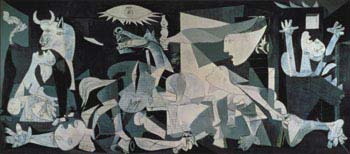
'Guernica' by Pablo Picasso is one of the most famous paintings in the world.

‘Guernica’ by Pablo Picasso is one of the most famous paintings in the world. It hangs today in the Reine Sofia Museum in Madrid.

In the attic of the old convent of Grands Augustins, near the Seine, Picasso completed  “Guernica” – probably the most important artistic statement of the 20th century against war.  The Spanish civil war from 1936 to 1939 left 500,000 dead.  Dora Maar, his companion, photographed each stage of the work , leaving a unique document on the creative process of the artist.

The composition is a frieze, powerful, fluid, easy to read and devoid of any narrative. The horse and the bull – the main actors of the bullfight about which he was so passionate – are treated like human characters.  The horse underwent many changes from deep suffering to the defiance he shows in raising his head.  The bull is aloof and protective of the population.  The dead warrior lying on the ground has the profile of Marie Therese Walter, his previous companion.  To balance the duo of bull and horse, Picasso created a screaming mother, head thrown back, with a tongue like a dagger, her dead child hanging limp from her arm.

Painted in May and June of 1937, “Guernica”  traveled the world, stayed several years at MOMA at the request of Picasso, then returned to Spain in 1981 and hangs today in the Reina Sofia museum of Madrid, never to be moved again.

Editor’s Note: This is the opinion of Nicole Prévost Logan.
Nicole LoganAbout the author: Nicole Prévost Logan divides her time between Essex and Paris, spending summers in the former and winters in the latter. She writes a regular column for us from her Paris home where her topics will include politics, economy, social unrest — mostly in France — but also in other European countries. She also covers a variety of art exhibits and the performing arts in Europe. Logan is the author of ‘Forever on the Road: A Franco-American Family’s Thirty Years in the Foreign Service,’ an autobiography of her life as the wife of an overseas diplomat, who lived in 10 foreign countries on three continents. Her experiences during her foreign service life included being in Lebanon when civil war erupted, excavating a medieval city in Moscow and spending a week under house arrest in Guinea.


Op-Ed: Another Q & A on the Proposed High Speed Railtrack

Today, we are publishing a second question and answer (Q & A) piece in our occasional series related to the Federal Rail Administration’s (FRA) proposal to route a high speed rail track through the center of Old Lyme bifurcating Lyme Street just to the south of the I-95 bridge.

We pose our questions to Greg Stroud, who then graciously responds with his opinion. Soon, we hope also to be publishing an update from Old Lyme First Selectwoman Bonnie Reemsnyder.

Stroud, an Old Lyme resident, has taken a deep and enduring interest in the FRA’s proposal and has, in the process, become extremely knowledgeable on the complexities of the project.  For regular readers, you will recall that Stroud wrote the original editorial on LymeLine.com that sparked an avalanche of interest in and concern about the FRA’s proposal.  The first Q & A we did with Stroud similarly generated a healthy discussion and can be found at this link.

Stroud has also created a Facebook page titled SECoast at Old Lyme where readers can glean a plethora of information about the project and be kept current on developments.

These postcards will be available for sale at the May Day 'Help Stop the Train' event being held at Studio 80 + Sculpture Grounds on Lyme Street from 2-4 p.m. All are welcome.

These postcards will be available for sale at the May Day ‘Help Stop the Train’ event being held at Studio 80 + Sculpture Grounds on Lyme Street from 2-4 p.m. All are welcome.

Question (LymeLine.com ): How would you respond to readers, who might make a back-of-an-envelope calculation, and conclude that the numbers for high speed rail simply do not add up?  Last December, Congress passed a transportation bill, the so-called FAST Act, which budgets only $2.6 billion over five years for passenger rail along the Northeast Corridor, and yet, NEC Future Alternative 1 (the least expensive high speed rail option) carries a price tag of at least $65 billion. Surely, you can’t build what you can’t fund?

Answer (Gregory Stroud): Well, I’d start by offering a simple equation of my own. Take a look at I-95 today. I think pretty much everyone agrees it’s a disaster. Now imagine how it will look in another 10 years if the population along the Northeast Corridor grows, as expected, by another 12 percent.  And in 20 years? An added lane in either direction—at its own estimated $9 billion—only adds so much. If not from rail, where else will we find the needed added capacity?

The Northeast Corridor is a $2.6 trillion economy, every day fed by 7,500 commuter trains, 1,200 Amtrak trains, 70 freight trains, more than 260 million passenger trips per year. Connecticut alone is proposing to spend $100 billion over the next 30 years on transportation infrastructure. Add to that the needs and economies of Boston, Providence, New York, Philadelphia, Baltimore and Washington, with Old Lyme perched somewhere in the middle.

A single day’s disruption—a malfunction of the lift bridge across the Connecticut, or by damage from a storm—comes at its own estimated cost of $100 million. Even the apparently unthinkable “no action” alternative would cost $20 billion.

Of course, Congress will never appropriate enough money to modernize high speed rail along the Northeast Corridor, but then that was never the plan. Instead, the idea is to negotiate a cost sharing between the federal government, the states and operators along the corridor, not just Amtrak, but VRE, MARC, SEPTA, NJ Transit, LIRR, Metro North, Shore Line East, MBTA, and the freight operators.

Another $35 billion of private financing is potentially available through the Railroad Rehabilitation and Improvement Financing program (RRIF). The Transportation Infrastructure Finance and Innovation Act (TIFIA) offers a further $275 million per year.

More financing will have to come from the private sector. Tens of millions each year from utility companies for leasing easements along the rail lines for natural gas, oil, fiber optic cable, an estimated 100 new cellphone towers, and so on. In Florida, high speed rail partnered with the Fortress Investment Group. In Maryland, the Purple Line is a $5.6 billion public-private venture. The Northeast Corridor will require  similar financing and investment.

Providing for these investments is exactly why, on a bipartisan basis, the FAST Act included a provision to effectively separate the Northeast Corridor from Amtrak’s other services. Rather than funding rail travel to Omaha or Elyria, Ohio, the Northeast Corridor will keep its steady stream of surpluses (currently about $300 million yearly) in exchange for assuming the long-term burden of its own infrastructure expenses.

But with costs stretching into the tens of billions, why would Connecticut settle for Alternative 1—a plan with few stops and relatively little service for the state? Perhaps it won’t … That said, given the current state of the Connecticut finances, perhaps the plan with the least service perversely best leverages the other states and operators along the Northeast Corridor to help solve Connecticut’s almost unmanageable infrastructure backlog. High speed rail service for New Haven and Stamford in exchange for a more favorable cost-sharing formula. Perhaps. It’s not clear.

Given the stakes, the complexity and scale of such negotiations, it’s no wonder not a single politician above the local level—not Malloy, not Blumenthal, not Murphy, not Courtney—has come out publicly opposed to a new rail route through Old Lyme. Taken as a whole, Old Lyme appears a very small matter in the very large scale of things. But for Old Lyme residents to feel at all safe, that must change.

Editor’s Note: This is the opinion of Greg Stroud.

Letter from Paris: Moderate, Radical Islamists in France — a Difficult Cohabitation

Nicole Prévost Logan

Nicole Prévost Logan

Introduction 

For years the buzz word in France has been “amalgam.” On ne doit pas faire l’amalgame entre Islam modéreé et Islamisme radical. (One must not confuse moderate Islam and radical Islamism.)  After the repeated terrorist attacks in France and Belgium and with the discovery of other jihadist enclaves, it is hard to keep making that distinction.  The voice of moderate Muslims has been barely audible lately.  Until they start speaking with a stronger voice, the cohabitation within our democratic and secular society is becoming more difficult.

Belgium

Belgium was the last victim of terrorist attacks when, on March 22, 34 people died at Zaventem airport and at Malbeek metro station (close to the European Commission offices) combined.

Why Belgium?  For the past two decades, it has been a divided country between Flemish and Walloon languages and cultures.   It remained without a central government for 18 months.  How can such country produce six parliaments and six governments? asked David Van Reybrouck, a Dutch-speaking Belgian writer in Le Monde dated March 28.  The author of the article adds with irony, “… and the icing on the cake is the creation by the government of a Commission communautaire commune” (joint Commission of communities.)

It was in Molenbeek that the four and a half month-long chase of Salah Abdeslam, who was involved in the Nov. 13 Paris attack, ended.  Molenbeek is one of  the 19 Brussels municipalities — it has a population of 93,000 with 80 percent of them Muslim, 56 percent of them unemployed and 24 mosques.  After the closing of the coal mines and the steel plants in northern France in the 1980s and 1990s, many of the workers  emigrated to Belgium.  Molenbeek is a typical agglomeration of a second generation Maghreb population – more specifically of Rifains, coming from the Rif mountains of Morocco.  It constitutes almost a self-ruled community, many of whose members are related and even siblings.  No better safe haven for people running away from the law. 

Belgium has been described as the “ventre mou” (litterally the soft belly), in other words, the weak link, of Europe. Patrick Kanner, one of the French ministers made the chilling remark, “but there are tens of Molenbeeks in France “.

France on the front line

France is, in fact, on the front line of the confrontation with radical Islamism.

The weekly Le Point‘s issue of March 24 describes the long history of France’s interaction with the Arabs. It started with the 732 AD defeat of the Saracens at Poitiers by Charles Martel, grandfather of Charlemagne. Then came The Crusades and subsequently Napoleon Bonaparte’s expedition to Egypt in 1798.  The French began their conquest of Algeria in 1830 and made it a part of France.  The country gained its independence after the bloody war of  1954-1962.  France established protectorates in Tunisia in 1881 and in Morocco in 1912 until 1955.  At the present time, France has become the “gendarme” across the Sahel region, ready to deploy its forces to stop extremist groups. 

Gilles Kepel, professor at Sciences Po and an authority on Islam, has  just published “Terreur dans l’Hexagone – Genèse du Dhihad Français,” in which he stresses the deep-rooted antagonism of the North African population for the former colonial power and the existence of a specific French jihadism.  Acts of terrorism in France are accomplished by individuals with French nationality. The country holds the sad record of having the highest number of jihadists in theEuropean Union who have gone to Syria. 

Eiffel-Tower-322x252Kepel, sees a correlation between politics and the spread of Islamism in France.  He remarks that, during the 2012 elections, François Hollande benefited from 93 percent of the Muslim electorate voting for him.  Kepel believes, as most other Islam scholars do, that the problem our society is facing is cultural.  He criticizes the unpreparedness of the political elites for the ongoing debate about religions.  He deplores the fact that insufficient public funds have been allocated both to research and Middle East studies.
Mohammed Sifaoui is a brillant French journalist born in Algeria, who is quite forthright in expressing his opinions.  He advocates a relentless reprisal against the preachers of violence in the 2,000 mosques and Koranic schools of France.  Sifaoui’s opinion is that we have to abandon the attitude that only the FN (Front National party) has a right to fight back against the Islamists.  Besides, he says, we should stop treating these people as victims from discrimination.

Daesch

After the fall and occupation of Fallouja in Irak in 2014, Abou Bakr al-Baghdadi became the self-appointed ruler of the Islamic State organization or Daesch. (The “ch” sound stands for “sham” meaning Levant in Arabic ) The objective of this organization is to re-create a caliphate reminiscent of the golden years of  the 661-750 AD Ommayad and 750-1258 AD Abbasid caliphates. The totalitarian organization banished the Wahhabism and any other doctrines of Islam and has broken all ties with Al-Qaeda.  Al-Baghdadi gave his founding speech at the great mosque of Mossoul, dressed in black like the Abbasids. 

Mathieu Guidère, professor of Islamic Studies at the University of Toulouse 2, a learned scholar in geopolitics with a PhD in the Arabic language, believes that the objective of Daesch is to build a state, anchored solidly in a territory, with the elimination of the 1916 Sykes-Picot borders.  Its aim is also to break up the cohesion of Europe.  So far, we are still only at the initial stage of “collateral terrorism,” comments Guidère. 

The riposte

Alain Bauer, professor of  applied criminology at the Conservatoire  des Arts et Metiers, former advisor to Nicolas Sarkozy and Manuel Valls on security and counter-espionage, says, “The problem is that we seem to have too much information and not enough analysis.  We still do not have the ability to connect the dots.  We have a brain and two ears and four ears will not help ” He concludes, “What we need is a return to Human Intelligence.”  Bauer and Guidère agree that there should be a European Intelligence agency but several states oppose it for fear of losing part of their sovereignty.  The creation of a PNR (personal name register) still awaits a vote.

Euro 2016 – the European soccer championship – will be held in France in June. This means, on the one hand, a great deal of excitement for millions of spectators, but on the other, an equal — or even greater amount — of nervousness for the security forces.

Editor’s Note: This is the opinion of Nicole Prévost Logan.

Nicole LoganAbout the author: Nicole Prévost Logan divides her time between Essex and Paris, spending summers in the former and winters in the latter. She writes a regular column for us from her Paris home where her topics will include politics, economy, social unrest — mostly in France — but also in other European countries. She also covers a variety of art exhibits and the performing arts in Europe. Logan is the author of ‘Forever on the Road: A Franco-American Family’s Thirty Years in the Foreign Service,’ an autobiography of her life as the wife of an overseas diplomat, who lived in 10 foreign countries on three continents. Her experiences during her foreign service life included being in Lebanon when civil war erupted, excavating a medieval city in Moscow and spending a week under house arrest in Guinea.

Op-Ed: Carney Says Proposed State Education Budget Cuts Will Seriously Impact Region 18

State Representative Devin Carney (R-23rd)

State Representative Devin Carney (R-23rd)

Does Governor Malloy have a problem with communities that succeed? This is a question we need to ask ourselves. Year after year, the schools of the 23rd District work diligently to provide quality education to our youth. Our teachers and administrators add to the success of our state by instilling the proper foundation to produce the industrial, business, and community leaders of tomorrow. Many of our best and the brightest students chose to continue their education in Connecticut – something of which the governor should be incredibly proud. Just last year the valedictorians from Region 18 (Lyme and Old Lyme) and Westbrook as well as the salutatorian from Old Saybrook chose UConn.

We have seen two budget proposals over the past two weeks that would do damage to the schools in the 23rd District. The Democrat-controlled Appropriations Committee released an incomplete budget that would cut Education Cost Sharing (“ECS”) funding to the towns in our district by 33 – 56%. This was bad enough. But, under the governor’s updated proposal, the four towns in the 23rd went from receiving a recommended amount of $1,831,496 in ECS funding to $0 for FY 2017 (July 1, 2016 – June 30, 2017). A total of 28 towns were zeroed-out, while many cities, like the governor’s hometown of Stamford, were held harmless. Talk about a shared sacrifice.

These proposed cuts – made at a time when most local Boards of Finance are crafting their own fiscal year budgets – are unfair. The clear lack of respect and care on the governor’s part is alarming. All four towns in the 23rd District will now have funding gaps and may require local property tax increases to offset them. This would add an even greater burden to Connecticut’s taxpayers and Connecticut simply cannot afford to lose additional wealth at this time. However, that’s where these indirect tax hikes would be directed – all 28 communities being zeroed-out are considered ‘wealthy’.

Although these cuts are debilitating to small towns like ours – which already receive far less back from the state than we put in – we must keep in mind that this is only a proposal.

I remain committed to finding a solution with other members of the legislature to address this inequitable cut to our towns and to solving our $930 million deficit. The state wants people to move to Connecticut and one of our best selling points is our top-tier education. While we are faced with many serious and pressing economic issues, predominantly the ongoing budget crisis, great public education is one area on which we can pride ourselves.

I have written a letter to the governor urging him not to turn his back on the children and the taxpayers of the 23rd District and to request that he amend his updated budget and eliminate these cuts. The taxpayers of Lyme, Old Lyme, Old Saybrook, and Westbrook provide a great deal to this state and the deficits would be much, much higher without us. If either the legislature’s or the governor’s cuts are enacted, then it would be only fair that some of the approximately 380 unfunded state educational mandates be eliminated.

Instead of education, the governor and the legislature must look to balance the budget through real structural changes in the way state government is run. Changes could include pension and benefit reform, re-negotiating of union contracts, a moratorium on unnecessary government projects, serious spending and bonding caps, and tighter controls on overtime. When I last checked, many don’t live in Connecticut for bloated government overtime, but they do for our great schools. In fact, it may just be the only thing keeping them here.

To read my letter to Governor Malloy: click here

To see how Connecticut towns fare under the Appropriations budget: click here

To see how Connecticut towns fare under the governor’s budget: click here

To read the governor’s budget proposal: click here

To see the approximately 380 unfunded educational mandates: click here

CT Legislators Support Study to Preserve Plum Island From Commercial Development

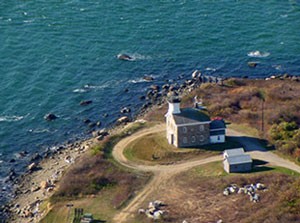
Aerial voew of Plum Island lighthouse. (From Preserve Plum Island website)

Aerial view of Plum Island lighthouse. (From Preserve Plum Island website)

Last Thursday, March 24, at a press conference in Old Saybrook, a triumvirate of Congressional legislators from Connecticut, State Senator Richard Blumenthal and US Representatives  Joe Courtney (D-2nd District) and Rosa DeLauro (D-3rd District) confirmed their support for a study to determine the future of Plum Island located in Long Island Sound.

Members of the Plum Island Coalition — which has some 65 member organizations all dedicated to preserving the island —  were in attendance to hear the good news.

The island still houses a high-security, federal animal disease research facility, but the decision has already been taken to move the facility to a new location in Kansas with an opening slated for 2022. The current facility takes up only a small percentage of the land on the island and significantly for environmentalists, the remainder of the island has for years been left to nature in the wild.

In supporting a federal study on the future of Plum Island, Sen. Blumenthal said, “This study is a step towards saving a precious, irreplaceable national treasure from developers and polluters. It will provide the science and fact-based evidence to make our case for stopping the current Congressional plan to sell Plum Island to the highest bidder.”

He continued, “The stark truth is the sale of Plum Island is no longer necessary to build a new bioresearch facility because Congress has fully appropriated the funds. There is no need for this sale – and in fact, Congress needs to rescind the sale.” 

Congress, however, still has a law on the books that authorizes the sale of Plum Island land to the highest bidder. Therefore, opponents of the sale will have the burden of convincing Congress to change a law that is currently in place.