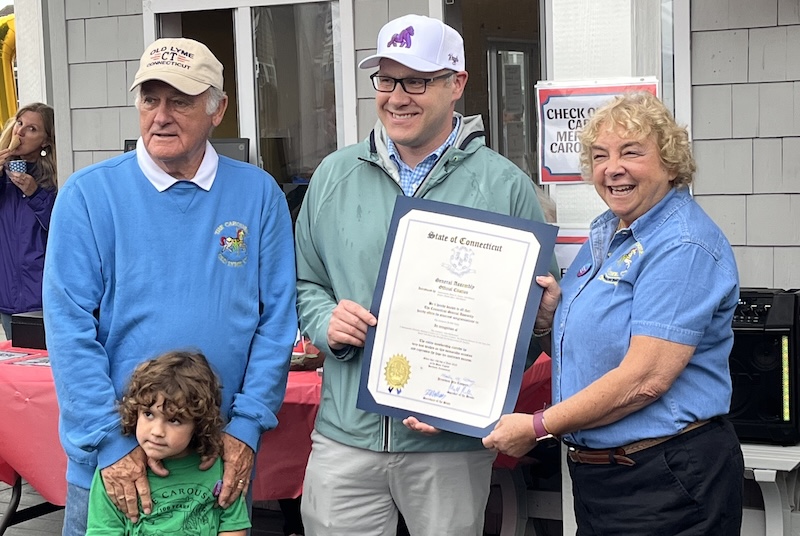
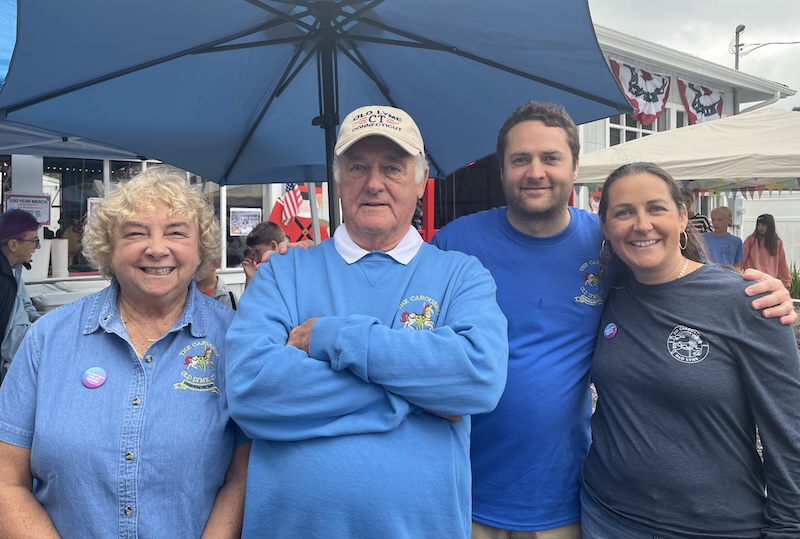
State Representative Devin Carney (R-23rd) stands between Jerry and Dee Vowles after presenting them with a Citation from the State of Connecticut celebrating the 100th birthday of the ‘Sound View Carousel.’
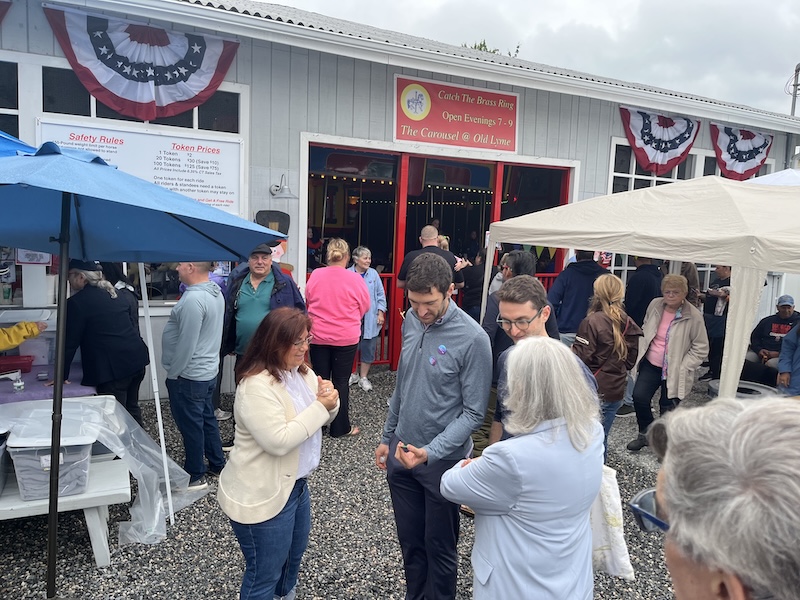
OLD LYME — It might have been a drizzly day on Saturday but spirits were high in the Sound View section of Old Lyme where celebrations took place to acknowledge the 100th anniversary of the construction of the beloved carousel.
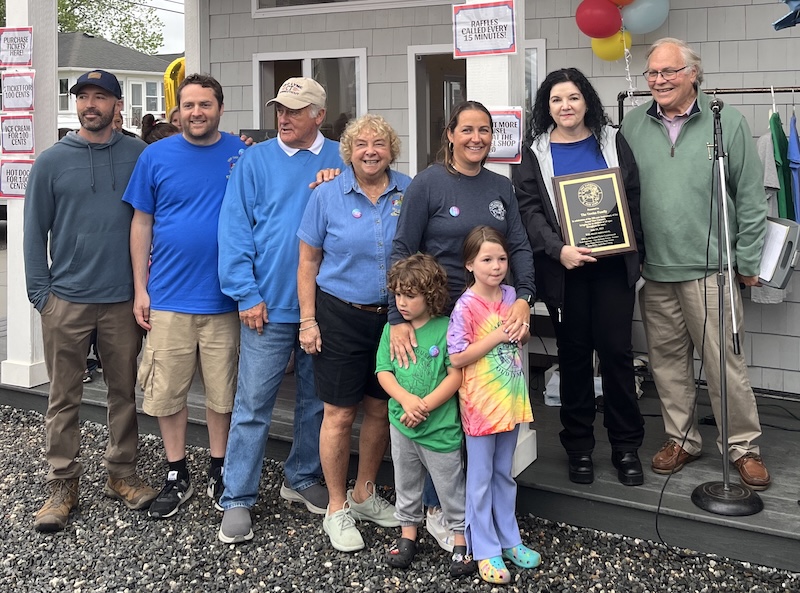
Sound View Commissioners Frank Pappalardo (right) and Michaelle Pearson (second from right) join the Vowles family for this celebratory photo after presenting the Vowles family with a plaque from the Sound View Commission.
The merry-go-round has been in its current location at the foot of Hartford Ave.since 1976.
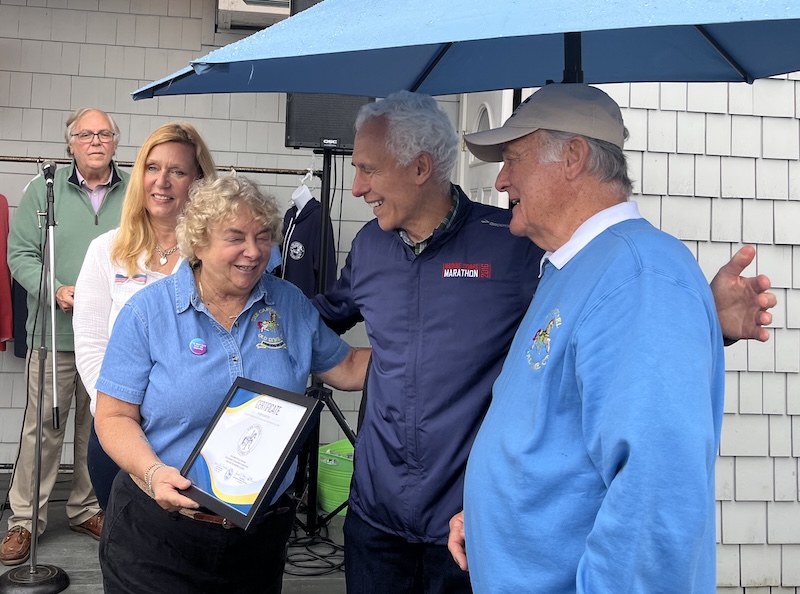
Old Lyme Economic Development Commission (EDC) Chairman Joe Camean (center) and member Mona Colwell (left) congratulate Dee and Jerry Vowles on their involvement in the business community after presenting a Certificate of Recognition from the EDC and Old Lyme Board of Selectmen. Master of Ceremonies and Sound View Commissioner Frank Pappalardo stands at rear.
Presentations were made by numerous individuals including State Representative Devin Carney (R-23rd), Old Lyme First Selectwoman Martha Shoemaker, Old Lyme Economic Development Commission Chairman Joe Camean, Democratic Town Committee member Kathleen Tracy, and Sound View Commissioner and Historian Michaelle Pearson.
Old Lyme First Selectwoman Martha Shoemaker (center) holds the US Proclamation from Representative Joe Courtney that she presented on his behalf to the Vowles family.
Old Lyme First Selectwoman Martha Shoemaker commented, “It was an absolutely wonderful celebration!”
More than 150 people turned out to celebrate the carousel’s birthday.
Enjoy our photo essay of the celebrations. Many thanks to Martha Shoemaker for providing the photos.
A smiling Dee Vowles (left) and husband Jerry along with daughter Jen Vowles Lathrop enjoy the day.
The weather did not keep folks away from the fun event at which free carousel rides, 100 cent ice cream and hot dogs, and t-shirt raffles were all on offer.
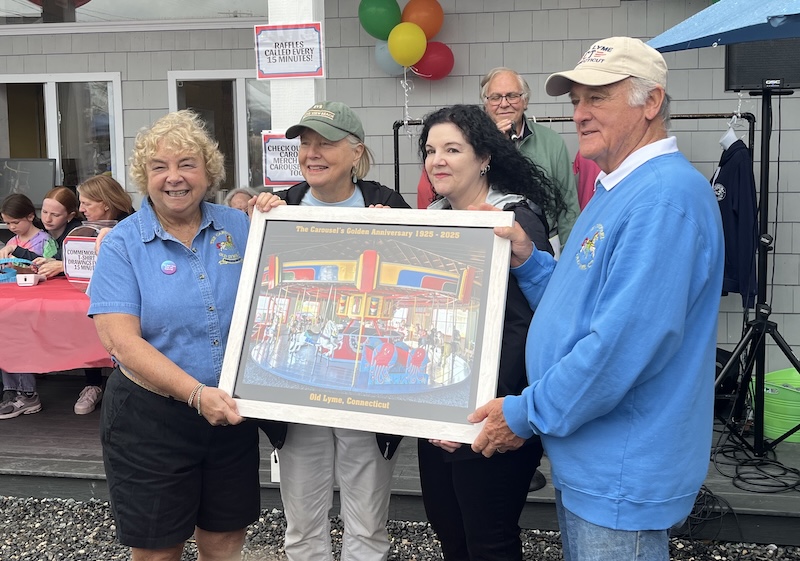
Old Lyme Democratic Town Committee members Kathleen Tracy and Michaelle Pearson stand with Dee and Jerry Vowles, who hold an illustration of the carousel that had been presented to them.
Our congratulations to Dee and Jerry Vowles and family on being such an important part of the Old Lyme community.
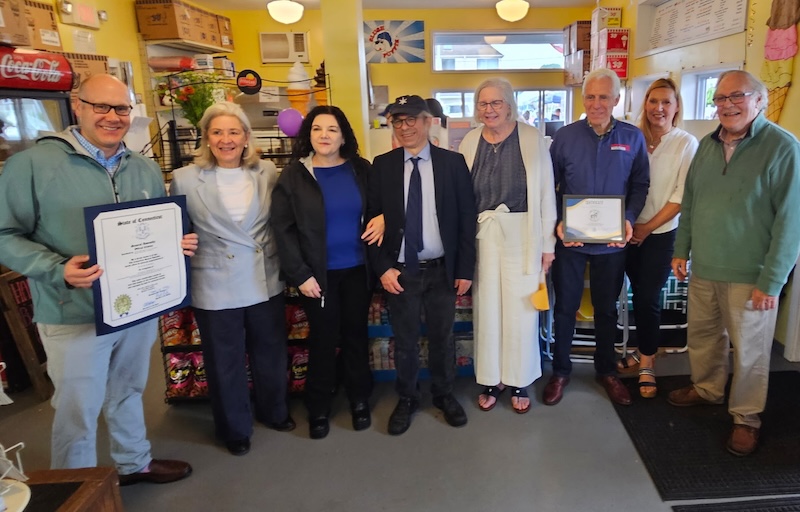
A host of dignitaries inside The Carousel Shop gather for a photo—all were involved in the celebrations.
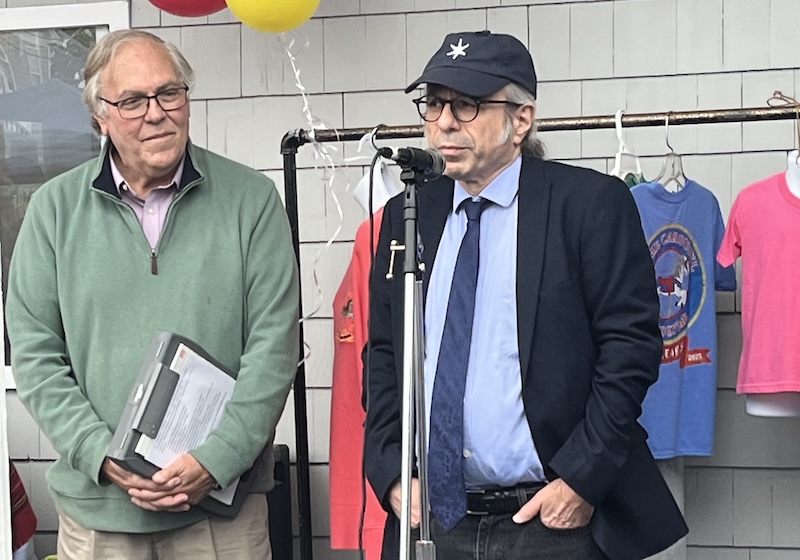
Old Lyme Selectman Jim Lampos (left) stands alongside Master of Ceremonies and Sound View Commission Chairman Frank Pappalardo as he gives a short speech congratulating the Vowles family on their commitment to the town.
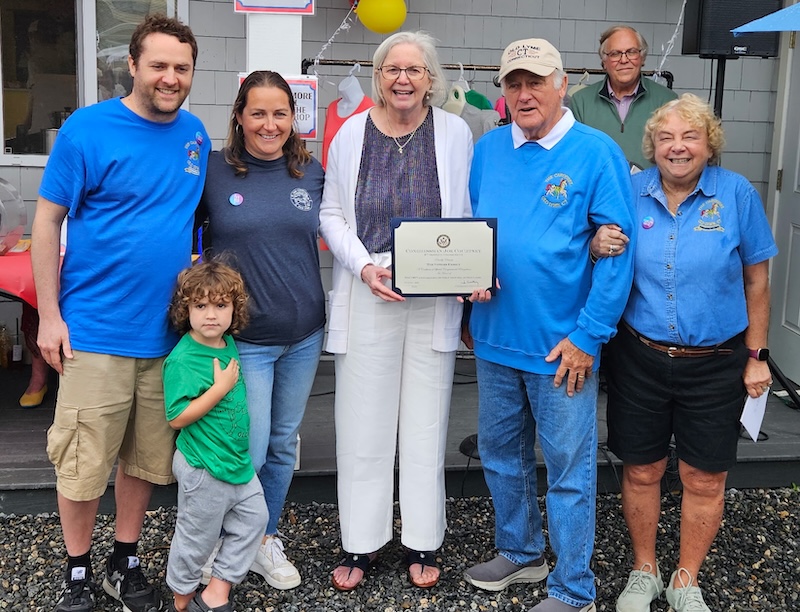
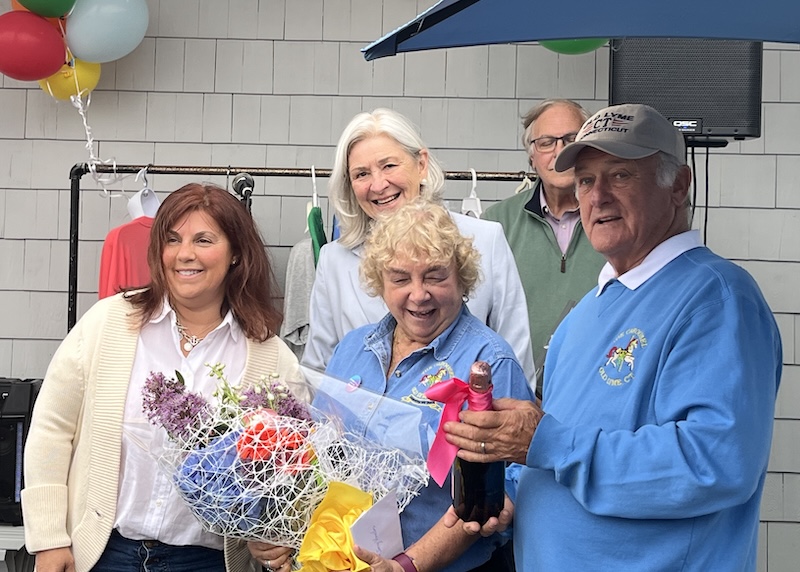
Flowers and champagne were yet another contribution to the celebrations. Old Lyme Selectwoman Jude Read and Old Lyme Republican Town Committee member Maria Marchant (at left) stand with Dee and Jerry Vowles in this joyful photo.
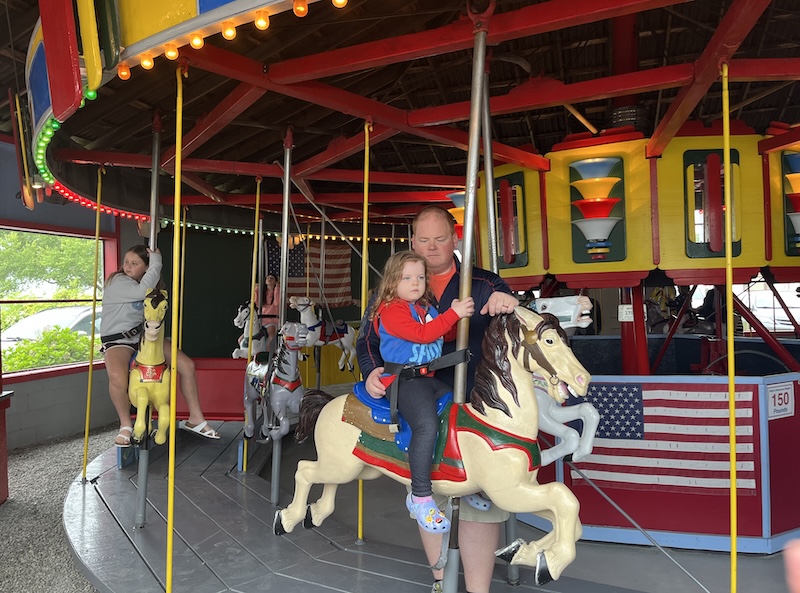
And the horses rode on …
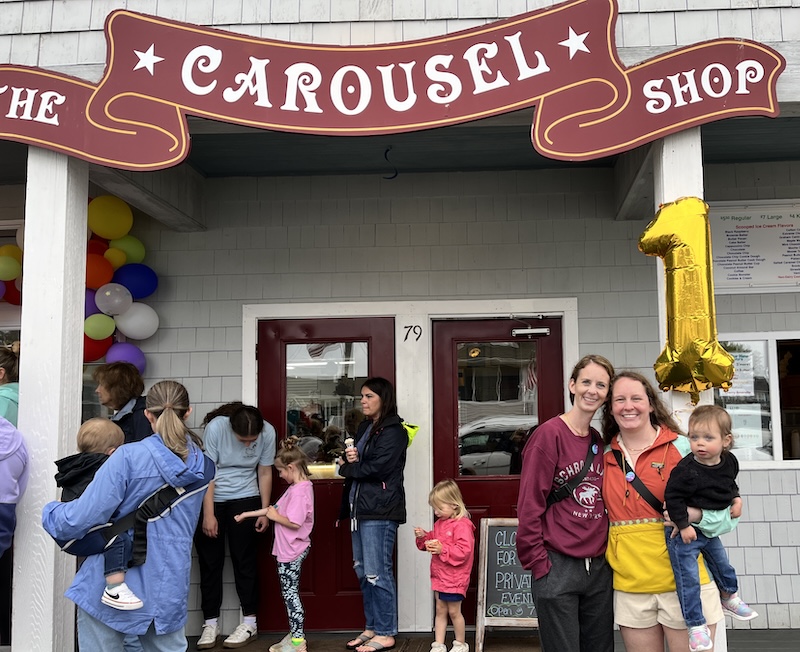
… while patrons of all ages enjoyed the celebrations. Photo by C. Nyberg.
OLD LYME/NEW LONDON – The Connecticut Early Music Festival (CEMF) returns for its 43rd season, presenting six concerts across the first three weekends in June. The festival brings together world-class musicians to perform both familiar and rarely heard works.
The Festival opened Saturday, June 7, at Harkness Chapel, Connecticut College, featuring Handel’s Funeral Anthem for Queen Caroline. James Burton, Director of the Tanglewood Festival Chorus, led the CEMF Ensemble in Handel’s tribute to his forward-thinking Queen, patron, and friend.
The Festival continued with a concert on Sunday, June 8, at St. Ann’s Episcopal Church in Old Lyme. Acclaimed flutist Emi Ferguson returned with a program of virtuoso sonatas by J.S. and C.P.E. Bach. Ferguson was joined by Guy Fishman on cello.
“This year’s Festival brings to life remarkable compositions from the 17th and 18th centuries,” said Artistic Director Ian Watson. “These performances, honoring the composers’ intentions, promise to be fresh and revelatory. They still have the power to transport us today!”
“Our 2025 Festival showcases the rich tapestry of early music, from the brilliance of the three sopranos in Concerto delle donne, to intimate chamber music featuring viola da gamba and theorbo, to the thrilling sound of our Festival Ensemble performing Vivaldi’s beloved Four Seasons,” said Henry Clapp, Board President.
He adds, “Whether you are a seasoned early music enthusiast or discovering these treasures for the first time, we look forward to sharing these extraordinary performances with you!”
After the first weekend, the festival continues with a series of four additional concerts as follows:
Saturday, June 14: St. John’s Episcopal Church, Niantic – Artistic Director Ian Watson performs a special concert of Baroque organ masterworks in memory of John P. Anthony, longtime President of the Connecticut Early Music Society.
Sunday, June 15: Chester Meeting House – In a program titled Concerto delle donne, three exceptional sopranos perform a stunning program of late 16th-century music composed specifically for professional female voices.
Saturday, June 21: La Grua Center, Stonington – An intimate evening of French Baroque chamber music, featuring viola da gamba and theorbo, perfectly suited to the acoustics of La Grua’s historic setting.
Sunday, June 22: Harkness Chapel, Connecticut College – The festival concludes with a celebration of the 300th anniversary of Vivaldi’s Four Seasons, performed by Susanna Ogata (violin) and the Festival Ensemble.
All concerts are at 5 pm. To encourage wider access, CEMF is offering half-price tickets for individuals under 40, along with complimentary admission for students of all ages. Special series and mini-series ticket packages are also available.
The book, originally published in 1970, is now available at the Gillette Castle State Park visitor’s center.
LYME–To celebrate the republication of “Sherlock Holmes and Much More,” the Friends of Gillette Castle hosted a book launch in the Visitor Center of Gillette Castle State Park on June 8.
The Friends in a press release said the republished book, available in hardcover and softcover versions in the gift shop, is made possible through a partnership with Belanger Books and the Connecticut Museum of Culture and History.
The book by historian Doris E. Cook was first published in 1970. It chronicles the life of the stage actor, playwright, and set designer best known for his portrayal of Sherlock Holmes.
“Starting this month, readers interested in William Gillette will no longer need to scour eBay for out-of-print editions of his definitive biography,” the group said.
The re-release party will include talks from resident and budding Gillette scholar Steven Gaudio and publishers Brian and Derrick Belanger. Gaudio will review some of the lesser-known aspects of William Gillette that comprise the “much more” in Doris Cook’s book. The Belangers will review the publication process for the book and discuss what makes it unique.
Friends’ President Lynn Wilkinson said Gillette’s “particular genius” is evident in the book.
“Gillette was a pioneer in American theater, a creative inventor, and a motorcycle and railroad fanatic,” she said. “His life was filled with joy and periods of hardship. This book provides a complete picture of this highly creative man.”
The Friends of Gillette Castle State Park will also be offering a free, guided walk along the train trail at 1 p.m., departing from the Visitor Center.
Gillette’s train system runs through scenic areas of the 122-acre state park, with numerous historic features along the way. The hike is approximately 1 hour and 15 minutes long. Registration is required.
The castle will be open throughout the day, with tours scheduled every 15 minutes from 10 a.m. to 4 p.m. Tickets are $6 for adults and $2 for youth ages 6 to 12. Children 5 and under are free. Advance purchase is recommended.
Food concessions will not be open on June 8, so visitors are encouraged to pack a picnic or purchase sandwiches locally.
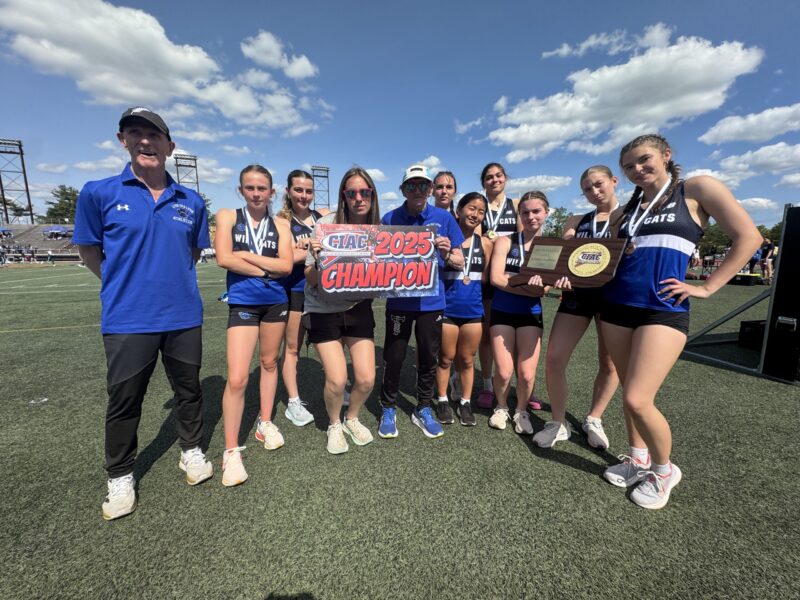
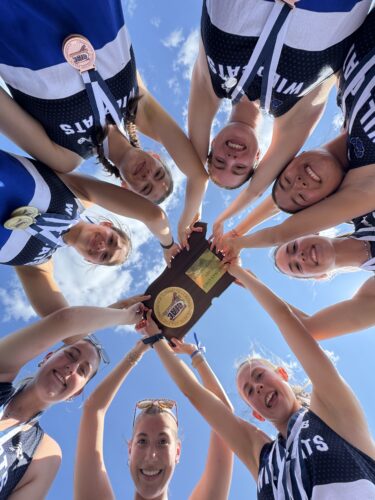
The Wildcats celebrate their second girls track and field state championship in a row – and in program history. From left to right are Jeff Morrin, Chase Gilbert, Maggie Thuma, Alyssa Mercaldi, Jan Merril, Serena Mazzi, Vivian Boller, Zoe Eastman-Grossel, Maia Guisti, Bella Presti and Tabitha Colwell. All photos courtesy of Lyme-Old Lyme High School.
OLD LYME–On Monday, the Lyme-Old Lyme High School girls track and field team successfully defended their title as Class S State Champions.
The team was led by junior Chase Gilbert, distance triple crown winner, and senior Zoe Eastman-Grossel, whose three wins included a class record in the 300 hurdles.
Scores show the Wildcats were victorious with 89 points. Canton came in second with 41 points and Windsor Locks took third with 38.
Runners listed in the results below with their respective event places are all from LOL High School.
Girls 100m
Zoe Eastman-Grossel in lane six takes first place while Serena Mazzi in lane seven takes third in the 100m dash finals.
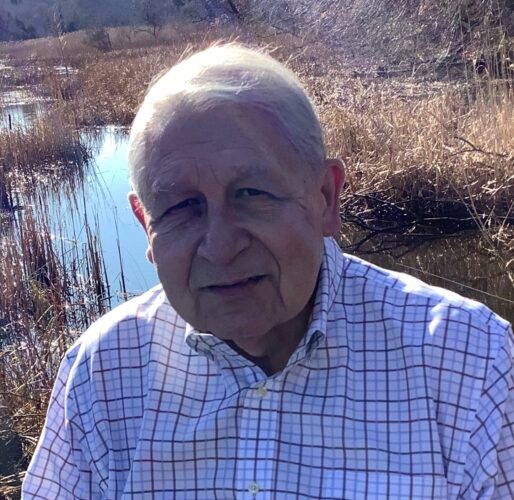
Christina and I attended a program at Phoebe Griffin Noyes Library on Tuesday, April 29: “Oral History: Kent State, 1970,” presented by Mike Alewitz, who as a student anti-Vietnam War organizer at Kent State University and a founder and chairman of the University’s Student Mobilization Committee Against the War, witnessed the bloodshed that occurred there on May 4, 1970 — 55 years ago.
Mike is now a New London resident and Professor Emeritus of mural painting and street art at Central Connecticut State University. He was subpoenaed to testify before the Presidential Commission on Campus Unrest. (below)
Mike’s presentation was very moving and triggered fraught memories for Christina and me; and I am certain, for other members of the predominantly “Baby Boomer” audience of about 30 or so.
His remarks motivated me to take a fresh look at that other dark period in American history and expand on his observations. I examine the events and actions that may have precipitated what has often been regarded as the “Kent State massacre” in this “View;” and then consider the factors and incidents that led to America’s entry and increased involvement in Vietnam; and the War’s dire outcomes in a subsequent essay.
And so, these are my “lest we Americans forget ‘Views’.”
Predisposing Events:
The 1967 March on the Pentagon:
The National Mobilization Committee to End the War, a coalition of anti-war groups organized what was, at that point, the largest antiwar rally ever staged for Saturday, October 21,1967 in Washington, D.C. The event began with more than 100,000 protesters gathered at a rally on the National Mall near the Lincoln Memorial.
The March was notable for its diverse coalition of participants. This was an ecumenical crowd: white and middle-class, middle-aged, young students, some clergy, and a group of political and social activists; — including Norman Mailer, Benjamin Spock, folk singer Phil Ochs; and counter-cultural figures Jerry Rubin, and Abbie Hoffman, co-founders of the Youth International Party; — i.e., the Yippies; who have been described as a theatrical, anti-authoritarian, and anarchist youth movement of “symbolic politics”.
Near 6 p.m. about 50,000 streamed across the Arlington Memorial Bridge toward the Pentagon.
There, most remained non-violent; but a smaller segment stormed ahead and scaled or toppled the fences surrounding the Pentagon; forcing their way onto the grounds past military policemen who were standing at 10-foot intervals. Six hundred and eighty-two demonstrators were arrested.
Garden Plot: The Department of Defense Civil Disturbance Plan (aka GARDEN PLOT) was a wide-ranging U.S. Army and National Guard plan to respond to major domestic civil disturbances within the United States. The plan was developed in the mid-1960s in response to a series of domestic civil disorders and provides Federal military and law enforcement assistance to local governments.
RMN and the Cambodian Incursion:
Richard M. Nixon defeated Hubert Humphrey in 1968; campaigning on a platform of achieving “peace with honor” in Vietnam; and positioning himself as the “law and order” candidate, who would restore domestic peace and stability amid the protests, riots, and rising crime rates of the 1960s.
By 1968, there were already over 500,000 American troops on the ground in Vietnam, and more than 31,000 Americans killed. This was the first televised war and television coverage was a major factor in American society ‘s perception of the war.
He entered office against a backdrop of a well-organized anti-war movement, which he had denounced and demeaned during his campaign.
In July, 1969 he promised to withdraw 150,000 troops; but despite that pledge, announced on a televised address on April 30, 1970 that American forces had invaded Cambodia after months of intense bombing to disrupt North Vietnamese supply lines
His secret expansion of the War drew immediate worldwide condemnation and intensified protests by antiwar activists at Kent State and many other college campuses across the United States; with marches, rallies, and clashes with law enforcement.
The Kent State Shootings- Chronology of Events:
On Friday, May1; — the day after Nixon’s announcement, an anti-war rally with about 500 students began late morning on the Commons, a traditional free speech area in the center of the campus. The rally started peacefully but expanded into the town and escalated into vandalism of storefronts and violence between protesters and the local police force, who eventually succeeded in using tear gas to disperse the crowd from the downtown area; compelling them to move several blocks back to the campus. Additional demonstrations were expected through the weekend.
By Saturday morning, Kent city officials and downtown businesses had received threats and abundant rumors of radical revolutionaries with caches of arms, plots to spike the local water supply with LSD, and of students building tunnels to blow up the town’s main store.
Kent Mayor, LeRoy Satrom feared that local law enforcement would not be able to handle the anticipated disturbances; and declared a state of emergency. He requested assistance from Ohio Governor Jim Rhodes, who decided to call in the National Guard to occupy the Kent State campus and restore order. The Guard did not arrive until 10 p.m., and by that time, a large demonstration was underway and the boarded-up ROTC building was set afire.
There were reports that some Kent firemen and police officers were struck by rocks and other objects while attempting to extinguish the blaze. Several fire engine companies were called in because protesters had cut the fire hose. The arsonists were never apprehended.
By Sunday morning, 1000 National Guardsmen were on campus. Governor Rhodes had flown in for a press conference at which he said, “We’re up against the strongest, best-trained, militant, revolutionary group that has ever assembled in America; — set on destroying higher education in Ohio.”
During the day, a small group of students came downtown to help with clean-up efforts. Mayor Satrom, under pressure from residents and business owners, ordered a curfew.
Another rally began on the Commons near 8 p.m., and confrontations amongst the Guardsmen and demonstrators escalated. By 8:45 p.m., the Guardsmen had dispersed the crowd with tear gas; but the students reassembled for a sit-in at the busy Kent intersection of Lincoln and Main.
At 11 p.m., the Guard announced that a curfew had gone into effect and began forcing the students back to their dorms. There were arrests, mostly for curfew violations; at least one student was slightly wounded with a bayonet.
School administrators, with the Governor’s backing, prohibited the rally scheduled for Monday, May 4th.
Early Monday, University officials distributed 12,000 leaflets declaring that the rally event had been canceled.
Defying the ban, about 2,000 students gathered again on the Commons, with another 1,000 behind them on “Blanket Hill”. A small contingent began ringing the campus’s iron Victory Bell just before noon, marking the start of the rally. A campus security officer, accompanied by three Guardsmen, approached the crowd in a National Guard Jeep, and ordered them to disperse. They were met with stones, curses, and the pealing bell.
At about the same time, more than 100 Guardsmen in gas masks assembled at the base of Blanket Hill. The Guard attempted to disperse the crowd via bullhorn. The protesters again ignored the order, and the Guardsmen began firing tear gas. They were then ordered to march forward up Blanket Hill; — with M-1 rifles “locked and loaded” and bayonets raised; compelling the protesters to move up the slope.
The Guard crested the hill and started downward. The crowd scattered, many of them towards a nearby parking lot. The Guard following the moving crowd into the nearby practice football field and lobbed tear gas canisters at the demonstrators, who yelled and threw rocks and other debris at them.
After several minutes, the Guardsmen begin to move back up Blanket Hill, having achieved their objective of clearing the Hill.
At 12:24 p.m., after again reaching the crest, the Guardsmen turned, aimed, and fired into the crowd of unarmed students. Twenty-eight Guardsmen fired 67 rounds over 13 seconds, killing four students and wounding nine others, one of whom suffered permanent paralysis.
Some claimed hearing an order to fire; but in repeated testimony, there was no evidence of an order.
Some said they fired because they were in fear of their lives. However, the students who had been shot by the Guard were from 70 to 495 feet away and were shot in their backs or sides.
Note: there is an iconic Pulitzer Prize winning photograph taken by Kent State photojournalism student John Filo showing teenager, Mary Ann Vecchio, kneeling over the bleeding body of Kent State student, Jeffrey Miller.
The Aftermath:
Kent State Administration immediately shut down the campus, and it remained closed for the remainder of the spring semester.
The shootings triggered immediate and massive outrage on campuses around the country and increased participation in the student strike that began on May 1. Ultimately, more than 4 million students participated in organized walk-outs at nearly a thousand universities, colleges, and high schools.
All in all, the anti-Vietnam War protests had drastically intensified due to the U.S. invasion of Cambodia, coupled with the Kent State University shootings.
Nixon backed down on threats to escalate the War, but concerned that backing down might make him appear weak to the Soviets, called a secret worldwide nuclear alert as a show of force.
On June 13, 1970, President Nixon established the “President’s Commission on Campus unrest,” which became known as the Scranton Commission after its chairman, former Pennsylvania governor William Scranton. It concluded that “the shootings at Kent State were unjustified;” and said: “Even if the guardsmen faced danger, it was not a danger that called for lethal force. The 67 shots by 28 guardsmen certainly cannot be justified. Apparently, no order to fire was given, and there was inadequate fire control discipline on Blanket Hill. The Kent State tragedy must mark the last time that, as a matter of course, loaded rifles are issued to guardsmen confronting studentdemonstrators.”
The massive demonstrations against the War and the bloodshed at Kent State turned the Nixon White House into a fortress. Two rings of city buses parked bumper to bumper encircled the mansion, and the 82nd Airborne was stationed in the adjacent Executive Office Building.
“If The Government Won’t Stop the War, We’ll Stop the Government.”—The 1971 May Day Protests: Woodstock hit the streets in 1971 for a series of wide-ranging civil disobedience actions in Washington, D.C.; and Nixon responded with force. The protests began on Monday morning, May 3rd and ended on May 5th.
12,000 anti-war demonstrators came to Washington D.C. — the culmination of several weeks of activity in the City. They were met by 5,100 city police and 1,400 National Guard soldiers, with 10,000 more Army and Marine troops held in reserve.
The goal of the protests was to disrupt the functioning of the federal government through nonviolent action; with an immediate focus on snarling traffic to prevent government employees from getting to work on Monday morning. Small groups would block major intersections and bridges; and protesters roamed downtown D.C., dodging huge tear-gas barrages. They created small barricades and left disabled cars in roadways, or temporarily blocked intersections with mobile sit-ins.”
By Monday night, more than 7,000 protesters had been arrested across the city; 5000 more were arrested on May 2, 4 and 5. Protesters filled jails beyond capacity; and were detained in makeshift open-air prisons and sporting arenas—The Washington Coliseum—the practice field for RFK Stadium.
These represent the largest mass arrests in U.S. history.
Ultimately, however, only 79 people were convicted of any offence related to the protests.
Members of the Nixon administration would come to view the events as damaging because the government’s response was perceived as violating citizens’ civil rights.
Author’s Comments: The title is derived from the lyrics of the protest song, “Ohio,” which was written by Neil Young and recorded by folk rock supergroup Crosby, Stills, Nash, and Young in the immediate aftermath of the Kent State shootings. It became identified as one of the anthems of the anti-Vietnam War movement. In 2010, ‘The Guardian’ described the song as the “greatest protest record and the pinnacle of a very 1960s genre.” The lyrics evoke the turbulent mood of horror, outrage, and shock in the wake of the shootings “Tin soldiers and Nixon coming; this summer, I hear the drumming, four dead in Ohio. Gotta get down to it; soldiers are cutting us down…” (Abridged)
Editor’s Note: This is the opinion of Thomas D. Gotowka.
About the Author: Tom Gotowka is a resident of Old Lyme, whose entire adult career has been in healthcare. He will sit on the Navy side at the Army/Navy football game. He always sit on the crimson side at any Harvard/Yale contest. He enjoys reading historic speeches and considers himself a scholar of the period from FDR through JFK. A child of AM Radio, he probably knows the lyrics of every rock and roll or folk song published since 1960. He hopes these experiences give readers a sense of what he believes “qualify” him to write this column.
Sources: “Tin Soldiers and Nixon Coming”—Part 1: Amadeo, K. “Vietnam War Facts, Costs, and Timeline. The Balance.” 09/20/2024. Buhle, P. & Alewitz, M. (2002). ”Insurgent Images.” Monthly Review Press. Glass, A. “Nixon signals U.S. troop withdrawals from Vietnam, July 25, 1969.” Politico. 07/25/2012. Johnston, L. “May 4, 1970: A graphic timeline of the Kent State University shooting.” Cleveland. 05/02/2020. Kimball, J. & Burr, W. “The Movement and the Madman.” PBS.; — American Experience. 03/28/2023. McFadden, R. “Students Step Up Protests on War.” NYT. 05/09/1970. National Archives. “Vietnam War U.S. Military Fatal Casualty Statistics.” The Defense Casualty Analysis System.04/29/2008. Jones, N. Document Friday: “‘Garden Plot:’ The Army’s Emergency Plan to Restore Law and Order” to America.” National Security Archive. 08/12/2011. Klein, C. “How Nixon’s Presidency Became Increasingly Erratic After Kent State.” History Vault; — This Day in History. 05/04/2020. Levy, D. “Behind the Anti-War Protests That Swept America in 1968.” Time. 01/19/2018 Lynskey, D. (2010-05-06). “Neil Young’s Ohio – the greatest protest record.” The Guardian. 05/06/2010. Mailer, N. (1968). “The Armies of the Night.” New American Library. Pruitt, S. “Kent State Shootings: A Timeline of the Tragedy.” History.05/01/2020. Rotondi, J. “How Nixon’s Invasion of Cambodia Triggered a Check on Presidential Power.” History This Week. 04/ 27, 2020 Rudin, J. “40 Years After Kent State: Remembering Ohio Gov. James Rhodes.” NPR. 05/03/2010. Scranton, W. (1970). “The Report of the President’s Commission on Campus Unrest.” U.S. Government Printing Office. 1970. Smith, D. “How this 1967 Vietnam war protest carried the seeds of American division.” The Guardian. 10/21/2017. Thomas, C. “Bombing missions of the Vietnam War.” Environmental Systems Research Institute.09/ 25/2017. Young, N. (1970) “Ohio.” [Lyrics] On “Highway 61 Revisited” [Single 45 rpm record]. NYC: Atlantic Records.