ESSEX—Judith “Judy” W. Simmons, beloved wife, mother, grandmother, great-grandmother and friend to many passed away at the age of 93 years, Sept. 15, 2024, after a short illness. She was born in Brockton, Mass., April 12, 1931, to Raymond and Morna Gertrude White, where she resided throughout her entire childhood.
Judy graduated from Brockton High School and Boston Children’s School of Nursing, and then without hesitation, married the love of her life, Philip N. Simmons … Judy and Phil settled in East Lyme in 1956, where they transformed an old farmhouse into a beautiful and welcoming home and raised their family for the next 52 years …
Judy was an active member of the First Congregational Church of Old Lyme where she served on many of its boards and committees, for which she was honored as a Deacon Emeriti. She and Phil, with their friend Nathalie Fogg, ran a cultural tour, “New England Experience,” under the umbrella of the church which welcomed people from Great Britain to enjoy our region …
Judy and Phil moved to Essex Meadows in 2008 …
Judy was predeceased by her parents; her beloved husband of 62 years; and two grandchildren, Brian David Simmons and Morna Paige Marolda. She is survived by her five children: Dana (Julie) of Summerfield, N.C., Jane of Salem, David (Kathy) of Jamestown, R.I., Jonathan (Lisa) of Niantic, and Jeffrey (Tara) of Tisbury, Mass. She is also survived by 13 grandchildren; seven great-grandchildren; and Daniel Jones of Texas, and Susan Heske of Colorado …
A celebration of her life will be held at 2 p.m. Jan. 11, 2025, at the First Congregational Church of Old Lyme. In lieu of flowers, the family requests donations in Judy’s memory be sent to the First Congregational Church of Old Lyme and be earmarked for the David W. Good Memorial Fund …
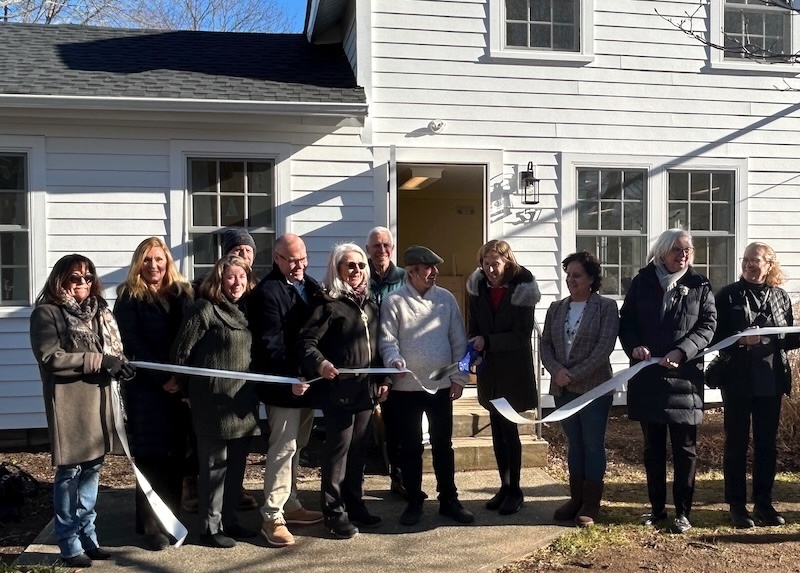
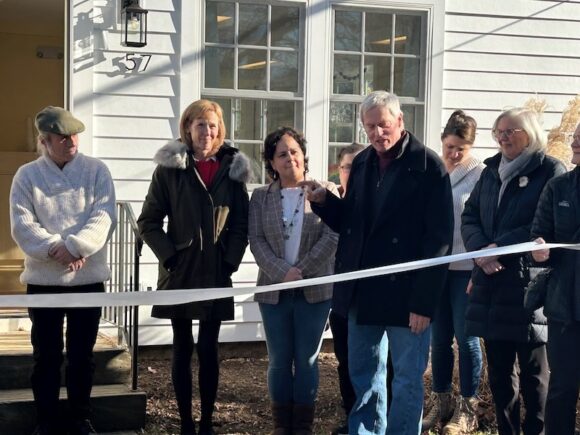
Old Lyme Children’s Learning Center Board Chairman Marie Ryan cuts the ribbon to celebrate the reopening of the newly renovated Center. From left to right are Wendy Russell* , Mona Colwell *, Cheryl Poirier* , Jeff Hartmann (to rear, in hat)*, State Representative Devin Carney (R-23rd), Old Lyme (OL) Selectwoman Jude Read, Joe Camean*, OL Selectman Jim Lampos, OLCLC Board Member Marie Ryan, OLCLC Board President Kristen St. Germain, OL First Selectwoman Martha Shoemaker, Jean Wilczynski*. Members of OL Economic Development Commission indicated with *. All photos by Rayna Dakin except where indicated.
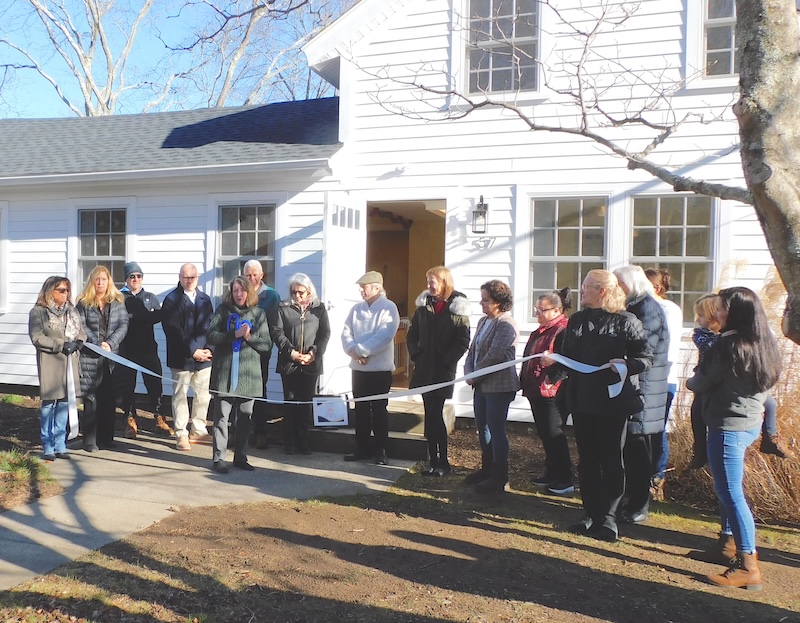
OLD LYME—It was a brisk and sunny afternoon on Saturday when state and local officials, Old Lyme Children’s Learning Center (OLCLC) Board Members and members of the public gathered at the OLCLC building at 57 Lyme St.for a ribbon cutting to celebrate the reopening of the Center after a major renovation. The ribbon-cutting was followed by an Open House with children’s crafts for little ones.
Old Lyme Economic Development Commission Chairman Cheryl Poirier (fifth from left at front) welcomes everyone to the ribbon-cutting.
The event kicked off with a warm welcome from Old Lyme Economic Development Commission (OLEDC) Chairman Cheryl Poirier, then Old Lyme First Selectwoman Martha Shoemaker spoke, noting, “We’re just so glad this renovation went so well, it’s another new bright spot on Lyme Street, and we’re glad to have you back and up and running.”
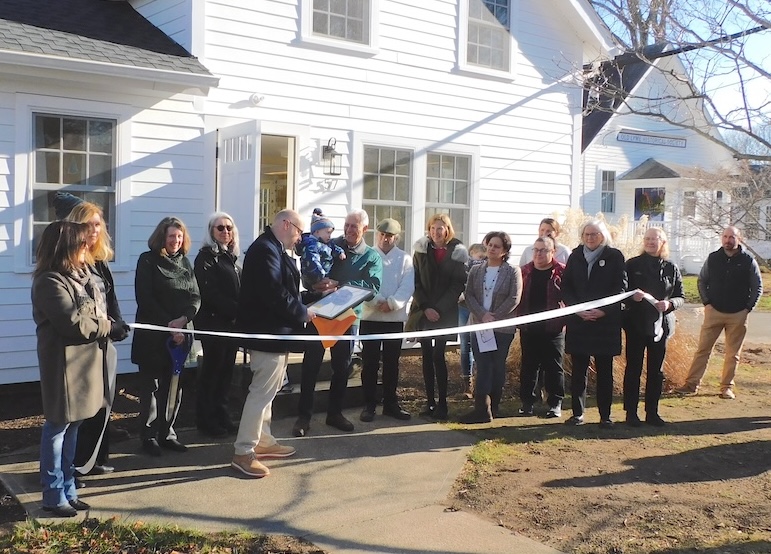
State Representative Devin Carney (R-23rd), whose District includes Old Lyme, spoke next reading an Official Citation from the State of Connecticut, which had been introduced by Carney and State Senator Martha Marx (D-20th).
State Representative Devin Carney (R-23rd) reads the Citation from the state celebrating the reopening of the Old Lyme Children’s Learning Center.
Carney said, “Be it hereby known to all that the Connecticut General Assembly hereby offers its sincerest congratulations to Old Lyme Children’s Learning Center in recognition of your years serving Lyme and Old Lyme children and families. Your programs have helped develop the skills of so many children and enhanced their self esteem. Your welcoming environment has benefitted our community, and we congratulate you on your beautiful renovation.”
He noted, “The entire membership extends its very best wishes on this memorable occasion and expresses the hope for continued success.”
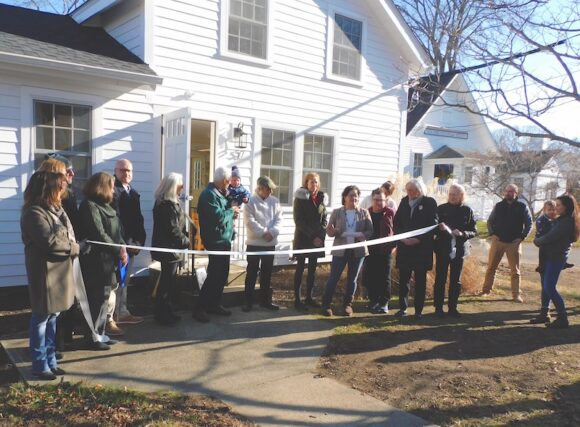
Then Kristen St. Germain, President of the OLCLC Board of Directors, spoke at some length about the importance of the Center and the renovation project, while expressing appreciation to many people. She first thanked the Old Lyme Economic Development Commission for organizing the event and all those in attendance for, “Joining us to celebrate this incredible milestone for the Center.”
Kristen St. Germain, former chair of the OLCLC Board of Directors, addresses the ribbon-cutting attendees. Photo by John Stratton.
She noted that the journey to reach the point at which they now stood had truly been “A labor of love,” adding, “For me, it’s personal—over the past 26 years, all three of my children have been part of the OLCLC programs making my own return to work that much easier. Like many parents on this board, I deeply understand the importance of quality childcare, and entrusting our children to a place that we can feel good about and I also know that this has been something that has become increasingly difficult for working families to experience these last few years.”
St. Germain went on to explain that following the pandemic, the Office of Early Childhood reported “a staggering shortage of 50,000 infant and toddler slots across the state.” She noted, “Our Center, too, faced significant challenges, having to close its doors for over a year. During that time, we reimagined our programming to help meet the growing demand for infant and toddler care in our community.”
But she noted the challenges did not stop there, referring to the discovery of a structural beam that was rotted in the OLCLC’s 1850 building. That “major setback” sparked the whole renovation project, which took some 18 months of intensive work to rectify. St. Germain then stated ebuliently, “But thanks to the unwavering dedication of so many, we persevered and reopened, ready once more to serve families seeking exceptional care for their children.”
She noted “an incredible team of people” had made the renovation happen, citing current Board Chair Marie Ryan and all of the Board of Directors, noting, “Your tireless volunteer efforts have been invaluable.” She mentioned the staff, who kept the OLCLC going in a limited capacity throughout the renovation and, “[worked] under some unbelievable obstacles to keep our toddler and school age programming running so successfully during the rebuild.”
Photo by John Stratton.
St. Germain added thanks to David Noe and HP Broom, “For transforming this space into a repurposed facility that will serve families for the next 40 years,” and to Charter Oak, “For helping us secure the funding to make this vision a reality.”
Thanking the Old Lyme Historic District Commission, St. Germain said, “We appreciate your partnership as we navigated the challenges of rebuilding within the historic district,” and then she mentioned First Selectwoman Shoemaker and the numerous town officials who had ensured, “Every requirement to get this project across the finish line,” was met.
State Representative Carney was also thanked for supporting the project at the state level.
The Old Lyme Historical Society also received a shout-out “For the use of your building during our renovation.” St. Germain elaborated on that act of kindness, saying, “This was so helpful in allowing us to conduct administrative work and operations while also being able to be close to the construction site.”
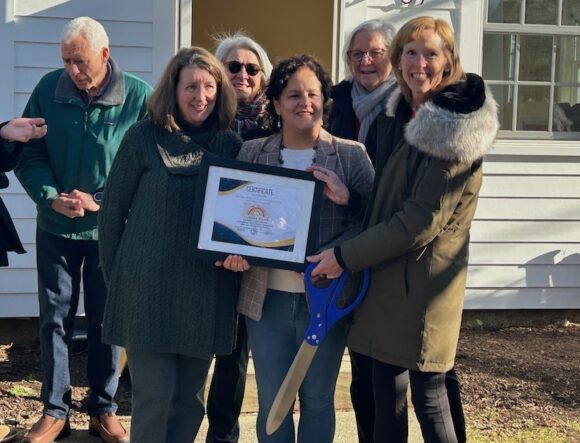
Celebrating the receipt of a congratulatory certificate from the OLEDC are, from left to right, OLEDC Chair Cheryl Poirier, OLCLC Board President Kristen St Germain, and OLCLC Board Member Marie Ryan.
St. Germain concluded by addressing the OLCLC patrons, whom she described as, “The most important people,” thanking them for their “patience and understanding during our temporary closure.,” noting how challenging it must have been and saying, “We appreciate your loyalty in returning to us. We promise to continue to take great care of your babies moving forward.”
Her final firm statement was, “As we stand here today, I can confidently say this was a labor of love. We are profoundly grateful to everyone who contributed to making this happen.”
Bill Bartlett of HP Broom addresses those gathered for the ribbon-cutting, noting the fun he and his team had enjoyed working with the OLCLC.
Bill Bartlett, project manager for HP Broom, the builder of the project, followed, saying, “We enjoyed working with the Old Lyme Children’s Learning Center, … when we met Marie and the gang in the early stages, you could walk in the door and see all the way down to the basement floor and then up into the roof rafters…. it was fun bringing it back…. it was great, it was a lot of fun.”
Poirier wrapped up the proceedings noting ” I think everyone knows childcare is an economic issue. Parents sometimes can’t have a caregiver go back to work because there isn’t quality childcare available. … We’re just very lucky to have the Center here on Lyme Street that our local employers can depend on to be part of the solution to employment.”
OLD LYME — On Dec. 7, 2024, Armand Romeo died at his home in Old Lyme. A mass will be held at 11 a.m. Dec. 14, at Christ the King Church in Old Lyme …
Armand Anthony Romeo was born in New Britain to Armando and Maria Romeo Nov. 11, 1934. When he moved to Old Lyme in seventh grade he met the love of his life, Barbara Mather. They were married in 1952 and lived in Old Lyme for over 55 years …
Armand was predeceased by his three brothers, Fred, Sam, and Vincent; his wife Barbara; and his eldest son Christopher Romeo. He leaves behind three children, Alex (Patrice) Romeo, Susan (Robert) Malestein, and Leslie Romeo; as well as daughter-in-law Deborah Romeo. He also leaves behind his grandchildren, Anthony, Samantha, Lauren, Sophia, Carly, Quinn, Maia and Rowan …
Editor’s Note: Visit this link to read the full obituary published Dec. 11, 2024 by The Day.
To the Editor: An Open Letter to the People of Old Lyme
I truly think that the Public Hearing this evening at 5:30 p.m. in the Old Lyme Town Hall is our last best chance to protect this precious Mile Creek River, this habitat. With the start of full-time quarrying operations at the gravel pit, the peace, the quiet, the wildlife are all about to disappear.
I wish I could have been more effective in helping to protect this, As Claudia Weicker, from R.T.P. Audubon called it when she visited our home, it is an incredible habitat, a birder’s dream. She truly loved the place.
Please, encourage your neighbors to attend and make their concerns be heard. If there is a large turnout the hearing may be continued.
So this may be a bit of a long haul, But not anywhere near as long or loud as the Gravel Pit operation will be …
Editor’s Notes: i) This op-ed was submitted by Eric Knapp, who is employed as the Town of Old Lyme’s Land Use Coordinator. He is writing here as a private citizen. ii) This is the opinion of Eric Knapp.
The Connecticut General Assembly has determined that creating more affordable housing in the State is a priority. It is hard to argue that we have sufficient housing in a price range that a family of moderate means can afford. As a goal, housing that residents can afford is worthy.
It is also apparent that Connecticut’s attempts to promote that goal have not been a success. The original legislation to promote “affordable housing” was adopted in 1988. In the intervening 36 years, a variety of carrots and sticks have been put forward, but the problem has not gone away. I am not even sure we can say it has gotten measurably better.
And yet the Legislature is looking at even more heavy-handed solutions to address the problem. To quote a popular gif, “the beatings will continue until the morale improves.”
It is worth exploring why these methods have failed in this part of the State. Whatever your political leanings, we all have an interest in not perpetually continuing failed methods.
For starters, much of the “easy” land to develop has already been divided up. This part of Connecticut has been carved up since colonial times, and there are few remaining farms or other large tracts to work with. While shifting “affordable” housing to marginal land has been a historical pattern, it is not a very successful, or equitable solution. Additionally, as we have discovered, filling wetlands does not solve the underlying hydrological reason the land was wet to begin with. Many lands that were filled back in the 1950s, 1960s or 1970s are returning to their original state. Climate change is accelerating that process.
Lack of sewers is an inherently limiting factor. If sewage for each parcel must be treated on the parcel itself, then larger uses require larger areas for septic treatment. Creating any type of increased density requires good (original) soils, and area used for septic systems displaces other possible uses.
For all of the talk and legislative push for “transit-oriented development”, this part of the State is notably poor in transit options. Yes, Clinton, Westbrook and Old Saybrook have train stations, constructed at great expense, but no one really uses these to get around locally. Old Lyme, East Lyme and Waterford lack even the station, although we have the tracks. Going up the Connecticut River Valley, there is no rail at all. Yes, there is River Valley Transit (formerly Nine Town Transit), but service is sparse and still requires either living near the pick-up locations or using the “XtraMile” ridesharing app on your phone. In short, having a car is more or less obligatory in this part of the State, and that becomes expensive.
The State can keep upping the ante. It can assign a “mandated” number of units. It can even prohibit single family zoning. Honestly, I do not believe even abolishing zoning entirely would have much of an impact on housing affordability for this part of the State. It is fun to complain about the hurdles zoning regulations place on development, but, while there are affordable housing projects that are violently opposed, it is usually not at the zoning commission where they are blocked effectively.
If the State of Connecticut is serious about rebalancing the housing market, here is what works: infrastructure and public services. If there was both public water and municipal septic disposal, there could be additional density. The State has largely dumped “Complete Streets” into the towns’ laps, but if it wants this done, it will have to do it itself. A more vibrant bus network will take state money and coordination. Upgrading drainage infrastructure will prevent flooding. None of this comes cheap. And historically, this part of the State has been underserviced compared to Hartford, New Haven and Fairfield Counties. By way of example, Route 11 sits unfinished.
The Southeastern Connecticut Council of Governments (SCCOG) produced a study in 2019, entitled the “Regional Wastewater Management Plan”. Five years ago, it noted that, “the sewer system in East Lyme has essentially exhausted its capacity allocation negotiated with New London and Waterford.” It also notes that, “sewers in portions of Groton, Jewett City, New London, and Norwich predate the federal Clean Water Act in 1972”. But the official policy of most towns is still “sewer avoidance,” which is an effective way to discourage further density.
The truth is that the towns of this area probably have about the population density that they want. And that is fine. But if you want to address the affordability crisis, you will need more housing units. More units require greater density. Greater density requires upgraded infrastructure. Short of that, it is like the old joke about the weather, “everyone talks about it, but no one does anything.”