Birches, Larches, Gingko, Oaks, Magnolia, and all flowering fruit and flowering trees as well as the Eastern Red Cedar. These trees have fleshy roots, and their feeder roots are not large when young and therefore take time to establish and are susceptible to frost heave.
Perennials that do not like to be planted in fall are Artemisia, Lambs Ears, Foxglove, Penstemon, Anemone, Campanula, Kniphofia, Lupines, Scabiosa, Ferns and Grasses.
Plant garlic this fall – garlic is the antibiotic of the garden. Plant garlic under fruit trees to avoid scab and root disease. Also, plant garlic near to ponds or standing water to control mosquito larvae or pour garlic water into ponds, bird baths and fountains to deter adult mosquitoes.
At this point I want to reiterate what Franklin D Roosevelt said in 1937; ‘the nation that destroys its soil destroys itself’. America has not heeded that warning. Precious soils in this country and around the world are being destroyed by dangerous practices in industrialized agriculture and poisonous chemicals, which completely disrupt our eco system and poison all living things.
THE HUMUS COMPONENT

Good news for organic gardeners – in your own garden you can build and retain a rich growing environment by building the Humus component. We are all carbon-based creatures as is all life on earth. Not only humans but also our soil microbes need carbon to flourish. To attract carbon from the atmosphere is needed to build the humus component.
To begin the process of humus – add composted manure three times through the year – early May, July and now in October. Manure builds soil structure and provides a rich planting environment for the following season by encouraging the millions of soil animals down below to manufacture nutrients for the roots of the plants.
Plus add mulch in the form of natural brown fine bark mulch or wood chips that you produce from your garden – aged wood chips with a combo of leaves, twigs and branches.
With manure and fine bark mulch, you are building the humus component. The manure and mulch attract carbon from the air, which builds the richest organic planting environment – the humus component.
Mulching the garden, and particularly any plants planted, divided or transplanted this fall with two inches of fine bark mulch, when the ground to cools in late October, the mulch will keep warmth and moisture in the soil and protect the roots of your plants through the winter.
You are probably asking what are the benefits of humus?
Humus acts like a sponge and holds 90% of its weight in water.
Because of its negative charge – plant nutrients stick to humus with nitrogen, calcium, phosphorus and other elements, which prevents these from washing away, and acts as nature’s slow- release fertilizer.
Humus improves soil structure, making it loose and friable, which helps plant roots move through the soil which makes for better access to nutrients, water and oxygen.
Humus also helps filter’ toxic chemicals from the soil, much like carbon-based water filtration systems that filter toxins from your water.
We cannot control industrialized agricultural practices – but in your own garden you can make a difference. Grow the soil organically and the soil will grow the plants.
Mulch and peat provide acidity, which is particularly important for any newly planted broadleaf evergreens installed in September. As previously mentioned, evergreens are shallow rooted and can heave above ground in hard frost. I suggest that you store a few bags of topsoil and mulch in the shed or garage. When you see exposed roots after frost heave, cover them with the soil and mulch until the plant can be resettled next spring.
THE VEGETABLE GARDEN

Now let’s look at what should be done right now in the vegetable, first focusing on cover crops. Last week I cut down the finished crops in the vegetable garden and incorporated them lightly into the soil.
This year, my choice for a cover crop in one area of my vegetable garden is Alfalfa, which has 3.4% nitrogen content. On the opposite side of the garden, I will plant Buckwheat, which has 1.4% nitrogen content which provides nectar for beneficial insects. Then I cover the seeds with organic composted manure.
There are many cover crops to choose from; I use white clover and rye grass in alternate years. In spring when the earth is workable that is, not too wet or cold, the cover crop is turned into the earth as ‘green manure’.
There is nothing better than your own homegrown organic vegetables – good for you and for the environment.
The less hectic pace of fall provides an opportunity to rethink your gardens. The garden’s pre-winter grooming can wait for a few weeks. You may feel that you would like a professional design, having thrown good money after bad and nothing looks right.
If that is so then contact someone that you trust to work with you to create a plan in the fall and winter, which can be phased in next spring. Engage someone who will listen to your wants and will stay within your budget. My son, Ian of Landscapes by Ian.com, always says ‘it is not what you do in the garden, but how it makes you feel’.
SPRING BULBS
Early November is the time to plant spring bulbs. When purchasing Daffodils, choose early, mid- season and late blooming Daffodils, by doing so you will have a succession of bloom. Be adventurous this year and go for masses of a single color for the greatest impact. No matter how small your planting area, it is the intensity that counts, with two or three dozen red Tulips or a hundred Daffodils planted on your woodland edge.
Buying daffodils in large numbers is less expensive, it’s true the bulbs are usually smaller but that is not a problem because daffodil bulbs grow larger each year they are in the ground. Even though many say that the bulbs should be spaced six inches apart, there is no reason they cannot touch one another.
Apply some composted manure or bulb food on the soil where bulbs are planted. Wear gloves when you plant bulbs as they contain a skin irritant, which may cause a rash.
The general rule is to plant bulbs about three times as deep as the bulb is tall and with the pointed end up. This method is appropriate for most bulbs although tulips should be planted about twelve inches down if you want to produce bloom for a second year.
Daffodils should be planted no less than nine inches down, which is below the frost line. I suggest that you do not plant the bulbs singly for the most colorful impact, but plant in groups of odd numbers, 5,7 or 9 bulbs as odd numbers are harmonious in nature.

Small bulbs like crocus can be tossed gently into a shallow trench with composted manure on the bottom of the trench, about three inches deep and plant them where they land, pointed side up. For larger bulbs like tulips and daffodils dig a trench about nine inches deep and three or four feet long with composted manure as the base and scatter these larger bulbs in the trench, also so that the pointed end of the bulb faces up!
Personally, I treat Tulips as annuals because their first year’s bloom is the best, after that first year the bloom is never as full and vibrant; the only exception to this is the parrot tulip, which I find, flourishes for years.
A word of caution -Tulips are the ‘caviar’ of the bulb family. The best method to prevent them from becoming tasty items on the rodent’s menu is to soak them in an organic deer repellent, which also repels rodents. Allow the tulip bulbs to dry before planting.
If you are unable to plant your bulbs immediately when purchased, keep them in a cool, dry place in paper bags. The best time to plant spring bulbs in the Northeast is in mid- November.
Observe Mother Nature; plants in nature do not grow in straight lines but in gentle curves that connect harmoniously with the earth.
TREE WORK
Ghoose a licensed arborist. This work is much less expensive to have done in the fall after the foliage has fallen, then the arborist is able to see more clearly what needs to be done and the work goes faster – meaning less labor time and therefore is less expensive.
If you have deep shade and want more sunlight in an area, ask the arborist to thin out the tree’s canopy and prune lower branches to make for a sunnier area, this will give you more choice of plants, that grow in dappled rather than deep shade.
If you have a badly damaged tree, meaning over 50% damaged or diseased, then have it removed, which may allow for a sun garden or perhaps the vegetable garden you have always wanted.
PERENNIALS
I do not cut my spent perennials to the ground in fall but leave them up so that I am able to enjoy the browns, grays, yellows and faded greens, which blend gently with winter’s muted landscape. The seed heads of the perennials are also wonderful snacks for the birds and in the dead of winter, what better sight than a red cardinal on the Winterberry bush in the snow.
Also wait until next April to cut down ornamental grasses; their graceful foliage is lovely to enjoy with the icicles on them shining in the pale winter sun.
However, on perennials, any spent perennials that show disease should be cut down but if the plant is more than one third diseased it should be dug up and discarded. Then throw the diseased material in the garbage not in the compost. Clean up any fallen plant debris from the soil and ONLY if it is disease and weed free, can it be added to the compost pile.
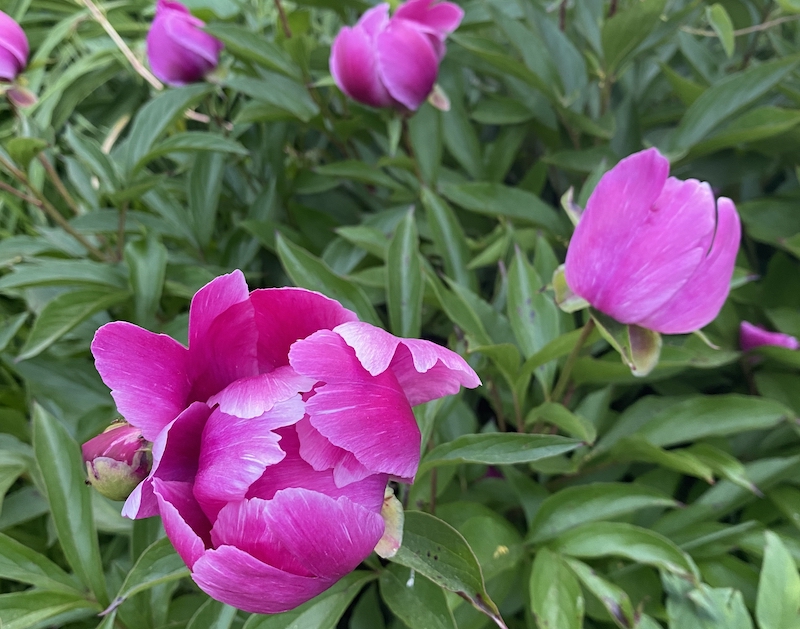
Peonies – In November after the first hard frost, cut down peonies to within six inches from the ground and add some composted manure around the base of the plant.
SIGNS OF FROST
You can foretell a hard frost when you notice the afternoon temperature falling fast under a clear sky. Assess the wind by taking a long strip of plastic, like a shopping bag from the supermarket, and hanging it from a tree branch. If the bag flutters about a foot in either direction, you do not have to worry about frost, but if it blows vigorously then frost is on the way. If you still have plants in the garden that are of concern, cover them with salt hay, newspapers or lightweight old quilts and put a brown paper bag from the grocery store over smaller plants like herbs, anchored down with rocks.
Your houseplants should be indoors now. After their summer sojourn outdoors, wash the pots thoroughly and add fresh potting soil. Then replant the plant at the same depth it was at originally and into the sink or shower and allow water to wash the foliage and water the plant well. If the plant has outgrown its pot, transplant it to the next size clean pot, only one and a half inches larger.
Enjoy the pleasant Fall weather and if you have any gardening questions, feel free to email me at MaureenHaseleyJones@gmail.com and I will see you in your garden in November.

About the author: Maureen Haseley-Jones is a member of a family of renowned horticultural artisans, whose landscaping heritage dates back to the 17th century. She is one of the founders, together with her son Ian, of The English Lady Landscape and Home Company. Maureen and Ian are landscape designers and garden experts who believe that everyone deserves to live in an eco-conscious environment and enjoy the pleasure that it brings. Maureen learned her design skills from both her mother and grandmother, and honed her horticultural and construction skills while working in the family nursery and landscape business in the U.K. Her formal horticultural training was undertaken at the Royal Botanic Gardens at Kew in Surrey.


