
TOP STORY: Controlling Hydrilla is Critical to CT River’s Health, Best Way to Implement Control Now Heated Discussion Topic

This photo was taken September 2020 during an inspection of Whalebone Cove in Lyme, in which it was found 60 to 70% of the waterways were clogged with hydrilla vines.

State Legislators say “There has been false and misleading information on social media” about use of herbicide diquat to combat Hydrilla growth in CT River

LYME, CT—Reactions to the use of herbicides in the fight against hydrilla along the lower Connecticut River have only recently begun to spread across social media, but the topic is old news to local property owners long concerned with the pernicious water weed. 

Joe Standart, a Selden Cove resident, said the herbicide treatment applied last year as part of a U.S. Army Corps of Engineers (USACE) project worked “beautifully” to rid the cove of a strain of hydrilla unique to the Connecticut River. 

“There’s no trace of hydrilla at the moment,” he said in a phone interview Wednesday. For four years prior, fast-growing and thick mats of the aquatic weed had rendered the water body impassable to power boats and inhospitable to many fish and native plants during the height of summer. 

Efforts to plan the next phase of the Connecticut River Hydrilla Research and Demonstration Project are ongoing despite federal funding limitations exacerbated this year by the threat of a government shutdown and related costcutting measures. 

Keith Hannon, USACE Project Manager, said Selden Cove may get another treatment this summer using money approved by lawmakers in the previous budget. But a proposal to add Hamburg Cove and Joshua Creek to the treatment mix, along with additional chemicals, will not happen this year. 

Meanwhile, critics of the state and federal effort to bring hydrilla under control – including a rap artist originally from Fairfield County, whose online petition has amassed 18,839 signatures to date – have gone viral with concerns about toxicity and a lack of government transparency. 

The petition calls on authorities to discontinue the use of the herbicide diquat dibromide while focusing on “non-toxic, mechanical and biological alternatives” to manage the plant. 

Documents from USACE engineers show the treatment last year in Selden Cove consisted of Dipotassium salt of endothall, while sites in four other towns along the river were treated with chemicals including diquat. 

A proposal for 12 additional sites currently under review specifies diquat is slated to be used in Hamburg Cove and Joshua Creek. 

Diquat is approved by the U.S. Environmental Protection Agency (EPA) and state Department of Energy and Environmental Protection (CT DEEP), according to Hannon. He said EPA approvals are based on field and laboratory studies that show the active ingredient doesn’t cause unreasonable risk to humans or the environment. 

He said the threat of the genetically distinct strain of hydrilla is real.

“It spreads quickly and aggressively, forms dense monoculture mats of the plant that block light which native plants need, prevents fish passage and boat traffic during the summer months, threatens native aquatic plant species by displacing them, and threatens the local river tourism and recreation economy, among other negative effects,” Hannon said. 

It can also lower property values and increase an area’s flood risk, the USACE said in a statement.  

A Public Statement issued July 8, led by State Representative Renee LaMark Muir and signed by 18 state legislators states, “There has been false and misleading information on social media that has triggered fear among residents about the use of the herbicide diquat to combat the growth of Hydrilla in the Connecticut River.”

The Statement continues, “If we do not act now, the ecosystems of the Connecticut River will be changed forever, and the river may never recover. Understandably, the use of any chemical in our environment causes concern. If we do nothing, the Hydrilla problem will worsen, and other invasives will proliferate.”

Congress allocated $5 million in 2024 and $6 million in 2023 to address hydrilla in Lake Champlain and the Connecticut River, and in 2022 authorized $1 million for the Connecticut River. 

At the state level, the Office of Aquatic Invasive Species was created in 2022 with roughly $600,000 in funding annually. 

Selden Cove, Pameacha Pond in Middletown and Petzold’s Chester Boat Basin remain the only sites that may be treated this year amid budget constraints, according to Hannon. A public notice will be posted to the project website once a treatment schedule has been determined.

An informational meeting on the proposed modifications affecting Lyme was held at the Town Hall in April. Comments on the project will be accepted through July 13 at CTRiver-Hydrilla@usace.army.mil

Natural Limitations

The project, overseen by the USACE in partnership with the Connecticut Agricultural Experiment Station and other organizations, began several years ago to figure out which aquatic herbicides ― and how much of them ― are best suited to fighting off the uniquely pernicious aquatic species.

Scientists in 2023 applied red dye to Selden Cove to mimic the flow of herbicide. It was a precursor to last year’s treatment meant to gauge the safest, least toxic way to stem the problem. 

Standart, who has spoken with scientists from his property at Selden Cove and has looked into the issue himself, said he was assured herbicides are carefully chosen based on the characteristics of each water body. He has also come to see it as the only effective option. 

He said pulling out hydrilla by hand doesn’t work because roots remain in the sediment and broken fragments can rapidly sprout new plants in new locations. 

Hannon pointed to the limitations of other natural options. 

He said introducing fish like grass carp – which he described as difficult to control, monitor and remove from the system – means beneficial native plants would be consumed in the process. And installing man-made mats to block the light would also kill off native plants – if it were feasible to cover such large areas, which Hannon said it is not. 

“Other methods to control the plant have been considered, but they do not work to effectively control hydrilla,” Hammon said.  

Standart said all signs of hydrilla disappeared within about a week of the herbicide application last August. But other forms of vegetation beneficial to the cove remained. 

“It’s still a very healthy ecosystem with wild rice and other things,” he said.

Editor’s Notes: (i) Visit this link to read more information about hydrilla from the U.S. Army Corps of Engineers is available here. For more facts on the USACE and ERDC’s efforts to eradicate Hydrilla, visit this link. 

(ii) The statement signed by the legislators states, “We can all help slow down the spread of this invasive and highly transmissible strain of Hydrilla and other invasive plants. CT DEEP and USACE recommend the best way is to “Clean, Drain, Dry” your boats and any type of watercraft and fishing gear after removal from the river or a lake. Report any sightings of the strain to DEEP at this link or to the Connecticut River Conservancy at this link.”

Happy ‘Bastille Day’! Memories of Celebrating ‘Le Quatorze Juillet’ in Spectacular Style

Nicole Prévost Logan

Editor’s Note: On this French National Holiday, we are pleased to republish a column from our oft-times Paris-based correspondent Nicole Logan (no relation), which she wrote in 2023 about the huge parade in Paris that celebrates the most memorable day in French history when the Bastille was stormed in 1789.

Letter From Paris:

Watching the 14th of July defilé [parade] is a well-anchored tradition for the French.

This year, as always, it was a two-hour impeccably choreographed event. Each French president takes it very seriously since it is an opportunity to display the military profile of the country, the vision for its future, as well as the latest technology, and to reaffirm the fact that strategic solidarity with European allies has become a priority. 

The tradition of a military parade on France’s national day — July 14th or Bastille Day — dates back to 1919, when  troops marched to celebrate the victory at the end of the Great War. In its early days, the defilé took place on the Longchamp hippodrome in the Bois de Boulogne in Paris.

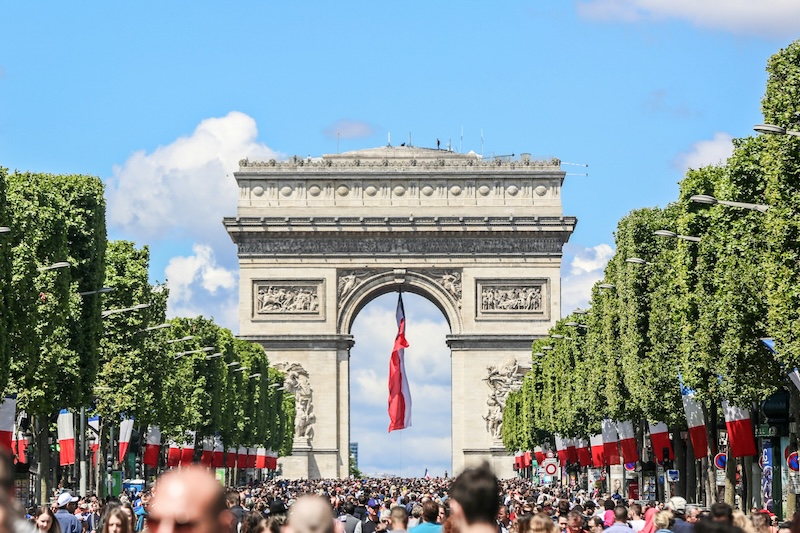
Today the Champs Elysées offers a majestic setting with the perspective of the modernistic sky scrapers of la Défense district, the Arc de Triomphe and the wide avenue leading to the Place de la Concorde. The TV Channel France 2 cameraman played with the hieroglyphs of the Luxor obelisk, which stand at the center of the square, before zooming down to the bleachers where President Macron, his wife Brigitte and the official personalities were seated.

Prime Minister Narendra Modi of India was on a state visit to France and a delegation of Indian troops was the first to march down the avenue. I was struck by their very unusual gait. They were not just swaying their arms back and forth but it looked as though those very arms were going full circle. 

Celebrating ‘Le Quatorze Juillet’ in Paris. Photo by Yewin on Unsplash.

The military parade has a special significance for me  – an officer’s daughter and the sister of an Air Force General – especially as the kickoff was done in synch with an air parade. To the delight of the crowd, two small planes flew one on top of the other, with the top one upside down.Those planes are part of the Air and Space acrobatic team of the French Air Force, who have been world champions since 2022. 

The “Big Nine” of the Patrouille de France gave a spectacular performance: nine Alphajets  flying in perfect unison with tricolor smoke trailing behind them. The Patrouille has existed since 1953 and is based in Salon-de-Provence.  

In all, more than 6o planes took part in the event: 26 RafalesMirages, and Falcon aircraft and 28 helicopters, including two light helicopters Guépard. The latest generation F4 Standard Rafale demonstrate improved connectivity with satellite and intra-flights links.

The modernization of the technology was developed during the French-led Operations Serval and Barkhane in the Sahel region since 2013. 

Polyvalence, info-valorization and integration principles were on display in the new military equipment such as  Leclerc tanks, Cesar canons, five-tons heavy tanks, 2022 hussards for infiltration and exfiltration of intelligence, armored vehicles essential for logistics in delivering troops, and equipment, such as anti-personnel mines, anti-ballistic missiles and trailers with drones .  

France already has eight aircraft carriers — the largest one being the Charles de Gaulle — along with 10  nuclear submarines.

The parade was an opportunity to display the latest equipment from the defense maritime system in existence from Belgium to both Cherbourg and Mont Saint Michel, as well as for the nuclear approach that was developed during the Harmattan Operation in the war against Libya in 2011. 

More than 6,500 men and women marched down the Champs Elysées. Their superb performance required at least six hours of rehearsals. The graduates of the élite military schools like Ecole Polytechnique, Saint Cyr-Cohêtquidan (founded in 1802 by First Consul Napoleon Bonaparte in Fontainebleau), Ecole de l’Air (created in 1933 and the oldest air force academy in the world), and Ecole Navale always have a special place in the military parade.  

Marching also were some of the 800,000 firefighters who are engaged in the fight against the growing danger of forest destruction. Thirty thousands of them are volunteers. In February 2023, they took part in a rescue mission to Turkey and Syria after the earthquake which killed 60,000 people. France uses 21 bi-engine bombers , including 12 Canadairs ( pioneered by Canada) to fight the fires from the air.

La Légion Etrangère [Foreign Legion] always stands out on the 14th of July. It is the only group which has its own band. The pace is strikingly slow. One soldier swirls his baton high in the air. The men from many nationalities are dressed completely in white. Some wear leather aprons. A soldier with a  beard longer than his companions’ holds a dog on a leash. 

The colorful contingent of the Garde Republicaine , accompanied by the noise of the horses’ hooves on the pavement is most popular with the public. Created in 1802 by (again)  Bonaparte – this special corps of 3,300 men and women is  part of the Gendarmerie Nationale. 

The defilé ended up with quite a moving choreography of young people positioned to form a Croix de Lorraine – the declared symbol of the Résistance  by General de Gaulle in 1940. The commissar of the armies read the letter of Jean Moulin, hero of the French Underground.

And finally, the crescendo of the haunting “Chant des partisans, ” a 1828 Russian melody imported by a Russian emigré to France in 1917, rose over the ceremony. 

The 2023 ceremony was indeed bristling with the symbolism of France’s destiny and its De Gaulle heritage.

Editor’s Note: This is the opinion of Nicole Prévost Logan.

Nicole Prévost Logan

About the author: Nicole Prévost Logan divides her time between Essex and Paris, spending summers in the former and winters in the latter. She writes an occasional column for us from her Paris home where her topics will include politics, economy, social unrest — mostly in France — but also in other European countries. She also covers a variety of art exhibits and the performing arts in Europe. Logan is the author of ‘Forever on the Road: A Franco-American Family’s Thirty Years in the Foreign Service,’ an autobiography of her life as the wife of an overseas diplomat, who lived in 10 foreign countries on three continents. Her experiences during her foreign service life included being in Lebanon when civil war erupted, excavating a medieval city in Moscow and spending a week under house arrest in Guinea.

TOP STORY: New Champs Crowned at Rogers Lake July 4 Boat Parade

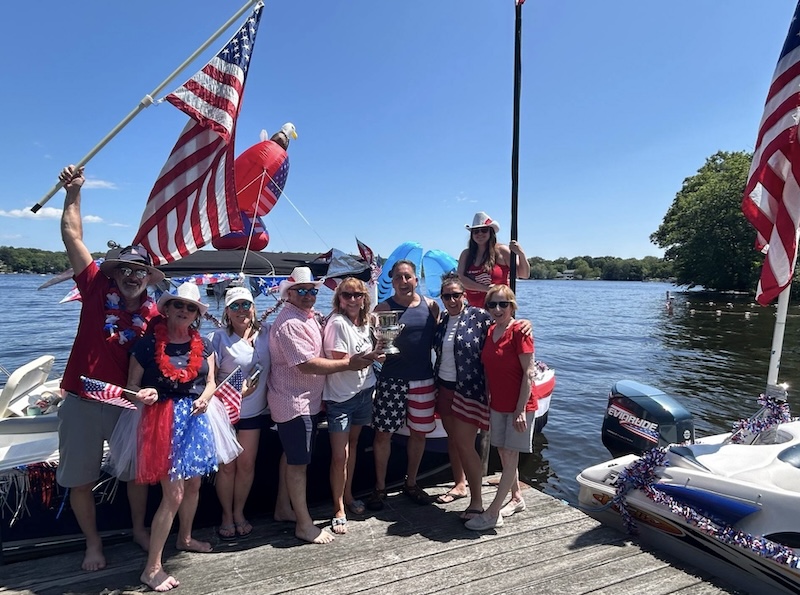
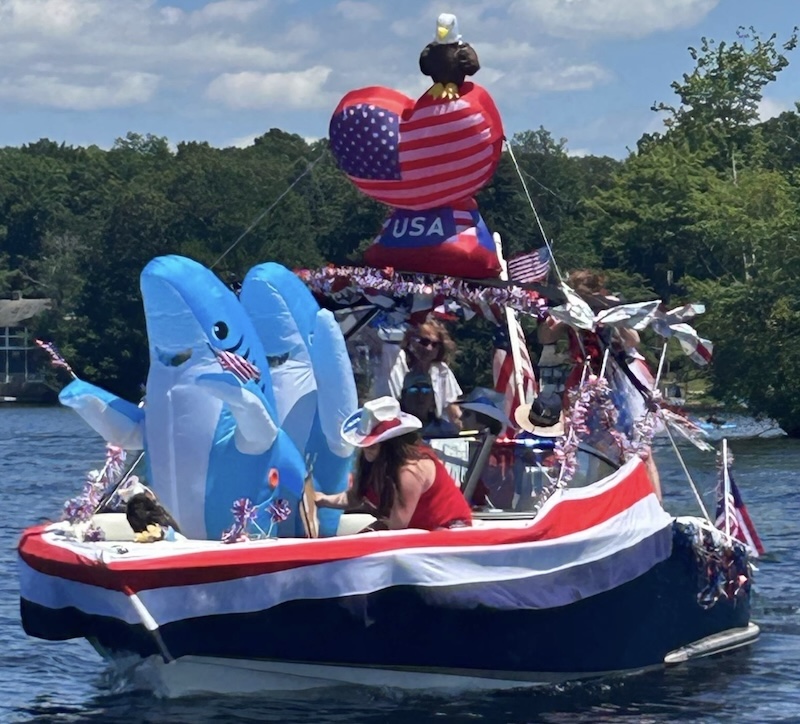
Jim and Christine Levasseur and family floated away with the 2025 Rogers Lake Boat Parade trophy.

OLD LYME—There are new Independence Day champions on Rogers Lake.

Rogers Lake Boat Parade organizers Christina and Dave Evers in an email said this year’s trophy for the “most enthusiastic, patriotic, and best decorated” boat has been awarded to Jim and Christine Levasseur and family.

The Evers said the family’s enthusiasm put them over the top during Friday afternoon’s parade around the lake.

“They never stopped dancing,” the organizers said. “There was a close second place winner, but the Levasseur family really brought that energy!”

The Levasseur family was recognized for their enthusiasm during the parade, as well as for their decorations.

Judges were placed randomly along the water.

The winners keep the trophy for 12 months and then return it to be presented to next year’s winner. The Levasseurs took the title from the King family.

This year marked the sixth annual boat parade. The trophy added friendly competition to the festivities in 2022.

TOP STORY: Lyme’s Fourth of July Parade Passes by in a ‘Blink’

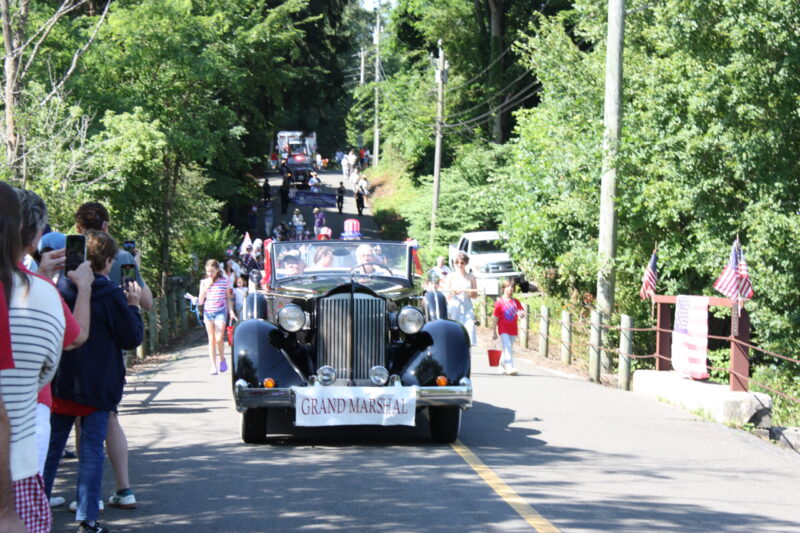
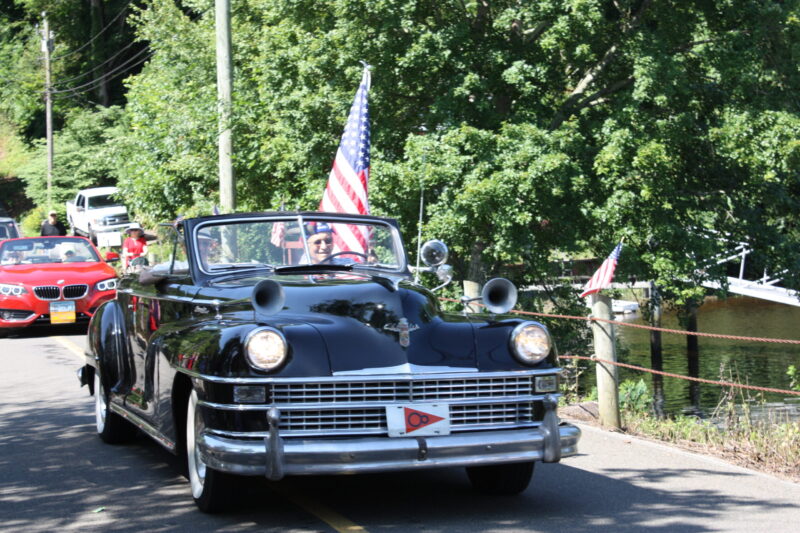
And so it begins again— the Grand Marshal’s car leads the Lyme Independence Day Parade down Cove Rd.

LYME—The parade that began over 60 years ago with a beloved doctor’s pot-and-pan band remains a short and timeless tradition.

There’s not much in the way of rules at Lyme’s Fourth of July Parade, and the clock is more of a suggestion than an absolute. You could even say time stops for this simple slice of Americana.

But nobody told that to Lyme Selectman John Kiker.

“We’re running five minutes late,” he said shortly before the scheduled 10 a.m. start.

The first vintage car set off not much later from the apex of Cove Road with Grand Marshal Bill Hawthorne in the seat of honor. Less than a quarter of an hour later, the final MINI truck cleared the Esther and Bill Irving Bridge below.

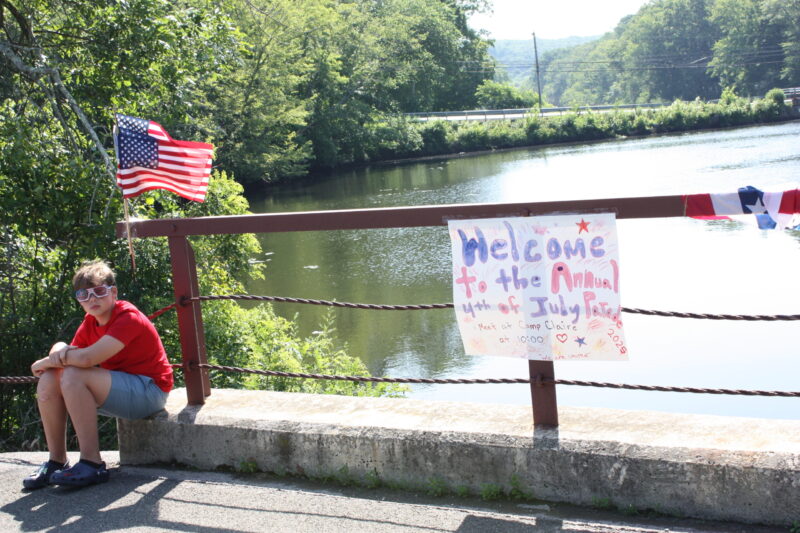
Trailing the MINI across the 10-foot span over the cove, Kiker had the answer for those wondering just how much time had elapsed.

“Twelve minutes,” he said.

Lyme First Selectman David Lahm put it this way: “Don’t blink.”

Parade founder Dr. William D. Irving was memorialized in his obituary 10 years ago for starting the tradition “on a whim” in 1958. He stepped down as grand marshal in 2008.

For a half century, Irving maintained the parade “starts promptly at about 11 a.m.” 

This time around, the annual town wide celebration got underway promptly at about 10 a.m.

Grand Marshal Bill Hawthorne, 88, served as the town’s treasurer for 26 years and treasurer of the Lyme Fire Company for 15 years.  The lifetime resident was a volunteer firefighter from the age of 16 until his 50s. George Willauer served as Hawthorne’s chauffeur.

The Hamburg Fair contingent of Lyme’s Fourth of July Parade prepares to toss candy into the crowds lining Cove Rd. and Rte. 156.

The Lyme Parks and Recreation group brought along candy for paradegoers.

Kids from Camp Claire have been a mainstay in the parade since Irving’s time. The beloved Old Saybrook pediatrician also served as the camp physician.

Campers could be heard singing along to songs like Miley Cyrus’ Party in the USA and chanting “USA” along the parade route.

Lyme Ambulance filled out a heavy contingent of first responders as part of the town’s volunteer tradition.

Ambulance volunteers from the back of this Jeep broadcast the message “Lyme Ambulance thanks you for your support” throughout the parade route.

Nancy Kalal, known for working with oxen at her Cranberry Meadow Farm in East Lyme, brought a livestock contingent to the parade. Kalal said it was the first time out in public for Red, a 400-lb, 4-month-old red Holstein in training to be an ox.  “Red behaved admirably,” she said afterward in an email. “He  seemed to enjoy all the attention, and still pull the cart on my commands.”  

Members of Lyme Pollinator Pathway represented butterflies, bees and other pollinators at the parade.

While kids all along the parade route dove into the road for candy, adults looked forward to bulbs of fresh garlic that were handed out again this year.

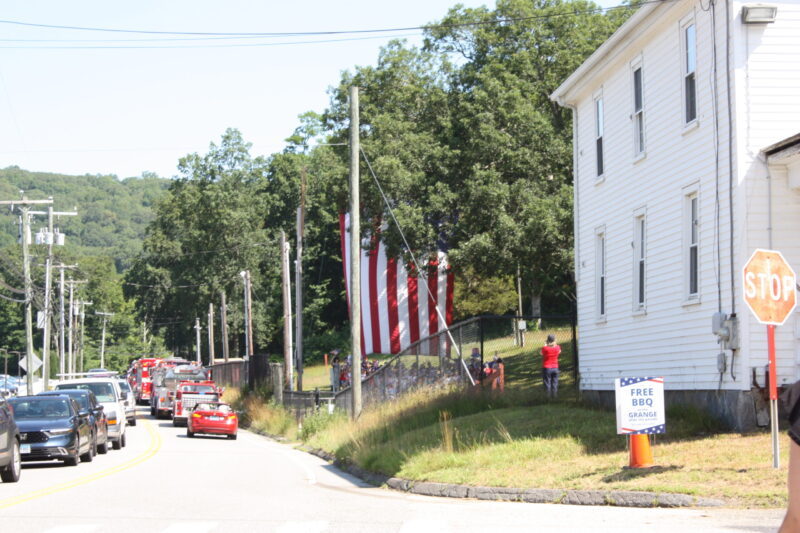
The Lyme Fire Department came out in force as a perpetual highlight in the community parade.

Enthusiastic honks and beeps reverberated across the cove as this vintage Chrysler brought up the rear of the parade.

Paradegoers on the sunny morning included those of the four-legged variety.

Fire apparatus prepared for the right turn into the Hamburg Fairgrounds as traffic resumed on Route 156, which was closed for the brief duration of the parade.

While Dr. Irving was known to hand out popsicles after the parade, members of the Lyme Recreation Commission laid out free hot dogs, hamburgers, chips and drinks at the Grange.

And that’s it until next year.

Editor’s Note: This article was updated with more information about Red, the ox-in-training.

Lyme Public Hall’s Exhibition on Impact of World War II on Lyme Residents Runs July 4-6

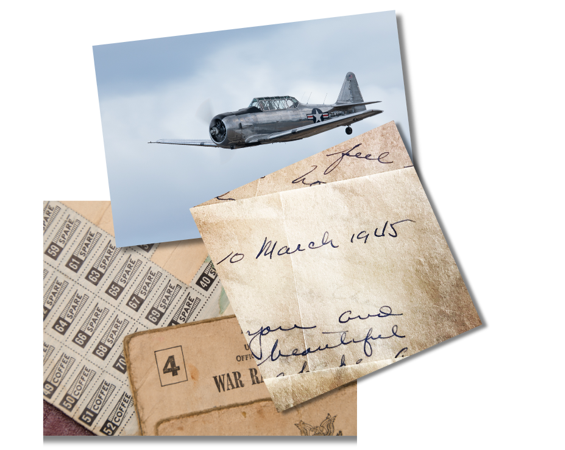
LYME, CT—2025 marks 80 years since the end of the second World War.

Visit Lyme Public Hall after the Hamburg 4th of July Parade to see a new exhibit from the Bacdayan Local History Archives exploring the impact of those war years on life and the families living in Lyme.

The exhibit will feature areas of interest such as:

  • Lyme’s WWII Veterans and Those We Lost in Action
  • Local warplane crashes
  • Lyme Minutemen & Grassy Hill Observation Tower
  • The Home Front: Grange, Rationing, Schools & More

As Jim Harding noted in the “Sound Breeze” on June 5, 1945: “… I don’t believe ever in the history of our towns have the people been scattered so far and wide.”

The exhibit will run Friday, July 4, from 10 a.m. to noon; Saturday, July 5, from 2 to 4 p.m.; and Sunday, July 6, from 11:30 a.m. to 1:30 p.m.

Lyme Public Hall is located at 249 Hamburg Rd.