Letter From Paris: Let the Games Begin … in Paris … in 2024!

Nicole Prévost Logan

The countdown has started for the Summer Olympic Games 2024 (or J.O. [Jeux Olympiques] 2024 as the French say) and the excitement is growing. The dates are July 26 through Aug. 11, and Aug. 28 through Sept. 8 for the Special Olympics . Paris will be the host of the events.

The interface of an historical city like Paris with venues for sporting events should be magical while also being a challenge.  Imagine watching beach volley ball under the Tour Eiffel or breakdancing on the Place de la Concorde !

Photo by Luca Dugaro on Unsplash.

The J.O. 2024 mark the centenary of 1924 inauguration of the first modern Olympic games. It will be the sixth time for France to host the event, and also represents the  largest event ever organized in the country. There will be total parity between men and women athletes – a first in the history of the games.   

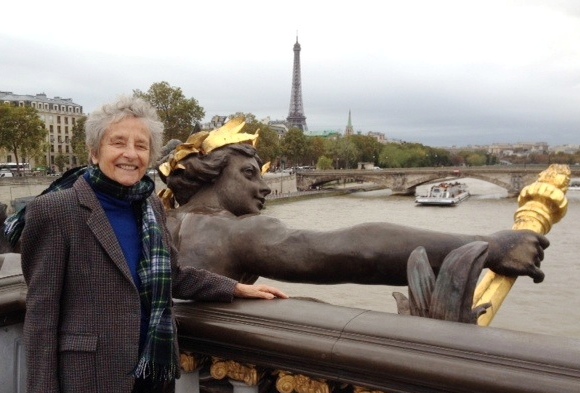
On Aug.  26, 2023, a disappointing announcement was made: because of a series of spring downpours, the sewers overflowed and ran into the Seine, which was declared too polluted to serve as a venue for water sports. The preparatory work for the competition on the Alexander III bridge had to be dismantled. 

In order to prevent the recurrent surge of polluting water into the Seine after storms, a gigantic project has been undertaken.  Between the Gare d’Austerlitz and the Hopital Salpêtrière east of the city, several blocks of apartment buildings were razed to make room for a “bassin de rétention”  50 meters in diameter. At the bottom of a 30 meter-deep well a massive “tunnnelier” machine will dig a tunnel under the Seine for huge pipes to be laid.   Other bassins will be constructed upstream east of Paris.

In a way the scheduling of the games in 2024 is helping to speed up this huge project of assainissement (sanitation).  Some day soon, maybe one will be able to swim in the Seine!

Logistics will be a major headache for the games officials, mostly to organize transport. Flying taxis will turn the skies of summer 2024 into a science-fiction scene of the future. A 10-minute flight from Charles DeGaulle airport can certainly beat a two-hour long ride by public transport.

Additional buses and trams will compensate for the closure of many metro and bus stops in central Paris and on the Périph (Beltway), a special lane will be reserved for athletes and games officials. 

The fully automated subway ligne 14 will be extended to include Orly airport and a new métro station will open near the Stade de France.

In order to assist in welcoming at least 13 million visitors, 40,000 volunteers positions were offered and filled up immediately.   

Security will be a top priority , particularly during the opening ceremony which will be watched by 600,000 spectators. All of them are obliged to have a ticket, including the 400,000, holding free tickets. 

Photo by Sebastien Gabriel on Unsplash.

Order will be maintained by 35,000 police. According to Gerald Darmanin, Minister of the Interior, the scope of the security plan is unprecedented, since it will cover six kilometers along the banks of the Seine when a parade of 115 boats will end up at the Trocadéro and the foot of the Tour Eiffel

A security perimeter will be installed around the city against any possible acts of terrorism. More than 4,000 video-surveillance cameras will function with “smart” AI algorithms to protect private data.

Anti-drones will be there also. During the Tokyo games, 400 million cyberattacks were detected. In Paris, the organizers will be ready for such a possibility. 

How expensive will the tickets be?  It is hard to give the exact prices since they depend on the competition. Just to give an idea, the most expensive seat at the opening ceremony will cost 2,700 Euros and the cheapest 90. 

At the closing ceremony, the respective prices are 1,600 and 45 Euros. 

Two of the most expensive competitions to watch will be Athletics at 900 Euros and swimming at 690 Euros. At the other end of the price range, tickets to watch the marathon or the urban games on Place de la Concorde will be either quite low or even free. In spite of the fact that many tickets have been made available for free,  people complain that prices are much too high. 

Given the politically-poisoned environment existing at present in France, it is hoped that the social unrest in the streets will not flare up again and add to the huge logistics problems of managing millions of spectators. As expected, criticisms of Paris 2024 abound centered primarily on protests against the entrance tickets being so expensive that the average person cannot afford them.

In fact, most Parisians will probably want to flee the capital during the games. Hotel rooms and AirBnB apartments will be offered at exorbitant prices. 

Most of the infrastructure to accommodate the Olympic sporting events already exists. The Aquatics Center for swimming and diving competitions is an exception. 

Close to 95 percent of the financing comes from the private sector. Private investors will bear the cost – estimated at 1.3 billion Euros – of the Olympic village. This is where the 10,500 athletes will stay in the Saint Dénis area, north-west of Paris. Architects have designed the temporary lodgings to be easily transformed into permanent apartments for low-income French residents. 

Except for the surfing competitions, which will be held in Tahiti, 9,800  miles away from Paris  (certainly not next door!), all the sporting events will take place in 30 sites equally divided between Olympic and Special Olympics throughout France but mostly in and around Paris. 

If you enjoy sightseeing in the old city, you might be interested in knowing that some key historical sites will be turned into “Sport Arenas” for various disciplines. Examples are:-

Place de la Concorde : skateboard (first time in J.O.) ; breakdancing; BMX bicycle free style,  basketball

Les Invalides: Archery

Eiffel Tower stadium and Champ de Mars: Judo and Wrestling;  Special Olympics (wheelchair rugby) 

Rolland Garros: Tennis

Chateau de Versailles:  Equestrian events, Dressage, Horse-jumping

Hotel de Ville to Les Invalides:  a 42km-long marathon touching on many historical monuments of Paris. On the first day, 80 men will run.  On the second day, 80 women .

Pont d’Iena: a beautiful location for spectator stands

Grand Palais: Fencing, Taekwondo  (Korean martial art)

Trocadero: Start of the road cycling races, 273 km

Parc de la Villette (north of Paris) largest cultural park in Europe.

Celebration Centers during the Games to meet athletes are:

Parc des Princes: Football

Vaires sur Marne Nautical Stadium: Rowing, Canoeing/Kayaking

Marseille: Sailing

La Défense Arena, Aquatics Center: Swimming and diving

Stade de France (also called Stade Olympique):  Athletics. This is the oldest discipline, going back to 776 BC in Greece

St Quentin-en-Yvelines: cycling track

A view of Notre Dame before the devastating fire.

To top it all, President Emmanuel Macron has a vision of Notre Cathedral opening for the public with a celebration of mass to coincide with J.O. 2024.  That would indeed make these ‘The Games of the Century’!

Editor’s Note:This is the opinion of Nicole Prévost Logan.

Nicole Prévost Logan

About the author: Nicole Prévost Logan divides her time between Essex and Paris, spending summers in the former and winters in the latter. She writes an occasional column for us from her Paris home where her topics will include politics, economy, social unrest — mostly in France — but also in other European countries. She also covers a variety of art exhibits and the performing arts in Europe. Logan is the author of ‘Forever on the Road: A Franco-American Family’s Thirty Years in the Foreign Service,’ an autobiography of her life as the wife of an overseas diplomat, who lived in 10 foreign countries on three continents. Her experiences during her foreign service life included being in Lebanon when civil war erupted, excavating a medieval city in Moscow and spending a week under house arrest in Guinea.

Letter From Paris: For Five Days in June, France Burned

Nicole Prévost Logan

“You should not go to France.  it is too dangerous.”  My American friends expressed their concern when I flew out to France for a summer vacation in early July.

I must admit that the news coverage of what happened in that country in late June was pretty scary: riots for five days and nights, hundreds of burnt cars, carcasses of buses left on the streets, black débris remaining after the many acts of arson, smashed storefronts and bus stops, and plundered shops and supermarkets.

In Montreuil, a suburb east of Paris, the demonstrators had used fireworks as a shield of smoke against the police. Videos showed children as young as 12 taking part in this wild rampage, running away from looted stores loaded with clothes and other goods. 

After I landed at Charles de Gaulle Airport in Paris, I expected to find widespread devastation with violence and vandalism still apparent. 

But no, the country seemed normal, traffic was as heavy as usual, restaurants full, people were flocking to outdoor markets and golf fans were eager to play their 18 holes over the weekend.

The explosion of anger against the police is not new in France with recurrent complaints against alleged police brutality and racial profiling. But this time it reached an unprecedented intensity. 

It all started when Nahel Merzouk was shot on June 27 after refusing to stop his car when summoned to do so by police officers. One month after the shooting, Le Monde published a description of what happened, based on the preliminary results of the inquiry. 

The traffic police had been alerted that a Mercedes was speeding through Nanterre, a suburb west of Paris, and that it carried guns. The traffic police then started chasing the car, which entered the bus lane, ran red lights and crossed a junction without slowing down. Finally the police managed to stop the yellow Mercedes AM, as shown on a video. This particular model has an incredible acceleration capacity and can reach a speed of 100 km per hour within less than four seconds. 

As the police officers, with blaring sirens, ordered Algerian-born Nahel Merzouk to pull over, the latter Instead made his vehicle surge away and attempted to flee. This is when the police shot the young man.  

Apparently the Mercedes had been rented the day before from a place, which opened for business just three months prior. It seems odd that a 17-year old would rent such a fancy car, particularly when, in France, the age to get a driver’s license is 18. 

Riots and pillaging occurred in cities all over France including in the capital city of Paris. File photo by Randy Colas on Unsplash

The atmosphere of hatred was also directed against any symbol of public authority vested in central or local governments, such as town halls and police barracks were sacked. Schools, gyms, social centers, and 300 bank branches were destroyed. Public buildings were damaged. In Nanterre, the rioters vandalized a memorial to the victims of the Holocaust. In Marseilles, the largest public library, named Alcazar, was also damaged.

After the violence abated, the population was left with a feeling of total paralysis. It was the middle class that had been primarily hit. Hundreds of shopkeepers saw their merchandise and also their stocks pillaged. Curfews and closures of public transport affected mostly the working population in poor suburbs.  

Threat and insults were hurled at local elected officials among the 35,000 municipalities existing in France. The private home of the mayor of l’Hay-les-Roses, a small town south of Paris, went up in smoke and his family was attacked.  

On June 30, President Macron had to cancel his official visit to Germany – the first time that has ever happened. 

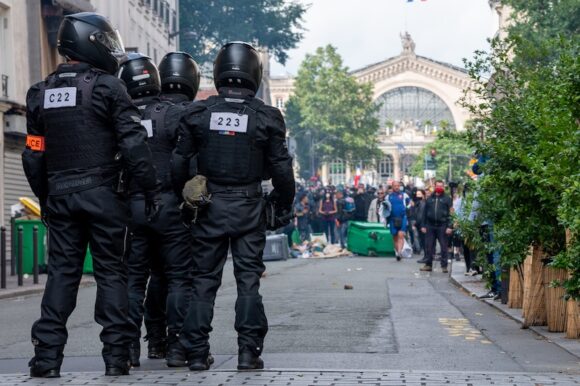
French police face protesters on a street blocked with garbage cans. Photo by Oscar Brouchot on Unsplash

The government deployed 45,000 police, including RAID ( Research, Assistance, Intervention, Dissuasion), which is an élite unit of the French police, and GIGN ( Groupe d’Intervention de la Gendarmerie Nationale). Since 2016, the law has authorized police to use firearms in cases of self-defense and to shoot a vehicle fleeing at traffic stops. More than 3,500 demonstrators were arrested. Macron threatened to cut off social networks at times of riots. He was he was accused of authoritarianism for saying that.

The financial sequels of the unrest are enormous. It is estimated at about one billion Euros, including the anticipated loss on future business. Who is going to pay? As usual, the taxpayers and mostly the little guy. The close to 1,000 shopkeepers, who suffered loss and damage, may get 10,000 Euros compensation paid by insurance .  Financial aid will be provided by chambers of commerce  and private associations. The cost of all this assistance will eventually be borne by the community.

The French population is deeply divided on the topic of police responsibility. Attempting a discussion is like entering a mine-field and you feel like you are walking on eggshells whenever you dare to express an opinion.

Conservatives and middle of the road people want law and order. They want scenes of violence in the street to be curbed. They admire the courage of police, who are so often exposed to angry mobs and to a society increasingly hostile. Hundreds of those police have been injured in recent years. The police should not be “above” the law but, at the same time, should not be “under” the law, they say. For the other segment of the population, police are the enemy with the presumption of culpability against them latent. 

The two sides of public opinion are so irreconcilable that they create immense tension and the possibility that a clash may happen at any time.

Nicole Prévost Logan

About the author: Nicole Prévost Logan divides her time between Essex and Paris, spending summers in the former and winters in the latter. She writes an occasional column for us from her Paris home where her topics will include politics, economy, social unrest — mostly in France — but also in other European countries. She also covers a variety of art exhibits and the performing arts in Europe. Logan is the author of ‘Forever on the Road: A Franco-American Family’s Thirty Years in the Foreign Service,’ an autobiography of her life as the wife of an overseas diplomat, who lived in 10 foreign countries on three continents. Her experiences during her foreign service life included being in Lebanon when civil war erupted, excavating a medieval city in Moscow and spending a week under house arrest in Guinea.

Editor’s Note:This is the opinion of Nicole Prévost Logan.

National, Local Legislators Respond to Invasive Hydrilla’s Threat to CT River; Announce New Testing, Remediation Efforts

State Rep. Christine Palm (D-36th) holds up some hydrilla during Wednesday’s press conference to demonstrate how its structure chokes native plants, harms fish and wildlife habitats, and prevents recreation. All photos courtesy of CT House Democrats.

Press Conference Held to Educate Public About Harm Caused by Hydrilla, Discuss Projects to Control Invasive Aquatic’s Spread

CHESTER — On Wednesday, Aug. 16, state and federal legislators, federal agencies, and stewards of the Connecticut River, met in Chester to educate the public about testing and remediation of invasive aquatic species in the Connecticut River, focusing on hydrilla (hydrilla verticillata), a highly problematic invasive rapidly spreading throughout the lower River Valley.

Experts addressed how these species cause ecological and economic harm, discussed the different research and removal projects being conducted in the Connecticut River, introduced the newly formed Office of Aquatic Invasive Species, and offered methods of prevention. 

“Hydrilla is a threat to the Connecticut River as it can crowd out native plants, harm habitat for fish and wildlife, and prevent recreation,” said Rhea Drozdenko, River Steward for the Connecticut River Conservancy.

Rhea Drozdenko, River Steward for the Connecticut River Conservancy., addresses the audience at the press conference.

She continued, “I’m grateful we have strong partnerships throughout the watershed as we learn more about this species and work to protect our waterways. The Connecticut River Conservancy has worked on several related projects including the use of benthic barriers to prevent hydrilla growth and promoting preventing the spread of hydrilla through the practice of ‘Clean, Drain, Dry.'” 

To improve understanding of the dynamics of water flow and exchange in the local waterways, the U.S. Army Corps of Engineers (USACE), in cooperation with the CT Agriculture Experiment Station (CAES), will be applying Rhodamine WT (RWT), a red tracer dye to the Chester Boat Basin, along with three other sites.

This dye release and study program is preparatory to the eventual release of herbicide treatment for the control of hydrilla at each site.

According to the USACE, RWT dye is a fluorescent, xanthene dye that has been used for water tracing since at least the mid-20th century to quantify time of travel in dynamic (in this case, tidal) waters. This dye has no significant effects on aquatic organisms and has been proven safe for these studies.

The dye will be applied to the sites during various environmental conditions using different application techniques at 10 parts per billion concentrations. The concentrations of the dye in the water will be collected using fluorometry equipment at certain intervals following initial dye treatment at sampling points within and just outside of the sites.

There will be impacts on the color of the water at the sites and surrounding areas as the dye is bright red in color but expected to be minimal and short-term as the dye will dilute and dissipate with the flow and tides of the river.

State Rep. Devin Carney (R-23rd) thanked State Rep. Christine Palm (D-36th) for taking the lead on the hydrilla issue and emphasized the urgency of eradicating it.

“I am grateful for the combined brain power of these biologists, engineers, and advocates,” said State Representative Christine Palm (D-36th), whose district covers Chester, Deep River, Essex, and Haddam.

She stressed, “We don’t want the public alarmed at the sudden appearance of red dye in the water, so we’re trying to get ahead of it by educating boaters, businesses, and residents. Ultimately, the goal is to eradicate the spread of this invasive, which is devastating our waterways.”

Rep. Palm, who serves as vice chair of the General Assembly’s Environment Committee, successfully introduced a bill in 2022 to establish and fund the Office of Aquatic Species at CAES.

“Hydrilla and invasive plants can and have caused significant damage across a number of bodies of water in our state, said State Senator Norm Needleman (D-33rd), whose district includes Lyme, Conn.

He noted, “By working to study how water flow and downstream activity can result in the spread of such plants, we can better prepare for and respond to the future spread of these plants, better supporting our natural resources.”

“It is vital that we continue to do what we can to prevent the spread of hydrilla and work to eradicate it,” said State Representative Devin Carney (R-23rd), whose district includes both Lyme and Old Lyme.

He said, “This is an issue that affects our environment, economy, and our overall quality of life. I want to thank Rep. Christine Palm for taking the lead on this issue and for all of the efforts by state agencies and organizations to remove this invasive species from our waters.”

U.S. Senator Richard Blumenthal said he had advocated for $6 million in federal funding to help the U.S. Army Corps of Engineers control and eradicate hydrilla.

“Hydrilla poses a significant ecological, environmental, and economic threat to the Connecticut River,” said U.S. Senator Richard Blumenthal.

He pointed out, “This invasive species is spreading rapidly – knocking out aquatic plants, choking fish and other wildlife, and making the waters unsafe for recreation,” adding, “I am proud to have advocated for the $6 million in federal funding included in the omnibus bill to help the U.S. Army Corps of Engineers control and eradicate this harmful species.”

Editor’s Notes: i) Visit this link to watch a Capitol News Briefing with U.S. Sen. Blumenthal, State Rep. Palm, State Rep. Carney on the threat of Hydrilla in the Connecticut River.

ii) This article is based on a press release issued by the Connecticut House Democrats.

Letter From Paris: Memories of Crimea … a Strategic Peninsula Steeped in History, Culture

Nicole Prévost Logan

Subsequent to the Russian occupation of Crimea in 2014, which took place 60 years after USSR First Secretary Nikita Khrushchev transferred it to Ukraine in 1944, the strategically-important peninsula has frequently made news headlines.

I visited the region twice and have always been fascinated by the important events and famous people with which it is associated.

Map of the Crimea with inset showing the broader geographic location of the peninsula. Image published under the Creative Commons Attribution-Share Alike 2.0 Generic license.

In July 1990, my husband Alan, four friends and myself were sailing around the Black Sea on “Katy II”, our French-built 44 ft. ketch. After a 24-hour stretch from Sochi, we proceeded south through the Sea of Azov. Lightning followed us throughout the night. (Alan’s comment was, “That was a hell of a good sail,” while mine was along the lines of, “That was a hellish sail in spades!” ) 

We reached the Crimean coast, carefully keeping away from the naval base of Feodosia. We passed Koktebel, famous for its writers’ colony, which has existed there since 1911. Some of the greatest Russian poets, among them Anna Akhmatova and Marina Tsetaeva, spent time at the colony.

As we approached the port town of Alushta, a booming voice from a loudspeaker barked, ” What are you doing there?” 

Soon after, we were boarded by the Soviet Coast Guard. Their metal launch rammed violently into our boat.  

But the encounter turned out to be pleasant. The  sailors enjoyed having their picture taken with Jane, our young crew member from California.

Then we sailed along a beautiful coast, reminiscent of the French Riviera. with elegant residences, hotels and casinos. This was the resort of Gurzuf  where Alexander Pushkin spent a few months in exile in 1821 for having written a piece about freedom. 

Yalta is located in a spectacular setting, with a mountainous backdrop reminding  me of Table Mountain in Cape Town. Initially, we tied “Katy II” near a boardwalk in the center of town. The people had never seen a foreign sail boat before, so you can imagine the crowd. 

It was on Yalta‘s boardwalk that Anton Chekhov staged one his most charming short stories entitled, ” The Lady and the Dog.”  The Russian playwright, sick with tuberculosis, spent his final days in the mild Mediterranean climate of Crimea. 

While staying in Yalta, we toured the vineyards’ cellars to taste some of the many sweet wines, like Porto, Tokaï or Muscat, grown on the sun-drenched hills.

Nicholas II, Alexandra and their five children spent several blissful summers in their Livadia palace, near Yalta. The elegant, neo-classical buildings overlook the Black Sea. 

In February 1945, the conference of the “Big Three” took place in this gorgeous area. US President Roosevelt stayed in the last Tsar’s summer residence. A special apartment was arranged for him on the ground floor. A few miles away, British Prime Minister Winston Churchill settled in the Vorontsov Palace – an extravagant architectural complex combining Moorish and gothic styles. S0viet Union Premiiiapi Stalin took his lodgings in the Koreiz palace also nearby. 

As we cleared a rocky promontory, west of Yalta, the Russian Coast Guard paid us another “visit”. The reason this time was that we were too close to the seaside “dacha” of Gorbachev in Soros.

In 1992, I accompanied the team from the Pushkin museum Department of Ancient Art and Archaeology to the ancient site of Pantikapeon * (or modern Kerch) on the most eastern point of the Crimean peninsula. I knew the team since I had taken part in the excavation of a 17th century estate located on the grounds of the Pushkin museum in Moscow. 

After a 28-hour train ride with the friendly group, lots of singing and a fair amount of vodka, we reached our dig-house at the foot of Mount Mithridates. 

In the 7th century BC, Pantikapeon was one of the most important settlements created by the wealthy Greek cities of Asia Minor (or modern Turkey) on the northern shore of the Black Sea. Numerous archaeological sites are being excavated by Russians, Ukrainians as well as Westerners in this part of the world. 

Offset poster for US lecture-series Energy Plan for the Western Man (1974) by Joseph Beuys,.

The Kerch region still shows traces of the fierce combats, which took place between the German and Soviet forces, particularly between 1941and 1942. Out of the tragic scenes of devastation and killings came an amazing story of redemption though it is disputed by German military sources. 

It is the story of the controversial modern German artist Joseph Beuys (1921-1985). He was flying with the Luftwaffe during World War II over Crimea. His plane was shot down and a Tatar shaman rescued him. (A shaman is someone who interacts with the spirit world through altered states of consciousness, such as trance.)

The shaman saved the pilot’s life by rubbing sheep fat on his skin and covering him with a felt blanket. From then on, felt and grease constituted the central part of the artist’s works and “installations.”

Wikipedia notes, however, that, “Records state that Beuys remained conscious, was recovered by a German search commando, and that there were no Tatars in the village at the time.”

Today, Beuys is considered an icon in Berlin.  

Author’s Note: For more information about the Pantikapeon excavation, access my article titled, ‘The View from Mount Mithridates’, published in the November/December 1994 edition of ‘Archaeology’ magazine.

Nicole Prévost Logan

About the author: Nicole Prévost Logan divides her time between Essex and Paris, spending summers in the former and winters in the latter. She writes an occasional column for us from her Paris home where her topics will include politics, economy, social unrest — mostly in France — but also in other European countries. She also covers a variety of art exhibits and the performing arts in Europe. Logan is the author of ‘Forever on the Road: A Franco-American Family’s Thirty Years in the Foreign Service,’ an autobiography of her life as the wife of an overseas diplomat, who lived in 10 foreign countries on three continents. Her experiences during her foreign service life included being in Lebanon when civil war erupted, excavating a medieval city in Moscow and spending a week under house arrest in Guinea.

Editor’s Notes: i) This is the opinion of Nicole Prévost Logan.

ii) The offset poster for US lecture-series ‘Energy Plan for the Western Man’ (1974) by Joseph Beuys, organised by Ronald Feldman Gallery, New York is published courtesy pf Ronald Feldman Fine Arts, New York. This file is licensed under the Creative Commons Attribution-Share Alike 3.0 Unported license.

Kinship, Respite Grants Available to Help Guardians Pay for Rent, Summer Camp and Other Expenses

LYME/OLD SAYBROOK — With so many Connecticut families feeling the financial pain of inflation, Saybrook District Probate Judge Jeannine Lewis reminds guardians caring for children that they may be eligible for thousands of dollars in grants to help with housing, food and transportation, as well as summer camp and other enrichment activities.  

The Saybrook District Probate Court serves the town of Lyme along with the eight additional towns of Chester, Clinton, Deep River, Essex, Haddam, Killingworth, Old Saybrook and Westbrook.

A guardianship case typically comes before the Saybrook District Probate Court when parents are unable to care for their children due to addiction, mental illness, incarceration or other circumstances. In most cases, Probate Courts appoint a grandparent or other relative to care for the children. In some cases, courts will appoint a close family friend who has a long-standing relationship with the child, as children tend to experience the most benefits when they are placed with adults they already know and trust. 

Appointing kinship guardians also saves Connecticut an estimated $72 million a year by keeping thousands of children out of foster care. However, unlike foster parents, Probate Court-appointed guardians receive no financial support for taking on this incredibly important – and often unexpected – responsibility. 

For more than a decade, local Probate Courts have annually awarded $2 million in grants from the state Kinship Fund and Respite Fund to guardians of children who meet low-income guidelines. 

The Kinship Fund awards grants of up to $550 a child — or up to $2,200 a family – a year to help pay for necessities such as eyeglasses and clothing, or for enrichment activities such as summer camp, art supplies or creative books. 

The second available fund, the Respite Fund, helps guardians with the cost of child care, rent, transportation and food. Respite Fund grants are capped at $2,200 a year.

“Many families are struggling,” said Judge Lewis, “with an increasing number of news stories talking about how some families are choosing between rent and food. These two grants can help guardians in meeting essential needs, as well as helping to ensure that extras like summer camp aren’t impossible. We’re so pleased this money exists to help guardians and the children in their care.”

Guardians can apply for both funds, though a separate application for each is required. Amounts awarded to local residents are determined by the Saybrook District Probate Court.  

Applications can be found at ctprobate.gov under the Children’s Matters tab, or by contacting the Saybrook District Probate Court at (860) 510-5028.