Jeff Duigou (R) is a candidate for Connecticut’s 33rd Senate District
COLCHESTER/LYME — Citing the need for “fresh, family-focused ideas” in the Connecticut legislature, Colchester’s Jeff Duigou announced yesterday that he is running to be the next Connecticut Senator from the 33rd District.
The 33rd District includes Lyme along with Chester, Clinton, Colchester, Deep River, East Haddam, East Hampton, Essex, Haddam, Portland, Westbrook and part of Old Saybrook.
“From groceries to gasoline, Connecticut remains unaffordable for working and middle class families as well as for seniors and small business owners,” Duigou said.“
He continued, “As State Senator, I will work with Democrats and Republicans to lower those tax burdens. I will also work to pass laws which make our communities safer. We need to better support our law enforcement officials and first responders. As state senator, I will put you, the taxpayers, first. Your voices will be listened to.”
Noting, “I will bring a law-and-order, business-friendly, pro-environment perspective to the State Capitol, adding, “As a conservationist, I believe we should be good stewards of the abundant natural resources we enjoy here in Connecticut,”
Duigou stated, “I will be a voice for sustainability, preservation. and public health. At the same time, I understand that innovation, research, trades, and small businesses are the backbone of our economy.”
A Republican, Duigou worked for more than 30 years in the environmental engineering field and retired from his Vice President of Environmental Sciences position at Eagle Environmental, Inc.
For 18 years, he served as a Licensed Environmental Professional, helping clients with compliance with federal and state environmental regulations and for 15 years, Duigou worked with multiple school districts to help provide safety services to administrators, teachers and maintenance staff.
Duigou concluded,. “From affordability to public safety to wasteful government spending, there are so many areas where we can improve our state’s policies.”
A graduate of the University of Connecticut, Duigou and his wife Cari have lived in Colchester for the past 38 years and have raised their family there.
Editor’s Note: This article is based on a press release issued Jan. 17, by Jeff Duigou.
Tragic link between the featured artists is that they all committed suicide
Nicole Prévost Logan
PARIS, FRANCE — The art scene in Paris during the last month of 2023 was quite intense. Three major exhibits of artists—coming respectively from France, the US and the Netherlands—attracted a sophisticated, international public. These artists have nothing in common, except that all three of them committed suicide.
Nicolas de Staël is all the rage today in Paris. The retrospective at the Museum of Modern Art in Paris is the first since 2003 when the Pompidou Center showed the artist’s early work. De Stael is considered as one of the most famous artists in France today and also the most expensive.
The large exhibit includes works coming almost entirely from private collections rather than from museums, indicating his success on the art market. This may explain the sometimes acerbic comments from art circles. Except for Braque, who became his longtime friend, de Staël was closer to writers and poets than to other artists. In contrast, the reaction of the public was gushing and unanimous enthusiasm.
De Staël was born into to the Russian military nobility in St Petersburg. In 1917, at the age of three, he left Russia with his family. After a few difficult years in exile, he found himself as an orphan at the age of eight. Wealthy friends, who welcomed Russian immigrants, helped him attend an upscale school in Brussels.
At the age of 23, he folded up his more than six foot five frame into the tiniest of all French cars—a deux chevaux ( a two-horsepower) Citroën—and drove to Spain on the first of his incessant travels, always searching for the perfect light. What he discovered in Morocco made him throw out everything he learned during his three years of study at the Royal Academy of Fine Arts in Brussels. He painted eight hours a day and destroyed everything he painted.
His life story reads like a Russian novel, full of passion, despair and drama. His flamboyant and vibrant personality was like a magnet, attracting relatives, lovers and friends and contributed a great deal to his fame as an artist. Disregarding morality conventions, he fell passionately in love with married women. The first one was a young painter, Jeanine Guillou, an adventurer, touring the Sahara desert on the back of a donkey with her husband, also a painter.
After her death in 1946 and the difficult years of the Occupation of Paris by the Nazis, he married Francoise Chapiton, 21, who was teaching English to his stepson Antek and had three children with her. A few years later without qualms, he would leave her and his three children and engaged in another passionate liaison with a married woman, Jeanne Polge.
A visitor to the exhibition is struck by the unusual journey of the artist’s creation which broke the traditional path from figurative to abstract and therefore did not fit into the accepted categories. During his earlier period, de Stael had produced a majority of black and white drawings, graphic work and then one witnesses an explosion of spectacular colors and a return to figurative work.
Actually it is deceptive:since, from a distance, landscapes, architecture, scenes with people or with activities—like a port, or a football game—may seem like figurative representations created “after the motif” but, on looking more closely, the scenes are, in fact, made up of geometrical shapes, which are close to abstraction. One of the earliest paintings where he used color was done in 1933—in the “Arbre Rouge ” (the red tree), red paint drips and makes the tree look as if shedding red tears.
His way of painting was unique. He worked on several paintings at the same time, borrowing from one to modify another. A buyer would be surprised to discover that the work he purchased from the artist was different from the one he saw at first.
Even his studio was out of the ordinary. Located on Rue Gauguet in the 14th arrondissement of Paris, close to Rue des Artists and Parc Montsouris, it had an incredibly high ceiling of eight meters. An art historian compared it to a well, a barn or a chapel.
In 1953, de Staël presented his works in New York and was celebrated by an enthusiastic public and rave reviews in the New York Times. But de Staël’s temperament clashed with art merchants. He disliked the way they speculated on his paintings even before seeing them. There was a great deal of tension at the time of hanging the paintings, which de Stael was used to insist on doing himself. Nevertheless the exhibition of 36 paintings was both a triumph and a financial success.
In 1954 he bought Le Castelet,Menerbes, a fortified manor perched on a rock in the Luberon region of southeast France. The family still owns it today.
In 1955, he continued his frenzy of travels and painting. He rented a studio in the ramparts of Antibes, overlooking the Mediterranean. Ten years earlier, Picasso had created his art studio in the Grimaldi castle also in the ramparts. Antibes was founded by the Greeks in the 5th century BC, under the name of Antipolis.
On the 16th of March, 1955, de Staël commited suicide by jumping onto the rocks.
The de Staël exhibit at the Museum of Modern Art is unusually large. It includes 11 rooms and covers his entire life. One is literally overwhelmed by the masterful works created during his last few years, painted in a wide spectrum of dazzling colors. Here are but a few of them.
“Agrigente”, 1954, 60x81cm .This Sicilian landscape, is simplified to the maximum. the colors are imaginary (purple sky, pink road, yellow hillside). An historian describes the choice of colors of de Stael as a “crashing wave of emotions.”
“Temple Sicilien”, 1954, 73x100cm. The colors are golden, softer, the architecture reduced to simple lines.
“Le Fort Carré d’Antibes”, 1955, 114x195cm. A symphony in blues and whites. The paint is light and fluid. Not much figurative work in this one, mostly geometric shapes floating between sky and sea.
“Ciel à Honfleur”, 1952, 100x73cm. The softer. shades of blues in horizontal bands under the pale sky of Normandy.
“Marseille”, 1954. 80.5x60cm bright primary colors, houses are just cubes, the Mediterranean sea is a flat deep blue
“Parc des Princes”, 1952, 200x350cm. France-Sweden soccer match. One of the master pieces of de Staël. The match takes place at night under spotlights. A ton of muscles fly around the green grass of the stadium. After many sketches, the final painting is an abstract composition of colored energy. At the 86th minute of the game France lost to Sweden.
Mark Rothko (I903-1969)
The Rothko exhibition is the blockbuster of this winter in Paris. Parisians have become accustomed to these spectacular events taking place in the museum of the Vuitton Fondation. Since its opening in 2014, it has held other breathtaking exhibits such as the collections of the two most important Russian art collectors of the Tsarist era: Morozov and Shchukin.
Photo of Mark Rothko, Yorktown Heights, ca. 1949 by Consuelo Kanaga (American, 1894-1978). Gelatin silver photograph, 10 x 8in. (25.4 x 20.3cm). Brooklyn Museum, This image was uploaded by the Brooklyn Museum as a content partnership, and is considered to have no known copyright restrictions by the institutions of the Brooklyn Museum.
An aerial picture of the Bois de Boulogne reveals that the spinnaker-shaped museum created by Frank Gehry is the only building peeping out of the green expanse of the forest. How did they ever obtain permission to build there? The fact that Bernard Arnault, the owner of LVMH—which stands for Louis Vuitton Moët and Chandon—was the richest man in the world until April 2023 perhaps helps explain why.
Twenty four years ago, the Museee d’Art Moderne in Paris had presented a full retrospective of the artist’s works. So, why a repeat in 2023? The long lines of visitors attest to the fascination of the Parisians for the American artist.
Christopher Rothko, son of Mark and co-curator of the exhibition, is playing an essential role in the present exhibition since he contributes the inside story about his father’s personality and the struggles in his artistic career. “It is a miracle”, he explained in an interview, that we were able to obtain 60 percent of the works we wanted as well as several never seen before in Paris. Besides, he added, the Fondation Vuitton helped negotiate loans, which usually have an exorbitant cost.
The Frank Gehry structure is perfect for an exhibition of this size. It allows for an easy flow of the visitors who can access painlessly the five levels of the display, thanks to the all-glass elevators located at strategic places. Personally I wish the confusing layout of the Orsay museum, with its cramped rooms, was more like this.
Learning about Rothko is to attend a course in the history of American art in the 20th century. Marcus Rotkovich Rothko was a scholar, a rebel, and a pioneer fighting for his deep philosophical and social convictions. In 1913 his family emigrated from Latvia, which was then part of Russia, to Portland, Oregon. A brilliant student, he attended Yale for three years. Until 1950 he taught children in the Brooklyn Jewish Center Association.
The exhibit starts with a huge room where his early works are exposed . For 20 years, he was a figurative artist, painting portraits, urban scenes (such as his subway scenes) and landscapes . He also liked to draw archaic figures and monsters inspired by his readings of Nietzsche and Aeschylus . He was most impressed by European artists like Matisse, Miro or Marx Ernst, the Surrealists, and later by the generation of artists—mostly Jewish—who left Europe in World War II.
In 1946 he began his “multiform” series and his definitive evolution toward total abstraction, which art historians call his “classic period” This is the period we are most familiar with, characterized by his “fields of color” .
There was a love-hate relationship between Rothko and New York. He found his inspiration in the town but was highly critical of New Yorkers for their mercantilism, calling them “shopkeepers.”. He hated the frenzy of his life as an artist. But American art was enriched by the stands he was taking.
In 1950, the Metropolitan Museum of Art organized an exhibit entitled: American Painting today” and did not even mention abstract art. Rothko joins the group of 19 “angry artists” , including Jackson Pollock and Willem de Koonig, rebelling against the conservatism of the Met. And today, what does the visitor to the Met or MoMA see? The works of Rothko seem to form the core of those museums’ collections.
The monumental sizes of Rothko’s paintings tend to overpower the viewer. One does not look at Rothko’s painting, wrote an art critic, but enters them. In the small “Philips room”, a simple bench invites the viewer to sit in front of a Roth’s painting and meditate .
The range of colors, from the luminous orange, to the maroon to the grey and black , has a strong impact on the feelings of the spectator. The canvasses are totally covered with paint The demarcation line between different strata of colors seem out focus and a zone with a fluffy texture. In the room at the upper level of the exhibition, his paintings are the most severe. We see a black sky and a grey earth transporting us into wnat one could describe as lunar scenery. The Giacometti statue of “man walking” add sto the somber feeling
Probably the most spectacular event in his career was the commission he received in 1958, to create murals for the elegant Four Seasons restaurant of the Seagram building on Park Avenue, between 51st and 52nd streets. Mies van der Hohe was the chief architect of the 37-floor skyscraper and Philip Johnson was his associate . Van der Hohe was German and the last director of the Bauhaus school in Berlin before it was forced to close by the Nazis in 1933. The innovative design of the Seagram was a steel structure on pillars with a reinforced concrete inner core. Rothko worked for months on the project in an oversize studio he had rented for that purpose. Then he abandoned the project. Later he donated nine maroon murals to the Tate Modern in London. The nine maroon murals are part o the Rothko exhibition on loan from the Tate.
His very last project, was “The Rothko chapel” in the Saint Thomas University in Houston commissioned by sthe extremely rich art collectors John and Dominique Menil (she was the heir to Schlumberger) .
At age of 66, in 1969, he committed suicide in his studio by overdosing on barbiturates and slashing an artery in his right arm.
Gallery talks, offered by art specialists or “mediators”at every level of the exhibit, provide some helpful guidance to the general public on how to analyze one’s emotions when trying to comprehend Rothko’s “Abstract Expressionism”
Vincent Van Gogh’s at Auvers-sur-Oise ( May 20—July 29 1890)
At the Orsay museum, the exhibit of the last three months of Vincent Van Gogh at Auvers-sur-Oise leaves the visitors dumbfounded at how the artist, whom we all know so well, could still impress us with paintings never seen before.
After a one-year, self-imposed stay in St Remy-de-Provence psychiatric hospital, the prospect of living in the small village of Auvers-sur-Oise around 30 miles to the northwest of Paris, and being totally free to go and plant his easel to paint wherever he pleased, was most enticing. His brother, Theo, could visit him often since Auvers was easily accessible by suburban train from Paris.
In Auvers, Dr. Gachet, who was to treat Van Gogh, became his close friend. They shared a mutual interest in Impressionist painting and even their neurasthenic (neurasthenia is a condition characterized especially by physical and mental exhaustion) tendency. Theo, who had made all the arrangements for Vincent’s stay, was optimistic as to the improvement of his brother’s condition. in such a setting.
One must go through a one small room called, “La Palette” before seeing the main exhibit for two reasons: first, saving hours of waiting in line and second, the short, three-dimensional, virtual experience conditions the visitor to plunge into Von Gogh’s haunted world.
You live through intense, almost scary, moments, with the heavy head-set on. You open an elegant, white door with a digital hand and enter a parlor furnished with a piano, a desk and a few chairs. Next, you are transplanted into the wilderness. A palette appears on your left and moves toward you, it becomes huge and threatening, with heavy blobs of paint on it. You are being attacked by it. You find yourself in a forest, surrounded by trees. Slowly you are going down, going through a layer of roots, menacing like a bunch of wiggling giant worms.
Or to use the words of Guillaume Morel’s, a regular contributor to the magazine “Connaissance des Arts,” “gnarled roots, charred trunks, twisted branches.” You are pulled down lower and lower into a bottomless pit, a wreath of trees above your head closes up the view of the sky. Still shaking, you return to the parlor. Now you are emotionally ready to affront the mob scene of the Von Gogh’s exhibit .
The theme of the small format paintings is the village, with its streets, houses and walled gardens, and the fields nearby. One of the streets is animated by two black figures of old women, followed by two young pony-tailed girls dressed in fluffy, white dresses. The 13th century church seems to be aggressively pulsating with life. On the outskirts of the small town, sleepy thatched roof farmhouses and cultivated fields seem peaceful at first.
‘Wheatfield with crows’ by Vincent van Gogh. July 1890. Van Gogh Museum, Amsterdam. This work is in the public domain in the United States because it was published (or registered with the U.S. Copyright Office) before January 1, 1929.
But the agitated brush strokes of Van Gogh turn the few trees into flames, the cottages about to collapse under the weight of their roof, the skies are torn with bizarre and tormented hieroglyphs. The use of aplats or flat areas of paint by the artist to picture the calm fields and sheaves of wheat left by the farmers are soon replaced by a stormy wheat field swept into a storm—a splash of yellow dotted with the black dots of the flying crows.
This most famous painting of all was long believed to be Vincent Van Gogh’s last one. No more. On July 27, 1890, the artist painted “Roots” (the painting the visitor suffered through during the virtual experience of La Palette). Later on that day Van Gogh shot himself in the chest. The painting was found on the easel after his death. He died two days later .
And let me leave you with this extraordinary fact—in the 70 days he spent at Auvers, Van Gogh created 74 paintings … more than one a day.
Editor’s Note:This is the opinion of Nicole Prévost Logan.
Nicole Prévost Logan
About the author: Nicole Prévost Logan divides her time between Essex and Paris, spending summers in the former and winters in the latter. She writes an occasional column for us from her Paris home where her topics will include politics, economy, social unrest — mostly in France — but also in other European countries. She also covers a variety of art exhibits and the performing arts in Europe. Logan is the author of ‘Forever on the Road: A Franco-American Family’s Thirty Years in the Foreign Service,’ an autobiography of her life as the wife of an overseas diplomat, who lived in 10 foreign countries on three continents. Her experiences during her foreign service life included being in Lebanon when civil war erupted, excavating a medieval city in Moscow and spending a week under house arrest in Guinea.
HARTFORD/ESSEX/LYME—Yesterday, State Senator Norm Needleman (D-Essex) announced he is running for a fourth term in the State Senate. First elected in 2018, Sen. Needleman represents the 33rd Senate District, which includes the town of Lyme along with Chester, Clinton, Colchester, Deep River, East Haddam, East Hampton, Essex, Haddam, Old Saybrook, Portland and Westbrook.
“While I am proud of what my colleagues and I have accomplished in Hartford since I was elected to the State Senate six years ago, there is still work left to be done,” said Sen. Needleman. “I want to continue to build on my reputation as someone who builds consensus and forges common-sense solutions to Connecticut’s challenges that have received bipartisan support.”
He continued, “From my leadership positions on the Energy and Technology and Planning Development committees to my membership on the Commerce, Finance, Revenue and Transportation committees.”
Needleman concluded, “I’m excited to continue working as a pragmatic problem solver and support my constituents.”
Since he was sworn in as a State Senator, Sen. Needleman has served as Senate Chair of the Energy & Technology Committee. In 2020, he authored and led passage of the “Take Back Our Grid Act,” and in 2023, he took those protections further with Senate Bill 7.
Sen. Needleman has also achieved victories in energy and technology legislation.
Additionally, In 2023, Sen. Needleman championed the passage of a state budget that included the largest income tax reduction ever enacted in state history, an increase in a tax credit targeting lowest-income workers, and expanded exemptions on certain certain pension and annuity earnings benefitting seniors.
In addition to his work as State Senator, Sen. Needleman also serves as First Selectman of Essex, currently in his seventh term in the role, with a focus on effective municipal management.
He is also the founder and CEO of Tower Laboratories in Essex, a pharmaceutical manufacturing company he built from the ground up to be a leader in its field.
Editor’s Note: This article is based on a press release issued by State Sen. Needleman’s office.
ESSEX/LYME/OLD LYME—The Lower Connecticut River Land Trust invites nominations for their 2023 fourth annual award of the Melvin Woody Lower Connecticut River Conservation Award. Nominations can either be for an organization or an individual that you feel has significantly contributed to the conservation of the lower Connecticut River region.
This award is named after one of the Lower Connecticut River Land Trust’s prominent board members. Melvin Woody has been an ardent supporter of the Lower Connecticut River and Coastal Region Land Trust Exchange (LTE) since its inception in 2009. He has also been the guiding voice in the transformation and growth of that informal organization from a conservation tool of the Lower Connecticut River Gateway Conservation Zone to a broader geography that encompasses and supports the conservation needs of all of the communities of the lower Connecticut River Region.
Woody has been a member of the Connecticut River Gateway Commission since 1973, served as its Chair for many years, and is currently the Commission’s first ex officio member.
Last year’s award went to John Hall and the volunteers of the Jonah Center for their work in control of the aquatic invasive Trapa natans or water chestnut in the Connecticut River. Other awardees are Janet Stone of the Deep River Land Trust and Marilyn Gleeson of the East Haddam Land Trust. Their contributions to the region can be found at https://www.lcrlt.org/awards .
The Commission is responsible for protecting over 1,000 acres within the Gateway Conservation Zone and has supported many environmental studies and restoration projects.
Saint-Émilion is a small village perched on the hills overlooking the Dordogne river about 28 miles east of Bordeaux It is surrounded by some of the most prestigious vineyards in the world and in 1999, the “cultural village”of St. Emilion was added to the list of UNESCO World Heritage sites.
In winter, the population of Saint-Émilion is not more than 200 but in summer the place turns into one of the tourist hot spots of France. Crowds start showing up early in the morning and people fill the café terraces, climb the steep and narrow streets, and look at the small shops selling cannelets and macarons. Unwelcome cars, bumper to bumper, search desperately for a parking place.
The town has over 1.3. million visitors a year.
A view of Saint-Émilion. Photo by Sigmund on Unsplash.
A family friend, now an enthusiastic guide, led us through the long history of the village with a series of colorful anecdotes. The first traces of human occupation in Saint-Émilion date back 35,000 years. We plunged into the past with our guide, who showed us the catacombs and some of the 200-km long tunnels, which turn the hill into something resembling a Gruyère cheese .
Saint-Émilion acquired its name from brother Aemilianus or Emilion — a monk who arrived from Brittany in the 8th century AD. He was a master in the art of making bread. In doing so he earned money, which was stolen by other monks, according to our guide. He then became a hermit and lived in a cave. He is remembered for accomplishing several miracles.
Word of these miracles attracted other monks and pilgrims on their way to Santiago de Compostela in Spain. Vestiges from the 8th to the 12th century are still visible underground, including wall paintings, wall carvings, altars and medieval chapels. The most striking is the “Monolith church” built in the early 12th century. Its gigantic 12-meter-high arch is made of a single block of stone. The best residences of Bordeaux are built out of the limestone found in the Saint-Émilion quarry.
In 1152 Eleanor of Aquitaine married Henri II Plantagenet. Two years later Henry became king of England and the region fell under British rule, where it remained for three centuries.This perhaps explains why the British still feel very much at home in this area.
The “One Hundred Year War” ended when the English army was defeated by the French at battle of Castillion in 1453.
In 1199, the youngest son of Eleanor, John Lackland, sealed the “Charter of Falaise” (Falaise is a town in Normandy) conferring rights to the Jurade – an association that is unique in the world. The Jurats of Saint-Émilion controlled all civic, legal and administrative affairs of the city. In the 15th century, the French kings reaffirmed those rights. The association was dissolved during the French Revolution.
Today the Jurade association exists again. Its 140 Jurats members wear the medieval scarlet robes during their annual celebration the third week in June. Quite a spectacle to watch on the top of the ruin of the Tour du Roy – the only intact Roman donjon (the great tower or innermost keep of a castle) remaining in the GirondeDépartement.
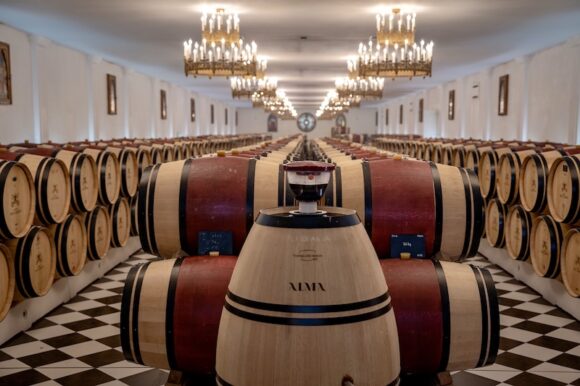
Barrels of Saint-Émilion wine are left to age in cool cellars. Photo by Brian Ashley Harris, www.brian-ashley.com.
The art of wine-making started as far back as 6,000 BC. In the Saint-Émilion area, the first wine amphora date from 56BC. The culture of wine intensified after the spread of Christianity in the 5th century AD. Archaeological excavations are ongoing in the Gallo-Roman villa du Pilat. Beautiful mosaics reveal the great wealth of that villa, which is probably related to the production of wine.
Wine-growing is a multimillion industry. It is highly regulated and fiercely competitive. It is also a vulnerable industry.
In the 1870s, a pest insect called phylloxera devastated French vineyards. It took them 30 years to recover by grafting resistant American rootstocks. Today close to up one third of the Bordeaux wine is again threatened by a double crisis, over-production and the vagaries of climate changes. A “sanitary plan” consisting of pulling vines, started in June 2023.
I obtained lots of information about Saint-Émilion while talking to a young student pursuing her university studies in Bordeaux in tourism, culinary art and oenology.
How are the Saint-Émilion wines ranked? At the 1855 Exposition Universelle held in Paris, Napoleon III, appointed a commission to rank the Bordeaux wines. That ranking has remained frozen since then for the Bordeaux wines, but only on the left bank of the Garonne River (Medoc and Graves.)
But since 1955 the ranking of the Saint-Émilion wines can be revised every 10 years. In 2022, the latest selection retained only two Premiers Grands Crus classés A:Chateau Pavie and Chateau Figeac, 12 “Premiers Grands Crus Classés B, and 72 “Grands Crus Classés. The expression “grand cru” can. be translated “first growth” in English.
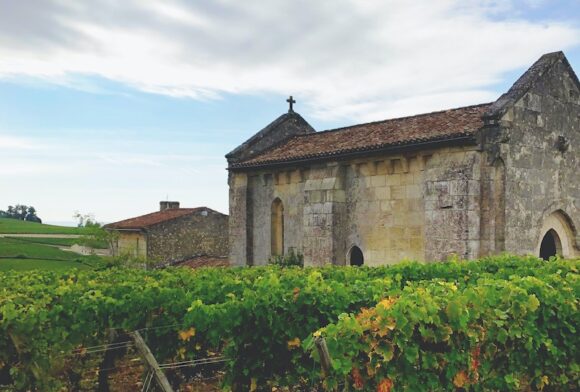
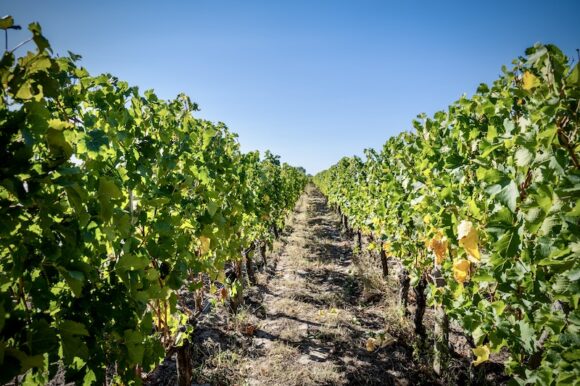
Looking down the neat rows of vines in a Saint-Émilion vineyard. Photo by Brian Ashley Harris, www.brian-ashley.com.
Saint-Émilion vineyards cover 5,400 hectares (out of 115,000 for the entire Bordelais region.) One hectare (or Ha) is the equivalent of three acres. Most of the plots in Saint-Émilion are small at 20 Ha or less.
In fact, keeping down the size helps make the wine rare and therefore more expensive.
The gaps between rows of vines are one meter or less to force the work to be done manually and not by machine.
To keep production as low as possible, the workers may even trim bunch of grapes if they are not in exact alignment. The lifespan of a wine can reach 65 years, but on our country road, I saw plots planted with brand new vines.
We approached Saint-Émilion from the main Bergerac–Libourne road in the lower plain on the right bank of the Dordogne river. A 68-meter high church steeple dominates a skyline of houses nestled among ruins of cloisters and medieval fortifications. It felt as if the winding road was taking us to the Holy Grail. On each side, we could see manicured rows of vines. Here land is worth gold and one hectare (about three acres) can be worth seven million Euros.
On top of the ridge, we notice an elegant house with a turret. Unfolding down the hill are impeccable rows of vines and low sustaining walls. This if the Chateau Belair-Monange, the residence of the Moueix family. They have been wine growers for three generations, as well as “négociants” (wine merchants) doing business in France and also the Napa valley. Their wine is “only” Premier Grand Cru Classé.”
What makes the Moueix family different from other producers is that they keep buying plots and now own 10 vineyards. In the 1960s, Jean Pierre, the head of the dynasty, made the brilliant move of buying Chateau Petrus located in Pomerol, an area adjacent to Saint-Émilion in the west.
To the surprise of everybody, the family sold 20 percent of the Petrus vineyard to a Colombian-American businessman in 2018.
Edouard Moueix, born in 1977, heads wine production today. His wife, Kelley, is American and runs a store in the village that sells bags and other luxury items.
Chateau Angelus is big in Saint-Émilion. In fact, very big.
Its offices, chais (local term for storerooms), shops and showrooms are quite conspicuous in the area. On the hill, the imposing main building where clients come to taste the wines has a beautiful roof. When foreign guests enter the building, the bells in the belfry above the entrance door will play the music of their country. The 85-Ha. vineyard is situated in a natural amphitheater near the center of town — a priceless location.
Until last year it ranked in the highest category of St Emilion wines but was excluded in 2022 and lost its “A”. The owner – Hubert Boüard de la Foresti – is the last of eight generations since 1785.
The reason for this earth-shaking development is that M. Bouard de la Foresti violated his responsibilities as head of the Confrérie du Grand Conseil du vin de Bordeaux where he served three years. He was convicted of fraud.
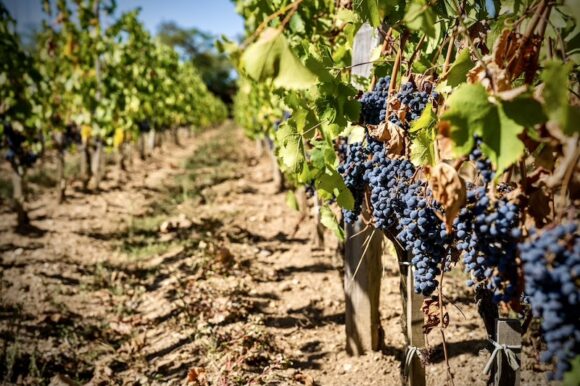
The vines are loaded with grapes prior to the ‘vendage’ when the grapes are harvested. Photo by Brian Ashley Harris, www.brian-ashley.com.
Although located not in Saint-Émilion proper but nearby in the west in the Pomerol region, Chateau Petrus is well worth mentioning. Its path to celebrity is different from the others since it received remarkable publicity through some really high-profile events.
Queen Elizabeth II chose Chateau Petrus to be served at her marriage in 1947.
John F. Kennedy offered Chateau Petrus as a gift to Jackie.
James Bond was served the Chateau Petrus in one of his films.
The acreage is quite small:- only 11 Ha.but a bottle can reach 2,300 to 5,000 Euros — and as much as 10,000 Euros — at auction.
Bernard Arnault, the richest man in France (LVMH), until 2022 owned a small plot in Saint-Émilion producing Cheval Blanc, Grand Cru Classé Catégorie A, until 2022. A 1947 bottle sells for $770.
The culture of wine in Saint-Émilion is strictly regulated. Fertilizers are not permitted, composts are but not more than every three to four years, since the earth does not need many nutrients. Watering is only allowed at times of drought.
Besides the wine growers must abide by the European Union blueprint to generate a sustainable production by respecting the environment. The label “AOC” or Appelation d’ Origine Controlée is granted to protect the production of a defined area – the terroir – using traditional know-how specific to the geographical area.
Do not miss a chance, next time you are in Saint-Émilion to do some wine-tasting by tilting the glass to see the color, twirl the glass to bring out the flavor and/or smell the wine to detect its alcohol content, aroma or acidity. You can taste the wine in one of the many wine caves àvins (wine cellars) in the village.
One can also visit estates such as the elegant Chateau Soutard — their wine-tasting package costs $800 for a group of four. A votre santé!
Editor’s Note:This is the opinion of Nicole Prévost Logan.
Nicole Prévost Logan
About the author: Nicole Prévost Logan divides her time between Essex and Paris, spending summers in the former and winters in the latter. She writes an occasional column for us from her Paris home where her topics will include politics, economy, social unrest — mostly in France — but also in other European countries. She also covers a variety of art exhibits and the performing arts in Europe. Logan is the author of ‘Forever on the Road: A Franco-American Family’s Thirty Years in the Foreign Service,’ an autobiography of her life as the wife of an overseas diplomat, who lived in 10 foreign countries on three continents. Her experiences during her foreign service life included being in Lebanon when civil war erupted, excavating a medieval city in Moscow and spending a week under house arrest in Guinea.