Essex Rotary Hosts 61st Annual Shad Bake This Afternoon

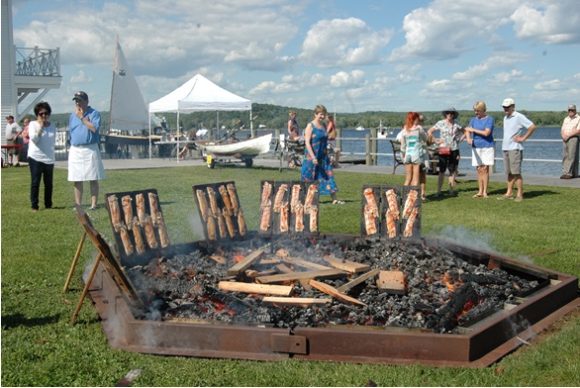
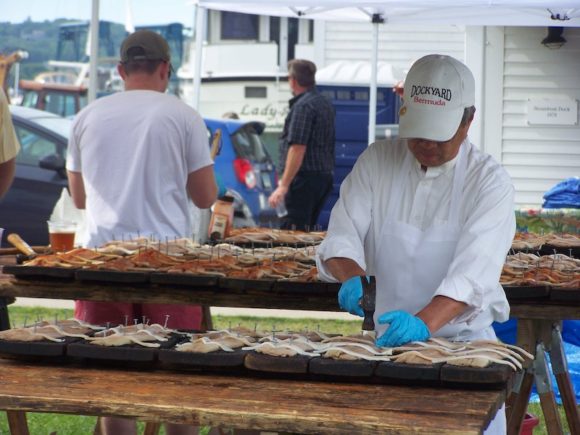
Planking the shad to cook in front of the fire in the same manner in which it has been done for hundreds of years.

ESSEX — One of our State’s great culinary customs returns to the Connecticut River Museum tomorrow from 3 to 6 p.m. with the 2019 Essex Annual Shad Bake.  For 61 years, the Rotary Club of Essex has been proudly holding this annual rite of spring, nailing delicious American shad onto oak planks and roasting them around a large bonfire.  Share this wonderful Connecticut tradition with your family and friends.

This year’s Bake is made possible through the generous support of AJ Shea Construction, Guilford Savings Bank, and The JECM Foundation. Additional support comes from Clark Group/Middle Cove Marina, Essex Savings Bank/Essex Financial Services, Tower Laboratories, and many other sponsors.

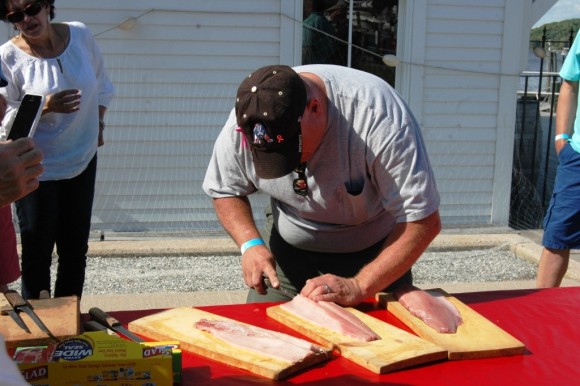
Bill Hoffstetler demonstrates the fine art of removing bones from shad; a fish referred to by local Native Americans as the “inside out porcupine”.

The Museum’s interim executive director, Thomas Wilcox said “We are pleased to host and partner with the Rotary Club of Essex on this iconic event that celebrates part of the Connecticut River’s heritage and supports the many worthwhile projects of Rotary and Museum.” This volunteer-run event has been organized by the Rotary Club of Essex and is coordinated by Bake Master Joseph Shea. Shea stated that “We offer one of the most unique culinary traditions in New England at one of the most majestic and historic locations. It is a winning combination!” 

In addition to the delicious food, a variety of activities take place throughout the afternoon. For shad lovers, the lure is the secret ingredients and the authentic method of preparing and baking the fish which has been handed down through generations of Connecticut natives.  Nailed onto oak planks with salt pork and placed in front of the bonfire, the fish picks up the smoky flavor of the fire and the seasoned oak boards on which it is baked. Add to this delicacy homemade potato salad, tossed green salad, and pie from Lyman Orchards and your shad experience is complete.

Baking the shad.

Don’t care for shad?  Grilled chicken is also available!  In addition to the food, participants will be able to enjoy live music and touring the Museum, which will be open until 6 pm.  The vibrant atmosphere is enhanced with picnickers and the delicious smell of shad baking around the open fire.  

The $35 adult (Shad or Chicken dinner option) and $10 child (10 and under) ticket includes the full meal including one water or soda (child ticket includes a hot dog and salads) and admission to the Museum.  Tickets, if available, will be $40 on the day of the event. Beer, wine and soda will be available for purchase with a valid ID.  Freshly shucked clams and oysters will also be available at an additional price beginning at 3 p.m. No carry-in alcohol will be permitted.

Bill Hoffstetler demonstrates the fine art of removing bones
from shad; a fish referred to by local Native Americans as the “inside out porcupine”.

To purchase tickets, visit shop.ctrivermuseum.org or buy them in person at the Centerbrook Package Store, Essex Hardware, or the Connecticut River Museum.  There will be no parking on the Museum grounds and on-street parking is very limited.  On the day of the event, a free shuttle will be running between the Museum and the Essex Town Hall parking lot. 

The Connecticut River Museum is located on the Essex waterfront at 67 Main Street and is open 10 a.m. to 5 p.m., closed Mondays until after Memorial Day. The Museum, located in the historic Steamboat Dock building, offers exhibits and programs about the history and environment of the Connecticut River. For a full listing of Museum programs and events, visit www.ctrivermuseum.org or call 860-767-8269.

The Rotary Club of Essex is the local chapter of Rotary International whose membership is made up of service minded professionals.  The club and its members are committed to improving the community, connecting with other professionals, sharing their time and experience with the young, supporting global causes, and using their skills to help others.  For more information about the Shad Bake and Rotary Club visit http://www.rotaryclubofessex.com.

Gainor Davis Appointed to Lead Connecticut River Museum in Essex, Starting July 1

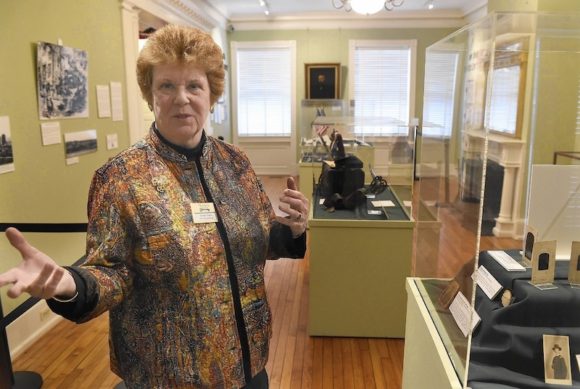
Gainor B. Davis, New Executive Director at the Connecticut River Museum in Essex, Conn.

The Connecticut River Museum, on the waterfront in Essex, Conn., has announced the selection of Gainor Davis as the new Executive Director. Chosen after a nationwide search, Ms. Davis will assume the duties of Executive Director on July 10, 2019.

Davis currently serves as the Executive Director of the Historical Society of Carroll County in Westminster, Md., a museum which she has led since January 2015. She is an experienced museum executive, having previously led several important institutions, including serving as the President/CEO of the Western Reserve Historical Society in Cleveland, Ohio, for six years; as President/CEO of the York (Pa.) County Heritage Trust; as Director of the Vermont Historical Society in Montpelier and Barre, Vt.; and as Executive Director of Longue Vue House & Gardens in New Orleans, La.

Davis has established a reputation of achieving financial stability for her institutions, along with overseeing up-to-date, audience-oriented, relevant programming that has attracted new audiences. Her accomplishments include overseeing the creation of three new hands-on spaces at three different museums – experience that uniquely qualifies her to create and open the Connecticut River Museum’s planned new River Discovery Center on its campus.

Davis brings a strong background in fundraising and marketing, and she has led two successful multi-million-dollar capital campaigns. Prior to her museum-director positions, her fundraising career included posts at Temple University in Philadelphia as Director of Development & Alumni Affairs for the College of Arts and Sciences; at the University of Pennsylvania in Philadelphia as Associate Director of Corporate & Foundation Relations; at the Strong Museum in Rochester, N.Y., as Deputy Director for Public Affairs, and at the Historical Society of Pennsylvania in Philadelphia as Director of Development and then as Associate Director of Administration.

Davis holds a Ph.D. in American History from Temple University in Philadelphia, an M.A. in American History and Certificate in Museum Studies from the University of Delaware, Newark, Del., and an A.B. in History from Smith College in Northampton, Mass. She has also published and lectured widely.

She stated, “I am very excited about the role that the museum can play in serving both the Essex-area community and the larger Connecticut River region north of the museum, extending into Massachusetts, Vermont and New Hampshire. I look forward to partnering with local and regional organizations to serve new communities. I am delighted to move back to New England and to the Essex region, where I have many ties, and to become part of the community” Davis added, “It is an honor to be invited to join the capable staff at the CRM and to work with such a committed Board.”

Peter Coombs, who chaired the Search Committee as well as chairing the museum’s board, said, “Gainor Davis was selected after a rigorous national search, with a unanimous decision of the Search Committee and the unanimous approval of the Board. We were impressed with Gainor’s accomplishments over a distinguished career as a history-museum director and advancement professional.”

Davis will take the reins from Interim Director Tom Wilcox, who is leading the museum through the transition period. Previous director Christopher Dobbs announced last August that he had accepted an offer to lead the larger Museum of the Rockies in Bozeman, Mont., triggering the nationwide search.

The Search Committee was chaired by Board Chair Peter Coombs and co-chaired by Alison Brinkman. It included board and community members Tom Klin, Joanne Masin, Brenda Milkofsky and Tom Wilcox. For the national search, the Connecticut River Museum retained Marilyn Hoffman and Scott Stevens of Museum Search & Reference, an executive-search firm located in Manchester, NH and Boston that specializes in placing museum leaders.

Founded in 1974, the Connecticut River Museum has developed as a place where anyone interested in topics about the River can come and be inspired through exhibitions and collections, a library, educational opportunities and public programs. The mission is to lead in the study, preservation and celebration of the cultural and natural heritage of the Connecticut River and its valley.

Since 1986, it has been accredited by the American Alliance of Museums, a mark of distinction in the field. The Connecticut River Museum’s campus includes the preserved 1878 Essex Steamboat Dock and Warehouse, which was saved from demolition, the Hayden Chandlery, which now serves as the Thomas A. Stevens Library, and the historic 1732 Samuel Lay House.

Education is central to the museum’s mission, and public programs include workshops for school-age children, adult lectures, and on-water excursions aboard the recreation of Adriaen Block’s Onrust and RiverQuest as part of its popular eagle watches. Annually, the museum serves more than 20,000 general visitors, delivers programing to 4,000 school children, and provides scholarship support to a further 1,000 underserved school children and summer campers.

The museum is located on the Essex waterfront at 67 Main Street and is a membership-supported educational organization. Membership is open to all.

For more information regarding the Museum, call 860-767-8269 or see www.ctrivermuseum.org.

Letter From Paris: As Notre Dame Burns, the World Mourns

Nicole Prévost Logan

On April 15, the world watched in shocked awe as the 850-year-old Notre Dame cathedral went up in flames.  The emotion was immediate, intense and spread around the globe.  Crowds of stunned people, who gathered on the banks of the Seine, many in tears, some singing religious hymns, gasped when the flèche (spire), consumed by the blaze, finally collapsed.

The French president decided to postpone an important public address.

Heads of state reacted to the fire in the same manner as if it were a major event in world affairs.

Michael Kimmelman wrote in the New York Times that France, “… Weeps for a Symbol of Paris’s Enduring Identity.

Notre Dame Cathedral in Paris was consumed by flames, April 15.

Why is this venerable monument so loved?  It is for a combination of reasons.  Situated on a strategic location on the Ile de la Cité, it is more than a place of cult but a symbol of a civilization.  A Gallo-Roman basilica or temple stood there in the 4th century when Paris was still Lutetia,  then a Merovingian palace was built by Clovis in the 5th century, which was followed by a Christian church in the 10th century.  The construction of the existing cathedral started in 1132 and was not completely finished until 1345.

Napoleon chose it for his self-coronation. as depicted by Jacques Louis David. in 1807. It was to Notre Dame that Charles de Gaulle went first, after marching down the Champs Elysées, in August 1944. During the funeral of François Mitterand, German chancellor Helmut Kohl could be seen with tears in his eyes.

“There was a great and furious flame rising between the two towers, with whirlwinds of sparks” wrote Victor Hugo in 1832. At that time, Notre Dame   was falling into disrepair and Victor Hugo accomplished the best ever exercise of “com” by writing the novel, “Notre Dame de Paris” (translated into English the following year as “The Hunchback of Notre Dame”) to attract attention to the plight of Gothic architecture.  The monument has become an iconic part of the popular culture since.

The 1939 American film,”The Hunchback of Notre Dame,” added to the collective memory by showing the unforgettable Charles Laughton begging for water on the pillory and the 19-year-old gypsy girl Maureen O’Hara helping him.  “Notre Dame de Paris” has been one of the most popular musical comedies in recent years.  Today computer games attract younger populations under the nave.  In this era of globalization, the cathedral has been an obligatory stop for mass tourism, bringing more than 12 million visitors a year to the building.

On a French televised literary program shown the day after the fire, British author Ken Follet was invited to talk about his 1989 best seller, “The Pillars of the Earth,” describing the generation-long construction of a fictional early Gothic church set in the English countryside.

The cathedral has inspired artists, like Turner, Corot, Hopper, Matisse.  In 1909,  Paul Delaunay created a modernistic vision of the city, as seen from the  top of the spire, through movement and light.  Listening to Debussy’s “La Cathedral Engloutie,” one can’t help thinking of  Notre Dame. The opening stark fifth chords describe the calm waters from which the cathedral slowly rose, inspired from a medieval Breton legend.

But the main reason to revere Notre Dame is that, like the Parthenon, it is a perfect example of the canon of architectural beauty. The masters of the 13th century created a well-balanced, light, elegant structure, devoid of unnecessary decorations.  They created a building at human scale.  Unlike some other cathedral, such as the much taller and rather austere Cologne cathedral, for example, the feeling of height is not oppressive because of the elegant archways of the  “tribune” and the “trifonium” and the upper windows pouring light over the six-point vault rib of the nave.  The giant 13th century rosaces (rose stained glass windows of the north and south transept) filter soft red-blue colors.

This is why I, like so many Parisians or visitors, have being seduced by the cathedral.  Once you visit it, it becomes yours.  Aware that I may never see it again, I am holding on to shreds of memories.

A view of Notre Dame before the devastating fire.

In the mid 19th century, the cathedral was showing its age and historian and medievalist architect Eugene Viollet-le-Duc,  aged 31, was chosen to lead the restoration starting in 1843 . He first created  stunning drawings, blueprints and watercolors.  Beside repairing the damage of time, he also made some bold additions such as the flèche – completed in 1859 – the gargouilles (gargoyles) and chimeras representing fantastic birds, demons, often used as rain spouts.  Built in Neo-Gothic style, they matched  the original spirit of the structure.

Within 48 hours of the fire, there was an unprecedented outpouring of donations.  French billionaires – Francois Pinault (maker of luxury goods, owner of Christie’s auction house) and Bernard Arnaud (LVMH, Vuitton) – rivaled each other as to whom would donate the most and turn down the tax deductions.

The main loss was the 13th century oak framework under the roof.  When it collapsed, the flèche fell through the nave at the crossing of the transept, leaving a gaping hole. For a while, experts feared the danger of collapse in three particular areas. Then stormy weather, with rain and strong winds, forced the workers  to do a fast and amazing job of protecting the structure.  The ones with mountaineering experience were dispatched to the most difficult places, like pinnacles, to lay down tarps over a temporary frame installed where the roof had been.

Two weeks after the blaze, Benjamin Mouton, former chief architect of Notre Dame commented that the building was still fragile.  Stones were at first dangling in the air.  Work by an expert will have to determine the damage caused, in a great part, by the tons of water the hundreds of firemen hosed on the building to put out the fire. It will take several months just to dry up.  The consolidation process alone will take about four months.

Fortunately the rosaces were not damaged, but to bring them back to their original condition will be a painstaking job: each pane of the stained glass will have to be taken down, cleaned, then stored until reinstalled.

Prime Minister Edouard Philippe announced an international competition.  How to conduct the restoration is causing an ongoing controversy:  whether to duplicate the original building or modernize it by using new technology?  Philippe Villeneuve, chief architect of historical monuments, will arbitrate opposing point of views.  Should Notre Dame freeze in the past or at the same time, should one stay away from wild architectural projects not in keeping with the soul of the cathedral?  One of the main dilemmas is whether to replace the oak framework (called “the forest”) with wood or use another material such as metal — as in Reims cathedral — or concrete and metal as in Chartres?

An army of carpenters,  stone-carvers and glass-blowers will be needed.  Les Compagnons du Devoir et du Tour de France (nothing to do with the annual bicycle tours), dating back to the Middle Ages, is an association of monastic character, with 80 houses across France, producing the best artisans and craftsmen in the world.  The transmission, through the centuries, of their savoir-faire will be crucial.

Restoration work, as a rule, is overseen by the Ministry of Culture.  But this time the government appointed General Jean-Louis Gorgelin, former army chief of staff, to conduct the work … and on the double.

The day after the fire, Notre Dame, seen from the East on Quai d’Orléans on Ile St Louis,  looked like a wounded bird.  With the roof gone, buttresses seemed disconnected and to be flying in all directions.

Let us hope it will rise again soon in all its former splendor.

Editor’s Note: This is the opinion of Nicole Prévost Logan.

Nicole Prévost Logan

About the author: Nicole Prévost Logan divides her time between Essex and Paris, spending summers in the former and winters in the latter. She writes a regular column for us from her Paris home where her topics will include politics, economy, social unrest — mostly in France — but also in other European countries. She also covers a variety of art exhibits and the performing arts in Europe. Logan is the author of ‘Forever on the Road: A Franco-American Family’s Thirty Years in the Foreign Service,’ an autobiography of her life as the wife of an overseas diplomat, who lived in 10 foreign countries on three continents. Her experiences during her foreign service life included being in Lebanon when civil war erupted, excavating a medieval city in Moscow and spending a week under house arrest in Guinea.
Thought-Provoking, Comedy Classic, ‘Guess Who’s Coming to Dinner,’ Opens at Ivoryton Playhouse.

Standing beside her fiancé Dr. John Prentice (Marc D. Lyons), Joanna Drayton (Katelyn Nichols) announces the unexpected news of her engagement to her parents, Matt Drayton (Gordon Clapp) and his wife Christina (Kaia Monroe) in Guess Who’s Coming to Dinner at the Ivoryton Playhouse.

Guess Who’s Coming to Dinner opens tonight at the Ivoryton Playhouse.

When the movie, Guess Who’s Coming to Dinner, began filming in March 1967, it was still illegal for interracial couples to marry in 14 states, mostly in the South. Changing attitudes in the country and the landmark case Loving v. Virginia coincided with the production of the movie and by the end of the year, the Supreme Court ruled in favor of Mr. and Mrs. Loving, ruling that marriage is a fundamental human right and effectively ending all anti-miscegenation marriage laws in America.

The Ivoryton Playhouse presents an adaptation of the movie by Todd Kriedler. Set in San Francisco in 1967, the play focuses on Matt and Christina Drayton, a progressive couple whose daughter, Joanna arrives home unexpectedly with her fiancé, Dr. John Prentice, an African-American doctor 11 years her senior. They’re in love and they want the Draytons’ blessing for their marriage – today.

Blindsided by their daughter’s whirlwind romance and fearful for her future, Matt and Christina quickly come to realize the difference between reading about and supporting a mixed-race couple in your newspaper and welcoming one into your family. It’s not long before a multi-family clash of racial and generational difference erupts.  At the end of the day, will love prevail?

This thought-provoking, comedy classic is a witty and insightful reflection on two families confronted by their prejudices.

Taking on the iconic role of Matt Drayton, made famous by Spencer Tracy, is Gordon Clapp*, best known as the Emmy-winning, Tony-nominated actor who charmed audiences as Det. Greg Medavoy on NYPD Blue (1993) and as loudmouth instigator Dave Moss in the 2005 Tony Award-winning Broadway revival of David Mamet’s Glengarry Glen Ross (1992).

Kaia Monroe*, who is an Associate Professor and Chair of Theatre at SCSU will play his wife, Christina and the rest of the cast include Richarda Abrams*, Cedric Cannon*, R. Bruce Connelly*, Krista Lucas, Marc D. Lyons, Kimberlee Monroe* and Katelyn Nichols.

The play is directed by Kathryn Markey, set design by Daniel Nischan, lighting design by Marcus Abbott and costumes by Elizabeth Saylor.

Guess Who’s Coming to Dinner runs through May 12, 2019. Performance times are Wednesday and Sunday matinees at 2pm. Evening performances are Wednesday and Thursday at 7:30pm, Friday and Saturday at 8pm. There will be one Thursday matinee on April 25th.

Tickets are $55 adult / $50 senior / $25 student / $20 children 12 and are available by calling the Playhouse box office at 860-767-7318 or by visiting our website at www.ivorytonplayhouse.org  (Group rates and subscriptions are available by calling the box office for information.) The Playhouse is located at 103 Main Street in Ivoryton.

*denotes member of Actors Equity

Photographer – Jonathan Steele

  1. Gordon Clapp, Kaia Monroe and Marc D. Lyons
  2. Kaia Monroe and Gordon Clapp
  3. Marc D. Lyons, Katelyn Nichols, Gordon Clapp and Kaia Monroe
  4. Cedric Cannon and Kimberlee Monroe

Letter From Paris: Exhibition of Macke & Marc’s Art Unintentionally Makes Powerful Statement on European Current Affairs

Nicole Prévost Logan

The exhibition titled Franz Marc / August Macke. The Adventure of the Blue Rider (der Blaue Reiter) at the Musée de l’Orangerie is the exhibit to see this spring when in Paris.  It is a festival of colors by two German artists, Macke (1887-1914) and Marc (1880-1916), who both died prematurely on the front during World War I more than a century ago.

Long overdue, and shamefully so – I believe all art historians would agree – Macke and Marc have never before been shown in France in an exhibit dedicated exclusively to them. The event opened first at the Neue Galerie of New York, then will remain in Paris until June 17.  The curators have made a few changes, particularly stressing the connection with the Blaue Reiter movement and the relationship with other European avant-gardes, particularly the fauvism and cubism in France.

After writing an article myself on April 11 2015 on this very site, it was pure pleasure to see the original works hanging in the spacious lower level rooms of the Orangerie Museum in the Tuileries gardens.

Franz Marc, The Dream [Der Traum], 1912, Museo Thyssen-Bornemisza, Madrid. Image taken from the Musee de l’Orangerie website.

Although they are shown together, the two artists have distinct personalities and styles. They first met in January 1910 and became close friends until the war.  Macke lived in Bonn on the Rhine in central Germany.  Marc, with the Russian artist Wassily Kandisnky and his companion Gabriel Munter and other members of the Blaue Reiter, loved Bavaria in southern Germany. He settled  first in Mirnau, about 40 miles south of Munich, then on Lake Kochel.

At a time when Europe is currently torn by political fractures, when the closeness of France and Germany is crucial to the survival of the continent, this exhibit has a strong symbolic meaning.  The European Union was founded on a determination to put an end to all wars.  What a powerful message when the art of these two young men is displayed together in an exceptional exhibition in Paris, considering, ironically, both men loved France and its culture, and yet died fighting against the country they revered.