CT River Museum Hosts Dinner in Old Lyme Tonight With Guest Speaker Jeff Cooley; Benefits Curatorial Fund

Jeff Cooley will be the speaker at the Connecticut River Museum’s Brenda Milkofsky Curatorial Fund benefit event on April 18 at the Old Lyme Country Club.

Would you like to know more about the ins and outs of collecting in the contemporary art world? 

Join the board, administration and members of the Connecticut River Museum Thursday, April 18, at the Old Lyme Country Club when Jeffrey Whitman Cooley of The Cooley Gallery in Old Lyme presents “Outs & Ins: The Art in the Life of an Art Dealer.” The event runs from 6 to 9 p.m. and includes dinner.

Cooley, a Hartford native trained at Harvard, apprenticed in the American Painting Department of Christie’s Auction House and graduated to the American Paintings Department at the Wadsworth Athenaeum will share his stories.

In 1981, Cooley established The Cooley Gallery in a yellow storefront on Lyme Street. There he continues to identify, gather, exhibit and interpret American paintings and painters to numerous different audiences.

He serves as an enthusiastic and committed advisor to the New Britain Museum of American Art, the Mattatuck Museum in Waterbury and the former Lyme Academy College of Fine Art, where he was awarded an honorary degree. Cooley is a board member at the Florence Griswold Museum and an Elector at the Wadsworth Athenaeum. He has been an influential guide to young, talented artists helping many to emerge as professionals.

Proceeds from this evening support the Brenda Milkofsky Curatorial Fund. Organized in 2009 to recognize the work of the Connecticut River Museum’s Founding Director, the fund is restricted to the acquisition and conservation of objects and manuscripts that enhance the historical focus of the Connecticut River Museum’s collections.

Purchases from this fund have included the portrait of a Middletown merchant mariner; a landscape of the oft-painted view of the Ox Bow below Mount Holyoke; the stern board of a Portland-built stone schooner; an Old Lyme hunting scene, and a model of a Blue Line tug-boat.

For more information or to make a reservation, visit this link or call the Connecticut River Museum at 860-767-8269. Tickets are $100 per person.

The Connecticut River Museum is located in Essex, Conn., and is the only museum dedicated to the study, preservation and celebration of the cultural and natural heritage of the Connecticut River and its Valley.  The Connecticut River Museum is located at 67 Main Street, Essex and is open Tuesday through Sunday from 10 a.m. to 5 p.m.

Legislators, Superintendents, Residents Express Universal Opposition to Forced School Regionalization

Special to LymeLine.com

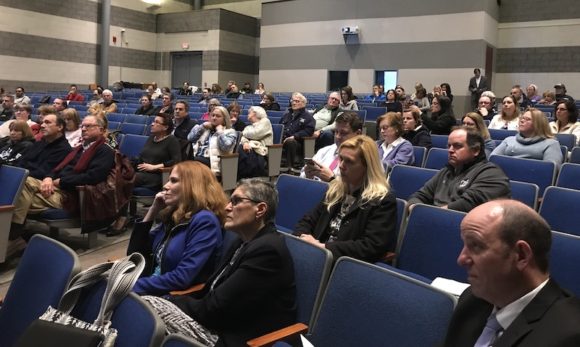
Sitting in the front row of the audience at Monday night’s forum on school regionalization were local school superintendents (from right to left) Ian Neviaser (Lyme-Old Lyme), Pat Ciccone (Westbrook) and Jan Perruccio (Old Saybrook.)

Over 100 people turned out for an Education and Regionalization Forum at Old Saybrook Middle School on Thursday, April 11. The event was hosted by Rep. Devin Carney, (R-23rd), with Senators Paul Formica, (R-20th), and Norm Needleman, (D-33rd).

While the two parties differ on Connecticut road tolls, all three local officials said they are against forced regionalization of school district bills proposed by Senate President Pro Tempore Martin Looney, Senators Bob Duff and Cathy Osten, Deputy President Pro Tempore, and by Governor Ned Lamont.

Rep. Carney said there was an enormous public outcry by small towns and school districts, thousands of pieces of testimony received and hundreds of people, including students from Region 18 schools, who testified in March hearings.  While this probably means that the idea of aligning school districts with recently consolidated probate districts is not advancing, the matter of reducing and reallocating education costs is very much still alive, and pieces of proposed legislation could still become law.

“Nothing is truly ever dead until we gavel out at midnight on June 5,” Rep. Carney said, explaining the state legislative process and timelines of the ongoing session in Hartford. 

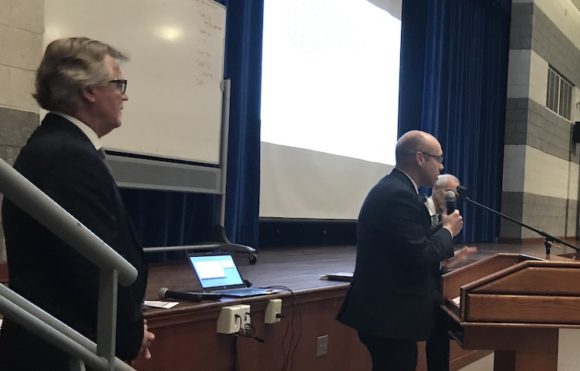
State Rep. Devin Carney (R-23rd) addresses the audience Monday night while (left) State Sen. Paul Formica (R-20th) awaits his turn to speak. Almost hidden from view, State Sen. Norm Needleman (D-33rd) stands to Rep. Carney’s right.

Of the six bills introduced that address regionalization of schools or services, three have been passed by the Education Committee and further action could be taken on them:

  • Governors Bill 874 establishes an appointed Commission on Shared School Services that is charged with developing shared school services recommendations, requires boards of education (BOEs) to report on currently shared school services and requires regional BOEs to post online monthly current and projected expenditures and to submit information to their town’s legislative body. The commission would issue a report in December 2020, recommendations could be binding on towns and districts. Because of costs of setting up a commission, the bill has been referred to Appropriations Committee;
  • HB 7350 requires regional education service centers (RESCs) to distribute an inventory of goods and services to member BOEs, and the Department of Education (DOE) shall develop a report of best practices by RESCs for regional cooperation. (LEARN, at 44 Hatchetts Hill Road in Old Lyme, is a RESC);
  • SB 1069, proposed by Sen. Needleman, which allows the DOE to study the effects of towns working together as Local Education Agencies, is intended to encourage voluntary regional cooperation and maximize efficiencies and cost savings without being mandated to become regional school districts.

Superintendents Ian Neviaser (Lyme-Old Lyme), Jan Perruccio (Old Saybrook), and Pat Ciccone (Westbrook) addressed how their districts have been sharing services and resources to reduce costs while maintaining the quality of curriculum along with educational, extracurricular and sports activities and programs.  Standard practices include health and dental insurance, energy, financial software, food service and supplies, plus student transportation for specialized programs.

Old Saybrook, Westbrook and Region 4 (Chester, Deep River and Essex plus the three elementary schools for each of those towns, which are not part of Region 4) school districts already share staff, Perruccio said, in an arrangement that has the flexibility to change yearly based on each districts’ demographic needs.

Perruccio said she was alarmed that the forced regionalization bills showed a lack of regard and understanding of how school districts are already sharing resources with a focus on quality of education.

Ciccone cited how the districts are coordinating to provide professional development for their teachers, and how Westbrook’s school facilities, sports programs and fields are utilized by the Town Parks and Recreation Department and local YMCA. The schools and town share legal and financial services support, as well. 

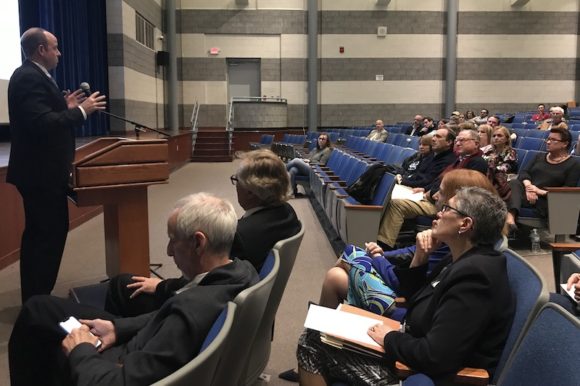
Lyme-Old Lyme Schools Superintendent Ian Neviaser stands at the podium during Monday evening’s forum.

“There is a money issue here, we need to be frank about it,” said Neviaser, pointing out that significant redistribution of wealth from school districts with higher property values and tax base already occurs. 

Fifty-one percent of New London’s school budget is paid by the state, he said., as is over 60 percent of Norwich’s, 33 percent of Montville’s and 14 percent of East Lyme’s school budgets. Meanwhile, Lyme-Old Lyme Schools receive less than one percent of operating expenses from the state.

“There was no mention of improving educational outcomes in these regionalization proposals,” commented Tina Gilbert of Lyme. “It is because of our school district’s focus on that, we are in the top four in the country in education.  There is no discussion of parent involvement in schools; we are not wealthy or privileged people, we chose to live in this school district for our children.  What it takes to build [highly performing schools] is parent involvement, working with parents.”

When asked if they moved to their town because of the quality of the schools, a high number of people in the audience raised their hands.

While the majority of questions and comments addressed specifics of proposed legislation, the overarching issue of state fiscal problems and how to address government spending arose. Lyme and Old Lyme residents were some of the most vocal about the impact of proposed legislation on property values, taxes and the quality of local school districts.

“The majority of the state doesn’t have a problem, town government works in Connecticut, but Hartford is not responsible,” said Curt Deane of Lyme, pointing out a seven-page summary of education service-sharing produced by LEARN in February.  “The initial [regionalization] proposals would have raised my property taxes by 50 percent overnight. Taxes go up, property values go down. People have to understand, this is going to hit our property taxes and hit hard. This isn’t going to go away.” 

“We can’t be a state with only great little towns and not great cities,” Sen. Needleman said, citing imbalances of health care outcomes and school performance between wealthier communities and the state’s large cities. He continued, “While we don’t want to mess up what we have, we can’t turn our backs on the disparities.”

The legislators encouraged voters to speak up, write letters, follow grassroots organizations such as Hands Off Our Schools or form their own group to express concerns to elected officials.

Five Days of Fun at Connecticut River Museum This Week

Come to the Connecticut River Museum during April School Vacation for a week of creativity and discovery. Join for one session or the whole week!

Staying in town for April vacation?

Connecticut River Museum (CRM) has five days of cool things to do for your child or children from April 15 to 19. Whether you are looking for one day or all five, there is something fun and exciting waiting for you at the Museum.

Bring your imagination and come prepared to create and experiment as we explore the River and its history. This year the Museum expanded their April Vacation day offerings to full days of fun. Workshops are designed for ages 6 – 12. 

Offerings this year are

  • Poetry and Art
  • Maritime Madness
  • Create a Museum
  • Mud and Dirt
  • Spring is in the Air

Explore the museum, go outdoors, create projects, do arts and crafts. Get more information about each day’s activities and register at www.ctrivermuseum.org.

Programs run from 9 a.m. to 4 p.m. and are $45/day, $205/week for CRM members and $50/Day, $230/week for nonmembers. Advance registration is required and space is limited.

Email sburns@ctrivermuseum.org or call 860.767.8269 x113 with questions. The Connecticut River Museum is located on the Essex waterfront at 67 Main Street.

Letter From Paris: And So It Goes On … Brexit, That Is

Nicole Prévost Logan

“Order, Order!” barked John Bercow, Speaker of the House of Commons before announcing the results of the third-time-around vote on Theresa May’s Brexit “deal” .  “The ayes to the right 286, the noes to the left 344,  the left have it.”

It was that fateful day, March 29 – chosen by the Prime Minister as the deadline to decide on the “divorce” of the United Kingdom (UK) from the European Union (EU).  The masterful and funny Speaker was able to control his troops and even to provoke laughter, telling one Member of Parliament (MP), “Get a grip, man, do yoga, it will be beneficial to you.”

In retrospect, not much progress had been made to resolve the Brexit issue on the British side since the June 23, 2016 referendum. It seemed that the government was taking its time and fantasizing about the legal elbow room it actually had to make decisions. (See my previous articles published on 3/5/2016; 4/6/2017 and 12/29/18)

Action in the House of Commons started really in earnest on Nov. 15, 2018 when Theresa May’s original deal was voted down. A second vote on the same motion, and a third with almost identical text were also rejected by the MPs. By drawing red lines, the tenacious but inflexible Prime Minister made it hard for herself to negotiate.

During the winter months, the parliament at Westminster offered the world a spectacle of one “decisive week” after another with votes ending in an inability to reach a majority. By March 14, Theresa May had lost her voice and the headlines in the press read “Game over.”

On the eve of the March 29 deadline, the situation turned surrealistic with two superimposed pictures (to use the words of Le Monde special envoy to London) of a vote on May’s deal and eight others on alternative proposals the MPs had organized on their own.  In a dramatic gesture, Theresa May used her last joker – stepping down from office – in case her deal was supported.   

The Prime Minister described the situation as “the end of a process” with the MPs having said no to everything : to the deal, to the absence of a deal, to Brexit, to Article 50 itself, to the eight separate proposals. In the face of this total collapse of a possible way out of this impasse, Donald Tusk, European Council President announced an extraordinary summit in Brussels on April 10.

A surprising amount of information and live coverage is now appearing on the French media,  shedding a new light on Brexit.

One report showed to what extent the public opinion was in fact manipulated.  More than 80 percent of the British press was hostile to Europe and contained “fake news” items.  The “Brexiteers” promised that the Commonwealth would save the UK. The famous red bus of Boris Johnson traveled throughout the country, displaying the number of 350 million pounds sterling ($455 million) in giant letters . That is the amount “BoJo” (Boris Johnson’s nickname) claimed that the UK is sending the EU every week instead of using it to fund the National Health Service (NHS). 

A Canada-based web site called AggregateiQ, created by Dominic Cummings, utilized private data collected from social networks and used it to “microtarget” individuals with “dark ads.” The “Vote Leave” site used a strategy comparable to that used by Cambridge Analytica, a company heavily implicated in the 2016 US election manipulation.

Other reports helped better understand why re-establishing a border between the two Irelands was a visceral impossibility. The Good Friday agreement in 1998 brought peace back but the catholic and protestant communities in Belfast, are still separated.

In this fragile context, the Irish people fear that a 300-mile external border with the EU would jeopardize the hard-won peace agreement. Trying to solve the problem of a border is an attempt at squaring a circle. The only solution might be a border at the bottom of the Irish Sea.  The backstop which allows the border to remain open until a final treaty is signed, is only a temporary solution.

It was not until the 11th hour – or less than one week before the March 29 deadline – that a significant turn occurred in London.  Prime Minister May entered into talks with Jeremy Corbyn, leader of the Labour party, in spite of their sharp disagreements.  It was such a breakthrough that the Chancellor of the Exchequer Philip Hammond declared on April 5, “the threat of the UK crashing out of the Union is heavily diminished.”  The Conservative party began to lean toward a “soft Brexit” and the possibility of the UK remaining in the Custom Union.

During all these months, the Europeans showed a consensual unity.  Their only caveat being that another delay would have to be justified by a clear plan such as general elections or a second referendum.  Their patience though began to wear out by early April as some divergences of opinion emerged. 

The priority for Angela Merkel is to avoid a no deal Brexit and she will bend over backwards to make that happen.   Although sharing many views with the UK in economy or trade, Mark Rutte, Prime Minister of the Netherlands, confirmed his alignment with the collective position. 

The “flextension” of one year suggested by Donald Tusk, President of the European Council, might not appeal to everybody. President Macron and EU Commissioner Juncker sound tougher on more delays. However, Macron reaffirmed on April 1, that he will stand by the decision made by Brussels and will not use his veto.   

The repeated postponements requested by Prime Minister May (April 12, May 23, June 30) forced the MPs to cancel their Easter recess. Much more serious, is the imbroglio caused by the colliding of the Brexit discussions with the European elections scheduled to take place May 26.

This long saga turned rather nasty when Tory MP Jacob Rees-Mogg, ultra Brexiteer, tweeted on April 5, “Let us stay [in Europe] and this way we will be able to damage the Union from the inside and oppose our veto on any Brussels decision”.

And so, the suspense goes on.  During these final hours, the two Houses of Parliament are scrambling to find a solution and seem to agree that a no-deal Brexit is unacceptable.  The Europeans do not want to push the UK out of the Union.

Chances are that the outcome will be Britain remaining in the Custom union, an à la carte solution, which was almost obvious from the beginning.  The British should take heart.  It only took 22 years for Norway to establish relations with the EU through the European Economic Area (EEA), and 29 years for Canada to negotiate with Europe through the Comprehensive Economic and Trade Agreement (CETA)!

Since all the thorny issues – the City, fishing , citizens’ rights, Gibraltar, etc – are included in the 27 pages of the non legally-binding Political Declarations, a  second part of Article 50 (in other words, swept under the rug ) will have to be negotiated later . Brexit will continue to haunt both the divided British opinion and also Europe .

Some may think it is the UK’s vocation is to be independent from Europe and turned toward the rest of the world.  It certainly seems British people consider EU membership a straight-jacket. Interestingly, these are the same reasons General Charles de Gaulle gave persistently more than 50 years ago as to why he was against the original entry of Britain into the European Economic Community (EEC).

Editor’s Note: This is the opinion of Nicole Prévost Logan.

Nicole Prévost Logan

About the author: Nicole Prévost Logan divides her time between Essex and Paris, spending summers in the former and winters in the latter. She writes a regular column for us from her Paris home where her topics will include politics, economy, social unrest — mostly in France — but also in other European countries. She also covers a variety of art exhibits and the performing arts in Europe. Logan is the author of ‘Forever on the Road: A Franco-American Family’s Thirty Years in the Foreign Service,’ an autobiography of her life as the wife of an overseas diplomat, who lived in 10 foreign countries on three continents. Her experiences during her foreign service life included being in Lebanon when civil war erupted, excavating a medieval city in Moscow and spending a week under house arrest in Guinea.


Letter From Paris: And So It Goes On … Brexit, That Is

Nicole Prévost Logan

“Order, Order!” barked John Bercow, Speaker of the House of Commons before announcing the results of the third-time-around vote on Theresa May’s Brexit “deal” .  “The ayes to the right 286, the noes to the left 344,  the left have it.”

It was that fateful day, March 29 – chosen by the Prime Minister as the deadline to decide on the “divorce” of the United Kingdom (UK) from the European Union (EU).  The masterful and funny Speaker was able to control his troops and even to provoke laughter, telling one Member of Parliament (MP), “Get a grip, man, do yoga, it will be beneficial to you.”

In retrospect, not much progress had been made to resolve the Brexit issue on the British side since the June 23, 2016 referendum. It seemed that the government was taking its time and fantasizing about the legal elbow room it actually had to make decisions. (See my previous articles published on 3/5/2016; 4/6/2017 and 12/29/18)

Action in the House of Commons started really in earnest on Nov. 15, 2018 when Theresa May’s original deal was voted down. A second vote on the same motion, and a third with almost identical text were also rejected by the MPs. By drawing red lines, the tenacious but inflexible Prime Minister made it hard for herself to negotiate.

During the winter months, the parliament at Westminster offered the world a spectacle of one “decisive week” after another with votes ending in an inability to reach a majority. By March 14, Theresa May had lost her voice and the headlines in the press read “Game over.”

On the eve of the March 29 deadline, the situation turned surrealistic with two superimposed pictures (to use the words of Le Monde special envoy to London) of a vote on May’s deal and eight others on alternative proposals the MPs had organized on their own.  In a dramatic gesture, Theresa May used her last joker – stepping down from office – in case her deal was supported.   

The Prime Minister described the situation as “the end of a process” with the MPs having said no to everything : to the deal, to the absence of a deal, to Brexit, to Article 50 itself, to the eight separate proposals. In the face of this total collapse of a possible way out of this impasse, Donald Tusk, European Council President announced an extraordinary summit in Brussels on April 10.

A surprising amount of information and live coverage is now appearing on the French media,  shedding a new light on Brexit.

One report showed to what extent the public opinion was in fact manipulated.  More than 80 percent of the British press was hostile to Europe and contained “fake news” items.  The “Brexiteers” promised that the Commonwealth would save the UK. The famous red bus of Boris Johnson traveled throughout the country, displaying the number of 350 million pounds sterling ($455 million) in giant letters . That is the amount “BoJo” (Boris Johnson’s nickname) claimed that the UK is sending the EU every week instead of using it to fund the National Health Service (NHS). 

A Canada-based web site called AggregateiQ, created by Dominic Cummings, utilized private data collected from social networks and used it to “microtarget” individuals with “dark ads.” The “Vote Leave” site used a strategy comparable to that used by Cambridge Analytica, a company heavily implicated in the 2016 US election manipulation.

Other reports helped better understand why re-establishing a border between the two Irelands was a visceral impossibility. The Good Friday agreement in 1998 brought peace back but the catholic and protestant communities in Belfast, are still separated.

In this fragile context, the Irish people fear that a 300-mile external border with the EU would jeopardize the hard-won peace agreement. Trying to solve the problem of a border is an attempt at squaring a circle. The only solution might be a border at the bottom of the Irish Sea.  The backstop which allows the border to remain open until a final treaty is signed, is only a temporary solution.

It was not until the 11th hour – or less than one week before the March 29 deadline – that a significant turn occurred in London.  Prime Minister May entered into talks with Jeremy Corbyn, leader of the Labour party, in spite of their sharp disagreements.  It was such a breakthrough that the Chancellor of the Exchequer Philip Hammond declared on April 5, “the threat of the UK crashing out of the Union is heavily diminished.”  The Conservative party began to lean toward a “soft Brexit” and the possibility of the UK remaining in the Custom Union.

During all these months, the Europeans showed a consensual unity.  Their only caveat being that another delay would have to be justified by a clear plan such as general elections or a second referendum.  Their patience though began to wear out by early April as some divergences of opinion emerged. 

The priority for Angela Merkel is to avoid a no deal Brexit and she will bend over backwards to make that happen.   Although sharing many views with the UK in economy or trade, Mark Rutte, Prime Minister of the Netherlands, confirmed his alignment with the collective position. 

The “flextension” of one year suggested by Donald Tusk, President of the European Council, might not appeal to everybody. President Macron and EU Commissioner Juncker sound tougher on more delays. However, Macron reaffirmed on April 1, that he will stand by the decision made by Brussels and will not use his veto.   

The repeated postponements requested by Prime Minister May (April 12, May 23, June 30) forced the MPs to cancel their Easter recess. Much more serious, is the imbroglio caused by the colliding of the Brexit discussions with the European elections scheduled to take place May 26.

This long saga turned rather nasty when Tory MP Jacob Rees-Mogg, ultra Brexiteer, tweeted on April 5, “Let us stay [in Europe] and this way we will be able to damage the Union from the inside and oppose our veto on any Brussels decision”.

And so, the suspense goes on.  During these final hours, the two Houses of Parliament are scrambling to find a solution and seem to agree that a no-deal Brexit is unacceptable.  The Europeans do not want to push the UK out of the Union.

Chances are that the outcome will be Britain remaining in the Custom union, an à la carte solution, which was almost obvious from the beginning.  The British should take heart.  It only took 22 years for Norway to establish relations with the EU through the European Economic Area (EEA), and 29 years for Canada to negotiate with Europe through the Comprehensive Economic and Trade Agreement (CETA)!

Since all the thorny issues – the City, fishing , citizens’ rights, Gibraltar, etc – are included in the 27 pages of the non legally-binding Political Declarations, a  second part of Article 50 (in other words, swept under the rug ) will have to be negotiated later . Brexit will continue to haunt both the divided British opinion and also Europe .

Some may think it is the UK’s vocation is to be independent from Europe and turned toward the rest of the world.  It certainly seems British people consider EU membership a straight-jacket. Interestingly, these are the same reasons General Charles de Gaulle gave persistently more than 50 years ago as to why he was against the original entry of Britain into the European Economic Community (EEC).

Editor’s Note: This is the opinion of Nicole Prévost Logan.

Nicole Prévost Logan

About the author: Nicole Prévost Logan divides her time between Essex and Paris, spending summers in the former and winters in the latter. She writes a regular column for us from her Paris home where her topics will include politics, economy, social unrest — mostly in France — but also in other European countries. She also covers a variety of art exhibits and the performing arts in Europe. Logan is the author of ‘Forever on the Road: A Franco-American Family’s Thirty Years in the Foreign Service,’ an autobiography of her life as the wife of an overseas diplomat, who lived in 10 foreign countries on three continents. Her experiences during her foreign service life included being in Lebanon when civil war erupted, excavating a medieval city in Moscow and spending a week under house arrest in Guinea.