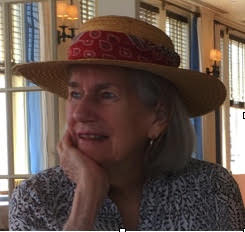
Death of Suzanne Brown Announced; Memorial Service to be Held in Old Lyme, Aug. 25

Suzanne Brown

ESSEX — Suzanne “Suzie” Brown, our mother, grandmother, great-grandmother, and friend, passed away Aug. 5, 2019, from complications after a fall in her home. She joins her beloved husband, Templeton “Temp” Brown of 58 years. We will celebrate them both by living their example of truth, love, and commitment.

Suzie celebrated beauty in life by picnicking in the countryside, arranging flowers from her garden, traveling the world, and savoring languages, cuisine, literature, colors, and the natural world. She cherished her family. We all have cultivated deep artistic roots because she showed us how to appreciate beauty in everything around us, every day of her life.

Suzie lived in Winnetka, Ill. for over three decades, and then returned to her childhood state of Connecticut to begin a new adventure with our dad, Temp, in Lyme. She had a wonderful group of friends, old and new, first from her many years in Illinois, and then more recently centered in Lyme and at the Essex Meadows Senior Retirement Community, in Essex. Suzie loved and appreciated the connections she made in Essex Meadows with her neighbors, staff, care-team, and her dear friend, Len Lonnegren.

Suzie will be remembered forever by her family, daughter Lisa Brown and her husband Mark Lellman; grandson Matt Lellman; and granddaughters, Leah Lellman (husband Josh Hisley) and Heidi Lellman (husband Jake Bonnerup); and great-grandson, Theo Bonnerup; daughter Suzanne Butz and her husband Ted Butz; grandsons Teddy Butz and Robert Butz (wife Jen Butz); and great-granddaughter, Hayden Butz; and daughter Maren Brown and her wife Patricia Morrison.

A Memorial Service will be held at 2 p.m. Sunday, Aug. 25, at the First Congregational Church of Old Lyme.

In lieu of flowers, memorial gifts can be made to the Lyme Land Trust, which was dear to both mom and dad’s deep appreciation of preserving nature for future generations to enjoy.

‘Cabaret’ Opens at Ivoryton Playhouse, Runs Through Sept. 1

Katie mack stars in ‘cabaret’ at the Ivoryton Playhouse as Sally Bowles.

IVORYTON – “There was a cabaret and there was a master of ceremonies and there was a city called Berlin in a country called Germany. It was the end of the world … and I was dancing with Sally Bowles and we were both fast asleep.” So begins the international classic musical and winner of eight Tony awards –  Cabaretwhich opened last night in Ivoryton to rave reviews. The show runs through Sept. 1.

Join other members of the audience at the Kit Kat Club as the Emcee takes us back to those tumultuous times with unforgettable musical numbers including,  “Wilkommen,” “Cabaret,” and “Maybe This Time.”

This Broadway classic is set in 1931 Berlin as the Nazis are rising to power. Cabaret focuses on the nightlife at the seedy Kit Kat Klub, and revolves around American writer Cliff Bradshaw and his relationship with English cabaret performer, Sally Bowles, as the world spins out of control.

The original 1966 Broadway production became an instant hit, winning eight Tony Awards in 1967 and four in 1998.  The show has inspired numerous subsequent productions in London and New York, as well as the 1972 film of the same name.

Cabaret is an unusual musical that has changed many times over the past 50 years to reflect the changes in the world, but the musical’s implicit warning about the temptations of fascism, nationalism and prejudice — the way they can sneak up on you when you’re having fun — has never seemed dated or irrelevant.

“It’s such an important piece of theatre, in what it says about the world and how quickly things can change,” says Playhouse Artistic Director, Jacqui Hubbard. “I think it is even more relevant today than when it was first performed over 50 years ago. Underneath the humor, the sex and the fabulous music is a constant alarm sounding, telling us to pay attention.”

Sam Given takes the lead male role in ‘Cabaret.’

The production stars Sam Given* as the Master of Ceremonies. Sam has appeared in Ivoryton in Godspell, A Chorus Line, I Hate Musicals: The Musical and in his own one-person show with his alter ego, Millie Grams. He has recently been seen as Ziggy Stardust inRebel Rebel: The Many Lives of David Bowie. 

Katie Mack* as Sally Bowles and Andy Tighe* as Cliff will be making their Ivoryton debuts. The cast also includes Will Clark, Carlyn Connolly*, Corrie Farbstein, Taavon Gamble*, Jade Genga, Aliah James, John Little*, Amanda Luppachino, Amani Pope, Carolyn Popp*, Renee Sutherland, Emerson Valentina, Max Weinstein and Jayke Workman. 

The production is directed and choreographed by Todd Underwood and musical directed by Michael Morris with set design by Daniel Nischan, lighting design by Marcus Abbott and costume design by Katie Bunce.

Performance times are Wednesday and Sunday matinees at 2 p.m. Evening performances are Wednesday and Thursday at 7:30 p.m., Friday and Saturday at 8 p.m.

Additional matinee performances are on Saturday, Aug. 17, and Aug. 31, at 2 p.m.

Tickets are $55 for adults; $50 for seniors; $25 for students and $20 for children and are available by calling the Playhouse box office at 860-767-7318 or by visiting our website at www.ivorytonplayhouse.org 

(Group rates are available by calling the box office for information.) The Playhouse is located at 103 Main Street in Ivoryton.

Pictures courtesy of Ivoryton Playhouse

*denotes member of Actors Equity

High Hopes Appoints New Board Chair, Trustees

Newly-appointed High Hopes Board Chair Jacqueline Kangley of Hadlyme leads a rider on the organization’s grounds. Photo credit: Michael Fanelli .

OLD LYME — High Hopes Therapeutic Riding, Inc. has appointed Jacqueline Kangley of Hadlyme as its new chair of the board of trustees for a two-year term.

Kangley was introduced to therapeutic riding by her Essex Elementary School classmates and has been a volunteer at High Hopes since 2004. She has been a Trustee since 2015 and currently volunteers in the therapeutic riding program and serves on the Program, Marketing Advisory, Event, and Development Committees.

She has co-chaired the ‘Concert in the Barn’ and served on many Auction, Décor, and other Benefit Committees. She is a past recipient of the Sally H. Aubrey Award, and the 2018 Path Intl. Region 1 Volunteer of the Year for her outstanding contribution to High Hopes.

“High Hopes is a unique, vibrant community with an important mission. For over 15 years, I’ve watched participants, instructors, volunteers, and horses work together to improve each others’ lives in very measurable ways. I am grateful to be a part of the High Hopes team and value this opportunity to help guide the organization,” said Kangley of her appointment.

As her first order of business Kangley thanked John Catlett as well as outgoing trustees Seymour Smith and Katherine Gibson. Catlett is stepping down as Chair but will continue as a trustee at the Old Lyme non-profit. Kangley said, “Under John’s leadership, High Hopes has ushered in its 45th year with a strong respect for its past and a clear vision for the future. He has overseen the launch of the ‘Share Hope’ Endowment Campaign, the implementation of a new strategic plan, and encouraged an active, engaged board.”

Kangley concluded, “John, Seymour, and Katherine exemplify the dedication and commitment of the over 650 volunteers who help keep High Hopes running. Thank you for all they have done to support High Hopes’ mission.”

Handing over the gravel, Catlett commented: “Jackie is an outstanding choice to lead High Hopes as it begins to implement its latest Strategic Plan and transitions to the public phase of its endowment campaign. Jackie’s long involvement with the organization gives her a deep understanding of High Hopes and positions her well to take on this important role. I’m sure she will help lead the organization to an even stronger position to help impact the lives of those who depend so much on High Hopes.

Two new trustees were also welcomed to the Board, Sarah Kitchings Keenan and Margaret (Mac) Mummert. Each will serve for a three-year term.

Sarah and her husband Christopher reside in Essex with their three children, Ryan, Maggie, and Ashley. Her son, Ryan, has been an active High Hopes participant for five years; both of her daughters have attended the High Hopes Unified Summer Camp. Sarah has served as a member of the High Hopes Development Committee and is currently Treasurer of the Essex Elementary School Foundation.

Mac Mummert of Lyme.

Lyme resident Mac Mummert and her husband, Earl, are veterinarians and have owned four small animal practices. Her special interests include internal medicine and oncology. She has served in many local civic organizations including the Lyme Garden Club, the Child and Family Agency and is a Past President of the SE Connecticut Professional Women’s Network.

Mummert has also served on the vestry of St. Ann’s Episcopal Church and was District Commissioner of the Connecticut Valley Pony Club. Mac has two children, Brian and Anya. Anya has been a participant at High Hopes since she was five and now works as a volunteer twice weekly.

High Hopes Therapeutic Riding, Inc. is a 501(c)3 non-profit based in Old Lyme, CT. Established in 1974, High Hopes serves over 1500 people each year with a unique range of therapeutic riding, carriage driving, and equine earning programs. Ninety-six percent of the organization’s workforce are volunteers who find their own lives enriched by our training, and the power of the horse-human interaction.

Participants include children, teens, adults, and seniors. Horses can build physical strength, emotional resilience, and cognitive development. Families in crisis learn how to trust; veterans deal with PTSD; teens at risk of substance abuse learn self-respect and children in wheelchairs feel the freedom of movement.

Mamma Mia! Opens at Ivoryton Playhouse, Runs Through July 28

Mamma Mia! cast members (from left to right) Cooper Grodin, Dane Agostinis, Stephanie Gomerez and Billy Clark Taylor rehearse a scene from the show now playing at the Ivoryton Playhouse.

IVORYTON – The Ivoryton Playhouse has been transformed from an historic New England theatre to a Mediterranean island, filled with the music universally loved for over 40 years!

Over 60 million people worldwide have fallen in love with the characters, the story and the music that make Mamma Mia! the ultimate feel-good show.  Set on a Greek island paradise, the story-telling magic of ABBA’s timeless songs propels this enchanting tale of love, laughter and friendship, creating an unforgettable show.

On the eve of her wedding, Sophie reads her mom’s diary, only to discover that the father she has never met, could be one of three men. The wedding invitation brings Sophie’s three dads to the Greek Isles in search of the life that could have been with Sophie’s mother, Donna.

The show is filled with laughter, heart and 22 hit songs including “Super Trouper”, “Lay All Your Love on Me”, “Dancing Queen”, “Knowing Me, Knowing You”, “Take a Chance on Me”, “Thank You for the Music”, “Money, Money, Money”, “The Winner Takes It All”, “Voulez-Vous”, “SOS” and the title track.

The three leading ladies of Mamma Mia!, from left to right, Carly Callahan, Laiona Michelle and Jessie Alagna sing a number in the show now playing at the Ivoryton Playhouse.

As of 2018, the show has productions in London’s West End, where it is the seventh longest-running show in West End history, as well as various international productions. Its Broadway incarnation closed in September 2015 after a 14-year run, making it the ninth longest-running show in Broadway history.

Get swept away by the infectious music, uplifting story, and dazzling dance numbers that have made Mamma Mia! a worldwide phenomenon.

The production stars Laiona Michelle* as Donna. Laiona was seen on Broadway as Nanna in Amazing Grace and in The First National Tour of The Book of Mormon.  Most recently she starred as the legendary jazz icon in the world premiere of Little Girl Blue – The Nina Simone Musical.  Joining her as her best buddies and the other two members of the band are Jessie Alagna* as Rosie and Carly Callahan as Tanya.

Callahan was last seen here in The Fantasticks and The Ivoryton Playhouse ChristmasHour. This is Alagna’s debut in Ivoryton.

Cooper Grodin*, Dane Agostinis* and Billy Clark Taylor* take on the roles of the dads and Stephanie Gomerez and Jack Kay play the young lovers, Sophie and Sky.

Evan Benjamin, Kelley Davies, Nico DiPrimio, Mark Gilchrist, Nicholas Gonzalez, Nigel Hall, Aliah James, Amanda Lupacchino, Melissa McLean, Ana Yi Puig, Carolina Santos Read*, Nathan Russo, Cameron Khalil Stokes, and Audrey Wilson complete this talented and energetic cast.

The production is directed and choreographed by J.R. Bruno and musical directed by David Madore with set design by Glenn Bassett, lighting design by Marcus Abbott and costume design by Elizabeth Saylor.

Mamma Mia runs through July 28. Performance times are Wednesday and Sunday matinees at 2 p.m. Evening performances are Wednesday and Thursday at 7:30 p.m, Friday and Saturday at 8 p.m.

Additional matinee performances are on Saturday, July 6, and July 20, at 2 p.m.

Tickets are $55 for adults; $50 for seniors; $25 for students and $20 for children and are available by calling the Playhouse box office at 860-767-7318 or by visiting our website at www.ivorytonplayhouse.org 

 (Group rates are available by calling the box office for information.) The Playhouse is located at 103 Main Street in Ivoryton.

*denotes member of Actors Equity

Photographer: Jonathan Steele

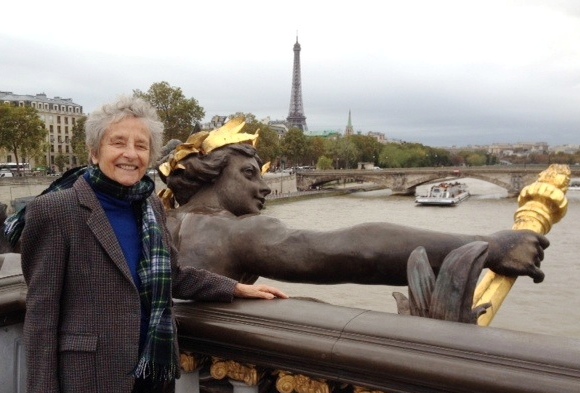
Letter From Paris: Seeing “Red” at the Grand Palais

Nicole Prévost Logan

The year 1917 in Russia marked a unique moment of history when art and  revolution fused together into a mutual source of inspiration. The creativity and energy fed on each other for a short few years, to eventually vanish under the brutal repression and purges of Stalin to become an official and bland art form called “Socialist Realism.”

The exhibit “Red – Art and Utopia in the Soviet Country” at the Grand Palais, Paris, in the spring of 2019 is breaking new ground in describing that unique moment.

All forms of arts were impacted by the October Revolution, from the visual arts to architecture, theater, cinema, music and, of course, literature.  In addition to major artists, already well known before World War I, such as Malevich, the Bolchevik government did welcome all talented artists eager to experiment with new art forms.

Mayakovsky (1893-1930) was the voice of the Revolution – a giant with a booming voice, who galvanized the crowds when he read his poetry.  His emblematic play, the “Bedbug,” is a satire of the NEP (New Economic Policy.)  A young man of that period is frozen and found himself  in a perfect communist world 50 years later where there was no drunkenness nor swearing. 

He decided he was not made for the future.  As a journalist, Mayakovsky used  simple street  language.  A gifted artist, he drew satirical cartoons, making fun of the “petty bourgeoisie.” One of the main metro stations in central Moscow was named after him. He shot himself in 1930 at the age of 37.

Malevich (1878-1935), a major artist of the 20th century, was inspired until 1914, by Gauguin, Matisse and Cezanne, and then moved to abstraction and geometric forms until he reached his extreme “White on White” in 1918.  He was the theoretician of art par excellence. 

His book “From Cubism to Suprematism in Art …” is considered one of the most important reference works of the 20th century. Toward the end of his life he was  forced to reintroduce figurative characters into his paintings.  He never left the Soviet Union where he died of cancer in 1935.

Tatlin (1885-1953) was associated with the concept of “constructivism,” based on the use of materials, the exploitation of movement and tension in matter.  He aimed at the harmonization of artistic form with utilitarian goals.

Artists’ association multiplied at that time.  AKhRR  (Association of Russian Artists of Revolutionary Russia) was founded in 1922.  Vkhutemas (higher Institutes of art and technique) were created as early as 1920 all over the country.  Both Malevich and Tatlin occupied important positions in those institutions .

Vsevolod Mayerhold, (1874-1940) following in the footsteps of Stanislavsky (master of the stage in the 19th century – particularly Chekhov plays), revolutionized theatrical techniques, suppressed settings and replaced them by “constructivist” space, trained the actors according to a new system of “bio-mechanic” and how to form human pyramids. His stage production of Mayakovsky’s  “Bed Bug” is emblematic of the Soviet era.

Rodchenko  (1891-1956) was the leading innovator of the 1917 revolution-inspired  art.  He wanted to bring art down from its pedestal.  He stood against estheticism and “art for art” and made art the champion of productivity. He created a new artistic language by experimenting with photography, using photo-montage, double exposures, and unexpected angles. He gloried the machine in a factory or objects of daily life rather than still life motives in traditional art.

Among this group of brilliant artists were two women – Lioubov Popova, (1889-1924), who died of scarlet fever, and  Varvara Stepanova (1894-1958i), Rodchenko’s wife.
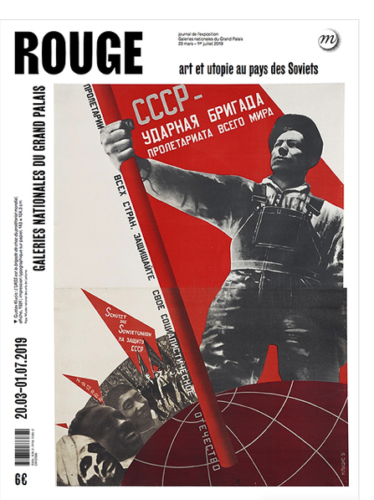
A poster by Gustav Klutsis.

Posters became a new art form used as the most important tool of propaganda. They were intended to make a strong and immediate impact on the viewer.  Using a graphic art medium with calligraphy and geometric designs, they carried a simple message.  The color red was used extensively  (it is interesting to note that, in Russian, “red” and “beautiful” are the same word.)

Oversize paintings like “Bolchevik” by Kustodiev are easy to understand.  A giant man walks through dwarfed  city landscape with churches, holding a huge red banner.  The messages of the October revolution were spread throughout the country in the “agit-prop trains”  to educate the masses.  Some figures are impressive: in 1917 the literacy of the population  was 25 percent whereas by 1939, it had risen to 81 percent.

Gustav Klutsis (1895-1935), born in Latvia, was also one of the best at using photo-montage and posters . He wrote: “Put color, slogan at the service of class war.”  Klutsis was arrested and shot in 1938.

Sergei Eisenstein  (1898-1948) – a pioneer of the cinema – created his own style characterized by melodramatic acting, close-up shots and theatrical editing.  A sequence of “Battlefield Potemkin” has become an absolute classic: during an attack by the Cossacks against Odessa civilians, a baby carriage falls all the way down the long steps.

Eisenstein ‘s mob scenes are so realistic (such as the storming of the Winter Palace in St Petersburg) that they are often mistaken for newsreels in documentaries.

Architecture played a crucial role in bringing about utopia of the proletariat.  Plans for grand buildings, squares and majestic avenues are intended to impress the masses, who are more important than the individuals.  Still standing today is the workers’ club Roussatov designed by Melnikov.
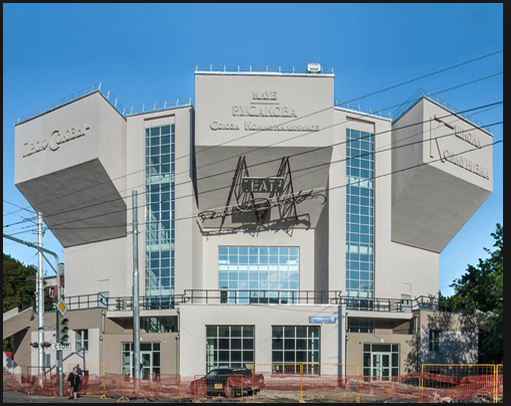
Roussakov Workers’ Club designed by Melnikov, 1927-28.

After the death of Lenin in 1924, power became concentrated in the hands of Stalin, who tightened his control over artists.  In 1932  all artistic associations were suppressed — artists were forced to join the official Union.

The creative, innovative productions had to bend and conform to rules of the new doctrine of Socialist Realism formulated by Andrei Zhdanov in a speech to the Writer’s Union in 1934.  In art,  it can be defined as representation of the bright future of communism through the representation of idealized  workers in healthy bodies.

Therefore, at the 1937 Universal Fair held in Paris, a double statue of a vigorous factory worker and a strong woman kolkhoz farmer stood on top of the Soviet building.

Most representative of this period was Alexander Deïneka, who painted naked, young factory workers taking a break on the beach in the Donbass or Lenin riding in an open sports car through bucolic countryside with several blonde children.

Somehow out of place in 1937 is a delightful painting by Yuri Pimenov called, “The New Moscow.”  A young woman is driving a convertible car on one of the main thoroughfares of central Moscow.  The style is very much in the Impressionist style.

Already in the 1990s, the Tretiakov Gallery of Moscow held exhibits on the 1920s and 1930s Soviet art.  At that time, the Soviet posters were readily available in the book stores of the Arbat pedestrian street.  

Although a large part of the exhibited works included in the “Red” exhibit come from the permanent collection of the Centre Pompidou, Paris, it is interesting to note that in the 1979 Paris-Moscow exhibit organized by that same museum, Soviet art was barely mentioned.

Editor’s Note: This is the opinion of Nicole Prévost Logan.

Nicole Prévost Logan

About the author: Nicole Prévost Logan divides her time between Essex and Paris, spending summers in the former and winters in the latter. She writes a regular column for us from her Paris home where her topics will include politics, economy, social unrest — mostly in France — but also in other European countries. She also covers a variety of art exhibits and the performing arts in Europe. Logan is the author of ‘Forever on the Road: A Franco-American Family’s Thirty Years in the Foreign Service,’ an autobiography of her life as the wife of an overseas diplomat, who lived in 10 foreign countries on three continents. Her experiences during her foreign service life included being in Lebanon when civil war erupted, excavating a medieval city in Moscow and spending a week under house arrest in Guinea.