Op-Ed: The Mirage of Affordable Housing

Editor’s Notes: i) This op-ed was submitted by Eric Knapp, who is employed as the Town of Old Lyme’s Land Use Coordinator. He is writing here as a private citizen.
ii) This is the opinion of Eric Knapp.

The Connecticut General Assembly has determined that creating more affordable housing in the State is a priority. It is hard to argue that we have sufficient housing in a price range that a family of moderate means can afford. As a goal, housing that residents can afford is worthy. 

It is also apparent that Connecticut’s attempts to promote that goal have not been a success. The original legislation to promote “affordable housing” was adopted in 1988. In the intervening 36 years, a variety of carrots and sticks have been put forward, but the problem has not gone away. I am not even sure we can say it has gotten measurably better.

And yet the Legislature is looking at even more heavy-handed solutions to address the problem. To quote a popular gif, “the beatings will continue until the morale improves.”

It is worth exploring why these methods have failed in this part of the State. Whatever your political leanings, we all have an interest in not perpetually continuing failed methods.

For starters, much of the “easy” land to develop has already been divided up. This part of Connecticut has been carved up since colonial times, and there are few remaining farms or other large tracts to work with. While shifting “affordable” housing to marginal land has been a historical pattern, it is not a very successful, or equitable solution. Additionally, as we have discovered, filling wetlands does not solve the underlying hydrological reason the land was wet to begin with. Many lands that were filled back in the 1950s, 1960s or 1970s are returning to their original state. Climate change is accelerating that process.

Lack of sewers is an inherently limiting factor. If sewage for each parcel must be treated on the parcel itself, then larger uses require larger areas for septic treatment. Creating any type of increased density requires good (original) soils, and area used for septic systems displaces other possible uses.

For all of the talk and legislative push for “transit-oriented development”, this part of the State is notably poor in transit options. Yes, Clinton, Westbrook and Old Saybrook have train stations, constructed at great expense, but no one really uses these to get around locally. Old Lyme, East Lyme and Waterford lack even the station, although we have the tracks. Going up the Connecticut River Valley, there is no rail at all. Yes, there is River Valley Transit (formerly Nine Town Transit), but service is sparse and still requires either living near the pick-up locations or using the “XtraMile” ridesharing app on your phone. In short, having a car is more or less obligatory in this part of the State, and that becomes expensive. 

The State can keep upping the ante. It can assign a “mandated” number of units. It can even prohibit single family zoning. Honestly, I do not believe even abolishing zoning entirely would have much of an impact on housing affordability for this part of the State. It is fun to complain about the hurdles zoning regulations place on development, but, while there are affordable housing projects that are violently opposed, it is usually not at the zoning commission where they are blocked effectively.

If the State of Connecticut is serious about rebalancing the housing market, here is what works: infrastructure and public services. If there was both public water and municipal septic disposal, there could be additional density. The State has largely dumped “Complete Streets” into the towns’ laps, but if it wants this done, it will have to do it itself. A more vibrant bus network will take state money and coordination. Upgrading drainage infrastructure will prevent flooding. None of this comes cheap. And historically, this part of the State has been underserviced compared to Hartford, New Haven and Fairfield Counties. By way of example, Route 11 sits unfinished. 

The Southeastern Connecticut Council of Governments (SCCOG) produced a study in 2019, entitled the “Regional Wastewater Management Plan”. Five years ago, it noted that, “the sewer system in East Lyme has essentially exhausted its capacity allocation negotiated with New London and Waterford.” It also notes that, “sewers in portions of Groton, Jewett City, New London, and Norwich predate the federal Clean Water Act in 1972”. But the official policy of most towns is still “sewer avoidance,” which is an effective way to discourage further density.

The truth is that the towns of this area probably have about the population density that they want. And that is fine. But if you want to address the affordability crisis, you will need more housing units. More units require greater density. Greater density requires upgraded infrastructure. Short of that, it is like the old joke about the weather, “everyone talks about it, but no one does anything.”

Literature in the Lymes: ‘The Witchstone’ by Henry H. Neff

Lazlo is an 800-year-old demon with a terrible work ethic, a movie star human ‘glamor’ and a wicked sense of humor. He’s selfish, lazy, snarky, maybe secretly kind of nice and in big trouble. His high-ranking, evil father is punishing Lazlo by making him work a thankless job in the devil’s bureaucratic offices. A Hell’s ‘“Hell,” if you will. 

While Lazlo runs up thousands of dollars in expense tabs doing nothing; he is supposed to be supervising the curse of a particular family; the Drakefords. 

The Drakeford Curse has been mutating the family with horrific outcomes since colonial times and Maggie, the current heir, is about to face ruin. Maggie is 19 and entering her darkest hours as a Drakeford. At the family compound in upstate New York, she is slowly transmogrifying. 

The Witchstone is an, as yet, unidentified totem at the center of what will unfold between Lazlo and the younger Drakefords. Lazlo , Maggie and young George, known as Lump, travel from upstate to New York City and then Europe. Lazlo takes the Drakefords in search of a way to break the curse. Or does he? Since he also tells his boss he specifically isn’t doing that. Then he tells someone else he might be thinking about, maybe not thinking of, not doing that. Smarmy to the last, we should definitely not trust a demon but we sorta do.

Demons from many sides intervene to stop the trio as they travel from fancy Italian hotel to cursed demon empress’s castle to holy church and every hell hole in between. Neff’s cast of demonic characters is unrivaled. I don’t usually root immediately for a movie to erupt from a book but this would be so great visually. Some of these creepy crawlers on the subway or tunneling underneath Central Park just scream for an agent. 

Best of all, the very end made me want a sequel—like a Bond flick with a forked tail.

About the author: Jen Petty Hilger grew up in New York and London, England, but finds herself happily quiet living by the water in Old Lyme. She and her husband have six children between them and a myriad of rescued animals.

An Open Letter to Old Lyme Residents About the Recent Revaluation

Editor’s Note: We received the letter printed below from Old Lyme First Selectwoman Martha Shoemaker. She noted in her accompanying message to us, “Our recent revaluation assessment letters arrived in mailboxes over the past weekend.  Residents have been very concerned about their higher assessments.  We have written a letter to the residents of Old Lyme to provide some clarity on the topic.” She then invited us to publish it, which we have done in the hope it is helpful to our readers.

Dear Old Lyme Residents,

We know that over the last few days most people in town received a Notice of Assessment including their new property assessment.  We also know that most residents have seen a large assessment increase since the last revaluation and are asking what this means for their property taxes.  Please be assured that the change in your assessment because of the town-wide revaluation does not mean a similar percentage change in your taxes.  Instead, that change will relate to (1) the difference between your assessment change and the change in the overall grand list, (2) any change over the revaluation period in the value of your property compared to the value of others, and (3) the budget adopted next spring and the resulting new mill rate. The grand list is not yet determined but will be by January 31, 2025.   Here is a brief explanation of the process and how it will continue to evolve over the next few months.  

The Town of Old Lyme hired a professional appraisal company, Municipal Valuation Services, to assist in the systematic reassessment of all real property in Old Lyme.  This includes residential and commercial.  The revaluation process is done per state statute every 5 years to ensure that everyone is paying taxes based on the current worth of their home (or other real estate).  This process essentially makes sure that the tax burden is distributed equitably and fairly across all property classes.  Some homes will see an increase in their assessed value, and others may have a decrease, compared to the previous assessment or compared to the property of others. The goal is not to raise taxes overall, but to accurately reflect the current market value of each property. 

In the revaluation the appraisers and the assessor compared your property with other Old Lyme properties that are similar, so that those properties pay similar taxes.  The appraisal company takes into account all market value sales of comparable properties in the area.  This process determines a new market value for your home, and, by statute, the assessed value is 70% of that value.  

As stated in your Notice of Assessment, you have the opportunity to come into Town Hall for an informal hearing, which must be requested by December 18.  At this hearing, you will meet with a revaluation representative and review your property data and value.  These hearings are not for discussing tax rates or tax bills.  

If a property owner disagrees with their new assessment, whether or not the taxpayer attended an informal hearing, they can file an appeal (February 1 – February 20, 2025) with the town’s Board of Assessment Appeals.  Decisions of the Board of Assessment Appeals may be appealed to superior court.

Let us restate that revaluation is not done to generate more tax revenue for the town but to distribute the tax burden more equitably among all property owners. Property values change over time due to market conditions, which is why regular revaluations are necessary.  A fair assessment system ensures that everyone is contributing their fair share to support the local services that make up our town budget.

We have just begun the budget process in town.  This starts with the Board of Selectmen reviewing the needs of each department and commission for the 2025-26 fiscal year.  Informal meetings with town hall departments are beginning now.  The Board of Selectmen will be putting together the budget throughout January, before sending it to the Board of Finance.  During the months of February and March the Board of Finance will analyze the Board of Selectmen’s budget, meet with various parties as needed and make changes.  The public is invited to attend all of these meetings and listen to the proceedings.  

At the Town Meeting in May, the Board of Finance will present the budget and a proposed mill rate that meets the budgetary needs.  Because of the substantial increase in the grand list, this mill rate inevitably will be lower than the current mill rate.  Your individual taxes will be based on your assessment multiplied by this new mill rate.  

Please feel free to reach out to members of the Board of Selectmen and the Board of Finance with your thoughts, concerns and questions.  

Respectfully,

Martha H. Shoemaker, Old Lyme First Selectwoman
Bennett J. Bernblum, Chair, Old Lyme Board of Finance 
Melinda R. Kronfeld, Town of Old Lyme Assessor

Old Lyme Junior Gilbert Qualifies for X-Country Nationals in San Diego, First Ever OL Runner to Reach Nationals

Pictured here are the four girls who qualified for the Footlocker Cross Country National Championship in San Diego on Dec. 14. Lyme-Old Lyme High Schools’s Chase Gilbert is at right in photo—the other girls are, from left to right, Tess Sherry (Conard), Brook Strauss (Glastonbury), and Liv Sherry (Conard.) Photo by T. Gilbert.

BOSTON, MA—UPDATED 12/02 WITH NEW PHOTOS: On Saturday, Nov. 30, Lyme-Old Lyme High School (LOLHS) Junior Chase Gilbert qualified for the Footlocker Cross Country National Championship with her fifth place finish in the 5,000-meter course at the Northeast Regional Championships at Franklin Park In Boston. 

Gilbert’s time was 17:56.9—only around six seconds behind the fourth place finisher, Liv Sherry of Conard High School in West Hartford at 17:49.3.

Brooke Strauss of Glastonbury was the highest-placed Connecticut finisher at third with a time of 17,41,5,

The National Championship will be held in San Diego, Calif., on Saturday, Dec.14..  

The fastest 10 girls, who finished the race, qualified for the National Contest and four of those 10, including Gilbert, were from Connecticut. The fourth was Liv Sherry’s sister, Tess—also from Conard—who came 10th.

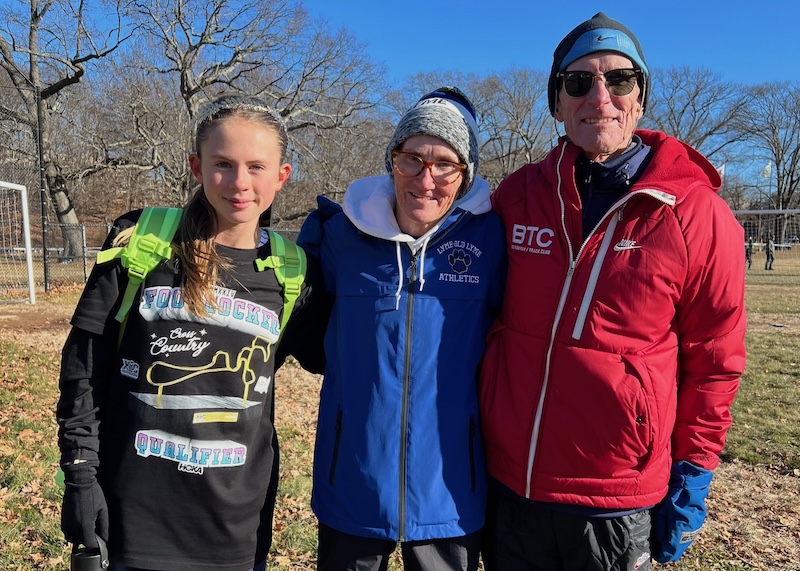
Chase Gilbert (left) is pictured here after Saturday’s race standing with her LOLHS coach, Jan Merrill-Morin, (center) and Merrill-Morin’s husband, Jeff. Photo by T. Gilbert.

Gilbert is the first Lyme-Old Lyme runner ever to qualify for the National Championship. She is coached at LOLHS by former 1976 Olympian runner Jan Merrill-Morin and LOLHS History and Civics teacher Aron Daquila.

Asked by LymeLine how she felt about her success, Chase responded by email saying, “I am so excited to represent the Northeast at nationals with an amazing group of girls! My coaches Jan and Aron have helped me earn this position with their commitments of coaching and supporting me. My family and teammates have been so supportive along the way as well.”

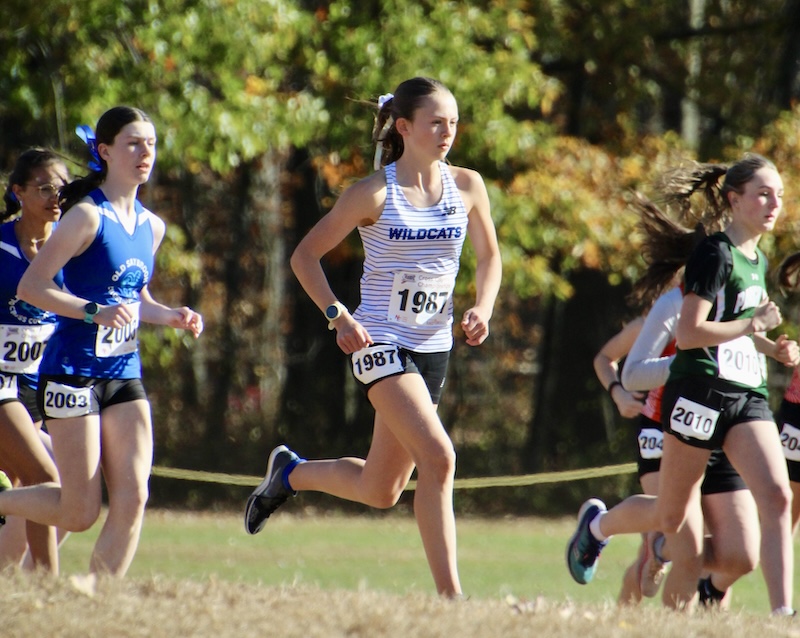
Chase Gilbert (center) in action. Photo by Alyssa Mercaldi.

“The whole community is very proud of Chase’s achievement,”  Daquila said in an email to LymeLine, adding, “Chase is a very focused runner and this amazing achievement is a product of her dedication, patience and perseverance.  Now she [has] earned a ticket to San Diego for Nationals, a goal of hers since freshman year.  And certainly not an easy one, literally only 10 athletes from the entire Northeast region earned this.”

He concluded emphatically, “I’m just so happy for her.” 

Here at LymeLine, we add our heartiest congratulations to Chase!

Talking Turkey—the Evolution of the ‘Quintessential American Holiday’

Linda Ahnert

Editor’s Note: Seventeen years ago, our friend and former colleague at ‘Main Street News,’ Linda Ahnert of Old Lyme wrote a wonderful column for us about the first Thanksgiving and how it evolved into a national holiday. As Thanksgiving is almost upon us, we are delighted to republish it here.

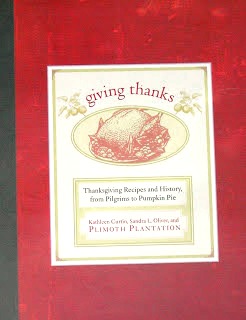
On this Thursday, Nov. 28, Americans from sea to shining sea will be sitting down to a turkey dinner. During these politically polarized times, this is something we can agree on—we all love Thanksgiving! Which is why I am grateful to re-read “Giving Thanks: Thanksgiving Recipes and History, from Pilgrims to Pumpkin Pie.” This book by Kathleen Curtin, Sandra L. Oliver, and Plimoth Plantation is a fascinating look at how an autumnal feast evolved into a “quintessential American holiday.”

And since this article was first published, The Plimoth Plantation has changed its name to Plimoth Patuxet Museums. Its mission is to tell the story of the English colonists in Plymouth, Mass. and the native peoples who lived there. So in 2020 the new name was adopted because it better reflects the multicultural history that is the essence of the museum’s mission.

After all, wasn’t this what we first learned about Thanksgiving in grade school? It was the story of the Pilgrims and Indians breaking bread together. And what is better than people sharing a good meal?

Read on to find out what was really on the menu that first Thanksgiving in 1621 and learn how this fall feast evolved into a national holiday.

Who Doesn’t Love Thanksgiving?

Giving thanks_book

In 2005 a book entitled “Giving Thanks: Thanksgiving Recipes and History, from Pilgrims to Pumpkin Pie” was published. The co-authors are Kathleen Curtin, food historian at The Plimoth Plantation, Mass., and Sandra L. Oliver, food historian and publisher of the newsletter “Food History News.”

The book is a fascinating look at how an autumnal feast evolved into a “quintessential American holiday.”

Most Americans, introduced to the story of the Pilgrims and Indians during childhood, assume there is a direct link between the traditional holiday menu and the first Thanksgiving. But we learn from the book that many of those food items—such as mashed potatoes and apple pie—were simply impossible in Plymouth, Mass., in 1621. Potatoes were not introduced to New England until much later and those first settlers did not yet have ovens to bake pies.

What we do know about the bill of fare at the first celebration in 1621 comes from a letter written by colonist Edward Winslow to a friend in England: “Our harvest being gotten in, our governor sent four men on fowling, that so we might after a special manner rejoice together after we had gathered the fruit of our labors.”

Later 90 Indians joined the party with “their great king Massasoit whom for three days we entertained and feasted.” Then the Indians “went out and killed five deer which they brought to the plantation.”

So venison was a principal food on the menu. It also seems safe to assume that mussels, clams, and lobsters (all in plentiful supply) were served as well.  According to other journals of the colonists, the “fowl” that Winslow described were probably ducks and geese. But wild turkeys were also bountiful in 1621, and so it is very likely that they were on the Pilgrims’ table. Thank goodness for that.

Throughout the New England colonies, it became common to proclaim a day of thanksgiving sometime in the autumn. In period diaries, there are many descriptions of food preparation—such as butchering and pie baking—followed by the notation that “today was the general thanksgiving.”

By the 19th century, Americans were taking the idea of a “thanksgiving” to a whole new level. The religious connotations were dropping away in favor of a holiday celebrating family and food. Roast turkey had become the centerpiece of these fall celebrations.

Turkeys, of course, were native to North America. (Benjamin Franklin, in a letter, had even proposed the turkey as the official U.S. bird!)

And turkey was considered to be a fashionable food back in the Mother Country. Just think of the significance of turkey in Charles’ Dickens’ “A Christmas Carol.” When Scrooge wakes up in a joyful mood on Christmas morning, he calls to a boy in the street to deliver the prize turkey in the poulterer’s shop to the Cratchit family. (Earlier in the story, the poor Cratchits were dining on goose.)

It is thanks to a New England woman that Thanksgiving became an American holiday. Sarah Hale was a native of New Hampshire and the editor of “Godey’s Lady’s  Book,”  a popular women’s magazine. She lobbied for years for a national observance of Thanksgiving.  She wrote editorials and sent letters to the president, all state governors, and members of Congress.

Finally, in 1863, she convinced Abraham Lincoln that a national Thanksgiving Day might help to unite the Civil War-stricken country. The fourth Thursday in November was now officially on the American calendar.

Connecticut’s own Harriet Beecher Stowe wrote this description of a New England Thanksgiving in one of her novels—“But who shall … describe the turkey, and chickens, and chicken pies, with all that endless variety of vegetables which the American soil and climate have contributed to the table … After the meat came the plum-puddings, and then the endless array of pies. . .”

The autumnal feast became a national holiday, but each region of the country put its own spin on the menu.   Not to mention that immigrants have also added diversity. The result is a true “melting pot” of America. The second half of “Giving Thanks” contains recipes that reflect what Americans eat for Thanksgiving in the 21st century.

In the South, for instance, the turkey might be stuffed with cornbread and there would be pecan and sweet potato pies on the table. In New Mexico, chiles and Southwestern flavors may be added to the stuffing.

There’s the “time-honored traditional bread stuffing” recipe. There’s also one for a Chinese American rice dressing and directions for a Cuban turkey stuffed with black beans and rice. Desserts run the gamut from an (authentic) Indian pudding to an (exotic) coconut rice pudding.  Old-fashioned pumpkin pie is included as well as the newfangled pumpkin cheesecake.

But no matter what food items grace our Thanksgiving tables, it seems that we all end up stuffing ourselves silly.

Perhaps overeating started at that very first harvest celebration in 1621. In Edward Winslow’s letter describing the feast with the Indians, he noted that food was not always this plentiful. But he wrote his friend in England “ … yet by the goodness of God, we are so far from want that we often wish you partakers of our plenty.”