TOP STORY: Old Lyme Resident State Trooper to Leave Post After Five Years

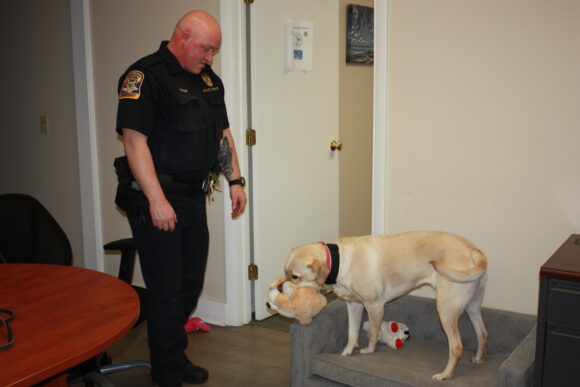
Resident State Trooper Matt Weber and comfort dog, Viera, will be transferring to Connecticut State Police headquarters to support the agency’s peer support program. File photo.

OLD LYME–The resident state trooper in charge of the Old Lyme Police Department for the past five years will be leaving early next month to lead the Connecticut State Police peer support program. 

Connecticut State Police Resident State Trooper Matt Weber on Friday said word came through the day before that he’ll be transferring Oct. 3 to the Middletown headquarters as the coordinator of the State Troopers Offering Peer Support (STOPS) program. 

He said the state police will assign a temporary resident trooper to cover the town while the agency goes through the process of finding a permanent replacement. 

Webe currently oversees five Old Lyme constables with full police powers. The resident trooper program provides leadership in more than 50 towns across the state without independent police departments. 

Weber, who lives in town, described the move as bittersweet. 

“Definitely, it’s a town I love, so hopefully I left it a little bit better than I found it,” he said. 

First Selectwoman Martha Shoemaker on Friday said Weber’s presence has led to a stronger summer ranger program, which places seasonal staff under the police department’s direction to patrol public beaches. She said the resident trooper has also helped curb fights and illegal activity at Sound View Beach. 

Resident State Trooper Matt Weber. File photo contributed by Connecticut State Police.

Shoemaker credited Weber with focusing on hiring new officers rather than exclusively making lateral hires from other departments. 

“His unique approach to build our staff by training officers at the Connecticut Police Academy has allowed us to hire individuals who have always wanted to be police officers and are now serving our town to the best of their ability,” she said. 

Among them are Officer Ethan Kula, a former summer ranger in Old Lyme who was hired in 2022 at the age of 24. Most recently, Patrolman George Sirigos graduated the academy in January as a 31 year old. 

Before Kula, Corporal Dominic Solari was the last Old Lyme officer to go through the academy in 2006. 

Shoemaker said she has not been given a timetable for securing Weber’s permanent replacment. She also has not been told what the town’s role will be in the selection process, though she hopes to sit in on hiring interviews.

She said staff members at the police department and town hall will miss Weber greatly in his professional capacity. But she acknowledged the town resident isn’t going anywhere.

“We’re still going to see him in Big Y,” she said.

Weber will bring 17 years of experience as a state trooper when he takes over the peer support program from state police Sgt. Rodney Valdes. 

Weber said he looks forward to the opportunity to help other troopers, “just for the mental well-being of them.”

He declined to further discuss his time in Old Lyme or his new role, citing the advice of the state police public information officer. 

The state police STOPS program provides peer counseling for troopers and other first responders in personal or professional crises, according to state police. The specially-trained network of troopers also helps during non-crisis situations amid the daily stresses of working for the state police.
TOP STORY: ‘Connection Is Prevention’—New Signs on Baldwin Bridge Provide Lifeline to Those in Crisis

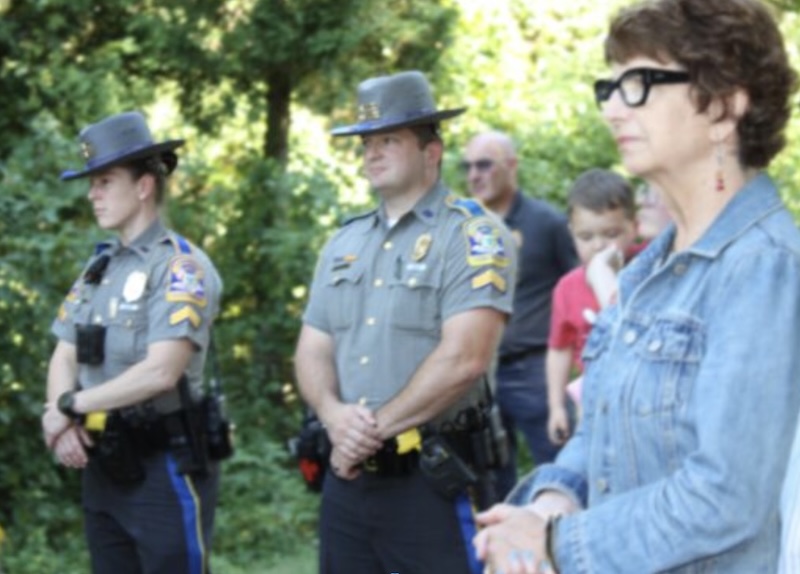
OLD LYME–Two state troopers recognized for helping a distressed woman off the side of the Baldwin Bridge in 2023 joined a group of suicide awareness advocates on Friday to commemorate the installation of new signs reminding everyone that help is out there. 

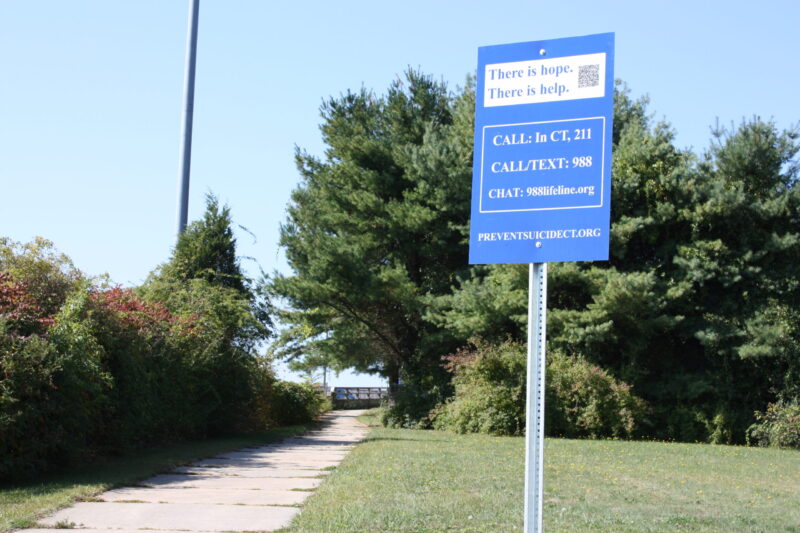
The four plain blue signs, installed on Old Lyme and Old Saybrook ends of the sidewalk along the bridge’s southbound span, direct those who have lost hope to the 988 Suicide & Crisis Lifeline.

Lymes’ Youth Service Bureau Director Mary Seidner during a ceremony on the Baldwin Bridge trail credited Sergeants Ashley Harkins and Matthew Belz with inspiring her to get the signs installed. A group of local, regional and state leaders made it happen. 

Belz and Harkins on Friday morning recalled for reporters the day over a year and a half ago when they found the woman perched atop a 5-inch ledge on the river side of a tall metal fence. Several  911 calls had alerted police to the despondent woman. 

“I made the connection with her,” Belz said, describing his position on the sidewalk as Harkins navigated the grooves of metal mesh in uniform boots to get herself up and over the fence to the woman’s side. 

Harkins remembered having difficulty at first scaling the fence in her uniform and thick boots. 

“Then I kind of took a quick second and reevaluated it, and I was like, ‘OK, this is what we’re doing. I’m doing this,’” she said. “And then I just did it.” 

For Harkins and Belz, helping people at risk of suicide is first and foremost about connection. 

“Showing that you care is a big step,” Belz said. 

State police shared the emotional and harrowing body camera footage shortly after the incident to call attention to the troopers’ quick, decisive actions. Harkins could be seen on the narrow shelf, one or two hands gripping the fence at all times, while she kept the woman close to the fence with her body. 

The sergeants coaxed the woman onto Harkins’ bent legs so troopers on the other side could pull her to safety. She was taken by ambulance for treatment, according to state police. 

Friday’s ceremony included a presentation by State Rep. Devin Carney, R-Old Lyme, of a citation from the state legislature to the troopers for “heroic actions saving a life in crisis.” The recognition was introduced in Hartford by Carney and State Sens. Martha Marx, D-New London, and Norm Needleman, D-Essex. 

“You saved a life. You saved a family’s heartache,” he said. “You gave someone an opportunity for the future.”

Sergeants Ashley Harkins and Matthew Belz were honored Friday for helping a distressed woman off the side of the Baldwin Bridge in 2023, an action credited with inspiring the placement of suicide prevention signs on the span.

Seidner told the audience of roughly 50 people that she started researching signs after she heard about the rescue. That’s when she engaged Old Saybrook Youth and Family Services Director Heather McNeil in the process. 

“I know some [bridges] have signs, but ours did not,” she said. 

Southeast Regional Action Council (SERAC) Director Mark Irons said the effort in technical terms comes down to “lethal means prevention.” 

“What can we do when someone’s choice leads them to potentially making a lethal decision? In the case of high places and bridges, we have the opportunity to use signage,” he said. 

The signs were funded with SERAC dollars through the state Department of Mental Health and Addiction Services and manufactured by incarcerated individuals in the state correction system. 

“There’s a notion that a crisis can be momentary, and we’re looking for some small breaks or opportunities to intervene,” Irons said. “In the case of seeing a sign, the message of hope and support can really make a difference.”

He said the signs can, and have, made a difference for people who stop to call or text the hotline number to find someone on the other side. 

“Connection is prevention,” he said. “And that’s what’s happening here.” 

Danielle Amaral, a facilitator with Eastern Connecticut Suicide Advisory Board, pointed to statistics showing 49,000 people die by suicide every year, or one every 11 minutes. 

According to data from the U.S. Centers for Disease Control (CDC), 356 people in Connecticut died by suicide in 2023, marking one of the lowest suicide rates in the country. 

“In Connecticut, we’re talking about it more,” Amaral said. “And that’s what it takes … talking about it.” 

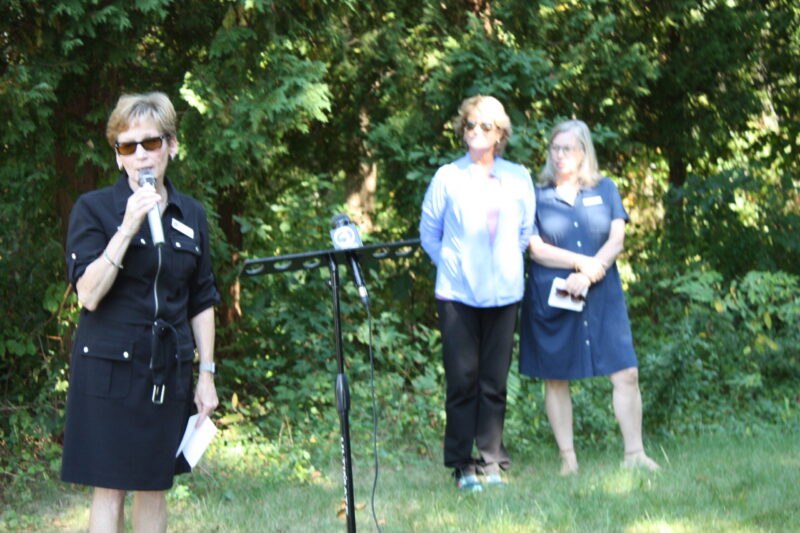
Ann Dagle addresses a crowd of roughly 50 people at a ceremony to commemorate new suicide prevention awareness signs on the Baldwin Bridge. Looking on are Old Saybrook Youth and Family Services Director Heather McNeil (left) and Lymes’ Youth Service Bureau Director Mary Seidner.

Ann Dagle, a grief counselor and founder of the Brian’s Healing Hearts center in East Lyme, said September is a difficult and immersive time for many prevention advocates. Her work during Suicide Awareness Month is consumed with presentations, training sessions and outreach for 30 days straight. 

Dagle’s son, Brian, died by suicide in 2011 while in his sophomore year of college. 

“It’s challenging to work in this space all the time, but days like this give us hope,” she said. “They give us hope that we can make a difference. They give us hope that we can save lives.”

If you or someone you know is in crisis, please reach out to the 988 Suicide & Crisis Lifeline or text “HELLO” to 741741 for free, confidential support at any time.

Soccer Roundup: Lyme-Old Lyme Girls Notch Impressive Win

Lyme-Old Lyme High School girls soccer finished the week with a 9-1 win over North Branford.

On Thursday, Brooke Burgess, Hailey Suisman , and Reagan Christopher each scored two goals. Olivia Lovendale, Adrian Raby, and Emily Bonatti contributed a goal each. Avery Spooner notched an assist.

Goalkeeper Grace Osborne delivered four saves.

North Branford’s lone goal came from Kaydence Caporale. Goalkeeper Sofia Ludington finished with four saves.

The girls are now 3-3-2 overall and 3-3-0 in the Shoreline Conference. They next play Haddam-Killingworth High School at 4 p.m. on Friday in Old Lyme.

On Sept. 16, Old Saybrook High School bested Old Lyme 4-2.

On the Old Lyme side, the team’s two goals came from Anna Bussmann and Addy Morosky. Vivian Boller provided an assist. Grace Osborne made 12 saves.

For Old Saybrook, Nadia Roslonek delivered three goals and Jameli Jara scored one. One assist each came from Annalise Sarette and Carmen Vercillo. Emerson Cooke made a pair of saves.

‘Witness Stones Project’ Merges with Massachusetts-based Preservation Group

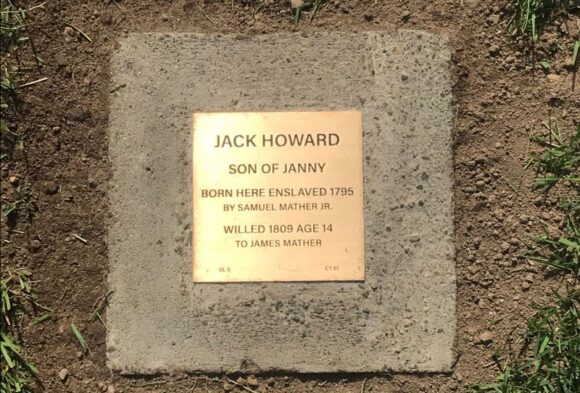
This Witness Stones plaque commemorating the life of the enslaved Jack Howard is located at 5 Lyme Street, the parsonage of the First Congregational Church of Old Lyme.

HAVERHILL, MA–Two organizations committed to recovering hidden histories, commemorating enslaved individuals and fostering a deeper understanding of the country’s complex past have joined forces. 

The Connecticut-based Witness Stones Project, which includes an active presence in Lyme and Old Lyme, has been absorbed by Historic New England, a preservation organization out of Massachusetts that goes back to 1910. 

The merger was announced Thursday in a press release from Historic New England. It brings the Witness Stones Project under the banner of Historic New England’s Stopping Stones initiative, which honors enslaved Americans through the installation of permanent markers and community ceremonies. 

Both the Witness Stones Project and Stopping Stones use small plaques in the ground to mark sites of enslavement – including 300 Witness Stones in seven states and more than 90 Stopping Stones from Vermont to Texas – but only the Witness Stones program incorporates a robust educational component. 

The Witness Stones Project in a website announcement said former Witness Stones Director of Operations Liz Lightfoot, of Lyme, will take on the role of Stopping Stones school and youth program manager. She will continue to use Witness Stone’s trademarked curriculum to help students explore historical records and to tell the stories of forgotten individuals, the group said. 

The Witness Stones announcement said schools, churches, and community organizations involved locally can rest assured their work is being preserved and will serve as a foundational part of the expanded effort. 

“And for the communities where we are currently working and will work in the future, the important research, education, and installations will proceed with the full backing of Historic New England’s resources,” the group said.

The Witness Stones Project was founded in 2017 by Dennis Culliton of Guilford. Stopping Stones, which is part of Historic New England’s Engagement Arts Fund, began in 2020 under the leadership of Paul Growald. 

Growald said joining with the Witness Stones Project enables his group to add a “powerful educational dimension” to the physical markers. 

“I have long envisioned curriculum components that accompany our memorials, inviting participants of all ages into this work,” he said. “This partnership fulfills that vision, aligning remembrance with education and community dialogue in a way that can truly transform how America reckons with its history.”

The expanded Stopping Stones team is led by director Pat Wilson Pheanious, a ninth-generation descendant of enslaved individuals in Guilford whose family history was among the first researched by the Witness Stones Project eight years ago. She is the founding chairman and a former executive director of the Witness Stones Project. 

“Embracing the past is vital to shaping America’s future,” Pheanious said in the Historic New England release. “This collaboration ensures that the work of these programs will remain strong, protected, and accessible to communities everywhere.” 

Historic New England CEO Vin Cipolla said the new collaboration will allow both groups to expand their reach nationwide by pairing memorial installations with classroom learning and community dialogue. 

“By uniting the Witness Stones curriculum with the national reach of the Stopping Stones program, we can ensure that the lives and legacies of enslaved people are recognized, remembered, and taught to future generations,” he said. 

Both initiatives are inspired by Germany’s Stolpersteine Project, which commemorates Holocaust victims with “micro-monuments” placed in public spaces. 

The merged groups will operate as part of Historic New England’s Recovering New England Voices (RNEV) initiative. RNEV supports research, storytelling, and public engagement to elevate underrepresented histories, including those of Indigenous people, women, immigrants, LGBTQ communities, and enslaved individuals. 

The public is invited to join the conversation at the Historic New England Summit, Nov.13–14. 

More information on the transition is available on the Witness Stones and Stopping Stones websites.

Old Lyme Boy Scout’s Eagle Project Benefits Rocky Neck State Park

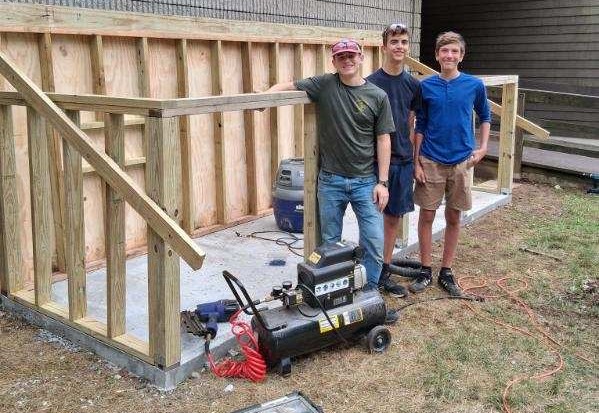
Henry Kyle recruited several friends to help him build a beach wheelchair shed at Rocky Neck State Park as part of his Eagle Scout project for the Boy Scouts of America. Left to right are Alex Glaras, Noah Brant and Kyle.

EAST LYME–A new beach wheelchair shed for Rocky Neck State Park is in place thanks to a soon-to-be Eagle Scout from Old Lyme. 

Boy Scout Henry Kyle of Troop 26, the son of Chris and Kate Kyle, assembled a crew of four Scouts and some of their parents to help protect beach wheelchairs from the elements. Project supporter Jolene Brant shared the details about the effort, which she described as ambitious from the start.

An Eagle Scout project, usually completed in a day or two with the help of volunteers, is a community service effort carried out by a Boy Scout to earn the rank of Eagle. It is touted by the Boy Scouts of America as a demonstration of leadership, planning, and problem-solving.

Kyle, a sophomore student at Lyme-Old Lyme High School, is set to receive his Eagle Scout recognition at the end of the month. 

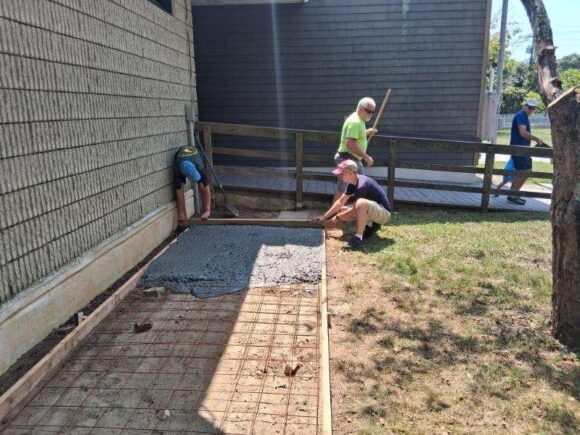
Henry Kyle and Alex Glaras work with Steve Urbowicz to lay concrete.

Kyle chose the Rocky Neck project after he saw the need for the enclosure, which was affirmed when a state park employee told him it would be helpful if a Boy Scout could do the work as an Eagle project. He thought it over and decided he was the person that could take the lead on it, Brant said. 

The project required approval from the Connecticut Department of Energy and Environmental Protection (CT DEEP), which took about three months. Meanwhile, Kyle had to pivot after the concrete contractor he initially secured fell through due to health issues. That’s when Kyle’s Boy Scout connections led him to Steve Urbowicz of the Branford-based Concrete Connections.

Urbowicz donated the concrete, the delivery, and his time to teach the Boy Scouts how to pour and finish concrete.

The project was also supported by Park Supervisor Marcella Hube, maintainers David Leiper, Cody Mullen, and Brett Lewis, as well as previous Park Supervisor John Guglielmoni.