Editor’s Note: We received this op-ed from Rev. Steve Jungkeit, who serves as the Senior Minister of The First Congregational Church of Old Lyme (FCCOL.)
In the winter of 2020, just before Covid stopped the world, I sat with a friend on a hillside overlooking Deschapelles, Haiti on a clear starry night. There were scarcely any lights to be seen, for few people in that remote valley have electricity. But the world around us was alive with sounds. From numerous directions, we heard the sounds of Vodou drumming, as people conducted nighttime ceremonies.
From other locations, we could hear the sounds of church services, with people singing hymns and worship songs. Occasionally the sound of conversation could be heard interspersed with the music, and sometimes laughter. The night was alive with a kind of sensual wonder, and even though vast poverty surrounded us, I couldn’t help but marvel at the richness of Haitian culture, and the gifts it has offered the world.
If only more people in the United States understood the beauty and vitality of Haitian culture. The racist and xenophobic lies of Donald Trump and JD Vance have cruelly stigmatized Haitians in Springfield, Ohio, demonizing them simply for being there. It’s an ugly behavior with a long history from all sides of the political spectrum in the U.S. Such remarks render even more precarious a population that has already suffered, and survived, much. For the sake of Haiti and Haitians, it’s time to tell – and to learn – a different story.
There are, of course, Springfields all across the United States, where significant populations of Haitians live. But that’s especially true in Connecticut. In the southeastern corner of the state where I live, Norwich and New London have thriving Haitian communities. But the same is true of Hartford, New Haven, Bridgeport, Waterbury, and countless other cities throughout our state. Haitians are our neighbors, and they make the places that we live better and more vibrant for their very presence.
Now is the time to reach out to those communities. Now is the time to say that we’re glad that you’re here. Now is the time to offer our support in any way we can, as threats, rumors of violence, and slander directed toward Haitians have increased. Now is the time to thank our Haitian neighbors, for enduring so much, and for making our world, and our state, a more vibrant place.
But now is also the time to educate ourselves, and to celebrate the gifts of Haitian history and culture. We can do that by reading the monumental histories of the Haitian Revolution written by C.L.R. James (“The Black Jacobins”) or Laurent Dubois (“Avengers of the New World”). We can do that by queuing up exemplary music on our streaming accounts from Haiti and its diaspora (RAM, Boukman Eksperyans, Leyla McCalla, Lakou Mizik, or countless others). We can do that by understanding better the complex genius of Haitian Vodou (start by reading “The Sacred Arts of Haitian Vodou”, but continue on to works such as Nan Domi, by Mimerose Beaubrun or “Tell My Horse”, by Zora Neal Hurston).
We can study the beauty of Haitian art, and appreciate the literature that has emerged from Haiti (start with the exquisite writings of Edwidge Danticat, but try others as well, like Jacques Roumain and René Depestre). Don’t forget the searing and profound films of Raoul Peck (Exterminate All the Brutes, for example) one of the most innovative filmmakers on the planet today.
And let us not forget to eat. You haven’t lived until you’ve tried piklis, a spicy Haitian vegetable mixture that will elevate your consciousness. You can find it in Norwich, at Mommy’s Delicious Food, or in Bridgeport, at Manje Lakay.
Above all, though, let us not forget the people, or neglect their stories. Let us not ignore the many gifts they have given to Connecticut, to the United States, and to the world itself.
I can’t reproduce that night in Deschapelles, but in a way Connecticut is a lot like that hillside: if you know how to listen (and see, taste, touch, and smell), the gifts of Haitian culture are all around us.
Now is the time to listen well, that we might come to tell, and to learn, a better story about Haiti.
Editor’s Note: The Crosby Fund for Haitian Education, one of the ministries of FCCOL helps Haitian young people receive an education, which is neither free in Haiti nor an expense that most Haitians can afford.
Editor’s Notes: i) This op-ed was submitted by Eric Knapp, who is employed as the Town of Old Lyme’s Land Use Coordinator. He is writing here as a private citizen. ii) This is the opinion of Eric Knapp.
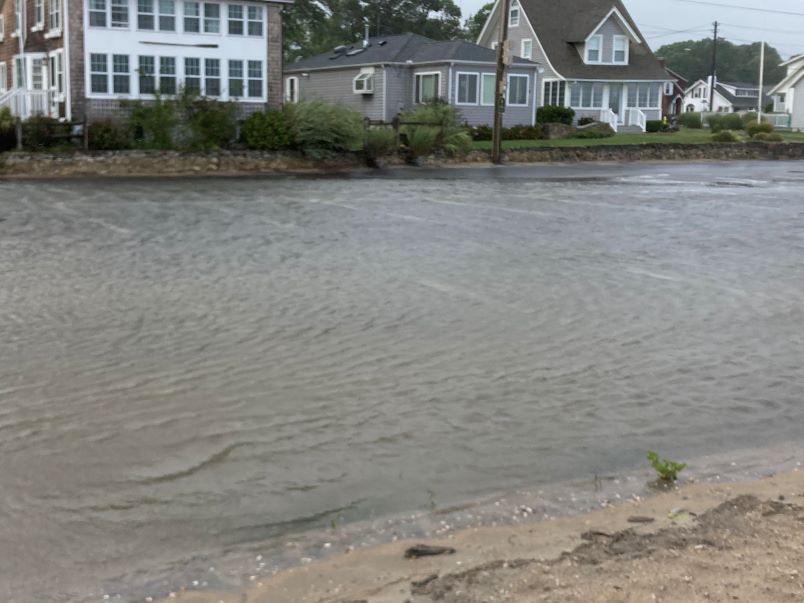
As Long Island Sound rises inexorably, flooding along the Connecticut shoreline is likely to become more frequent. This file photo shows flooding in a prior year at White Sand Beach in Old Lyme.
I have lived in Connecticut my entire life. My career as a lawyer involved representing property owners and land use commissions across the state, but especially along the shoreline, attending countless evening meetings, court hearings and conferences with municipal officials. In my time as a land use officer, I have staffed commissions and served in various positions as a zoning enforcement officer, wetlands enforcement officer, flood plain manager and de facto planner. While I am not a planner by training, my decades of time seeing the Connecticut shoreline in variance capacities has given me time to think about its present and its future.
Connecticut is blessed with abundant water, both fresh and salt. We have a system of rivers that flow through every community, many man-made lakes (almost all of the lakes and ponds in Connecticut are man-made) and a long shoreline with natural harbors. The waters of Connecticut powered our industrialization in the 19th century, and we continue utilizing them for off-shore power and maritime-related centers such as the Coast Guard Academy, Electric Boat and the submarine base. You would be hard-pressed to find anyone who does not have some fond association with the waters of the State.
That makes it particularly difficult to address the sorts of changes that have already arrived and those that are likely to arrive during the course of the 21st century. It does not rain in the same way it did when I was a child. We get many more “rain bombs” — short intense storms that drop an inch, two inches, sometimes more in an hour. It does not snow in the same way that it did when I was a child. December and January are largely snow-less now. Storms during February and March more frequently involve collisions between moisture moving north and a cold front moving south, resulting in huge dumping events, with feet of snow falling at a time.
Infrastructure designed for the 20th century cannot keep up with the 21st century weather. Culverts are now undersized, leading to road-flooding. Some of the pipes draining into Long Island Sound now flow backwards during high tide events. Bulkheads are failing. Streets are flooding. The cooling system for the Millstone nuclear plant has been unable to draw water that is sufficiently cool from a warmer ocean, leaving the biggest source of energy for Connecticut subject to shutdowns. All of this is already here. But more is to come.
The Federal Emergency Management Agency (FEMA) has released a detailed map showing where it anticipates coastal erosion in New London County. It is a scary map to look at, with entire streets anticipated to face serious erosion by 2030.
Nearly all the properties around the mouth of the Connecticut River are serviced by septic systems, most of which are outdated. As Long Island Sound rises, saltwater intrusion will make these systems ineffective. Even now, the nitrogen and phosphorus being added to the Sound due to the over-concentration of septic systems is impairing the water quality, impacting attempts at re-establishing shellfish beds along our shorefront.
As impervious surfaces increase year after year, and the rain bombs occur with greater frequency, storm sewer systems will fail with increasing regularity. Roads will flood and then fail. Methods such as rain gardens and detention basins will lose their effectiveness as the water table rises. There will be, quite literally, no place to put the water.
Elected leaders have not fully embraced this reality. It is not hard to see why. In towns such as Clinton or Westbrook, these low-lying areas provide a large percentage of the real estate taxes. Importantly, since many of the dwellings are seasonally-used, they contribute the same taxes as year-round dwellings, but use a fraction of the services, and do not send any children to the school system. The fact that these neighborhoods are at risk poses potential financial threats to these communities.
Property owners do not want to face this reality either. These are valuable properties. Even when the structures on them are old and dilapidated, the land is worth a great deal. That this investment might lose value, or worse, become valueless, is a hard pill to swallow. Taking steps to address climate-related issues only highlights the problem, putting pressure on resale values. There is frequently an insistence that all that is required is a simple fix: a better drain, or an elevated road, and whatever “temporary” issue there is with water can be resolved.
One of the clearest examples of how the system is not working is the FEMA “substantial improvement” requirement. In theory, the rule is simple: if you perform improvements on your structure, the fair market value of which exceeds 50 percent of the value of the structure, you are obligated to make the structure FEMA-compliant for flood zone purposes. The idea is commendable: over time, as owners perform necessary repairs and improvements, houses will have to be raised, diminishing that owner’s and the community’s flood risk.
The reality is quite different. There are three pathways, and none of them is ideal. First, yes, there are those with the money to elevate their houses. But the truth is that if an owner is going to spend the money to elevate their home, they will also likely want to maximize their investment, making the home as big as zoning will allow, and obtaining variances to go beyond even that. The effluent will still be in the septic system, of course, but the house will be there after the next storm.
Next are the “dodgers”. As any zoning officer will tell you, people will play games to show that they are not exceeding the 50 percent threshold. They can provide their own appraisal of the structure to show it is worth more. They can claim that there is some code-related emergency. They can try and undervalue the work proposed, or simply do more work than their permit sets forth, or maybe not bother to get a permit at all.
The fact that all of this will leave them vulnerable when some future storm arrives is tomorrow’s problem. By then, it may be another owner’s problem. Every seller of a vulnerable shoreline dwelling silently knows that they have dodged a bullet.
Finally, there are those who are simply not in a position to make improvements. Their dwellings will continue to deteriorate, making the problem harder to solve. Each dollar of value that a structure depreciates lowers the threshold of any future improvement that would trigger the “substantial improvement” requirement. These houses are potential death-traps. Inevitably, when these structures collapse and wash away, their debris will harm other properties.
Each year, the amount of impervious coverage grows, the Sound inexorably rises and the odds of a catastrophic storm get worse.
As the saying goes, the first step to recovery is admitting that you have a problem. Shoreline Connecticut has a problem.
So, what happens next?
Realistically, a lot of hard choices. Solutions will take money. There will be winners and losers. Some towns may need to rethink how they see themselves. But it must be done, and we need to start now.
Let’s start with what we can’t do. We cannot simply try and armor the coastline. Not only is this completely disfavored by both FEMA and the Department of Energy and Environmental Protection, but it would also be wildly expensive and would not even work. Armor merely diverts the energy and water from the ocean. The water that is not coming ashore on one site will search for another location to enter.
Water may not overtop a wall, but it will exert pressure on the surface water beneath the wall, pressing the fresh water north and then rising up out of the ground. Likewise, where streams or inlets meet the shore, the tidal wetlands will fill up and freshwater wetland will become brackish. A Maginot Wall along the Sound will work as well as the real one did. Water will find a way around. It always does.
Realistically, we are going to need to create space.
“Creating space” will mean different things in different locations.
For distressed homeowners, who cannot afford to make improvements, a modest buyout program may be possible. Removing houses and creating more pervious area for water to infiltrate will help, if only modestly. Removing potentially hazardous structures from the flood zone will reduce the danger to other structures. Finally, if the structure is removed, there is no chance of anyone being inside during a storm event.
This latter option has two negative financial implications. First, there is the cost of any buyout. Second, each of these dwellings pays taxes, and removing them directly affects the Grand List. But increasing the security of other structures should, in theory, increase their value, somewhat offsetting this loss.
Buffers around tidal wetlands may need to increase. As the Sound rises, these coastal areas will try and move inland. By creating and enforcing realistic buffers, towns can protect the spaces into which these tidal marshes and flats will want to intrude. Property owners will not like seeing these encroachments on their properties. They will feel, rightfully, that they are losing something they own. The abstract idea that healthy tidal areas protect everyone is little comfort to those most affected by these efforts.
Fortunately, there are other creative ways being developed to help mitigate some of these issues. Boston is trying out an “emerald tutu” system, described by the American Society of Mechanical Engineers as, “A linked group of floating spherical mats. Each is roughly a meter in diameter, made of a mix of biomass, seeded with marsh grass, and surrounded by a net to hold it all together.” These serve the dual purpose of assisting the ecosystem while also helping to dissipate wave energy, preventing or mitigating erosion.
In Stratford, they are using concrete reef balls to perform a similar function. Other communities are adding a layer of additional soil to their tidal wetlands to keep them above rising waters.
It will take a lot of trial and error to figure out the best ways to accomplish these goals. Not every project will be successful, and what may work in one place may not work in another.
At the risk of starting a firestorm, there is also the dynamic of reliance on individual septic systems in a large portion of the coast. From Clinton to Old Lyme, the official policy has been “sewer avoidance”. As a result, many older systems, while not officially “failing”, are putting nitrogen and phosphorus into the ecosystem at a rate higher than it can be absorbed. There is also the basic hydrological issue that most of the shore is served by public water, so water arrives from outside of a community and then leaves through the septic system, creating a net increase in water.
The likelihood that new large sewer plants will be constructed is low. They are expensive and unpopular, however necessary they might be. What seems feasible is that smaller community systems can be installed on small lots throughout shoreline communities. Even tying eight or 10 houses into a small system would prove beneficial. Of course, this is not easy to do under the present Health Code, so regulatory changes may be required to allow this to occur.
For larger commercial uses, there may be some benefit to having them build systems that exceed what they require (in exchange for regulatory benefits), which could allow nearby substandard systems to be phased out and those properties to hook into the commercial system (for a cost.)
Inevitably, while making choices, there will be those who will lose property rights, or more clearly, their properties will be reduced in value, sometimes to zero. The reality is that this is going to happen anyway, as the water rises. But if the government does this, it constitutes a taking and compensation will need to be paid. This will cost real money. People will fight to get as much compensation as possible in exchange for giving up some or all of their property, and rightfully so.
The alternative is to wait for a large storm to come and then see who has the resources to rebuild. I am not persuaded that this would be better.
I am not writing this because I have the answers. I am writing this because we all need to come together and start contemplating the answers together. This will take time. It will be hard. People will disagree, quite loudly, about the extent of the problem, before we even get to the question of what answers will look like.
But I would encourage the people of Connecticut to take up this work now, so that my 14-year-old sons will have a future here. We may be the Land of Steady Habits, but we are also a land of inventors and hard workers. We can solve this, but only if we put our minds and our energy, and yes, our dollars towards a solution.
Editor’s Note: This op-ed was submitted by Howard Margules of Old Lyme.
Our town’s major projects—Halls Road, Lymes’ Senior Center, Sewers, Shoreline Gateway, and Affordable Housing—are all vital to our town’s future economic viability.
They also share something else in common: they have been “works in process” for quite a while, and all remain unfinished. It is important to point out that these projects have been ongoing across multiple administrations, regardless of which political party is in power; so this is not a partisan issue but one that crosses party lines.
Why do these projects take so long to complete, and what can be done to expedite them?
Over the last ten years I have been involved, one way or another, in most of these projects.
I am a current member of both the Halls Road Improvement Committee and the Planning Commission and the former Chair of the Economic Development Commission. Thinking back on my front-row experiences has led me to some observations on those questions and suggestions for improving timely project completion.
Relying on Volunteers
Our town is very fortunate to have a motivated, engaged volunteer corps staffing our town Boards, Committees and Commissions. I have worked with good people from both parties, and I have been generally impressed with the competence, knowledge and commitment they bring to the job. And, they are doing this work for “free.”
But, there are issues with relying on volunteers.
First, there is a town requirement that the Boards and Commissions be balanced politically. This occasionally leads to appointments made simply to fulfill the political balance requirement rather than appointing the most qualified individual.
Additionally, there have been instances where the Committee or Board Chair has had no input in the selection, or, objected to the appointment, but was overruled, even though the person appointed was not the best candidate.
Second, our town relies almost solely on volunteers to address some very complex projects which often require specific expertise and knowledge that may be absent in our volunteers.
Additionally, most Boards and Commissions only meet once per month, which is acceptable for routine issues but inadequate for addressing major complex projects.
Finally, it is also difficult to put too much pressure or expectations on volunteers since they can always elect to just bow out. Relying almost totally on volunteers makes it hard for the town to complete major projects successfully in a timely fashion.
Low Accountability
Many municipalities, especially larger ones, employ a full- or part-time professional planner, to lead major projects. They are professionals with the expertise required to address the complex issues major projects raise. Most importantly, they are held accountable as professionals for completing projects.
Currently, we don’t have the structure or ability to hold any one person accountable. Accountability gets more complicated given the number of Boards and Commissions involved, various interests that have to be satisfied, and political agendas that occasionally get in the way.
Lack of Collaboration
All of these major projects require approvals from multiple Boards and Commissions Typically, this is done sequentially. One Board or Commission generates proposals that then require approval from another body. Of course, it is natural then for everyone to want to add their two cents.
The sequential review and approval process frequently leads to varied opinions, occasionally to conflicts, and thus delays. Each set of potential conflicts must be resolved in sequence, drawing out the process and the projects unnecessarily.
In my view, it would be more beneficial to provide a mechanism for the Boards and Commissions to collaborate initially, perhaps reaching broad consensus and some level of buy-in before the official approval process.
The Board of Selectman should form a specific project committee for each major effort. We do have some such now, but they do not include representatives of the bodies that will have to provide approval later on.
The relevant Boards and Commissions or representatives of those bodies need to be involved early in the project, if not from its inception.
Relevant Expertise
Expert advice (engineering, law, environmental science, design, etc.) is required for these major projects. We are very fortunate in Old Lyme to have a wide range of skills represented in our citizenry and we have benefitted from their help over many years.
Unfortunately, those with the most relevant skills are often still working, raising children, etc. and have little time to volunteer. We can take advantage of these local skills where they are available, but major projects need consistent and constant expert input, even if it means we must hire professionals to assist.
Even to manage the work of hired experts can require Board or Commission members to climb a steep learning curve.This is another area in which a professional planner could be very helpful.
Leadership
Finally, these complex projects require engaged leadership from the Board of Selectman. The Board of Selectmen needs to assist with coordination, monitoring, oversight, timetables, expense control, lobbying public officials for funding, and commit to completing projects on time and on budget.
Our town will face more challenges going forward. If we are to successfully face these challenges and secure our economic future, we need to enhance our approach to supporting and managing major projects.
Two years ago, my son—a student at Lyme-Old Lyme Schools—attended a regional wrestling tournament, where he witnessed a remarkable act of ethical behavior. One of the matches featured two giants from rival high schools. Not long into their spirited contest, those colossal opponents collided in an unplanned way. They sent each other to the ground in pain. The breathless silence of alarm seized the crowd. Time ceased, uncannily, before the coaches and medical personnel could race to attend the injuries of the fallen. But in those frightening seconds of unease when so many bad decisions could have been made, the two young competitors mustered the mettle, composure, and respect for each other to share a fist bump in solidarity.
I ask that you keep that image in mind as you continue reading on.
In a series of letters to the editor of CT Examiner, I have made known my abiding concern about the escalating erosion of democracy in Lyme and the lack of viable and honest elections. Rather than reiterate the case here, I would request that readers examine those letters for a detailed explanation of the issue. The summary is that in five election cycles since 2015 and including the 2023 election, there has been only one competitive election in town for the Select Board, held in 2017. In the four other elections, the Select Board members chose their successors through mid-term retirements, self-promotions, and appointments of people who were not formally elected to the Board. The Lyme DTC and RTC have actively supported this anti-democratic process through cross-endorsements or by not running candidates and accordingly arranging uncontested races.
Predictably, this undemocratic practice has now spread to other boards. In the 2023 election, the Lyme DTC and RTC predetermined all board memberships, so that voters had no choice on the ballot. The only contest in town was for the Region 18 Board of Education.
Despite my numerous attempts to engage them in writing, the members of the Select Board have avoided any debate or discussion about this problem in public forums. The closest they came was an interview in this newspaper conducted by the daughter of the DTC Nominating Committee chair, and two interviews in The Day in October and November of last year. In the latter, John Kiker (the current Second Selectman and DTC chair) continued a talking point that David Lahm (the current First Selectman and now former RTC chair) and Steve Mattson (the former First Selectman and former DTC chair) introduced in LymeLine that such lack of elections is the “reality of life in a small town”—that is, presumably, a place in which few people run for office or volunteer for public service.
I will reserve commentary about the sheer falsity of that claim with an offer to provide copious data about political activism in small towns. Here, I would only note that honest elections require us to be honest about elections. And I would add that people generally do not become involved in civic affairs if they are made to toe a line that benefits only a handful of residents, including and especially the expectation for “polite cooperation” previously demanded by the DTC and RTC.
I say “previously,” because there is finally a sign of hope. On January 9th, the Lyme RTC held a caucus, the result of which was a revitalization of a rapidly declining membership, including with several new members. I want to express tremendous gratitude to all of them who stepped up at this precarious time. And I do so as a lifelong registered Democrat, a far-Left progressive, and a democratic socialist.
I am hopeful that a rejuvenated RTC may signal the return of competitive elections in Lyme—the very lifeblood of a healthy democracy. I am also hopeful because as a proponent of pluralistic democratic society, I believe strongly in the need for an allegiance with each other that encourages and protects differences of opinion and dissent. A robust democracy predicated on oppositional political perspectives not only assists each side reconcile with their blind spots, but it guarantees accountability in elected officials through checks and balances, a need for compromise, and opportunities to correct failures (or abuses) at the next election. In other words, legitimate democratic contests are the antidote both to a “polite cooperation” or an agreement that only benefits the few and to political combat and its rapacious reliance upon vilification, demonization, and misinformation.
The problem is that in our current political climate (and due to too many factors to unpack here), it is nearly impossible to achieve such democratic culture at the national and state levels, or even within larger municipalities. But such principled engagement—in which we regard politically disagreeing others as opponents but not enemies, rivals but not villains, and all as fellow human beings—is precisely the promise of small towns. It pains me to see Lyme fail the virtue of respectful competition.
I know there will be readers of this newspaper who will respond that Lyme is well governed. That is not the issue here. There are many places in the world that are “well governed” without a hint of democratic practices, the most important of which are viable and honest elections.
That said, let me also offer something I have not previously afforded: praise for First Selectman David Lahm, who finally stepped down from RTC chair. Whether a formal conflict of interest or not, it is highly questionable to have the governing representatives of the town—that is, the Select Board—also be chairs of the town committees, whose important job is to recruit partisan candidates to run for office. I hope that Mr. Kiker follows Mr. Lahm’s example and recognizes the wisdom of keeping those two positions separate, even as it would entail his yielding power to capable others.
Although I am arguing for regular contests to enjoy the genuine benefits of disagreement, I also know that as we cascade into the 2024 presidential election, we will all hear the siren song to side solely with our side—and to see all political opponents as the threat who must be conquered for there to be peace. I want to call attention to that profoundly unjust treatment of competitors, which we unfortunately caught a glimpse of in Lyme’s sole election last year.
To be clear, I am not trying to rehash 2023. I am expressing my concern, two years before the next municipal cycle, that if routine elections return to Lyme they not deteriorate into untoward negative campaigning and disinformation. Again, the democratic promise of small towns lies in their “thick networks”—the notion that the very person about whom you write a letter to the editor will be in line at the check-out in front of you the next day. Or behind you at the school pick-up, waiting for their kids whom they love with equal fervor as you do yours. Or rushing out of their homes to help you when the car accident erupts on their street. So let’s call a spade a spade: We failed in Lyme to uphold the obligation of community in the last election. But we can get it right in the future. We can model the democracy in town that we want to see thrive everywhere.
To do so requires a simple responsibility from the single most important civic role a person can undertake, that of citizen. As citizens, we must hold our own parties accountable to the democratic values we profess to uphold. And we must insist upon viable and honest elections, especially so in places where we can readily secure their fruition and success, namely in a small town.
That brings me back to those two teenagers—the future when we are all gone. Each of them entered the ring desirous of a victory for themselves and for their team. Each opposed the other and competed with a full commitment to win. But each also played within the rules and norms of a well-established contest, without deception or deceit. And when they both fell down together, each stopped before the collision went too far. And then each summoned the strength to show fidelity to a greater bond.
My son will never know their names. But in what I hope will be a very long and happy life, he will also never forget the good he saw arise that day.
Will he and all our children be able to say the same of the democracy we will leave to them in Lyme?
Editor’s Note: This is the opinion of Stephen Olbrys Gencarella of Lyme, Conn.
1/18: Updated with revised title: One July day in 1961, my mother and I landed at Idlewild Airport (now JFK) to join my father in America. My parents made the decision to emigrate from Scotland in search of a better life for their two-year old son and any other children who might follow. That move would eventually include my two sisters.
January 9th marked the 45th year of American citizenship for me. I remain as grateful now as I was that day in 1979 when I raised my hand and chose to turn my Permanent Resident status to citizenship, swearing my allegiance to the United States of America.
Given the events of the last 45 years and with a particular emphasis on what is referred to as the “current state of America”, I think it is easy for those born in the USA to be overly pessimistic about where we are as a country. When viewed from the outside, the USA remains a beacon of opportunity and hope for millions.
On the brink of my 65th birthday, I do find one troubling aspect of our “American experiment”. More and more Americans are involving themselves less and less in the daily affairs of our communities. The very existence of our institutions and republic depends upon people of all philosophies and backgrounds to put in the work.
Our democracy requires vigilance. Get involved as a volunteer. Run for elective office or serve on local boards and commissions. If everyone leaves it up to the other guy, you end up with a small group of fringe individuals holding power–sound familiar?? It is time for our citizens to emerge from their self-absorption, time to put aside obliviousness to the lives of others, time to, as President Kennedy famously said, “Ask not what your country can do for you, ask what you can do for your country.”
I cherish my Scottish heritage and the family I have who still live there. It is a constant source of pride and a pretty good conversation starter! However, each night before I fall asleep, the knowledge that I am an American provides me comfort and reinforces the fact that I am among the fortunate.
God Bless America—thank you for making me one of your own.
Editor’s Note: This is the opinion of Old Lyme resident Brian Cole.