Editor’s Notes: i) This op-ed was submitted by Eric Knapp, who is employed as the Town of Old Lyme’s Land Use Coordinator. He is writing here as a private citizen. ii) This is the opinion of Eric Knapp.
Many years ago, in my former life as an attorney, I attended a hearing before a land use agency in Canterbury. Ahead of my matter on the agenda was a proposal for a single-family house. A neighbor was strongly opposed. Her argument was stated as follows: I moved to Canterbury so that when I looked out my window, I would not have to see another house. And for years, I have not. If this is approved, I will see this house every day.
This did not turn out to be a winning argument, but it did point to something deeper. The suburban lifestyle is extraordinarily popular. A good number of people want to live on a cul-de-sac, with their own land and few neighbors.
The problem with this is that there are fixed costs, for land, utilities, driveways, drainage, not to mention basic building materials, and the incentives all point towards maximizing the return on each lot. That means that most of the new subdivisions being built out in this part of the state tend to cater to the top of the market.
As I noted in my last piece, while everyone seems to agree that the market needs more moderately priced homes, the market conditions do not favor this result. The Affordable Housing Statute, C.G.S. §8-30g, was supposed to address this, by offering greater density in exchange for “affordable” units. But this tradeoff has not been the boon it was supposed to be, and most developers in this part of the state use it as a last resort.
Along the shore, a similar dynamic plays out. The Federal Emergency Management Agency (FEMA) pressures homeowners to elevate their homes to be higher than the “flood elevation.” While many of the existing homes are modest ones on small lots, the cost of elevating them is quite high. The result is that if a property owner is willing (or financially able) to elevate a dwelling, they will usually want to maximize the size of the newly-elevated structure. It makes little financial sense to spend $100,000 to elevate a $200,000 house.
Flood-prone areas are increasingly a patchwork of expensive homes that have been elevated, and their “left behind” smaller homes that have not.
At some point, and I have no idea when, we will be hit with a Category 3 storm. When that happens, the demographics of the shore will change. FEMA will require damaged houses to be upgraded, and only those with the means to do so will be able to return.
The state government in Hartford is pushing—with increasing force—for towns to embrace “transit-oriented development.” But the residents of this part of the state stay here precisely because it does not look like the more densely populated communities. Quite literally, you could not pay a resident of Essex or Old Lyme to live in Stamford or Norwalk, or even New London. They like living in their suburbs/exurbs and are loathe to give up the comforts of their shoreline home.
A local Stew Leonard’s would be convenient but few here pine to live in Newington or Danbury. People may visit Trader Joe’s in Orange, but Rte. 1 there versus here is no comparison.
That brings us back to the “suburban dilemma” mentioned in the title. We are trying to square the lifestyle we love with the housing market we don’t. So far, the lifestyle is winning. It remains to be seen whether this will hold true going forward.
Editor’s Notes: i) This op-ed was submitted by Eric Knapp, who is employed as the Town of Old Lyme’s Land Use Coordinator. He is writing here as a private citizen. ii) This is the opinion of Eric Knapp.
The Connecticut General Assembly has determined that creating more affordable housing in the State is a priority. It is hard to argue that we have sufficient housing in a price range that a family of moderate means can afford. As a goal, housing that residents can afford is worthy.
It is also apparent that Connecticut’s attempts to promote that goal have not been a success. The original legislation to promote “affordable housing” was adopted in 1988. In the intervening 36 years, a variety of carrots and sticks have been put forward, but the problem has not gone away. I am not even sure we can say it has gotten measurably better.
And yet the Legislature is looking at even more heavy-handed solutions to address the problem. To quote a popular gif, “the beatings will continue until the morale improves.”
It is worth exploring why these methods have failed in this part of the State. Whatever your political leanings, we all have an interest in not perpetually continuing failed methods.
For starters, much of the “easy” land to develop has already been divided up. This part of Connecticut has been carved up since colonial times, and there are few remaining farms or other large tracts to work with. While shifting “affordable” housing to marginal land has been a historical pattern, it is not a very successful, or equitable solution. Additionally, as we have discovered, filling wetlands does not solve the underlying hydrological reason the land was wet to begin with. Many lands that were filled back in the 1950s, 1960s or 1970s are returning to their original state. Climate change is accelerating that process.
Lack of sewers is an inherently limiting factor. If sewage for each parcel must be treated on the parcel itself, then larger uses require larger areas for septic treatment. Creating any type of increased density requires good (original) soils, and area used for septic systems displaces other possible uses.
For all of the talk and legislative push for “transit-oriented development”, this part of the State is notably poor in transit options. Yes, Clinton, Westbrook and Old Saybrook have train stations, constructed at great expense, but no one really uses these to get around locally. Old Lyme, East Lyme and Waterford lack even the station, although we have the tracks. Going up the Connecticut River Valley, there is no rail at all. Yes, there is River Valley Transit (formerly Nine Town Transit), but service is sparse and still requires either living near the pick-up locations or using the “XtraMile” ridesharing app on your phone. In short, having a car is more or less obligatory in this part of the State, and that becomes expensive.
The State can keep upping the ante. It can assign a “mandated” number of units. It can even prohibit single family zoning. Honestly, I do not believe even abolishing zoning entirely would have much of an impact on housing affordability for this part of the State. It is fun to complain about the hurdles zoning regulations place on development, but, while there are affordable housing projects that are violently opposed, it is usually not at the zoning commission where they are blocked effectively.
If the State of Connecticut is serious about rebalancing the housing market, here is what works: infrastructure and public services. If there was both public water and municipal septic disposal, there could be additional density. The State has largely dumped “Complete Streets” into the towns’ laps, but if it wants this done, it will have to do it itself. A more vibrant bus network will take state money and coordination. Upgrading drainage infrastructure will prevent flooding. None of this comes cheap. And historically, this part of the State has been underserviced compared to Hartford, New Haven and Fairfield Counties. By way of example, Route 11 sits unfinished.
The Southeastern Connecticut Council of Governments (SCCOG) produced a study in 2019, entitled the “Regional Wastewater Management Plan”. Five years ago, it noted that, “the sewer system in East Lyme has essentially exhausted its capacity allocation negotiated with New London and Waterford.” It also notes that, “sewers in portions of Groton, Jewett City, New London, and Norwich predate the federal Clean Water Act in 1972”. But the official policy of most towns is still “sewer avoidance,” which is an effective way to discourage further density.
The truth is that the towns of this area probably have about the population density that they want. And that is fine. But if you want to address the affordability crisis, you will need more housing units. More units require greater density. Greater density requires upgraded infrastructure. Short of that, it is like the old joke about the weather, “everyone talks about it, but no one does anything.”
A reader recently described LymeLine as “The Cornerstone of the Community for News and Information.” Those words made my day since they perfectly describe LymeLine’s mission, and how we at LymeLine feel about the Lyme-Old Lyme community we serve.
We aim to present accurate, objective coverage of Lyme and Old Lyme community news, events and information while striving at all times to avoid sensationalism and negativity. And from the positive feedback we receive and the ever-increasing number of readers who visit our site, we have the sense that you value what we do and agree we are meeting a need.
By an extraordinary coincidence, today—December 3rd—is not only ‘GivingTuesday’, but also our 21st birthday! We are one of the oldest, continuously published, online community ‘newspapers’ in the U.S. And not once in all those years have we carried out an Annual Appeal but this year—partly at the urging of a number of readers—we are doing just that … and here’s why.
Some readers already know that we are no longer Old Lyme residents but others are unaware that we now live just outside Washington, D.C and publish remotely from there. This was never intended to be a long-term plan but has somehow turned into one. It is, however, becoming increasingly apparent that fulfilling our mission now requires, “Boots on the Ground,” and that, in turn, means we need additional funds to pay for an in-town editor/reporter.
So we are—for the first time ever—joining the throng of requests you are receiving at this time of year for donations. We are hoping to raise sufficient monies to help fund a part-time Editor/Reporter in Lyme-Old Lyme and also assist with our ever-increasing operating expenses.
So if you value our work and would like to support this effort, please consider a donation in any amount to help us meet this goal. You can donate online via this linkor mail a check to: Shoreline Web News LLC 10208 Kensington Pkwy Kensington, MD 20895-3305
Thank you so much in advance for your generosity. And also huge thanks to all those of you, who have already donated to LymeLine—in some cases, multiple times over multiple years. Your contributions, coupled with payments from our wonderful band of loyal advertisers, are, quite simply, why we are still here.
Editor’s Note: This op-ed was submitted by Joseph F. Camean, P.E. of Old Lymeand reflects his opinion.
Connecticut’s purportedly regulated electric utilities have been making news of late, with articles claiming Connecticut’s electricity bills are the highest in the continental U.S. and that as electric prices are set to skyrocket, there aren’t any immediate solutions. There have also been suggestions that Eversource needs a new CEO.
Contrary to the position that there aren’t any immediate solutions, I submit that there actually is one. And it is the competent regulation of our state-sanctioned monopolies and/or conversion to municipally governed regional utility cooperatives.
As one who has witnessed the conduct of Connecticut Utility Regulation for almost 40 years, the political appointment mechanics for selecting and installing commissioners has resulted in an outcome of no one having pertinent expertise serving as a commissioner. It’s a non sequitur to have lay persons holding sway over multi-billion dollar, 100-year impact decisions for which ratepayer-taxpayers get saddled with unreasonable costs and unreliable services. Some examples:
The aberration as to how our monopoly utility operating companies and physical assets have been allowed to be cashiered to out-of-state and out-of-country ownership, along with unrestrained use of out-of-state service providers for administration, construction, and operations. How illogical for a state-granted-monopoly to facilitate ratepayer monies sailing out of our state’s borders rather than recirculating these funds within our domestic economy.
In the 1980’s Connecticut had a municipal waste, i.e., garbage crisis. The Environmental Protection Agency (EPA) made it near impossible to continue with landfilling, so the default became capitalizing public and private waste incineration “Resource Recovery” plants, producing some electricity.
Connecticut’s towns shuddered at the capital costs that had to be borne, the legislature in a dilemma of what to do? Easy—facilitate long term contracts for the purchase of electricity from the proposed plants at 300 percent of fair market value, disguising and socializing the garbage problem into everyone’s electric bills.
Sadly, had utility regulators piped up and made this ruse transparent to the public, the upward spiral of our electric rates would not have begun its initial upward acceleration, and a more responsible solution to waste disposal could have been motivated, i.e., recyclables and compostable wastes being source-separated, might have started decades ago.
The 1980s also found Eversource’s predecessor allowed to grossly mismanage the construction of the Millstone III nuclear plant, resulting in the capital cost of the then three-unit Millstone nuclear complex to exceed $4 billion (in 1980’s dollars); this cost burden then saddled upon the ratepayers. More egregious was the evolution to follow, whereby our original four nuclear generation plants were so negligently mis-operated that federal regulators had to order a stand-down to protect the public.
Shutting down a majority of our state’s electric generation capacity nearly bankrupted Northeast Utilities, and its managerial failings scandalously made the cover of Time magazine. Further failure to regulate, extended into allowing Northeast to unnecessarily retire two of the four nuclear plants, followed by auctioning off the two remaining active units to an out-of-state owner.
In a profound illustration of failed governance, the regulators acquiesced to the utility valuation of Millstone, in year 2000 dollars at $235 million, when in fact the plant brought the highest cash bid ($1.3 billion) of any divested nuclear plant in the USA. End-game was Connecticut ratepayers paid over $4 billion for what was sold for $1.3 billion.
Adjusting to today’s dollars, with a replacement value of the four plants at $32 billion, all of which could have been life-extended to operate until 2045 and cheaply provide 70 percent of Connecticut’s electricity, all carbon-free, is an unconscionable forfeiture of ratepayer’s money. How’s that for a lasting regulatory impact!
Following the model of electric ratepayers being hoodwinked to pay for municipal waste disposal, Fuel Cells are one more facet of Connecticut’s electric price road to hell paved with good intentions. Fuel Cells are machines that were made practical during the 1960s space race to provide electricity for spacecraft, using rocket fuel, i.e., pure hydrogen and oxygen. These machines were developed by the fuel cell division of a now-departed Connecticut company called United Technologies Corporation (UTC).
Fueled on pure hydrogen, these aerospace Fuel Cells make electricity very cleanly, exhausting only water vapor and heat. As a utility power generator, it sounds too good to be true. In fact, fuel cells cost six times the price of conventional electric generators, and hydrogen fuel costs six times the price of fossil fuels. Nevertheless, UTC promoted fuel cells as a source of Connecticut jobs and sought state support, with the hydrogen fuel being extracted from natural gas, ignoring that this extraction dumps carbon dioxide into the atmosphere – no differently than conventional natural gas-fueled power plants.
So should a power generator that costs six times more, with carbon emissions hardly better than conventional generators, be generously subsidized with ratepayer money? Don’t think for one minute the lobbying power of UTC would be daunted by such minor issues – they succeeded in getting our regulators to allow the fuel cells to be subsidized under the aegis of Renewable Energy Credits (REC’s).
Recall the stock market derivatives manipulations? Not the same, but REC’s were a mechanism whereby the production of renewable electricity would mint a power generation bitcoin of sorts, which our regulators obligated the utilities to buy. Essentially treating natural gas-fueled fuel cell power as different yet equal to renewable energy.
Despite all the ratepayer subsidy, UTC still could not profitably deploy their fuel cell product, ultimately paying ClearEdge Power, an almost bankrupt company, $48 million to take it off their hands and subsequently UTC wrote off $227 million. ClearEdge then bankrupted and the former UTC fuel cell product was acquired from bankruptcy by Doosan of South Korea, who continues to troll for Connecticut projects.
The Connecticut subsidies also support Fuel Cell Energy, another Connecticut fuel cell company that consistently loses money and marginally survives on subsidies. Inexplicably, in 2021, our utility regulators allowed natural gas-fueled fuel cell projects to be outright classified as renewable energy, like power made from hydroelectric, wind, and solar power.
Only in Connecticut is electricity produced from natural gas classified as premium-priced renewable energy. This poorly crafted legislation backfired in opening the door to out-of-state fuel cell companies such as California company Bloom Energy—a remote but similar player living on government grant welfare, struggling to financially break even.
Connecticut taxpayers have generously helped Bloom’s solvency by multiple subsidized projects throughout our state, a most recent example is the $80 million fuel cell project at a redevelopment of the former Stanley Works in New Britain. So much for the intent of creating Connecticut jobs as we now give ratepayer money to fuel cell products from companies our Secretary of State deems foreign corporations.
Putting aside the abovementioned special failings, we must also look at general mismanagement of our electric system’s basics: the siting of generating plants and electric transmission to deliver this power to our towns and cities. For the most part, Connecticut has delegated this responsibility to the regional power grid, an entity called Independent System Operator New England (ISO-NE). Although it is prudent to participate in a larger grid, in the recent past illustrated by the stand-alone Texas power grid collapsing, our regulators nevertheless have a fiduciary obligation to ratepayers to look out for what’s best for Connecticut.
For example, Connecticut’s greatest electric load is concentrated in the western downstate part of our state, whilst the lowest electric load is in the central and eastern upstate areas. Shortly after the regulators coerced our utilities to divest their generating assets, two large private power projects were built in Killingly and Middletown, far away from the electric “load pocket” of southwestern Connecticut. The plant sites were easy marks for private developers that acquired cheap land having access to ISO-NE transmission wires and interstate pipeline natural gas (more about this later).
However, placing power generators far away from the “load pockets” resulted in the need for long distance transmission to move the power. Not a problem, Eversource’s predecessor ran a 70-mile power transmission line from Middletown to Norwalk at a cost of $1 billion – Oh. Thank you ratepayers. By the way, recall that natural gas fuel; it enters our state from our western border with New York; there were considerable costs to expand this infrastructure to supply the power plants as were built way to the east. Not to worry, those costs have quietly been baked into your electric bills too.
Looking down a bit closer to home, after the bulk electric power gets moved long distances around our state at very high voltages, ultimately it gets reduced to distribution voltages and then sent along our streets and roads. All utilities are adamant that overhead power distribution lines are more economic than underground power lines. Of course, we live in a state with a legacy of over 4,000 miles of overhead power lines.
Numerous studies, almost exclusively prepared by persons deeply invested in the legacy system, profess that it remains best to stay with overhead distribution. What is left unsaid is that since we are a coastal state with repetitive storm events, these power lines frequently come tumbling down, with two repetitive costs, tree trimming at a nominal $100 million per cycle, and storm recovery at up to $250 million per cycle. The latter consisting of a periodic re-capitalization of infrastructure conducted under emergency conditions at extraordinary cost. Harder to quantify are outage costs from loss of refrigeration and food spoilage, frozen pipes and flooding, commercial business interruption etc., which affected ratepayers are coerced to absorb.
Meanwhile our major cities downtowns have underground distribution that is approaching 100 years of being in place with little to no maintenance costs. Even more interesting is that pretty much all suburban and rural new developments built by private developers in the last 50 years are almost exclusively built with all underground utilities. Be assured that the private developers are not building this way because it costs more, but the demonstrated reliability and avoidance of storm damage is plain to see. Relative to putting electric distribution underground, our regulators have never blinked an eye toward socializing the costs of burying natural gas piping, which along with water and sewer pipes can only be placed in the ground. Water and sewer might be essential services, but natural gas was less necessary, until our past Governor made it a policy to expand, seeking to replace then more costly and more polluting heating oil.
Since our regulatory bureaucracy also governs monopolies for unavoidably underground water, sewer, and natural gas, another great imprudence in squandering of ratepayer money is the regulators being oblivious to the big ticket cost for these utilities. Specifically, breaking up pavement, trenching, backfilling and re-paving. If the public utilities were indeed regulated, there would have long ago been a consensus, protecting the ratepayer-taxpayer interests, to avoid ongoing duplication of costs due to each underground utility separately locating and placing their underground work absent any sensible and orderly co-location, e.g., arrange orderly placement of utilities in defined lanes with street openings coordinated to eliminate repetitive unnecessary duplications.
A big part of the exorbitant cost of Boston’s Big Dig was unscrambling the spider web of haphazardly placed underground utilities which ultimately were rerouted into orderly utility corridors. Today’s reality that we must get off fossil fuels has ended the previously legislated natural gas expansion, when miles and miles of gas piping were placed underground, yet completely ignoring coordinated placement of electric and communications utilities which could have been simultaneously placed underground very economically by sharing the trenches. Perhaps even a glancing look at the $22 billion Big Dig utility rework might have inspired some sensibility, but examining exemplar utility experiences was ‘out of sight, out of mind’ for regulators with little to no industry technical savvy.
Connecticut electricity is the most egregious utility ratepayer cost burden, clearly benchmarked against all other states. However, telecommunications utility service has become equally overpriced on account the absence of competent regulation. Internet is almost as essential as electric power, which along with cable TV, is provided sole source in most towns, often costing ratepayers more than electricity.
It is exasperating that our state government has enabled PURA to step aside and allow the now essential utility of Internet and its first cousin Cable TV to be grossly overcharged. PURA has been happy to limit its regulatory power to governing the near obsolete landline Plain Old Telephone Service. PURA should have adapted to the modern world, and as fiduciary of the ratepayers, be diligent in bringing the power of State Government to oppose the absence of concern by federal authority.
Connecticut Internet and Cable TV pricing has no clarity of published rates for discrete services and ratepayers are instead confronted with an arcane bundling of service packages, absent any transparency of pricing. The only advertised tariffs are teaser rates for recruiting new customers while existing customers are denied access to any rate flexibility amounting to unabashed price discrimination. It is time for PURA to step up!
OK we have examined a few basic elements of how Connecticut has taken the crown of most expensive electricity, and perhaps communications as well, in the contiguous 48 states.
So how to fix this?
Step one is to put an end to the political patronage system for appointing commissioners, whereby two former legislators, and an out-of-state recruited lawyer-lobbyist, conduct oversight and decision-making over technically complex critical state infrastructure, absent any appropriate education other than learning as they go along. No different than any governing body requiring appropriate technical qualification, how is it that Connecticut installs lay persons having no bench depth of specific education or credentials to serve as Commissioners?
It is time to establish basic qualifications and a job description for PURA’s commissioners. The patronage system had swelled to five unqualified commissioners prior to Gov. Malloy cutting it down to three. In the distant past there was at least one commissioner having technical expertise. The only remotely technical qualification within the current PURA commissioners is the chair holding a Bioengineering degree, not exactly the preferred discipline for a utility regulator.
The newest patronage appointee holds a degree in Public Health, even more distant a skill set for the job, who when voted out as a state representative, went to work lobbying for an electric utility and a fuel cell company that enrich themselves through a deficit of regulation.
Rather than a collection of appointees of the body politic, who stumble and bumble their way through learning how to regulate through self-education and commiseration with the utilities they are supposed to regulate, why not have a rationally qualified group of experienced individuals, such as a commission comprised of apolitical, non-bureaucrat industry professionals, having pertinent experience, recruited from industrially-recognized, successful private practice professionals, as follows:
Attorney
(Power contract and regulatory law for public and municipal utilities, encompassing all services, inclusive of independent power producers, commodity and services suppliers for fuel, electric and communications)
Consulting Engineer
(Design and construction of infrastructure for electric, gas, water, sewer, data and telecommunications, system operations and maintenance, and sustainability)
(Siting and permitting, techno-economic analysis, Engineer-Procure-Construct project delivery)
Step two is to examine seriously if the “regulated public utility” model could be rehabilitated, or is it time for a major realignment:
A number of states have enjoyed competent regulation, with which the regulated monopoly model has and continues to work well to delivering services at fair pricing.
Within Connecticut and numerous other states, there are municipal utilities, which usually provide service at lower costs than regulated public utilities.
It is important to recall that it was a weather event that led to the monopolization of the electric power and communication businesses. An 1888 Blizzard devastated the Eastern seaboard from Maine to Maryland laying down up to five feet of snow accompanied by wind gusts of 85 mph. Utility poles came tumbling down into a ruinous spider web of power and communication wires. Multiple utilities owned the wires, government had little power to oversee the restoration, and it took months to restore services.
The public demanded government intervention.
The electric industry leader of the day, Samuel Insull, advocated that utility infrastructure exists as a natural monopoly, and advocated for state-regulated monopolies. Insull gave a famous speech asking for states to grant “cost plus a reasonable profit”. The monopoly model secured initial investment to capitalize utility infrastructure, almost exclusively directed at large cities, leaving rural and semi-rural towns in the dark, much as today’s utility outages where small towns are the last to get service restoration after storms take the wires down.
Having relinquished control of Connecticut’s electric and telecommunication utilities to foreign corporations, the state’s power to effect reorganization is somewhat compromised. However, inasmuch as it was so easy for the original owners to divest, there may be an option for a reacquisition of the ownership to Connecticut domestic corporations, with regulatory controls to assure competent management and ongoing regulation.
Otherwise, in a validation of Sam Insull’s projected fears, the lowest cost utility services in Connecticut (and for most of the USA) have been demonstrated to be as provided by Municipal Utilities, serving towns and cities that did not relinquish control to the state’s monopolization mandate.
Though Connecticut is comprised of 169 towns, there already exists cooperation between towns as well as the state through mutual aid for emergency services, regional school districts, resident state troopers, and other cooperative arrangements. Much as every building in Connecticut complies with the State Building Code, it would be very straightforward to privatize the utilities no different than how numerous privately held engineers and electricians uniformly design and build the electric systems of single or multi family residences, commercial and industrial facilities.
Proper regulation of our utilities must include a shift in the willingness to be innovative in examining our energy resources that have been for the most part overlooked.
We have assets and options that need closer attention, especially for our potential to shift to sustainable energy and the requisite energy storage, such as:
Expansive parcels of land that are too rocky and rugged for agriculture or the built environment, but appropriate for siting of solar energy arrays, rather than foolishly siting solar farms on arable farm land (that we may yet need in view of climate change affecting our nation’s former default agricultural footprint).
Interstate highway and railroad right-of-ways, whose margins afford clear solar access to place solar panels with unobstructed solar exposure alongside these routes.
Connecticut’s rivers affording potential for tidal energy.
Lakes and other water bodies offering elevation changes (inclusive of 4,800 legacy mill dams most of which require rework for public safety) which with appropriate design could be used for energy storage in a more sustainable manner than batteries.
Connecticut’s construction capabilities to expand offshore and onshore wind.
Connecticut as an originator and early adopter of nuclear power. We retain a significant number of engineers, technicians, and trades well versed in nuclear power from our long history of naval and commercial nuclear power. It remains plausible that we could resurrect our once vertically integrated supply chain of nuclear power systems, which had included in-state production of fuel bundles through power generating machinery.
We have options but need effective governance.
Editor’s Note: This is the opinion of Joseph F. Camean, P.E.
About the Author: Joseph F. Camean, P.E. is a Marine and Mechanical Engineer with over 50 years of professional practice experience. Beginning with field work in construction and operations of fossil, nuclear, biomass, and chemical process plants, he progressed to Engineer-of-Record for numerous utility and infrastructure projects. A Connecticut Power and Energy Society past president, Adjunct Professor at Central Connecticut State University, and Professor of Practice Emeritus of the U.S. Coast Guard Academy, he remains active in expert consulting, advocating for sustainable design and revitalization of America’s Industrial Base.
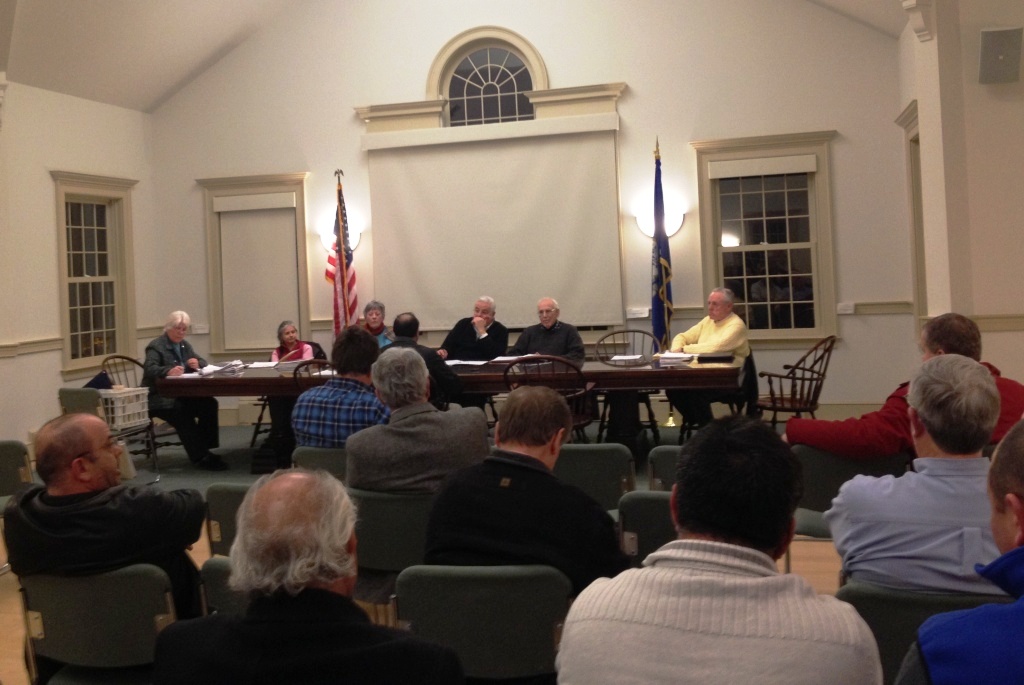
What is the future of zoning? File photo above shows a historical photo of a former Old Lyme Zoning Commission during a meeting.
Editor’s Notes: i) This op-ed was submitted by Eric Knapp, who is employed as the Town of Old Lyme’s Land Use Coordinator. He is writing here as a private citizen. ii) This is the opinion of Eric Knapp.
Zoning in Connecticut is 100-years-old this year. West Hartford was the first town in the State to adopt zoning regulations in 1924. The practice did not make its way to this part of the shoreline until the post-war (World War II) period, when the federal government undertook a concerted effort to promote home ownership for white families. For most of the towns in this area, the adoption of zoning came well after the development of the immediate shoreline areas. How this was addressed—or not addressed—is something I will explore later in the essay.
It seems apparent, at least to me, that the concept of zoning is starting to show its age, and increasingly, it is a poor fit to address issues such as the Americans with Disabilities Act or flood zone requirements. What is not so clear is where to go from here.
From the very beginning, zoning was always a suburban conceit. The idea that residences should be separated from businesses, and both should be separated from industrial uses stems from the very idea that suburban residents want quiet, well-tended neighborhoods, and less desirable uses should be concentrated elsewhere.
This never really made sense in rural areas, where people lived on properties, which doubled as their place of work, and frequently where they sold their products. The fact that the work was odiferous and made noises at early hours hardly bothered the neighbors. Since they were probably engaged in the same activities and were sufficiently far away, it hardly mattered.
In urban areas, there was a long tradition of living over storefronts. Many of Connecticut’s cities developed as “company towns”, where workers lived close enough to arrive on foot and shopped at the company store. Trying to separate out uses made little sense. To get a sense of what this looks like in practice, look at the New Haven Zoning Map, where there are individual “planned development districts” by the dozen, in sizes that would be considered “spot zoning”, if that were a real thing these days.
In the suburbs, though, people still want to limit their neighbors’ activities. [Zoning is always about what your neighbor can do. You should be able to do whatever you want, of course. (Please note, that this is meant tongue in cheek — zoning applies to everyone equally. I am not suggesting that anyone should be able to act with impunity.)]
The relatively late arrival of zoning meant that other tools served that purpose for decades. There are a profusion of associations, some granted powers by special act of the General Assembly. Each one comes with its own rules and rights, all of which must be enforced, but not by the local zoning enforcement officer, much to the confusion and dismay of some residents. (See “hammer laws” for details.) There are boroughs, and fire districts, a “city” and historic districts.
The diffusion of responsibilities and roles gives lie to the idea that we have only 169 municipalities.
A problem that has existed since the adoption of zoning locally is that the shoreline areas were divided into very small lots. The smallest “standard” zoning lot size for most towns in the area is 10,000 sq. ft., just under a quarter acre. But a casual glance, the shore area is made up of plenty of 50’ x 100’ lots, and some even as small as 3,600 sq. ft.
I have argued with local commissions for years that if every lot in a zone is nonconforming, that probably means that there is an inherent defect in the regulations. No local commission wants to take this issue head on.
Instead, the reality is that land use decisions in these areas are largely made by zoning boards of appeals. By statute, of course, these boards are supposed to grant variances only in cases of “exceptional difficulty or unusual hardship”. When every lot is nonconforming, though, the hardships are hardly “unusual”. “My house/lot predates zoning.” “I need to go higher in the setbacks to meet FEMA requirements.” “My septic system takes up my backyard.” “The house is riddled with code violations.” All of these statements can be true, but they are hardly “unusual”.
The truth is, though, that zoning boards of appeals do grant variances. And according to Joe Capossela, who taught the Zoning Board of Appeals (ZBA) piece of the Bar Association’s Land Use Law and Practice for many years, that is exactly what they are supposed to do. They are, in Joe’s words, the “lollipop board”.
If you are liked by your neighbors and do not get greedy, the ZBA will give you a lollipop. But this is exactly the opposite of the “uniformity of zone” that is promised by Connecticut General Statutes Section 8-2. And it delegates the power statutorily given to zoning commissions to zoning boards of appeals.
There are ZBAs that impose gates on variance applications, but these are frequently arbitrary and unfair. One method I have seen, and do not recommend, is to require every variance application to have a complete A-2 survey, architectural plans and not-infrequently, a lawyer’s discussion of the claimed hardship.
This poses as a strict test of the worthiness of an application, but what it really amounts to is a means test. If you can afford to pay to produce an application, your application will almost certainly be granted. If you do not have the resources to provide these materials, at a cost easily exceeding $10,000, then you are not worthy of the ZBA’s time.
As land use law is theoretically tied to the inherent location and characteristics of the property, not its owners, this debases the value of zoning itself.
This is not the only tension between “land-based rules” and “owner-based rules”. The Americans with Disabilities Act requires that governmental bodies provide “reasonable accommodations” for people with disabilities. In zoning terms, this may require handicapped ramps in setback areas or elevators that may exceed height or coverage allowances.
There are workarounds.
Many cities and some towns have systems in place that allow zoning regulations to be “temporarily” modified to allow these improvements to be placed, on the theory that once they are no longer needed, for instance when the individual with those needs moves away, the improvements will be removed. In practice, the improvements never go away, if for no other reason than the administrative headache of trying to police such things is beyond the resources of most land use offices.
Flood zones present a different challenge. The zone lines drawn by FEMA do not respect the zone lines drawn by the zoning commission. The rules of uniformity within a zone do not align well with the requirements that houses be elevated out of the flood zone. Some houses get to have basements. Others cannot. And people really like their basements.
For most towns, additional vertical expansion, if done too close to property lines, is considered an improper expansion of a nonconformity. As most houses on their tiny lots along the shore violate one or more setback, trying to elevate a house will violate this principle. A variance will be required, and many zoning boards of appeals are sympathetic to the need to meet FEMA requirements. Zoning bends to address this, but these goals should be more compatible.
So far, I have spent this article addressing the failings of standard “Euclidean” zoning, but the title suggests that there must be a future for zoning out there. I suspect that there is.
The suburban desire to have bad things over there, not over here is a powerful one and will likely continue to drive the need for zoning. There have been trends, or fads, in the past few decades. Form-based zoning does not really help most suburban areas. Transit-oriented development has its uses, but there is a big gap between Old Saybrook and New London with no service and very limited bus or other transit options.
The State of Connecticut has been increasing its pressure on affordable housing, but without solutions that involve remedying the septic situation, no mandate can force the densities needed. I fully expect that zoning limits of “one house per lot” and/or “single-family zoning” will be curtailed or eliminated. I have no expectation that will make things better.
This cannot just be a paper about pessimism. What can be done? For starters, let’s meet people where they are. If you want to limit new lots to 10,000 sq. ft., okay. But let’s just admit that most lots along the shore do not meet that. Zoning regulations should say that any valid lot in existence today is conforming. All the other limits, setback, coverage, floor area ratio, can still effectively control density.
Having hundreds of nonconforming lots is a useless relic and should be addressed.
In flood zones, maximum height should be measured from the point above flood elevation needed to meet the local freeboard requirement. Again, for most of these small lots, there are other tools to address bulk issues. But we want houses to be elevated out of the flood zone.
Requiring variances to elevate when that is the only issue is a waste of resources and counterproductive.
We need to be more creative on what a “mixed use” looks like. The idea of “store downstairs, apartment upstairs” is less useful now, in the age of Amazon and Zoom. The use of space is more fluid and less defined than it was. People are running businesses from their phones, which is not “land use” at all. Kitchen tables might double as crafting tables. Ovens can cook dinner or make cookies for sale. A garage might hold tools, but some of those tools might be “dual purpose”.
Zoning does not address this well. We have “home occupations”, but not everything neatly qualifies for that designation. Some better definitions and understandings on this are probably required.
The technology is not quite where it needs to be for seamless hybrid meetings. Sure, people can watch from anywhere. And they can even speak. But trying to have exhibits available to everyone watching, and then to allow people watching to submit exhibits in real time that every other participant can see—both in the room and on a device—requires an expertise that is just beyond what most small towns have available.
We will get there, but perhaps not quite yet.
Legal notices are a relic as well. The idea of a “newspaper of general circulation” is not especially meaningful when no one gets a physical “newspaper” anymore. Sure, getting notices up on a town webpage is a good step, but, again, this relies on expertise that varies from town to town.
I would propose having the Connecticut Secretary of the State handle every legal notice. There would be one page at the State’s website that would be a clearinghouse for legal notices. The State could charge for the privilege. It would still be cheaper than what the local papers charge. And everyone, no matter where they are, would know where to look. No guessing which paper. No searching for some tiny print on page 38.
I know that there is a hesitancy to create new state bureaucracy, but in this case, a central monopoly would actually make sense.
I would love to see towns be much more proactive in getting their land use information into an electronic format visible to everyone, anywhere, at any time. In a 21st century world, you should be able to click on a parcel on the GIS map and be able to access its history before municipal land use boards; its outstanding and historical permits; and its zoning, building and health department files.
This is all public information. It should be widely available to the public.
I would love to see a “flood zone improvement calculator” tool. Owners of dwellings in a flood zone should be able to calculate how much work they can do before needing to elevate their house. This would need to include the value of permits within the “lookback period” and be keyed to the assessor’s valuation of the structure.
As I noted in my last piece published Aug. 30, 2024 on LymeLine.com, I have no monopoly of wisdom here. I cannot claim that I, alone, have answers. But we should be searching for these answers, and right now, I just do not see a lot of that happening.