First EEE Positive Mosquitoes Confirmed This Year in Voluntown; Southeast CT Residents Advised to Take Appropriate Precautions

HARTFORD — (10/02 Press Release Issued By CT DPH) The Connecticut Department of Public Health is advising residents in southeastern Connecticut to protect themselves and their children from mosquitoes to reduce the chance of contracting eastern equine encephalitis (EEE) virus.

Mosquitoes trapped in the Pachaug State Forest in Voluntown on Sept. 23 have tested positive for EEE. These results represent the first EEE positive mosquitoes identified in the state by the Connecticut Agricultural Experiment Station this year. 

The mosquitoes were Culiseta melanura, a predominately bird-biting species, and Ochlerotatus canadensis, a mammal-biting species.  Connecticut residents are reminded to protect themselves from mosquito bites and mosquito-borne diseases.

“We encourage residents of southeastern Connecticut to take simple measures such as wearing mosquito repellent and covering bare skin, especially during dusk and dawn when mosquitoes are most active,” said DPH Commissioner Manisha Juthani, MD. “While the detection of EEE virus is of concern, it is important to remember that we do not expect to see a lot of mosquito activity in the month of October.” 

Eastern Equine Encephalitis is a serious but rare illness caused by a virus that is transmitted by mosquitoes. Mosquitoes can only acquire the virus by feeding on infected wild birds. In most years, the virus is found only in species of mosquitoes which feed on birds, but occasionally the virus can be passed on to other mosquito species known to bite people and horses. 

The virus cannot be passed from person to person or from horses to humans. The risk of mosquito-transmitted diseases such as EEE virus usually increases through the late summer and early fall. Mosquitoes are active until the first heavy frost.

Infection with EEE virus can cause serious illness affecting the brain. Symptoms include high fever, headache, stiff neck, and decreased consciousness. The disease is fatal in 25-50 percent of cases and many of those who recover experience lasting health problems.

Individuals with symptoms suggestive of EEE infection should contact their physician immediately. No human vaccine against EEE virus infection or specific antiviral treatment for clinical EEE virus infections is available.

To reduce the risk of being bitten by mosquitoes residents should:

  • Minimize time spent outdoors between dusk and dawn when mosquitoes are most active.
  • Be sure door and window screens are tight-fitting and in good repair.
  • Wear shoes, socks, long pants, and a long-sleeved shirt when outdoors for long periods of time, or when mosquitoes are more active.  Clothing should be light colored and made of tightly woven materials that keep mosquitoes away from the skin.
  • Use mosquito netting when sleeping outdoors or in an unscreened structure and to protect babies when outdoors.
  • Consider the use of mosquito repellent, according to directions, when it is necessary to be outdoors.

Connecticut Mosquito Management Program

The State of Connecticut Mosquito Management Program is a collaborative effort involving the Department of Energy and Environmental Protection, the Connecticut Agricultural Experiment Station (CAES), the Department of Public Health, the Department of Agriculture, and the University of Connecticut Department of Pathobiology and Veterinary Science. These agencies are responsible for monitoring the potential public health threat of mosquito-borne diseases.

The CAES maintains a network of 108 mosquito-trapping stations in 87 municipalities throughout the state. Mosquito traps are set Monday through Thursday nights at each site every 10 days on a rotating basis.

Mosquitoes are grouped (pooled) for testing according to species, collection site, and date. Positive findings are reported to local health departments and on the CAES website at http://www.ct.gov/caes/mosquitotesting.

For information on EEE and other mosquito-borne diseases, what can be done to prevent getting bitten by mosquitoes, the latest mosquito test results and human infections, visit the Connecticut Mosquito Management Program web site at https://portal.ct.gov/mosquito.
Lyme-Old Lyme Food Share Garden Welcomes Community to Open House This Morning

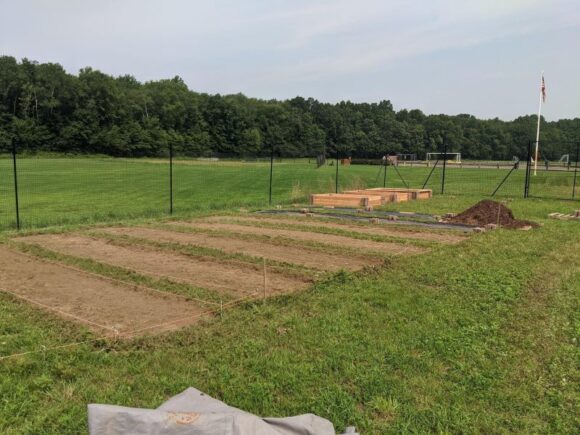
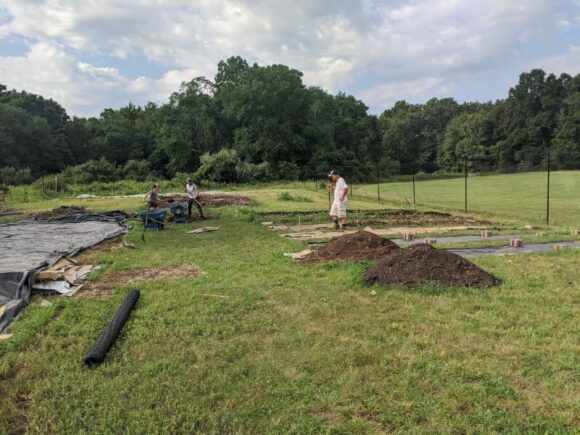
Volunteers tend the Lyme-Old Lyme Food Share Garden at Town Woods Park.

OLD LYME — In March 2021, a group of interested residents of Lyme and Old Lyme met on Zoom to plan the Lyme-Old Lyme Food Share Garden (LOLFSG), a garden dedicated to growing and donating all produce to local food pantries. As the end of summer draws near, the group is delighted to share their progress and invite readers to visit the site.

The LOLFSG will be holding another Open House/Work Sessions on Saturdays, Sept. 25 from 8 to 11 a.m. at the garden, which is located behind the field house and playground at Town Woods Park.  All are welcome.

Jim Ward, who conceived the original idea for the garden and has been the driving force behind its development, explained, “Board members are anxious and excited to share the progress we have made in establishing the garden and look forward to answering any questions concerning our vision.”

In the months following the inaugural meeting, the LOLGSF participated in a crowdsourcing fundraiser sponsored by Sustainable CT in which 82 donors helped raise $8350.  With $7500 of those funds being matched, the LOLFSG was able to purchase fencing materials and broke ground at Town Woods Park in June.

A view of the Community Share Garden showing the three raised beds in the background.

Ward commented enthusiastically, “Through the dedicated efforts of volunteers, an eight-foot deer fence has been erected, the installation of an irrigation system is in progress, three raised beds have been built and additional in-ground beds have been prepared.  We are on track to plant and harvest our first crops in Spring 2022!”

As the number of LOLFSG members increases, volunteers of all ages are invited to join the organization. Ward invites readers to consider volunteering, visiting the garden, or continuing to support the LOLFSG financially.

He notes, “Our next steps are to complete the installation of the irrigation system, install electricity, erect a storage shed and garden (plant, weed, water, harvest).   Updates and additional photos are available through Facebook, Instagram or at the LOLFSG website.”

Alberio, Andromeda, Milky Way & More: Super Sights on Most Recent ‘Dark Skies’ Night in Lyme

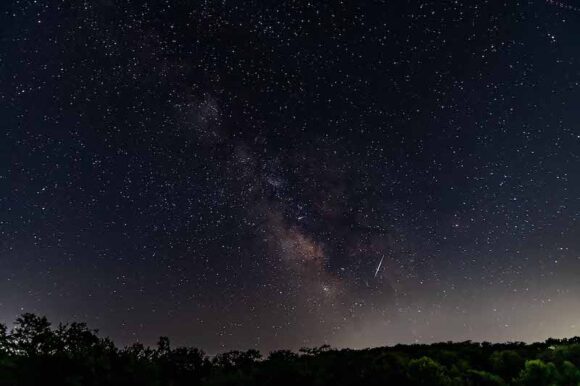
The Milky Way rising like steam from the teapot of Sagittarius. Photo by Roger Charbonneau Jr.

LYME — As the setting sun dipped below the horizon on the evening of Sept. 3, the quick cooling gave a hint of the damp night to come. Indeed, our equipment was already showing bits of moisture as the wet air let go of its precious cargo.

Unlike previous sessions, the moisture-laden air belied the towns and cities nearby as their unshielded light fixtures reflected against the water vapor in the atmosphere. With this unmistakable glow, we all became aware first-hand of the insidious effects of light pollution.

Despite that, we were ready to observe whatever this evening’s skies were ready to reveal.

Early in the evening, we had reviewed what a Dobsonian telescope is all about, and how it differs in form and function from the other telescopes on hand, namely, Schmidt Cassegrain reflectors.

We also did a quick review of how to locate the Summer Triangle, Polaris, the Little Dipper, and the handle of the Big Dipper. The bowl of the Big Dipper was below the tree line all night, as it will be for several months to come. 

Most striking of the early ‘stars’ to shine in the night sky was the great planet Jupiter and its four brightest moons. Throughout the night we checked back in on Jupiter, and by night’s end it was readily apparent that those little dots of light had actually moved in their orbits around Jupiter.

Up and to the right of Jupiter, we also trained our telescopes on Saturn and its glorious rings. The next few months will afford ongoing opportunities to see both of these gas giants all night long.

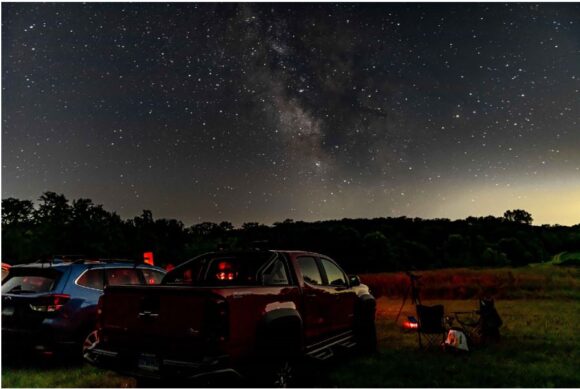
With the sky darkening more slowly than usual because of the high humidity and resultant glare of city lights, we challenged ourselves to observe the Milky Way. Lyme skies are pretty dark, and it became easier and easier to discern the Milky Way as the dusk turned to night. Even in the poor seeing conditions that night, everyone was able to see the obvious ‘steam rising from the teapot’ of Sagittarius. At the zenith, the Great Rift of the Milky Way was visible to all. 

From there, we checked in on the globular cluster M13 in Hercules and the open cluster M25 in Sagittarius. Later in the night, we brought M31, the Andromeda Galaxy, into view in Scott Mallory’s 12” Dobsonian.

Despite being almost 3 million light-years away, Andromeda is our home galaxy’s nearest neighbor. It can be observed in binoculars, and on a dark night, it can even be discerned with the naked eye.

To learn how to spot Andromeda, we traced out the Great Square of Pegasus, and then learned how the right-hand triangle of the “W” of Cassiopeia points to Andromeda, and how to star-hop along the lower left corner of Pegasus’ Great Square to the precise location of that great galaxy.

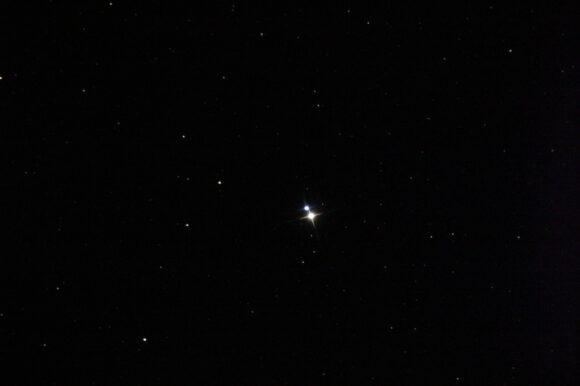
The binary star Alberio. Photo by Alan Sheiness.

At the end of the evening, we observed Alberio, the nose of Cygnus the Swan, and we could all see that it is actually a beautiful binary pair of stars of contrasting colors.

The Lyme Land Trust will continue to hold monthly dark sky observing sessions, usually on the Friday night closest to new moon. As always, first-timers without any equipment are welcome to share the evening with us.

We also highly encourage those with telescopes to bring them out, even if it has been a while since they were taken through their paces. This way, our debutantes will be able to spread out and share the views from more telescopes. Scott and I will be happy to help with setup if your skills have become rusty.

Our observing site is likely just what you have been hoping for. We have acres of open field, with the east and south tree lines well off in the distance, and Polaris visible above the tree line to the north. And we have two other prepped sites in the same large field to allow a setup that better favors the west or the north, if need be.

Learn more about our upcoming astronomy sessions at lymelandtrust.org.

And most of all, come on out!

About the author: Alan Sheiness is a 10-year resident of Lyme, CT, and treasurer of the Lyme Land Trust (LLT). A life-long astronomy enthusiast and astrophotographer, Sheiness is a promoter of dark skies and along with Lyme resident Scott Mallory has established a new astronomy program as part of LLT’s public offerings. Contact them at alan.sheiness@icloud.com and scott.mallory@gmail.com .

Observing Session Explores the Wonders of Lyme’s ‘Dark Skies’

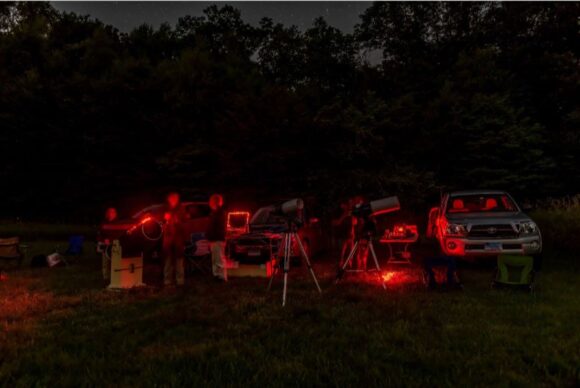
LYME — On July 30, Lyme Land Trust held a public observing session at its dark sky site. Attendees hailed from Westbrook, Colchester, and Lyme. Observers were able to take advantage of three telescopes, a spotting scope, and binoculars.

Observers gathered, darkness fell and the ‘spotting’ began. Photo by Roger Charbonneau Jr.

We gathered before darkness and learned what the Perseid meteor showers were all about: why we see them; why they are called Perseids; and why best observing is after midnight. Attendees are now duly informed.

As the sky darkened, the brightest stars became visible one after the other, and we were taught mnemonics and tips for orienting in the summer sky. From the Big Dipper, we learned to “arc to Arcturus” and “spike to Spica”. Next up was the Summer Triangle, formed by the prominent stars Vega, Deneb, and Altair.

With that starting point, we outlined the constellation Cygnus the Swan with Deneb as the ‘tail’ and observed the ‘nose’ of the swan, Alberio, through the telescope. At low magnification all could see that it is actually a binary star system, consisting of one blue and one yellow star.

As darkness took hold, Saturn and then Jupiter rose in the east. Between the two planets, we could see seven of those giant planets’ moons; four of Jupiter and three of Saturn. Saturn’s rings were easily discernable all night long.

Now fully dark, we traced out the outlines of Scorpio and Sagittarius with pointing equipment, and then the ‘steam’ rising from the Teapot in Sagittarius: the Milky Way itself. All night long we noted as the Milky Way became easier and easier to make out, arching upward and northward back through Cygnus and ultimately disappearing into the northern tree line.

Within the Milky Way, we aimed our telescopes at M8 The Lagoon Nebula, the globular cluster M22, and various other open clusters. High overhead in the constellation of Lyra (where Vega resides), we examined M57, The Ring Nebula, which is a supernova remnant from times long gone. In Hercules, we trained the scopes on the famous globular cluster M13, a dense collection of individual stars that meld into a round orb of light.

The Milky Way was visible throughout the night observing session, becoming consistently easier to distinguish. Photo by Roger Charbonneau Jr.

In between telescope observing, we sharpened our Big Dipper-, Little Dipper- and Polaris-spotting skills. Within the Big Dipper we noted that the middle handle star is actually two stars, one much dimmer than the other, named Alcor and Mizar, also known as the ‘Horse and Rider’.

We saw several shooting stars blaze in the sky, which were, of course, Perseid meteors, and several satellites passed overhead during the night. The most famous such passing, and by far the most prominent, was the ISS International Space Station!

It is so rewarding to look up and take in the natural beauty of the night sky. Our Lyme night sky is uniquely dark owing to our unpopulated open spaces and prudent land management. The Lyme Land Trust is dedicated to promoting dark skies by hosting observing sessions aimed at familiarizing you with the splendid vistas that lie straight overhead.

LymeLine readers are invited to join our next observing session. Telescopes are encouraged and welcomed, but first-timers without any equipment are equally welcome to share the evening with us.

Learn more about Lyme Land Trust, and our upcoming astronomy sessions, at lymelandtrust.org.

About the author: Alan Sheiness is a 10-year resident of Lyme, Conn., and treasurer of the Lyme Land Trust (LLT). A life-long astronomy enthusiast and astrophotographer, he is a promoter of dark skies and, along with Lyme resident Scott Mallory, has established a new astronomy program as part of LLT’s public offerings. You may contact them at alan.sheiness@icloud.com and scott.mallory@gmail.com .

Ledge Light Announces Raccoon Tests Positive for Rabies in Gales Ferry

A press release from LLHD states that a racoon in Gales Ferry, “…  was tested and found to be positive for rabies on Aug. 3.”

NEW LONDON — Ledge Light Health District (LLHD) has announced that a raccoon in the Town of Gales Ferry was tested and found to be positive for rabies on Aug. 3.

On account of that finding, LLHD says, “The public should refrain from feeding or approaching any wild or stray animals” in the towns covered by their Health District. These include both Lyme and Old Lyme.

In a press release issued Aug. 10, LLHD states, “Rabies is a deadly disease caused by a virus that can infect all warm-blooded animals, including people. It is  spread mostly by wild animals, but stray cats and dogs may also become infected and spread the virus. The  rabies virus lives in the saliva and brain tissue of infected animals. Rabies can be spread by scratches from  infected animals or when infected saliva comes into contact with open wounds, breaks in the skin or  mucous membranes (eyes, nose, mouth, etc.)”  

If you have any questions or concerns, contact LLHD at 860-448-4882 or Ledyard Animal Control at 860-464-9621.